In September , a suitcase filled with sculptural odds and ends was discovered beneath a spiral staircase in Louise Bourgeois’s house in Chelsea, New York. It had been tucked away behind a rail of clothes and forgotten. Bourgeois died in 2010, aged 98, but the suitcase hadn’t been touched in more than forty years. I was staying at the house next door, where her archive is kept, when I received a message saying: ‘We found an old suitcase with latex and mould materials in it this afternoon (!!) – will have it out to show you in the morning! Enjoy!!’ I was researching a chapter on Bourgeois’s latex sculptures, and was due to leave the following day. The last time I had visited there had been an earthquake and a total eclipse of the sun; somehow the suitcase felt just as auspicious.
The next morning, we donned powdery surgical gloves and began the task of gently lifting the stale-smelling objects out of the case and onto a paper-lined table. The contents, ‘L.B. Latex Elements and One Costume’, were recorded on the suitcase lid in black marker pen. Latex is a notoriously unstable material, which shrinks, darkens and dries out over time, a process accelerated by exposure to light and air. It comes in both natural rubber and synthetic versions. The orange-brown latex ‘elements’ were in varying states of degradation, although the dark, moisture-free environment of the fabric suitcase meant they had remained surprisingly flexible and in generally good condition. It wasn’t, however, immediately clear what they were. Sculptural salvage? Experiments? Moulds? Mistakes?
Laid out flat, the eight shapes looked like swimming caps or oversized rubber nipples. They were recognisable from Bourgeois’s sculptures and drawings of the 1960s, in which bulging mounds group in faintly phallic and breast-like clusters. (Bourgeois enjoyed the play between male and female body parts in her work, their abstraction breeding the kind of uncertainty she liked.) To make them, she painted thin layers of synthetic liquid latex onto cut-out circles of cheesecloth stretched over polystyrene moulds. Most of the pieces in the suitcase were roughly the same size, with one outlier, rounder and flatter than the others, about the size of a dustbin lid. It looked like a dried-out blister, its darkened surface marked by fine fissures and cracks. There was no sign of the promised costume. Other items in the case included a length of latex that looked like an exercise band left out too long in the sun, a handful of hardened latex shards, a scrap of hessian and some loose Italian lire.
Bourgeois’s assistant, Jerry Gorovoy, recognised the suitcase and suggested it had been there since he and Bourgeois returned from a trip to a marble quarry in Italy in 1984. He told me he had a matching suitcase. Bourgeois went to Italy to work on her marble sculpture Blind Man’s Buff, a thick chunk of stone mounted on a rough-hewn wooden base. The marble torso (what else to call it?), adorned with drooping protrusions, crumples and scrunches over on itself. The plaster maquette for the sculpture was modelled on a latex piece from 1978: the ‘costume’ listed on the suitcase, Gorovoy told me. Bourgeois had first discovered latex in the early 1960s (she called it ‘a workshop discovery’) and returned to it in part because it was expedient – teaching colleagues at Brooklyn College had asked her to stop clogging the sinks with plaster – but also because she enjoyed working with it.
Asked in 1968 about the change in her materials, Bourgeois said: ‘I consider myself completely modern,’ pointing out that she had also used vinyl chloride in her sculptures. ‘I had the latest things,’ she insisted, refusing to engage with the question of her age, which was what the interviewer really wanted to discuss. Bourgeois was in her mid-fifties when she began working in latex, thirty years older than sculptors such as Eva Hesse and Bruce Nauman. Her resin, plaster and latex works presaged a shift among younger artists, who also followed her in turning away from modernist precedents to make what the artist Robert Morris called ‘antiformal’ sculpture, in which edges were softened, boundaries blurred and internal structure collapsed.
In 1964, Bourgeois showed her new latex work at the Stable Gallery in New York. The pieces were very different from the upright wooden ‘personages’ with which she made her name in the late 1940s, or even her Surrealism-inflected Femme Maison imagery. Most of the critics found them unfathomable and ugly. What to make of this array of deflated and eccentric forms? One reviewer complained that the piles of latex set in soft folds and fat lazy coils looked as though ‘the sculptor hadn’t felt like working.’ Michael Fried dismissed the work as ‘excremental’. For others, including the young feminist curator and critic Lucy Lippard, Bourgeois’s formal volte-face heralded a new era for sculpture. As she later put it, ‘I was sick of beauty.’ By 1975, Lippard had begun championing Bourgeois as an important precursor to the feminist art movement, her work incorporating themes of sexuality and violence, inner turmoil and abstract, erotic play.
The ‘costume’ recorded on the lid of the suitcase and used as the model for Blind Man’s Buff belonged to a group of latex tabards Bourgeois had made for the one-off performance A Banquet/A Fashion Show of Body Parts, which marked the close of Confrontation, a large installation at the Hamilton Gallery in 1978. In both Confrontation and The Destruction of the Father (1974), Bourgeois was returning to the ambiguous latex forms of the 1960s. The loose pieces in the suitcase relate to the latex dresses; surviving video footage of the event meant I could match them, teat for teat. Rubbery bulbs and soft mounds protruded indecently from front and back, wobbling as the models walked, as though drooping udders. Bourgeois described one piece as sporting ‘dear little labial accents’. ‘Have you ever seen latex used better?’ she asked in her voiceover for the show. It was a chaotic, camp affair: Bourgeois had persuaded various art world luminaries and members of the punk scene to parade around the installation, their naked bodies barely covered by the semi-transparent latex sheaths. The ‘body parts’ dangling from the costumes were echoed in the pile of latex objects on the long table at the centre of Confrontation. At the head of the table was the latex mould of Bourgeois’s sculpture Avenza (1969), sprouting her trademark cluster of phallic stumps.
The Stable Gallery exhibition of 1964 came after a nearly decade-long break from making or exhibiting any new work. During that time, Bourgeois ran an antiquarian bookstore and underwent intensive psychoanalysis, which she continued off and on for the next thirty years. Two of her earliest latex pieces, both titled Portrait, are distended and swollen, a travesty of what a portrait should be. One she nailed to the wall like a mirror. The other, even less identifiable as a face, is a puddle on a tabletop, shrivelled and flat. With their knobby surfaces, curled edges and general air of collapse, it is hard not to see in these ‘portraits’ a devasting image of self, something dragged out from within, like entrails.
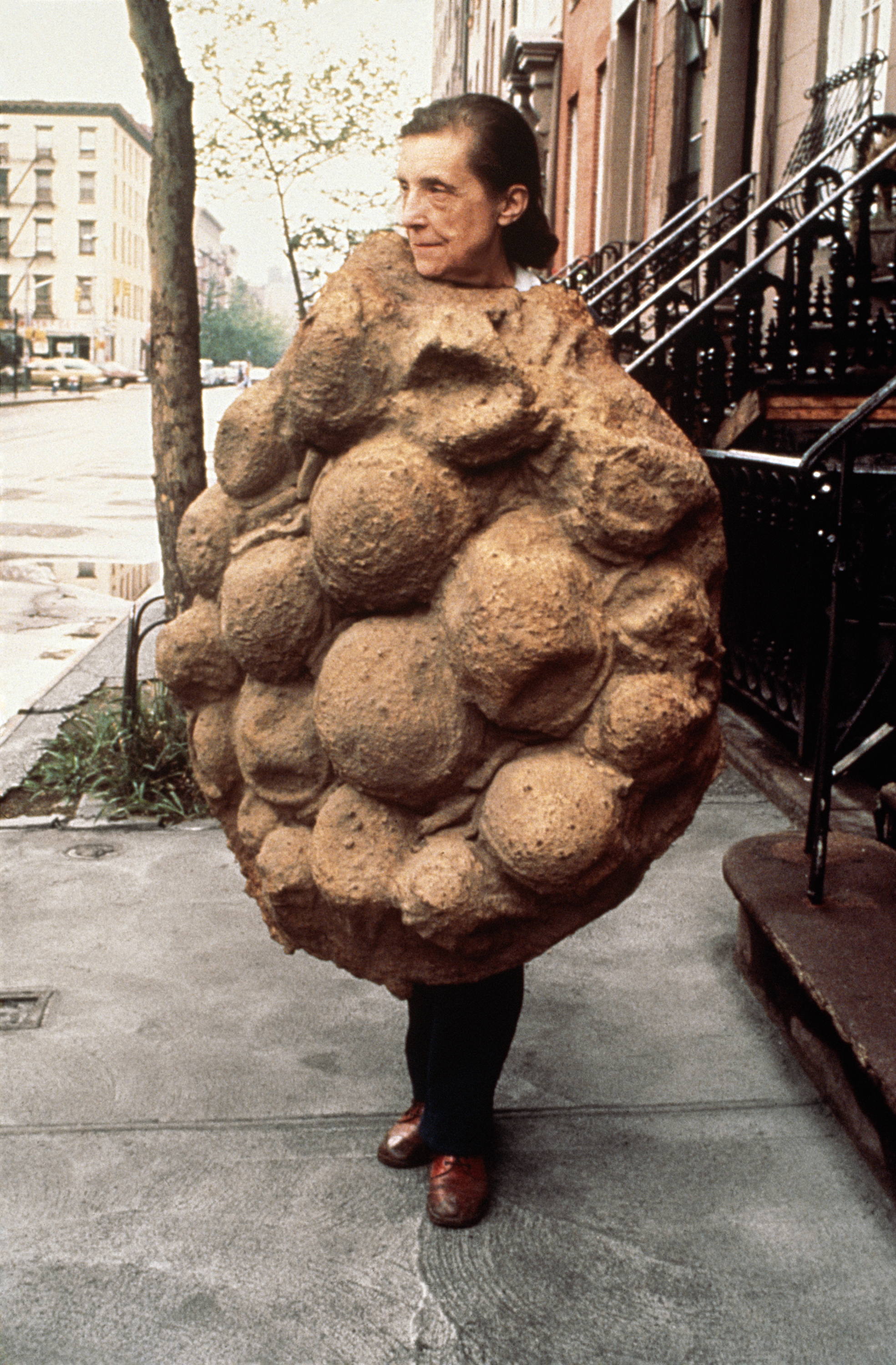
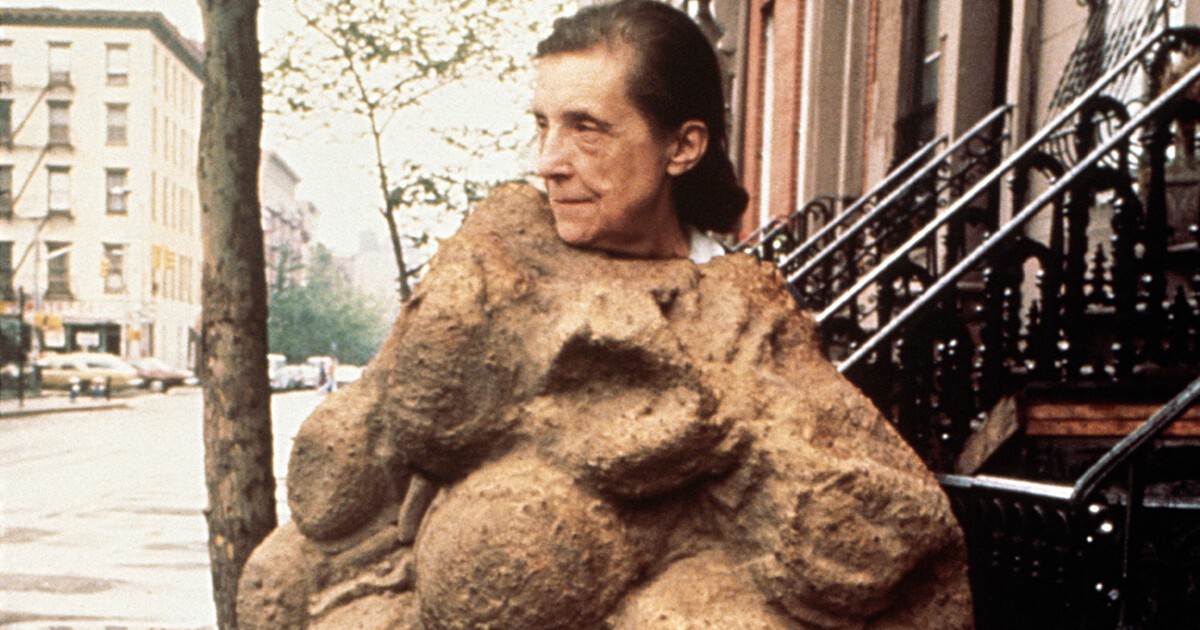
Louise Bourgeois wearing her sculpture Avenza (1975)
© 2025, The Easton Foundation/VAGA at ARS, NY and DACS, London.
Bourgeois often wore her insides on the outside. ‘For me, sculpture is the body. My body is my sculpture,’ she said, a point she reiterated in 1975 when she posed with the latex mould of Avenza on the steps of her house, her small frame swamped by its rubbery folds. The mould is not so much a substitute for her own body as an appendage, a weight to bear. It stands for her relationship to her work. She experienced rage and fear as both debilitating and motivating forces, often channelling them into her work, but just as often aiming them outwards, at others, as well as inwards at herself (‘When I do not “attack” I do not feel myself alive,’ she wrote).
Bourgeois moved back and forth between materials and processes, from bronze and marble to plaster and latex, and later to large-scale fabric sculpture. ‘I do, I undo and I redo,’ she said, aligning her working method with unconscious processes of repetition and negation. She remained committed to the analytic process, despite her hostility, as she put it, to ‘Freud & Co’. On starting analysis, she was furious at being assigned ‘housewife’ hours in the middle of the day. In 1958, at the height of her most intensive period of therapy, she described it as ‘a duty’, ‘a joke’, ‘a love affair’, ‘a bad dream’, ‘a pain in the neck’ but also, ‘my field of study’. In 2004, two metal boxes of papers, written during her analysis, were found in an upstairs closet. Six years later, just before she died, another two boxes filled with papers turned up.
The exterior of Bourgeois’s house, where she posed wearing the mould of Avenza, doesn’t declare itself as such. There is no sign, no suggestion that it is anything other than a handsome brownstone, though if you know to look out for them you can spot the distinctive scalloped metal grilles she designed for the front window. The small backyard is dominated by one of her steel spiders, Spider Couple (the view of which is a selling point for a nearby Airbnb). The year before she died, Bourgeois purchased the neighbouring house; along with her archive it contains offices for her foundation and a bedroom for visitors – mercifully spider-free.
Bourgeois moved into the house with her husband, the American art historian Robert Goldwater, in 1962. Except for the addition of a few sculptures, it has remained untouched since her death. The two buildings are connected via a sliding door in the basement: stepping across the threshold from the bright exhibition space of the archive into the dark, cool air of her workshop gave me goosebumps. Arch of Hysteria (1993), a bronze cast of Gorovoy’s arched body extending over a daybed, confronts you as you enter. A sewing machine and two heavy printing presses take up the rest of the space, along with a large sink, cluttered workbench and walls of shelving. The surfaces are strewn with tools and maquettes while a central table is covered with half-sewn pieces of fabric. Photographs show Bourgeois playing with the configuration of the latex pieces for Confrontation on the table. Over the years, she used the bare walls of the house as a giant notepad, scrawling phone numbers and bits of information on them. A mantelpiece contains empty bottles of her favourite perfume, Shalimar, alongside lipsticks and bits of paper. There is a defunct fax machine and a folding metal chair. Drawers are stuffed; one of them overflows with colourful ribbons dating back decades.
Despite a preponderance of soft-seeming forms, there is barely a comfortable seat in the house, and the furniture is a curious mishmash of antique wooden chairs inherited from the family home in France and more workaday items acquired over the years. Bourgeois’s clothes still hang on open rails, which stand here and there about the house. On one of the rails, which you brush past to leave the kitchen, hangs the black monkey fur jacket seen in Robert Mapplethorpe’s portrait of Bourgeois aged seventy, cradling her plaster and latex phallus, Fillette, under her arm, a wicked grin spread across her face. When the photograph was used for the catalogue of her retrospective at MoMA in 1982, it was cropped to remove all trace of the rubbery phallus, reducing the image to that of a benign old woman – a particularly egregious act of bad faith given that Bourgeois was anything but.
After Goldwater’s sudden death in 1973, Bourgeois lived alone in the house. Their sons had grown up and departed. She stopped sleeping in the bedroom, opting instead for a narrow daybed in another room, and had the stove ripped out and replaced by two small gas hobs in a tiny nook (her only concession to domesticity). It was a statement of intent. No longer the femme maison of her prints and paintings from the 1940s, which depict a headless hybrid – half-woman, half-house – carrying the weight of the home as burden or protective shell, she could now reorient the house to serve her and her work alone.
Bourgeois liked to sit, draw and hold court in the slightly dilapidated back parlour on the first floor. After Goldwater died, she had the dining table cut in half, and would sit behind it during her Sunday afternoon ‘salons’, which started in the mid-1990s and continued until shortly before her death (Sundays were Gorovoy’s day off, and she liked to have company). Bourgeois orchestrated proceedings, plying guests with drink and tough questions. To get off to a good start, you had to arrive with chocolates and something interesting to say. Her temper flared when people were bland, self-congratulatory or, worse still, sought her approval. Gary Indiana described her on these occasions as ‘a hilarious terror’.
That sense of ‘hilarious terror’ seems to linger in the house. Every corner is cluttered and engrossing. The telephone is still connected and sometimes still rings (I nearly jumped out of my skin). Post continues to arrive; the latest weekend edition of the FT had been delivered, still addressed to Bourgeois. The house isn’t an official museum, though fans sometimes try their luck by ringing the doorbell. It would be a pity if that changed. There is something almost overwhelmingly intimate about being there, which would be lost in a shift to information panels and security barriers.
At the same time, it’s easy to fetishise the house, to make it stand for Bourgeois herself. Just as the latex pieces are not exactly works of art but things Bourgeois thought and made with, so too the house is another kind of work, something she made in the course of making, which yields information to those willing to rummage around. After being unpacked and examined and catalogued, the latex objects were stored in acid-free cardboard archive boxes, repurposed from the foundation of another artist. This seemed like another example of what would, in Bourgeois’s hands, have become a form of play, an opportunity for transformation. On the spines of the archive boxes, the words ‘YOKO ONO’ are written in thick black ink.