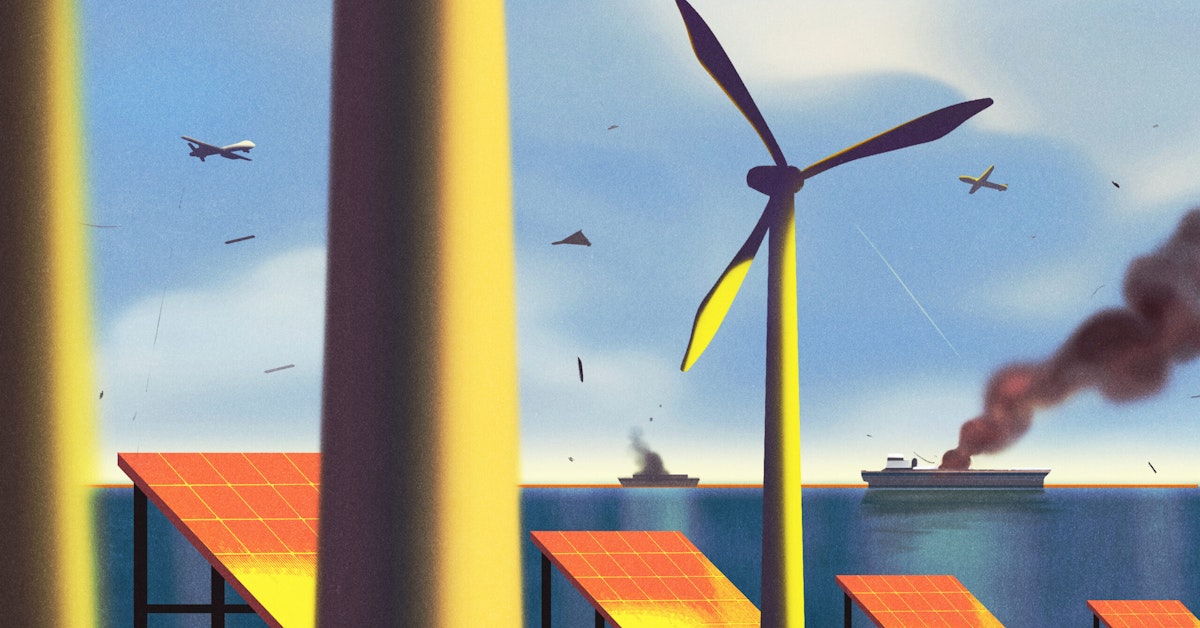
Complex systems can engender the opposite outcome of intentions.


Ibrahim Rayintakath for Noema Magazine
Credits
Nathan Gardels is the editor-in-chief of Noema Magazine. He is also the co-founder of and a senior adviser to the Berggruen Institute.
Like the global Covid pandemic and the energy shock in Europe after Russia’s invasion of Ukraine, the winding down Iran war offers yet another lesson in the fragility of complex systems and the unexpected outcomes the rupture of these systems generate.
Instead of Trump’s America and Netanyahu’s Israel proving to the naïve that hard power military might is the way the world really works, its limits have been revealed. Despite all the shock and awe aimed at toppling the theocratic regime and obliterating Iran’s nuclear assets, the regime and its uranium stockpile both remain. The notion that only war could achieve what diplomacy could not has been refuted.
Moreover, the effective Iranian drone and missile attacks on the integral energy infrastructure of the Gulf states, combined with the unanticipated closure of the Strait of Hormuz, have spread the virus of inflation and shaken economies everywhere.
Like the famous chaos-theory trope of flapping butterfly wings influencing weather patterns on the other side of the planet, the fossil-fuel energy shock from the Hormuz shutdown occurred at the very moment of China’s arrival as the dominant global purveyor of renewable energy technology. Burned by yet another energy shock, the world is sensibly turning away from fossil fuels endlessly associated with the disruptions of war — and turning to China for the very wind turbines, solar panels, storage batteries and electric vehicles the Trump administration is so fervently laboring to kill.
Paradoxically, historians may well look back to the Iran war as the midwife in the pivotal transition to the global renewable energy economy.
Small Inputs, Big Effects
It is worth revisiting in this new context earlier reflections in Noema concerning previous systemic shocks. If civilization advances by challenge and response, we will sooner or later learn from experience how to navigate the labyrinths of our own construction.
Whether it’s Middle East oil, China’s rare earth minerals or Taiwan’s semiconductor supremacy, the specialization of supply chains combined with just-in-time logistics has created disequilibrium in the world economy. When a disruption occurs, production and distribution across a vast but shallow system stalls. Critical nodes of connectivity in otherwise efficient networks become chokepoints. As the Nobel chemist Ilya Prigogine pointed out, in complex systems far from equilibrium, even small inputs can have disproportionately large effects. The black swans of disorder are always waiting in the wings. Stability is never a given.
Starting with the Covid pandemic, the shock of these unexpected, random events prompted belated policies to re-shore production and retool supply chains from just-in-time to just-in-case for critical items from medicine to microchips, so that countries, communities and companies become more resilient, robust and reliable in the face of shocks.
Nassim Taleb has famously theorized the usefulness of random shocks in advancing the efficiency of complex systems. For Taleb, resilience can simply mean the return of a system to its previously vulnerable state. By contrast, the active awareness of what he calls “antifragility” learns from disorder to build back better.
Yet, when building back better, the seeds of the next crisis are, as often as not, planted by systemizing a single solution to the most recent disruption. Systems that monopolize the response to a given crisis only prepare the ground for a new disequilibrium exposed to the next novel shock from outside of its operational conditions. An autarkic, wholesale shift to a home-based import-substitution strategy would be no less of a folly than over-reliance on wide-open free trade, specialization and supply chains at the height of one-size-fits-all hyper-globalization.
Over-systematizing a single solution also risks reaching internal thresholds, beyond which what was originally beneficial becomes counterproductive. As anyone who has ever driven on a freeway knows, mobility turns into congestion when too many cars clog too few routes. The burgeoning overcapacity of China’s “whole dragon” integrated sourcing, supply chain and export production machine fits into this category.
Distributed Simplicity
In a conversation in Noema, the visionary materials scientist Vaclav Smil argues, with respect to renewable energy production and climate action, that the way to avoid such a conundrum is by diversifying minimalism through a broad array of simple responses instead of simplifying maximalism by putting all eggs in one basket with little scope for redundancy or alternatives. In this, he echoes the ideas of “appropriate” technology and scale promoted back in the 1970s by Leopold Kohr and E.F. Schumacher, whose seminal book was titled “Small is Beautiful.”
Solar panels distributed across rooftops that generate energy directly from the sun, instead of a single huge power plant that must transmit energy across vast distances, is an obvious example of Smil’s point.
Maximizing reliance on large systems with complex interrelated links invites all manner of vulnerabilities. It would be better to think big but act in many different small ways. Distributed simplicity creates a more stable, diverse and thus sustainable equilibrium for the next shock that is sure to come out of nowhere.
More From Noema Magazine

