
In July 1943, while Americans were invading Sicily and island-hopping across the Southwest Pacific, residents of Los Angeles thought they were targets of a Japanese chemical warfare attack. The air smelled like bleach and corroded rubber tires. Pilots could not see through brown clouds to land their planes safely.
Los Angelenos were indeed victims of a surprise chemical attack, but it was not Japanese. Rather, it was photochemical smog, an attack of their own making. The wartime boom had brought more people, cars, and industry to greater Los Angeles. Tailpipe and smokestack emissions combined with sunshine to brew up thick smog that obscured the sky, gnawed tires, and irritated raspy throats and itchy eyes.
The United States has had an outsized impact on world affairs at least since World War II, if not earlier. It has also had an outsized impact on the planet itself, its ecosystems, biota, and climate. This is partly because the United States was, already by the 19th century, a big country that mobilized a lot of resources, from beaver fur and bison leather to oil and steel. And it is partly because the United States pioneered some innovative models—including car culture, industrial farming, and national parks—that had profound ecological consequences.
For better or worse, this form of U.S. primacy is unlikely to last. China appears to be destined to wield greater influence than the United States over the condition of the Earth—if it doesn’t already.

A watercolor print depicts an early American whaling expedition, with a large whale destroying a whaling ship, circa 1875. GraphicaArtis/Getty Images
From the dawn of the republic, Americans exercised powerful and direct effects on wildlife at sea and on land. By killing animals such as beaver, whales, and bison, they triggered ecological impacts that transformed ecosystems in North America and beyond.
Fur trappers sprang into action well before the foundation of the United States, responding to a fashion craze for beaver hats and coats. At the time of the American Revolution, North America’s beaver population stood at roughly 150 million. That fell fast, as trapping peaked between 1790-1840, by which time beavers were running low. By 1900, only about 100,000 remained, and some 4 million tons of beaver biomass had vanished.
Since beavers are energetic ecosystem engineers, building dams and creating ponds, the near elimination of beavers altered the face of North America. Most beaver ponds drained away. Streams ran faster. Rivers eroded their banks more quickly and dumped more sediment at their mouths. Beaver ponds emit methane to the atmosphere, so the disappearance of maybe 30 million ponds moderated methane emissions a little bit, postponing the onset of global warming very slightly.
Between 1780 and 1880, Yankee whalers operating out of Nantucket and New Bedford played the leading role in cutting the oceans’ sperm whale population by one-third. Sperm whale oil proved crucial to industrialization. It provided illumination and, more importantly, a superb all-weather machine lubricant used in guns; locomotives; watches; cotton-mill spindles; and, until the 1970s, cars’ automatic transmissions.
By 1880, the oceans had lost 10 million tons worth of sperm whale biomass. As a result, oceanic food webs thinned slightly, because sperm whales play a major role in fertilizing surface waters. They hunt in the depths for their food but release their “fecal plumes,” to use the polite phrase, near the surface, putting key nutrients such as iron, phosphorus, and nitrogen where plankton can absorb them.
Meanwhile, bison hunters fanned out onto the Great Plains in pursuit of the perhaps 25 million-30 million bison that roamed North America. Unfortunately for bison, their hide made the best belting in factories that used waterwheels or steam engines to power looms, lathes, saws, or bellows. Bison leather made good suspension systems for wagons. Bison robes also made good blankets.
The bison hunt climaxed after the U.S. Civil War, when the country teemed with unemployed marksmen in need of a living. New tanning technologies made bison leather more flexible. New railroads made it cheap and easy to get hides off the plains and into markets. Dead bison just happened to fit snugly into the emerging industrial economy of the United States.
By 1885, only about 1,000 living bison remained. The hunters—with a little help from drier weather, infections passed on from cattle, and the U.S. Army’s efforts to deprive Native Americans of their livelihood—had obliterated about 25 million tons of bison biomass. The antelope that needed bison trails to get around in snowy winters nearly disappeared, too. So did the prairie grasses that prospered under bison hooves and grazing. Those grasses—big bluestem, switchgrass, and others—keep 80 percent of their biomass in deep root systems that hold carbon like an underground forest. Without bison and prairie grasses, some of that carbon leaked into the atmosphere.
Meanwhile, as American whalers, trappers, and hunters were thinning out wild animal populations, farmers and, to a lesser degree, lumberjacks were pruning back forests. North America was the most active frontier in global deforestation during the 19th century. In 1776, forests blanketed nearly half of what would become the United States. But an area nearly twice the size of Texas—almost every acre atop good farmland—was cleared by 1920, when U.S. forest cover reached its nadir.
In contrast to the fate of whales, beavers, and bison, this biotic transformation was not driven primarily by market demand for specialized goods but by population growth. For each additional American in the 19th century, about three or four additional acres of farmland was needed. The timber trade came a distant second as a driver of deforestation.
Wildlife depletion and deforestation occurred widely around the world and still do. But unlike the situation today, from 1776 to about 1920, a large share of this destruction occurred within the borders of the United States or, in the case of sperm whales, at the hands of Americans. Of course, the consequences extended beyond U.S. borders, as some of the carbon formerly locked up in trees, the root systems of prairie grasses, and phytoplankton nourished by sperm whales cycled into the atmosphere.
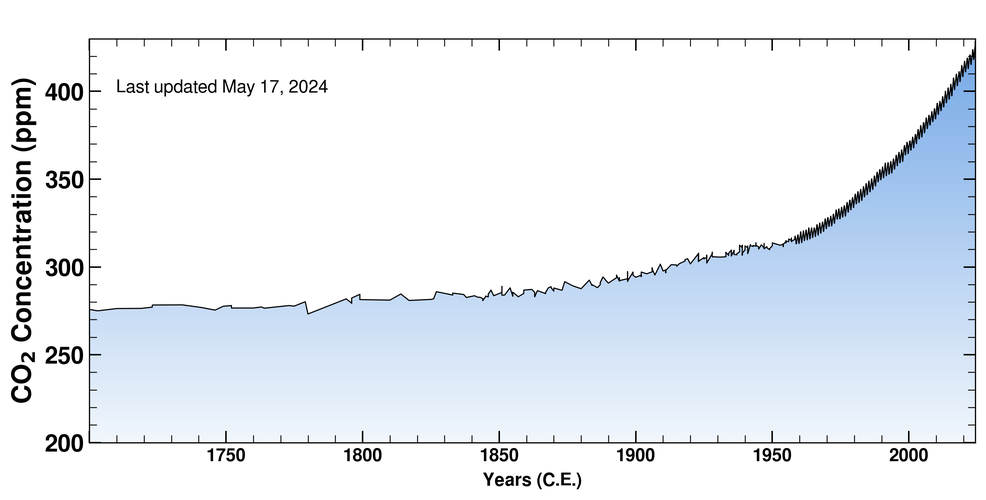
In 1776, carbon dioxide accounted for about 280 parts per million in the atmosphere, as we know from air bubbles trapped in glaciers. By 1910, the figure had risen to 300 ppm, and most of this resulted from changes to the biosphere, chiefly to its vegetation. Not for long.

Smog causes premature darkness as northbound cars clog a freeway in Los Angeles on Nov. 27, 1954.Bettmann Archive/Getty Images
By the end of the 19th century, the U.S. impact on planet Earth came increasingly from its burgeoning industries rather than its agricultural expansion or market hunting. Carbon emissions reflected this change: By 1912, U.S. emissions from fossil fuel burning outstripped those from land use and vegetation changes.
By 1870, U.S. industry ran chiefly on coal. The United States outstripped the U.K. in coal production—and carbon dioxide emissions—by about 1890 and continued to hold that lead for about a century. Only in 1980 did China overtake the United States as a coal-consuming country. It now uses roughly five times as much coal as the United States, and since 2006, it has put more carbon dioxide into the atmosphere each year than any other country. Still, the United States held its lead long enough that it still tops the charts in cumulative carbon emissions. China now ranks second, at about 60 percent of the U.S. total.
But the biggest reason for the United States’ outsized environmental impact remains oil. Between 1912 and 1930, the United States forged the technological, engineering, and marketing synthesis that made cars and trucks with gasoline-powered engines commonplace on every road. This synthesis, bringing together vehicles made mainly in Michigan with oil drilled in Texas, served the U.S. well economically and militarily for decades. It also reshaped the American (and Canadian) landscape, inspiring more road construction, street signs, gas stations, parking lots, motels, and junkyards piled high with old tires and rusting car bodies.
Cars were the most environmentally consequential technology of the 20th century. By 1930, U.S. factories built 5 million a year and at their peak, from 1970 to 2000, averaged between 13 million and 18 million annually. Each one required iron ore, rubber, copper, and many other raw materials taken directly from nature. Driving these cars, in turn, poured out tailpipe pollution, including, between the 1920s and 1980s, 7 million tons of lead with its pernicious impacts on children’s health. By 1970, average Americans carried 100 times as much lead in their bodies as had their grandparents before leaded gasoline.
Cars came to account for about a quarter of U.S. carbon emissions. More consequentially, the car culture pioneered in the country, along with all the associated technology, manufacturing, and marketing techniques, spread worldwide after 1950. This magnified the environmental impacts of cars and oil from Nepal to Namibia.

Workers burn off a field from the previous crop in Imperial Valley, California, on Aug. 6, 2009, in an agricultural area that uses water from the Colorado River distributed through a series of canals and irrigation channels. Brent Stirton/Getty Images
Concurrently, the United States shaped the way the world fed itself and measured its prosperity. U.S. technology transformed agriculture almost beyond recognition. For ten thousand years, farming was a solar-powered operation relying on photosynthesis and the work of people and animals. But now, in much, if not quite all, of the world, farming has become a petrochemical operation relying on nitrogenous fertilizer, pesticides, mechanization, and behind it all, oil. This sea change, which doubled and tripled yields per acre, took root first in the American Midwest. Then, thanks to the Green Revolution, it proceeded to spread everywhere from Mexico to Morocco to Malaysia after 1960.
Modern, industrial agriculture created its own novel environments. Mechanization rewarded gigantic fields, so farmers tore up hedgerows and filled in ponds and sloughs. Pesticides killed off insects of all sorts, pollinators as well as pests, with effects that rippled through the food chain. Nutrient runoff, from croplands and feedlots, loaded streams, lakes, and estuaries with extra nitrogen and phosphorus, fueling algal blooms that choked off other life. Scientists created new crop breeds that responded prolifically to timely doses of irrigation water. Farmers, in turn, drilled millions of tubewells that lowered water tables in north Texas and north India, while engineers erected several thousand new irrigation dams round the world.
From the 1920s onward, the United States also shaped the global environment by its citizens’ consumption habits. In the 19th century, U.S. imports were few and mainly came from Cuba, Mexico, or Canada. By the 1920s, however, and especially after 1945, imports surged. Chilean copper, Brazilian coffee, Venezuelan oil, Canadian newsprint, Liberian rubber, and hundreds of other commodities flowed into U.S. ports in mounting quantities. These flows helped to ratchet up output from the world’s mines, plantations, and forests, transforming environments everywhere.
Another important, if nearly invisible, way in which the United States affected global environments was the invention of GDP, or gross domestic product. During the Great Depression, U.S. economists sought to measure the size of the national economy, creating the yardstick subsequently used, with some modifications, nearly everywhere. Around the world, politicians and voters came to evaluate political performance partly on GDP growth.
This measure, however, left nature out of the equation, because it only took into account market transactions. As a result, an oil spill that required millions of dollars to clean up still went down in the books as boosting GDP. While economists and others have tried for half a century or more to create a metric that includes natural wealth rather than destruction of nature, none has had the global influence or staying power of GDP.

A 1930s postcard shows a view of the Grand Canyon from Inspiration Point in Yellowstone National Park. Ivy Close Images/Universal Images Group via Getty Images
The United States affected the global environment through conservation, too. By most accounts, Yellowstone, which opened in 1872, was the world’s first official national park. And nowhere did parks become so large, so numerous, and so culturally important so soon as in the United States.
The ambition to create national parks became a U.S. export, not least to the USSR. Soviet scientists visited Yellowstone in 1961 and—together with nature-lovers—began to agitate for national parks. Moscow resisted the concept, tainted as it was by its associations with America, but dogged Russians prevailed in the end, and the first Soviet national park opened in 1983. Russia now has 75.
Americans also preached the gospel of forest and soil conservation around the world before, during, and after the 1930s Dust Bowl. Chinese enthusiasm for afforestation and erosion control owed something to the science and lobbying of Arizonan Walter Lowdermilk and his collaborator, Ren Chengtong, in the 1920s. Lowdermilk also took his message to North Africa and the Middle East beginning in 1938. He advocated for an 11th Commandment that read int part: “Thou shalt protect thy fields from erosion and thy hills from over-grazing by thy herds, so that thy descendants may have abundance forever.”
While the surge in popular environmentalism during the 1960s and 1970s was a global phenomenon, it had a strong American component to it. After Sweden, the United States was the first country to translate environmentalism into comprehensive (if far from perfect) national legislation and institutions. That example was widely imitated. Even Mao Zedong’s China, which until 1972 officially maintained that pollution could only exist under capitalism, created environmental protection institutions shortly after the United States did.
Until the 1990s, Washington was also influential worldwide in setting standards for admissible quantities of pollutants. Since then, more and more countries have developed sufficient scientific expertise to set their own standards. Washington’s relaxation of standards in recent years has converted the country into an outlier more than a model in environmental protection.
Since 1776, the United States has affected the global environment in a thousand ways. But today, the country no longer wields the planetary influence it did in the 20th century. China imports far more raw materials than the United States, driving environmental changes from Australia’s coal seams to Brazil’s savanna. China also now emits twice as much carbon dioxide as the United States, so its carbon emissions policies matter more for climate than do American ones.
What’s more, China, rather than the United States, is drawing the blueprints for green energy technologies and seems determined to profit from, rather than resist, the coming transition away from fossil fuels. Beijing matters more than Washington now in setting the course of the Anthropocene.
The author would like to thank to Erin Mauldin and George Vrtis for their input on an early draft of this article.