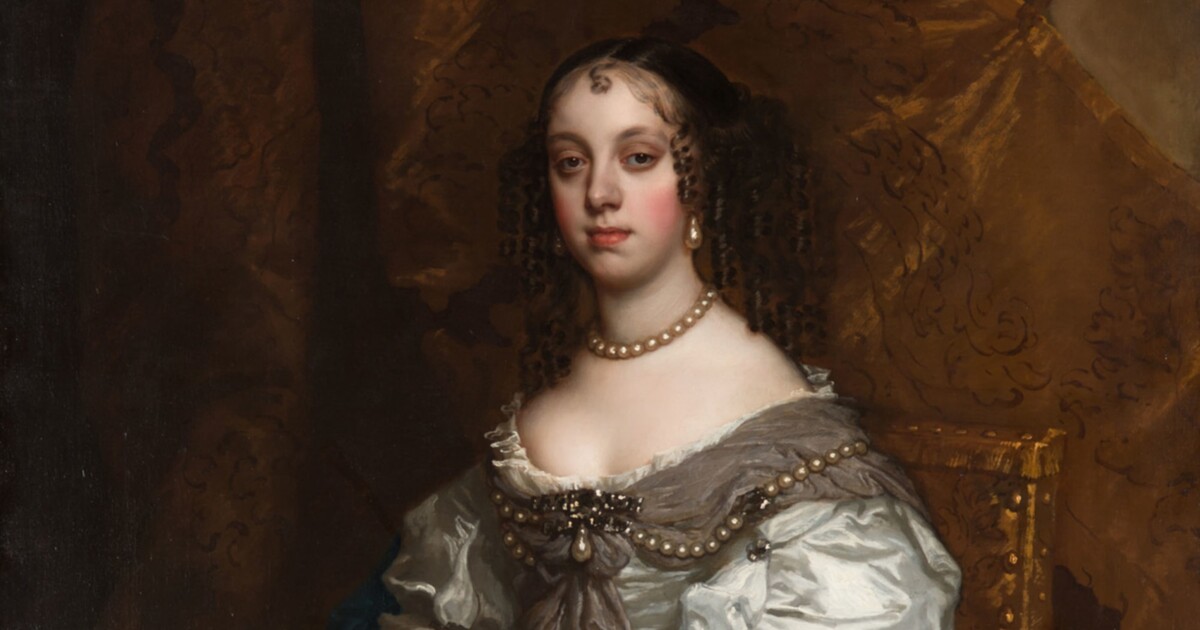
In her early 15th-century conduct book for women, Christine de Pizan advised a princess, not yet married, to ‘love her husband and live in peace with him, or otherwise she will have already discovered the torments of hell’. Tough advice for the 23-year-old Portuguese Infanta, Catherine of Braganza. Soon after her arrival at the Restoration court in 1662, as the wife of Charles II, she was confronted with Charles’s mistress of the moment: the dazzling Barbara Palmer, countess of Castlemaine. Castlemaine had recently given birth to Charles’s baby. Charles demanded that Catherine accept Castlemaine as one of her ladies of the bedchamber. Catherine was horrified.
The few biographies we have of Catherine, queen of Great Britain from 1662 until Charles’s death in 1685, have tended to pity her as the long-suffering wife. How could she have put up with such a philandering husband? Castlemaine went on to give birth to four more of Charles’s children, and Charles had perhaps thirteen illegitimate children in all, with various mistresses. Catherine, meanwhile, may have suffered four miscarriages and never had a child of her own. Lillias Campbell Davidson in her 1908 biography – still brilliant – writes that the queen would become known as ‘Catherine the humiliated, the wronged, the disdained’. But she gives the last word to virtue: ‘She was one of the best and purest women who ever shared the throne of England.’ To this, Sophie Shorland replies ‘How boring!’ Shorland would rather talk about Catherine’s ‘love of parties, fun and gambling’. Queen Catherine’s Court presents her as a ‘trouser-wearing tastemaker’ who ‘defied social conventions to change Britain for ever’. This is misleading. Catherine deserves to be reappraised, but, as other recent works suggest, it is precisely her conventional goodness that is interesting: it was an image deliberately managed by Catherine, and it ensured her survival at Charles’s oversexed and factious court.
I suspect that many people know more about Charles’s mistresses than about his wife. Some may know that Queens in New York was probably named after Catherine, in 1683. A giant bronze statue of her was planned in the borough in the 1990s, but then scrapped because of the Stuarts’ connections to the slave trade: Charles II founded the Royal African Company in 1660. History has, until recently, neglected British queens consort – apart from Henry VIII’s wives or the ‘agent of corruption’, Henrietta Maria, consort of Charles I. Meanwhile, histories of the Restoration are still dominated by Charles the ‘merry monarch’: mistresses in tow, keen on jokes and blessed with the common touch. He doffed his cap at inferiors and rolled up his sleeves to pass buckets of water when London was burning. Not all accounts are as forgiving. In his excellent 1989 biography, Ronald Hutton presents a monarch who brought monarchy into disrepute and whose ‘good-humoured composure’ was a mask, behind which was ‘a cold void’. Catherine does not really feature, although Hutton is clear that Charles was mean to her.
The burgeoning field of queenship studies has rescued lost queens consort. Medieval and early modern scholars in particular have argued for the political agency of queens and their cultural impact. By comparing royal women from the ancient world to the present day, and from Europe to China, queenship historians emphasise the surprising consistency of the virtues associated with the wives of royal men. They should be pretty and pious. They should be good wives and good mothers. They could be patrons – employing writers, artists, architects – and arbiters of taste and fashion. They could mediate between king and subjects, offer redemption, bring peace. Later Stuart Queens includes new research on several queens regnant and queens consort – their influences, reputations, legacies. The essays try to tease out the queens’ ‘construction of their own identity’, and argue that the Stuart queens’ ‘engagement with contemporary culture was a potent expression of their political influence’. Eilish Gregory and Fleur Goldthorpe both contribute pieces about Catherine of Braganza. Shorland’s Queen Catherine’s Court is the most accessible biography for decades, and Catherine is far from passive (although Shorland does seem to find her a bit silly: she smiles and swoons too much, and was frequently ill). Her narrative does not, however, benefit from the new research – the range of sources, the small but rich details – carried out by Gregory and others. This feels like a missed opportunity: much of this work has yet to be recast for a general reader.
Catherine was born in Portugal on 25 November 1638, St Catherine’s Day. Her home was the vast Vila Viçosa, set among olive groves in Alentejo, outside Lisbon. She was the fourth child of João, duke of Braganza, and Luisa de Guzmán, from the house of Medina Sidonia, one of Spain’s most prominent families. João was bookish, liked music (he possibly composed the tune to ‘O come all ye faithful’, according to Shorland) and not particularly ambitious. Luisa liked to paint and was, unlike her husband, very ambitious. The Braganzas were very religious and they were also very rich, owning over a third of Portugal. Catherine’s childhood, however, seems to have been cloistered. An English consul reported that she ‘hath hardly been ten times out of the palace’. She had no formal education but her mother taught her Spanish, and gave her Castilian books to read. She could also understand French and Italian.
Portugal had been ruled by Spain since 1580, and yanked into the Habsburg empire, which imposed heavy taxes to fund its wars. The Braganzas had a claim to the throne and, in 1640, João was urged to accept the crown. He was persuaded, so the story goes, by his wife. On Catherine’s second birthday, Luisa asked her husband: ‘How can you find it in your heart to refuse to confer on this child the rank of a king’s daughter?’ When rebels stormed Lisbon’s Ribeira Palace, the viceroy, Margaret of Savoy (Philip IV’s cousin), fled and bonfires were lit to welcome Portugal’s rightful king. João became John IV, known as ‘the Restorer’. Catherine was elevated to Infanta.
Portugal’s newfound independence was vulnerable and the Braganzas needed allies. England recognised John IV and the toddler Catherine was suggested as a bride for the young Prince Charles. But England was on the brink of its own wars, and soon Charles I would be tried and executed. During the period of England’s republic, Portugal tried to remain neutral, keen to keep trading with England and keep a fellow enemy of Spain on side. At the end of the 1650s, Luisa wrote to Cromwell as Lord Protector, sending money in anticipation of what she believed would be his imminent coronation as King Oliver I. With the fall of the republic and the restoration of Charles II, Luisa again suggested Catherine as a wife. Charles had rejected Protestant German candidates on the grounds of their looks and he did not want to marry a French or Dutch princess. He had found living in exile, bounced between France and the Netherlands, humiliating. Catherine was Catholic, of course, but Portugal’s ambassador, Francisco de Melo, reassured Charles that she was ‘totally without that meddling and activity’ of Henrietta Maria, and would not threaten the English Church. Catherine’s faith meant that she was devout – which was a good thing – and any children she bore would be safely Protestant. And, of course, her money trumped religion.
Catherine brought an enormous dowry: two million gold crowns, or cruzados; the strategic trading posts of Tangier and Bombay; free trade in Brazil and the East Indies. In exchange, England would support and protect Portugal’s independence, both at home and in Portuguese territories abroad. This was useful to Charles, as it meant dissident soldiers previously loyal to England’s republic could be sent away to fight for Portugal. Catherine knew – for this was the lot of the queen consort – that she was a political pawn. She later recalled that there were ‘reasons for my coming to this kingdom, solely for the advantage of Portugal, and for this cause and for the interests of our House I was sacrificed’. Soon after the treaty was signed, Charles II wrote to Richard Fanshawe, soon to be his ambassador in Lisbon: ‘One of the principal advantages we propose to ourself by this entire conjunction with Portugal is the advancement of the trade of this nation and the enlargement of our own territories and dominions.’ Chinese silks and Indian printed calicoes flowed in. New dyes from across the Atlantic saw an explosion of colour at court. Portuguese rush mats furnished chilly palace floors.
On 14 May 1662, a diminutive, dark-haired and rather frail Catherine stepped off the Royal Charles in Portsmouth. She had never been away from Portugal and she had been seasick on the journey. Her foreignness was noted: her olive complexion, ‘monstrous’ farthingales and distinctive hairstyle. John Evelyn, who otherwise admired Catherine, commented unfavourably on her teeth, which apparently protruded too far, and on ‘her foretop long and turned aside very strangely’. This is the young woman caught by Dirk Stoop’s portrait, which was painted before Catherine left Portugal and which circulated widely in print. When Charles met Catherine he was pleased. She was not ‘so exact as to be called a beauty’, he told the Earl of Clarendon, but he could see that she was ‘as good a woman as ever was born’. Royal memorabilia had recently become popular. To mark the wedding, loyal subjects could decorate their homes with wallpaper block-printed with half-length portraits of Charles and Catherine, surrounded by cherubs.
How could Catherine negotiate a strange court that was just out of exile and described as a ‘cross between a brothel and a bear garden’? She was not able (or she refused) to match the style and behaviour exhibited by many of the ‘painted ladies’ at Whitehall. In his memoirs, the courtier Anthony Hamilton recalled that Catherine was ‘far from appearing with splendour in the charming court where she came to reign’. The display of sex and power at this charming court was unusual. Charles paraded his mistresses, canoodling with them in public. They, and the king, were lampooned in shocking and exaggerated satire. Charles’s ‘sceptre and his prick are of a length’, John Wilmot, earl of Rochester, wrote. And, of Castlemaine: ‘Her Grace of Cleveland,/Has swallowed more pricks than the ocean has sand.’ Evelyn, a frequent visitor to Whitehall, lamented the court’s ‘inexpressible luxury and profaneness, gaming, and all dissoluteness’. The Restoration court, as Kevin Sharpe has described, was an ambivalent place. Traditional ideals were in conflict with changing values. Monarchy looked to the past for legitimacy and stability, but it also needed to be reinvented. There may have been a kind of ease in palace apartments, but the political and religious divisions that had ended in a king being executed by his Parliament, and which the republican regimes had tried variously to heal, were still there. Underneath the rustling silks and behind the sexual confidence was the unavoidable truth that monarchy was no longer assured. Commonwealths and republics were still being dreamed up in London’s coffee houses.
In this world, Catherine chose to endorse the traditional role of a queen consort. She capitulated to Charles’s demand that Castlemaine become one of her ladies of the bedchamber, and she tolerated his other mistresses, from Nell Gwyn to Louise de Kérouaille. She was kind to Charles’s first illegitimate son, James Crofts, duke of Monmouth – just 13 in 1662 – and would later plead (unsuccessfully) for his life after he tried to topple his Catholic uncle, James II, in 1685. Catherine found allies in women like herself: the young Frances Stuart, who resisted Charles’s advances; Mary Villiers, the devout duchess of Buckingham; and, after 1673, Mary of Modena, James’s 15-year-old Italian wife. Like her mother-in-law, Henrietta Maria, Catherine began to host her own popular circles, welcoming courtiers, administrators and ambassadors to her Whitehall withdrawing room. More than a hundred visitors would mingle there daily to talk and be seen. Samuel Pepys attended, keen to keep up with news and gossip. Catherine also learned how to dance and hosted masques and balls. She liked to play cards and gamble. She frequently went to the theatre and enjoyed archery. She drank tea for pleasure, rather than medicinally as the English were used to, thus setting a new and lasting trend. She soon dropped the monstrous farthingales in favour of more relaxed, if revealing, English dress. She would sometimes, like other noble women, wear a man’s riding clothes. She commissioned portraits of herself. But instead of patronising Sir Peter Lely, the artist favoured by Charles’s mistresses, Catherine patronised the Flemish (and Catholic) baroque painter Jacob Huysmans. In 1664, Huysmans portrayed her as her namesake, St Catherine of Alexandria. It is a work of serious, and sensuous, modesty. Catherine’s exposed flesh looks chaste rather than sexy. Other women copied it, including Protestants. Pepys, for example, was ‘infinitely pleased’ with how his wife, Elizabeth, looked as St Catherine. St Catherine, though, was a devout princess who had converted to Christianity, and who was famous for converting others. A portrait of Catherine as Catherine of Alexandria anticipates that she, too, might convert others.
Maria Hayward has argued that Catherine ‘played the part of a “good wife” to assert – quietly but firmly – her position and thereby came to represent normative, virtuous women at court and in the country at large’. In this way, Catherine could oppose the promiscuity of Charles’s mistresses and other ‘court beauties’. Underpinning this image, and her resilience, was Catherine’s faith. She knew, as did others hailing the alliance between England and Portugal, that, as queen in a Protestant country, she could protect and nurture English, and Irish, Catholics and even advance Catholicism. Her marriage treaty had allowed her to continue to worship as a Catholic. She brought her own Portuguese priests and was given the chapel at St James’s Palace, and then, after Henrietta Maria’s death, at Somerset House, where she welcomed English Catholics, even when to do so was prohibited. She spent a great deal of money on silver plate, clerical dress, white linen cloths. She employed the Italian artist Benedetto Gennari to decorate the interior and, in 1668, appointed Giovanni Sebenico, from St Mark’s in Venice, to be her master of Italian music. The new sound was heard and loved by Henry Purcell; Pepys considered it ‘beyond anything of ours’. As well as establishing beautiful places of worship that would attract London’s Catholics, Catherine’s patronage of Italians countered and rivalled the pro-French influences at the court that Charles encouraged and which, from the early 1670s, were associated with Louise de Kérouaille (later duchess of Portsmouth), Catherine’s French maid of honour and then Charles’s maîtresse en titre.
While Shorland refers to ‘Catherine’s real Catholic agenda’ and her ‘desire to spread the good news about the religion’, she does not really show whether or how Catherine did this. Catherine the Catholic cultural patron has been drawn out by, among other historians, Chelsea Reutcke, Edward Corp, Eilish Gregory and Peter Leech. The Licensing Act of 1662 had prohibited the publication of popish books, but Catholic writers could look to Catherine for protection. Her chaplain Thomas Godden, for example, dedicated his controversial defence of the Catholic faith – Catholicks no Idolaters – to Catherine, and the work circulated freely. When the unlicensed printer, John Winter, was prosecuted for printing a popish, and potentially seditious, book that Catherine herself had commissioned, she stepped in. Winter’s printing shop was left alone. Catholic printers and booksellers set themselves up around Somerset House, including Catherine’s own bookseller, the recusant Anthony Lawrence. According to Reutcke, Somerset House itself became a place where seditious texts could hide from the law.
To read cover to cover a volume of a royal household’s expenses might seem daunting, but Maria Hayward’s meticulous and beautiful edition of Catherine’s privy purse accounts is testament to the potential of lists of everyday stuff to be a rich and revealing biographical source. (Hayward is at work on a biography of Catherine.) The privy purse was the pot of money that Catherine could spend on household items and some luxury goods, as well as on wages, tips, rewards and travel. It was separate from expenditure on furniture and clothes. In these accounts, monies spent on sweet water, gloves and buttons, linen for sheets and a silver chain for a pet monkey sit alongside payments to settle gambling debts incurred during card games, alms given to the poor and tips given to servants who brought gifts for the queen: fresh salmon or lampreys, fruit, seasonal flowers. Some gifts came from Charles’s mistresses, such as orange blossom from de Kérouaille. Other payments are poignant in a different way: a funeral for a footman who died from the plague; £1 given to two soldiers who saved a ‘Cristall Candellsticke’ from Somerset House during the Great Fire.
Laced through the lists of objects and the columns of money are the names of the men and women, many Catholic, and many Portuguese, who made up Catherine’s household – the women who kept her apartments clean; Portuguese cooks; the dean of her chapel, Father Howard; Dom Patricio, her almoner – as well as prominent ministers such as the Duke of Buckingham. While account books, as Hayward notes, are not always able to tell us exactly what value or meaning objects or goods had for the owner, they give clues to Catherine’s individual style and habits: her preferred milliner, for example, was Mary Cherrett, in Covent Garden; there are multiple payments for muffs, ribbons and lace to trim her clothes; she displays a fondness for plants and animals. The way she practised her faith is shown through payments made to servants who helped her mark religious days: a gift of a leek from a footman on St David’s Day; a cross on St Patrick’s Day. Others brought fish to be eaten on fish days.
The accounts, written in a neat italic hand, were compiled by Barbara Howard, Countess of Suffolk, who was keeper of Catherine’s privy purse as well as first lady of the bedchamber and groom of the stool. Suffolk was also the Countess of Castlemaine’s aunt, and she and her husband, James Howard, were, in Hayward’s description, a ‘Restoration political and social “power couple”’. It was Suffolk who helped Catherine adapt to English court life, and prepared and dressed her body.
The queen’s body, as the potential bearer of a Protestant child, was scrutinised. The Italian diplomat and writer Lorenzo Magalotti noted ‘the extraordinary frequency and abundance of her menses’. In June 1663, Pepys wrote in his diary that ‘the Queen hath much changed her humour, and is become very pleasant and sociable as any; and they say is with child.’ Catherine’s summer trips to Tunbridge Wells and Bath, where it was hoped the therapeutic waters would help her to conceive, were gossiped about, as were rumoured miscarriages. One report claimed she had miscarried after Charles’s pet fox had jumped on her bed. In not producing an heir, Catherine was perceived to have failed in a queen consort’s primary duty. As it became clear that she was unable to conceive – Shorland plausibly suggests endometriosis – Charles came under pressure to divorce Catherine and marry again. An anti-Catholic Whig faction, led by Antony Ashley Cooper, Lord Shaftesbury, agitated to divert the succession away from James, duke of York. James had begun to worship openly as a Catholic and his marriage to Mary of Modena in 1673 meant that he might have a Catholic son, who would push aside Mary, James’s safely Protestant daughter with his first wife. Popular verse began to laugh at Catherine. ‘The Lord Chancellor’s [Shaftesbury’s] Speech to the Parliament’ asked: ‘Would you once bless the English nation,/By changing of Queen Kate’s vocation,/And find one fit for procreation?’ To which Parliament answered: ‘I should be glad to see Kate going.’
Anti-Catholic hatred was never far below the surface in post-Reformation England. Between 1678 and 1681, the country succumbed to a wave of hysteria in response to the ‘Popish Plot’. It was alleged that Catholics were conspiring to kill Charles II and assume power, and that the pope was behind it. But the plots were only stories, fabricated by Titus Oates and Israel Tonge. Oates was an Anglican preacher who had converted to Catholicism and then turned against Catholics. His testimonies were flimsy, inconsistent and clearly unreliable, but it did not take much to stoke anti-Catholic paranoia. Oates was dangerous because he was believed – men were imprisoned and executed on the basis of his ‘evidence’ – and because he could be used by Shaftesbury and his faction to advance their agenda for the succession. In 1679, Shaftesbury introduced the first of three exclusion bills that sought to prevent James from inheriting the throne unless he renounced his Catholicism. Charles’s illegitimate son, James, duke of Monmouth was proposed as a possible heir. Charles dissolved Parliament before any of the bills could pass, and sent James abroad for a while – an act Catherine believed to be ‘so contrary to the affection he bears towards this brother to whom he owes so much’.
Catherine and some of her household found themselves implicated. Oates named her Catholic doctor, George Wakeman, as a would-be assassin; he was imprisoned in the Tower and tried for treason (he was found not guilty). Meanwhile a man called William Bedloe, an associate of Oates, had claimed that a high-profile Protestant magistrate, Sir Edmund Berry Godfrey, whose body had been found at Primrose Hill in strange circumstances, had been murdered in Somerset House. Oates circulated rumours that Catherine herself was planning to poison Charles. Charles questioned Oates personally but was not convinced. He could not believe Catherine ‘capable of a wicked thing’. While the Commons pressed for Catherine’s banishment, the House of Lords expressed belief in her goodness. Catherine, for her part, put her faith in God: ‘My trust is that the Almighty will establish the truth,’ she said. She did not take up her brother Pedro’s suggestion that she return to Portugal to wait for the hysteria to die down. And Charles did not bow to the pressure to divorce her, or abandon her, declaring that to do so would be ‘horrid’.
Charles’s loyalty to Catherine, when he was anything but faithful, may be surprising. There was precedent, after all, for an English king to divorce in pursuit of an heir. He may have been motivated by genuine attachment, as well as principle. His attitude may also have been bound up with the loyalty he maintained to James, as his brother and as the legitimate heir. Charles’s entire kingship depended on the continued principle of hereditary right. Perhaps his own religious beliefs played a part. When he died in 1685, he died a Catholic. His last rites were read to him by Father Huddleston, the priest who had sheltered him from Cromwell’s soldiers after the Battle of Worcester in 1651. Catherine mourned in the traditional way, and for a long time. She was appropriately consoled by poets who praised her, as Joshua Barnes did, as ‘the sole good queen’ and ‘the best that ere/did th’honourable chains of wedlock wear’.
After Charles II’s death , Catherine lived in Somerset House and presided over her own household and privy council. She still had her own money, as part of her jointure. Once king, James II pushed for the toleration of Catholicism throughout England, Scotland and Ireland – much to the horror of many in Parliament and the Church. This brief climate of religious toleration gave Catherine new opportunities to support and patronise Catholics, as shown by Gregory in her chapter in Later Stuart Queens. But it was short-lived. On 10 June 1688, Mary of Modena had a longed-for child, a boy, named James. To block this Catholic succession, the Whig faction in Parliament began to negotiate with James II’s first daughter, Mary, and her husband, William of Orange, stadtholder of the Dutch republic. In the so-called Glorious Revolution of 1688, William and Mary were crowned, and James, Mary and their son – who would become the Pretender – were sent into exile.
Catherine was allowed to remain at Somerset House but she was now alone as a Catholic royal. Her relationship with William and Mary was cordial, but strained. She did not attend their coronation and William withheld money due to her. Unsurprisingly, as Gregory shows, Catherine’s home became a meeting place for Jacobites, those who remained loyal to the deposed James II and his son. Most were Catholic, but not all; the principle of hereditary succession was held dear. Catherine, however, wanted to return to Portugal. As she wrote to her brother Pedro, who was now king, her duty to Charles as his wife, which was also her duty to God, was done.
Catherine left England in 1692, taking with her 103 loyal members of her household, including English ladies-in-waiting, her English clothes and some English customs. Back in Portugal, she did not retreat from public life but rather built her own baroque palace, Paço da Bemposta, in Lisbon. She twice acted as regent for Pedro II: in 1704, when he was on military campaign against Spain, and again in 1705, after he had suffered a stroke. As regent in a country where female rule was legitimate but often resisted, Catherine successfully oversaw military victories against Spain that preserved the crown. She maintained a British identity until her death, styling herself ‘Queen of Great Britain, Infanta of Portugal’. As Goldthorpe shows in her essay in Later Stuart Queens, Catherine played a part in reviving the Anglo-Portuguese alliance once Queen Anne was on the throne. While the poet Edmund Waller associated this ‘best of queens’ with the ‘best of herbs’ – tea – Goldthorpe credits Catherine with some influence over the British love of port. A treaty in 1705 reduced the import duty payable on Portuguese wines in exchange for freer trade in English woollens and cloths. As a result, port and madeira dominated the wine trade for ‘over a century’. On 31 December 1705, Catherine died, still as regent. The Braganza family continued to rule Portugal until 1910.
On Charles II’s death, Aphra Behn dedicated a consolatory poem to Catherine, addressing her as ‘the great pattern of piety and virtue’. Despite not securing the succession, despite being Catholic, Catherine managed to be perceived as an ideal consort. Royal wives were – and are – loved or loathed according to values that remain spectacularly unchanged: pretty (not too sexy), devout, dutiful. This May, Catherine, princess of Wales, returned from a trip to Italy during which she had pursued her interest in early years education. It was a solo trip, to confirm Catherine’s renewed health but also to emphasise her own, appropriate sphere of influence. A press opportunity allowed Prince William to praise Catherine, which he did in entirely conventional terms: a great wife, a great mother, thoroughly devoted to her causes. Meanwhile, the photographers captured Catherine’s radiant smile, Botticelli curls, sharp suit in Marian blue. An image that balances the expected, successful virtues of a consort is carefully curated. It has a long history.