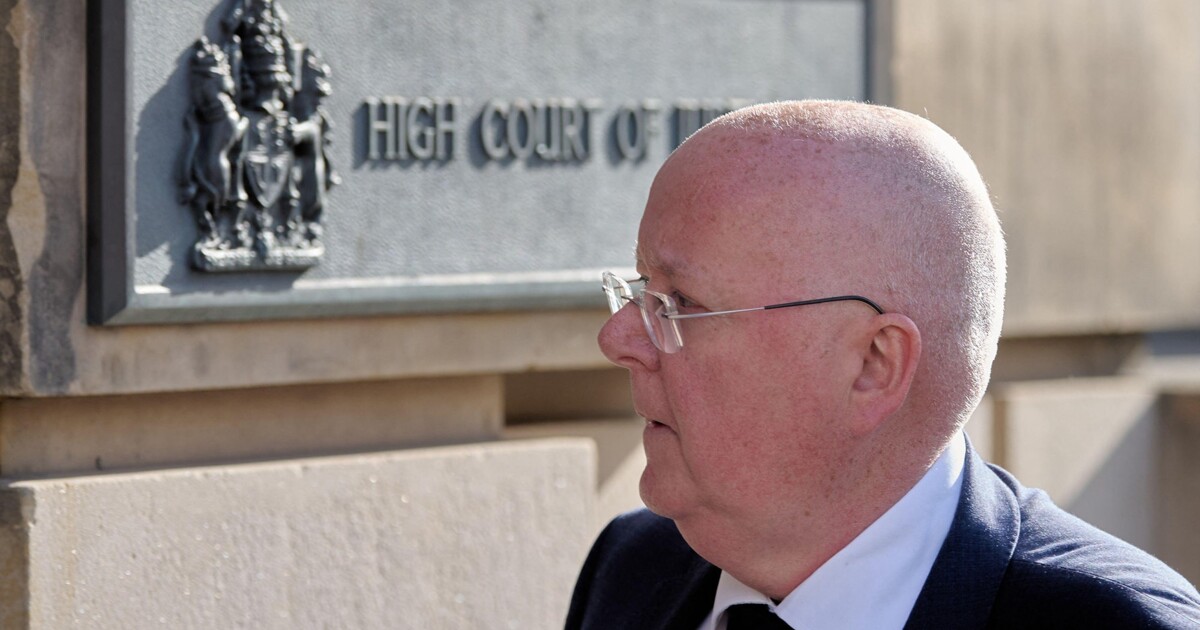
In early 2021, when the SNP’s chief executive Peter Murrell was being questioned via Zoom by a Holyrood inquiry into the Scottish government’s handling of harassment allegations against Alex Salmond, others on the call noticed that he kept looking off to the left. When asked why, he claimed he was being distracted by magpies. It was an odd and brazen thing to say, because he knew then what we all now know: that Murrell is a thief who covets shiny trinkets. Even as he spoke, scattered round the properties he had access to were Mont Blanc pens, Bremont watches, Le Creuset pans and a Smythson tea set paid for with money stolen from the party he helped to lead. But then everything about this story is odd and brazen, from the quiz show hodgepodge of goods Murrell bought – from an £81,000 Jaguar to a two-piece silicone egg poacher for £24 – to the announcement two days before Murrell’s sentencing that his estranged wife, Nicola Sturgeon, had accepted a role on a reality TV show. On Sky’s Wargame, the woman who led Scotland through Covid will play second fiddle to Michael Gove as the fictional prime minister of a UK government fighting Russia.
Murrell, who was jailed for five years and three months, was said to feel ‘guilt and remorse’ over his embezzlement of £400,000 over twelve years. But no explanation was offered as to why a man who earned a substantial wage defrauded his own party to buy things he didn’t need and often didn’t use. The Bremont watches are still wrapped in cellophane and the £124,000 Niesmann & Bischoff Smove 7.4e motor home has only four miles on the clock – his drive from the dealer to his mother’s home – despite the three travel books for round-Britain camper-vanning Murrell had picked up in anticipation.
While Nigel Farage is being investigated over £5 million he received from a crypto billionaire, Murrell squandered the SNP’s reputation on £42,660 worth of Amazon packages and a necklace from a Shetland jeweller that Sturgeon thought was a sweet gift. Outside the court, reporters argued over which of his purchases was the most humiliating: some thought the Ali Baba laundry basket, others the slouch pouch onesie.
In mitigation, Murrell’s lawyer, John Scullion KC, said his client had become the object of public ridicule. But he has made a laughing stock of the SNP, too, revealing the inadequacy of its financial governance and its reluctance to scrutinise those at the top. The court was told that the methods Murrell used to carry out his embezzlement weren’t very sophisticated. They didn’t need to be. As chief executive, he had full control of the SNP’s accounts and was able to sign off his own expenses. Having made his purchases, he falsely labelled or misdescribed them in the party’s accounting software system, to which he had direct access; on a few occasions he raised false invoices. When he bought the motor home he bypassed a transfer limit of £30,000 by making multiple transactions. It also emerged that Murrell was able to make false claims without providing receipts because, he said, he couldn’t get into the online expenses portal.
Perhaps the gravest flaw was the concentration of power in the couple at the helm of the party, and the conflict of interest that posed. Alex Salmond was among those who told Sturgeon her husband should not remain as chief executive after she became leader. But she ignored his advice and no one within the party or the media forced the issue. This meant that when people finally began to question the SNP’s governance, Sturgeon felt she could shut them down. A leaked clip from 2021, in which she tells the National Executive Committee that the party has never been on a stronger financial footing, is a master class in entitlement. It was filmed the day after three members of its finance and audit committee had resigned because they didn’t have access to the accounts. Brought in by the party’s then treasurer, Douglas Chapman, to find out what was going on, they only lasted six weeks. Chapman himself resigned two months later. ‘Just be very careful, all of us, about suggestions that there are problems with the party’s finances because we depend on donors to donate,’ Sturgeon says in a tone that can only be described as hectoring. This was peak ‘wheesht for indy’: a phrase used to describe the papering over of problems to ensure they did not damage the independence movement.
To understand how the party got to the point where its funds could be embezzled, it’s necessary to go back to the period before Sturgeon became party leader and first minister in the wake of the 2014 Independence referendum. Before 2014, the SNP consisted mostly of old-timers, bonded by their outsider status and shared history. After the referendum, there was a surge of new party members, and the following year, the SNP won a landslide in Scotland in the UK general election. The party had grown hugely and moved from the fringes to the mainstream, but its structures, its governance, its cliquiness and its defensiveness remained. This failure to adapt wasn’t so damaging while the SNP was riding high in the polls and there wasn’t too much stress along its internal faultlines. But by the time Murrell appeared before that Holyrood inquiry in 2021, the party and movement had fractured.
Some of those who believed that the accusations against Salmond were the result of a conspiracy on the part of his successor, Sturgeon, and her administration, and who also opposed the SNP’s Gender Recognition Reform Bill, were openly gunning for Sturgeon. Legitimate criticism of her managerialism and lack of transparency was mixed, in some quarters, with a deep-seated misogyny, and it became difficult to separate the two. Independence discourse on X, which had previously split along Yes/No lines, turned on itself, with some former advocates angrier at the parliamentary SNP than with their unionist rivals. There were defections to Alba, the party Salmond set up in 2021 following his acquittal in 2020, and defections back again; leaking became commonplace.
After the Brexit vote in 2016, which the SNP believed constituted a ‘material change in circumstances’ justifying a second independence referendum, the party set up two crowdfunders which raised some £600,000 from donors who thought their money was being ring-fenced for a new referendum campaign. When the 2019 accounts showed the party only had £97,000 in its bank account, the pro-indy blogger Stuart Campbell, better known as ‘Wings over Scotland’, began asking where the money had gone (the suspicion then was that it had been used to cover general party expenses).
Rumours began to circulate. Because some of those raising concerns belonged to the movement’s wilder fringes, no one in the upper echelons of the SNP paid them much heed. The widespread leaking fostered (or was used to justify) more secrecy, on the grounds that anything circulated internally would probably end up in the public domain. But Sturgeon and Murrell were no longer unassailable. Sean Clerkin, a left-wing independence activist (and one-time member of a group called Scottish Resistance), lodged a complaint with Police Scotland, and the force launched Operation Branchform, which stumbled across Murrell’s embezzlement. No charges have yet been brought in relation to the alleged repurposing of the crowdfunders.
Murrell is now in a prison cell in Dumfries. His lawyer told the court he intended to return all the money he stole. Sturgeon, who was also arrested, but not charged, is no longer first minister, no longer even an MSP. Her insistence that she knew nothing about her husband’s crimes – in particular the claim she never noticed the 24-foot camper van parked outside her mother-in-law’s house – continues to generate mockery and memes. Many of those who were quick to deride Sturgeon were the same people claiming that Salmond’s acquittal exonerated him of behaving inappropriately.
Still, Sturgeon has done little to endear herself to those who once supported her and hoped she would acknowledge her part in creating the conditions that made Murrell’s behaviour possible. Instead, she has dismissed all criticism of her actions as sexist while continuing to punt her autobiography, Frankly, attend book events and take on that reality TV role. We’ve been there, most of us, making out that we’re having a good time when our lives are falling apart. Sturgeon has lost her marriage, her status and her home – she has ‘fled’ to London, where she is apparently renting. But since she was the leader of Scotland and of her party for eight years, it isn’t unreasonable to expect a degree of soul-searching and accountability.
As for John Swinney, the current SNP first minister, he and Murrell go back a long way: both born in 1964, both raised in the Edinburgh suburb of Corstorphine, both members of the same company of the Boys’ Brigade. Several sources have claimed that Salmond told them Murrell was forced to repay money stolen from party funds while he was membership convenor of the SNP’s Peterhead branch in 1989. If this is true, why didn’t Salmond tell anyone when Swinney appointed Murrell chief executive in 2001 during his first period as party leader? And why, when concerns started to emerge two decades later, didn’t anyone mention Peterhead?
This is not the first time the SNP has been stung by one of its own senior figures. In 2022, Natalie McGarry, the former MP for Glasgow East, was jailed for embezzling £25,000 from the Glasgow Regional Association of the SNP and Women for Independence. She was the treasurer of both organisations. At WFI, she transferred crowdfunder money into her personal account, while claiming to be reimbursing herself for legitimate expenses.
Swinney has spent the weeks since Murrell’s guilty plea talking down the impact of the scandal. He may be right that a parliamentary inquiry is not the appropriate forum for an investigation of the governance of an individual political party; an alternative would be to appoint a KC to lead an independent investigation. Swinney would prefer the public to take it on trust that the changes he has stipulated are sufficient. These include a requirement that every payment be seen by three people – the head of finance, the chief executive and the national treasurer – before it can be authorised. But unless these measures are independently scrutinised and the party’s cosily informal culture is addressed, how effective will they be? It is also difficult to take Swinney’s assurances of a commitment to transparency seriously when he has refused to criticise the recent decision by Holyrood officials to put lobby journalists in a restricted area, limiting their access to politicians after First Minister’s Questions.
Whether the scandal will have a long-term impact on the party’s electoral success is hard to determine. Some have suggested that if Murrell’s guilty plea had come before the Holyrood election on 7 May – in which the SNP held on to power, but won six fewer seats than in 2021 – the outcome would have been very different; but recent developments suggest it’s not so straightforward. The two Westminster by-elections held on 18 June along with the one in Makerfield were both in Scotland. The SNP’s loss of Aberdeen South to the Tories had more to do with fears for the oil and gas industry than with Murrell’s actions. The same night, the SNP held Arbroath and Broughty Ferry, increasing the party’s majority from 859 over Labour to 5278 over the Tories. According to Swinney, there was an increase in donations to the SNP in the wake of Murrell’s guilty plea: a nationalist middle finger in the face of unionist Schadenfreude.
The SNP has been winning by default for years now. Everyone knows the party is exhausted and out of ideas, but people keep voting for it for want of anything better. And, like Labour when it ruled Scotland, it never tries anything new. Why bother? The day before Murrell’s sentencing, the party’s eight remaining Westminster MPs backed a presentation bill aimed at devolving independence referendum powers to Holyrood. These bills are highly unlikely to be passed. A futile gesture. Business as usual.