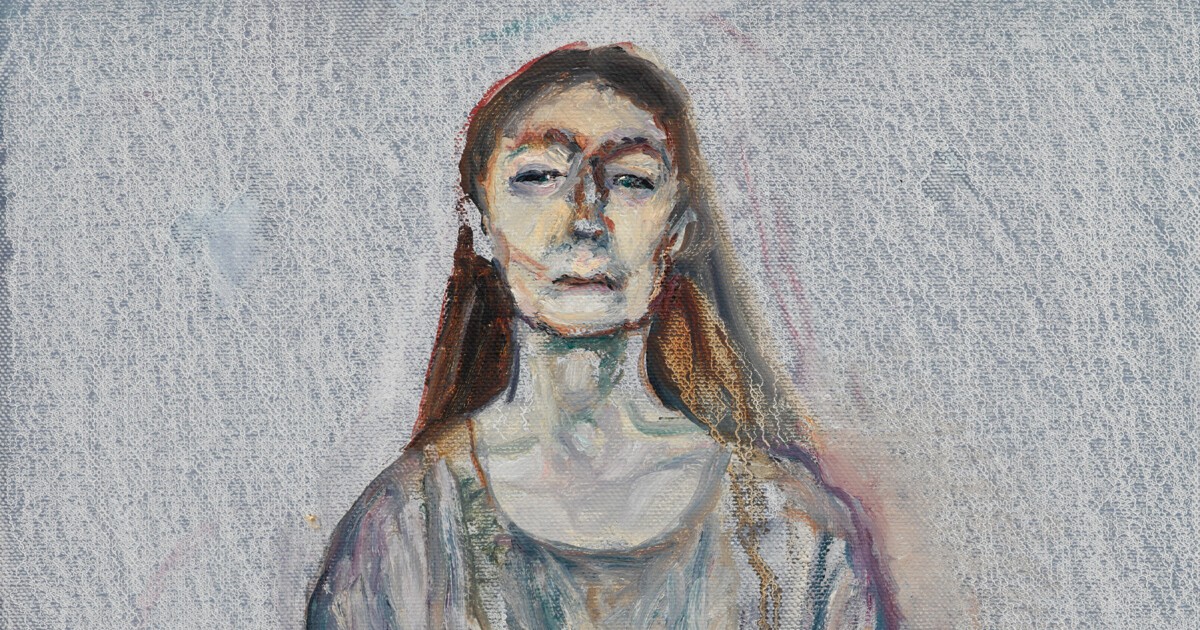

‘Ghost of a Girl with an Egg’ (2022)
© Celia Paul. Courtesy the artist, Gladstone and Victoria Miro.
Celia Paul’s My Mother and God, from 1990, shows Paul’s mother, the obsessive subject of her art, against a louring cloud of thickly layered black and brown paint; at the top of the canvas, a glow of gold gives a promise of sunrise. The head seems to float in the lower half of the painting, an apparition in a welter of night; the eyes are lowered and the face turned to the side, almost as if she were listening to the hum of the darkness that bears down on her and threatens to engulf her. This is a god who does not offer easy consolation.
The painting is one of an immense sequence of images made over thirty years, from 1977 until 2007, for which Pamela Paul devotedly sat for her daughter. Early on, Paul had drawn ‘the backs of her knees, with the tender little line at the crease; her feet, with the beautiful toes already showing signs of their later crookedness; her legs, with their familiar large thighs’. In her memoir, Self-Portrait (2019), she recalls telling her mother to take off her clothes and lie down: ‘I peremptorily instructed my mother about what position she should assume … When she faltered and didn’t get the position just as I had wanted, I shouted at her. I was very cruel. She cried and said that I was treating her like an object.’ Later on in their long collaboration, her mother is no longer manipulated like a doll, but seated in contemplation. She used the time to pray, and reached a state of ecstasy, Paul tells us, if she had ‘sat well’. The paintings exude a rare intimacy, as in Rembrandt’s of his mother reading the Bible, an intimacy more usually found in pictures by a lover, a spouse or a parent.
Victoria Miro, Paul’s gallery, has published a massive volume of her work in collaboration with Mack press: nearly three hundred drawings and paintings, made since the 1970s, selected to emphasise her evocation of silence and solitariness. It includes essays by Hilton Als, Karl Ove Knausgaard and others, worth reading but difficult to read because of the book’s bulk. Clare Carlisle offers Proust’s feverish yearning for his mother as a parallel to Paul’s intense closeness to hers. Yet in her writing Paul tells us very little about Pamela: that she studied English at King’s College London, that her happy childhood in North Crawley was riven by tragedy when her little cousin was run over. This reticence is a central quality of Paul’s artistry as both writer and painter. In the course of a rare public conversation, held at the London Library in 2023 and transcribed for the Miro volume, Edmund de Waal suggests that ‘the real research is thinking and living into someone else’s visions,’ to which Paul replies: ‘And knowing what to leave out, as well.’ Her paintings and her writings seem unflinchingly to scrutinise their subjects (often herself). But they leave out a lot, as well.
Geoffrey Paul, her father, was a missionary in Thiruvananthapuram, Kerala, where Paul was born in 1959. She was the fourth daughter, and for a while the youngest. Then another sister, Kate, came along. Paul found this very hard to bear, as she describes with raw honesty, trusting her readers’ sympathy. ‘I refused to eat. I became really ill and was diagnosed with leukaemia.’ The family returned to England to get treatment, and Paul was cured. ‘My parents said it was a miracle, brought about by so much prayer. I thought otherwise. I knew I had brought the illness on myself to get my mother’s attention. I succeeded. My mother gave me her devotion for the rest of her life.’
In England, Geoffrey took up the post of warden of Lee Abbey, a Christian evangelical community on Exmoor; later the family moved to Hull, where he became a bishop, and then to Bradford. This upbringing was sheltered, unworldly and spartan: the exactions of a pastor’s family life, borne uncomplainingly, can be seen in Pamela’s worn features, her resigned, drooping and exhausted body, her gnarled and broken feet. After Bishop Paul died suddenly in 1983, the family circumstances became yet more straitened; having always lived in church property, they had no home of their own. Pamela would survive him by another thirty years. After she could no longer sit for her portrait, Kate was enlisted. The family resemblance is striking: the long eyes, the round arcs of the eyebrows, the tapering neck, the sloping ‘champagne’ shoulders (as my own mother called them). Painting Kate again and again and others she felt close to was, Paul suggests, a way of securing them as co-disciples in her vocation and another form of self-exploration.

‘My Mother with a Rose’ (2006)
© Celia Paul. Courtesy the artist, Gladstone and Victoria Miro.
Paul does not really paint portraits, if penetrating insight into character is what’s expected, and she hasn’t accepted commissions. Not that she can’t catch a likeness as well as any journeyman: Lucian Freud’s vampiric stare – blue-grey, strabismic – dazzles in Colony of Ghosts (2023), painted after a photograph John Deakin took sixty years ago of the ‘School of London’ and Colony Room members Freud, Francis Bacon, Michael Andrews and Frank Auerbach together at Wheeler’s restaurant in Soho. Paul wanted to conjure the power of that boys’ gang and express her own uneasy position vis-à-vis this now auratic company. ‘I belong among them,’ she asserts, ‘even if they can’t let me in.’
Freud admired and learned from her, Paul makes clear. He embarked on Large Interior, W11 (after Watteau) in 1981 after she had shown him her ‘first real painting’, called Family Group, in which her father, mother and sister Kate are sitting together but somehow each isolated and apart. She painted it in 1980 and Freud, who specialised in single portraits, was struck by her attempt to express relationships that were both loving and tense. Paul is there in his response, partly hidden by the fall of her hair and enveloped in a long, flower-sprinkled dress; she is sitting squashed up beside Freud’s daughter Bella, who is the same age as Paul, his former lover Suzy Boyt and her son, Kai. ‘We look lost and isolated,’ Paul writes, ‘like sheep huddled together in a storm.’
Paul’s writings give every impression of translucency and quivering confession; she is an artist of self-exposure, of hurt and sorrow, both on canvas and on the page. Her confidences inspire love and a desire to protect her and have given rise to something of a cult. But, as I have said, much is concealed as well as revealed. The bishop father remains in the shadows, except for one scene, in Self-Portrait, where he teases his daughters by declaring that Lucy is ‘the creative person in the family’ and Kate is ‘the genius’. Paul bridles with jealousy, feeling utterly rejected. This glimpse of the bishop at the family table, a pastor who remains mostly distant, busy in his study writing his sermons, sounds an alarm.
Unexpectedly, Freud’s friends and his many children single out among his characteristics his craving for affection, expressed demonstratively, caressingly. We may hoot, deplore or shrink in revulsion from his promiscuity and baby fathering, but many women, one after another, and often at the same time, responded and, like several of his daughters, remain fiercely loyal. When I wrote a profile of him for the New York Times Magazine in 1988, one of his lovers gave me an interview, off the record. She described the way he noticed when her skin changed colour because the heating wasn’t set high enough, or, from the look of her tummy muscles, when she hadn’t been swimming that morning. It was intoxicating, she said, to have someone pay such full attention to you.
Self-Portrait chronicles the all-consuming love Paul felt for Freud, who became her lover when she was 18 and he was 55. The last but one in a family of six women, dependants of a patriarchal institution, she hungered for such attention. Scarcity in her social and religious background seems to provide the foundation of her life choices. The thick, dark paint of My Mother and God evokes her mother’s faith in the material existence of a deity but also conveys, perhaps unconsciously, the oppressive impenetrability that her mother’s faith – and her sisters’ too, perhaps – presented to Paul. One of her sisters, Mandy, is a priest; another, Jane, became a theologian in the Anglican ministry and is married to Rowan Williams. It is startling that the family connection led to the Archbishop of Canterbury’s officiating at the funeral of Lucian Freud – as if the pope had presided at Don Giovanni’s obsequies. Asked to deliver the eulogy, the prelate must have produced a masterpiece of evasion.
Paul committed herself to a modern, secular version of the life of an anchoress walled up in a cell, with only the rare visitor climbing the long flights of stairs to her studio-home in Bloomsbury, which Freud bought for her. She recounts in Self-Portrait how she gave up her son, Frank, in order to dedicate herself to art – and to return to his father. Or rather, to resume waiting for him to telephone her or to summon her or to call on her: Freud had always been unpredictable and was already closely involved with other women, causing agonies of jealousy. She doesn’t name them in her books but evoked them calmly and even coolly in a piece for this paper.*
Her mother agreed to look after the baby, happy to have another child at home, she said, and a boy, too, after her five girls had fledged. Paul writes of her anguish at the separation from her baby, but painting her mother and son together, she reassures herself: ‘My mother’s love for her grandson was as strong as a mountain. The years had chiselled and focused her need to give love. Her body was a fortress. No harm would come near him.’ Why did Pamela want to do this for her daughter? Did she feel she had failed to protect her? Or did she too see this as enabling a higher calling? The parable of the talents in the New Testament denounces the man who buries his in the ground. At my convent school, the nuns would instruct us in moral priorities and explain that, in future, our duty as wives and mothers would be to serve God and our husband, who was his stand-in. For example, if our husband was posted to India, we should leave the children behind and go with him. Is it possible that in a God-fearing family these values held, and that cultivating the gift of artistic ability, bestowed by God, took precedence? That loyalty to the father of your child was paramount? In other words, that Pamela took up Martha’s role so that Paul, the child needing love, could be Mary Magdalene and cultivate the better part?

‘Kate in a Starry Landscape’ (2025)
© Celia Paul. Courtesy the artist, Gladstone and Victoria Miro.
Paul’s account of her choice makes for painful reading, especially when Freud, finding milk leaking from her breasts onto her dress, asks what it is and then appears to be repelled. Rachel Cusk’s profile of Paul for the New York Times in 2019 is filled with a kind of pity for and rage against Paul’s subjugation, and places it in the larger context of the impossible combination, for a woman, of motherhood and a creative life (as in Cyril Connolly’s famous jibe at the pram in the hall). But many women artists have had children, some of them even a whole gaggle of them. Julie Phillips’s book The Baby on the Fire Escape gives a broader historical picture of the many stratagems women artists have devised. Less attention has been given to the way artists – and writers for that matter – have themselves been mothered. Paul is unusual in the intensity of her bond, and she feels none of the anger and reproach current in memoirs and autofiction. Besides, she did not exactly abandon Frank – every week she would go to Cambridge to be with him and, it seems, every weekend too. She handed over the childcare but perceives the arrangement through the prism of Christian love, oblation and self-sacrifice.
Several writers on Paul – Knausgaard as well as Cusk – express awe at the self-inflicted deprivation of her life in the small, austere walk-up flat, the nearest thing to a freezing garret imaginable, and marvel at the eremitical squalor, the rime of paint crusts and detritus on the floor, the stiffly bedaubed artist’s smock which Paul wears to work, the self-mortification. In her youth, at the Slade, she describes, insouciantly, trying heroin, drinking too much, having sex here and there and forgetting to eat, to wash. Self-care wasn’t a word then, but she lacks it and to some degree, like an ecstatic saint, has made a philosophy of self-neglect as transcendence.
In ‘Painting Myself’, her own essay for the Miro catalogue, Paul writes that she could not paint a self-portrait in the years when her mother was her principal subject: ‘Somehow, her adored image blotted out my own. It took her death for me to be able to start to see myself. And then I found a way in.’ That way in involved choosing other compass points from which to take her bearings. In Letters to Gwen John (2022), her second book, she writes beautiful, confiding letters, which are intensely seductive to the reader. Unlike a child’s imaginary friend, John doesn’t make up for what Paul lacks but reinforces it. John’s spells of self-abasement to another Great (Male) Artist, Auguste Rodin, comfort Paul and help vindicate her own lacerating passion for Freud, while her chosen double’s privations, poverty and seclusion, her fierce privacy and composure and stillness, beckon to Paul as if John were her soul sister, or she her reincarnation.
Her closeness to this avatar offers a clue to looking at Paul’s paintings of people: they aren’t portraits as such but a form of self-portraiture by mediumship. John offers her a mirror in which she can find her own character, in the same way her mother, and then her sister Kate, offered her paths to discover who she was. The quest was frustrated, unresolved, hence the patient, taxing iterations of her mother, Kate and herself.
Unlike Jenny Saville, eleven years younger than Paul, or Paula Rego or Barbara Walker, Paul’s subjects are not powerful or carnal. Indeed they are disincarnate, a riposte to Freud’s fleshly displays (my sister, the art critic Laura Gascoigne, saw Freud’s nudes in Ballardian terms, ‘posed like casualties of a car crash in a nudist camp’). In Ghost of a Girl with an Egg (2022), Paul reproduces the portrait that Freud made of her in 1980, in which she appears naked, her eyes averted, and prone (the view from above much favoured by Freud). She writes in Self-Portrait that Freud was surprised by the voluptuousness of her ‘curves’ and that towards the end of the sittings, he suddenly decided to add in the foreground two halves of a hard-boiled egg. Naked Girl with Egg is a ‘cruel objectification’: ‘I am shown lying on a black bedsheet; one hand cups my full breast, the other is raised to my excruciated face. A halved boiled egg sits in a white dish on a marble-topped table. The brown swirling veins of the marble echo my pubic hair, and the egg resembles my breasts.’
Sarah Lucas later skewered this kind of male facetiousness and swagger with her Self-Portrait with Fried Eggs (1996), but she has a far tougher humour than Paul. Freud’s addition of the egg was a cruel joke, a silly, crude, schoolboy snigger. It is no wonder her lover’s image of her imprinted Paul’s sensibility, or that she returns to it. In a very recent painting, La Chevelure, she summons a ghostly memory of the first time she visited Freud’s studio. He grasped her long hair, plunged his face into it and breathed in its scent, and asked her if she knew Baudelaire’s poem ‘La Chevelure’. In the painting, she and Freud appear together, gauzy and insubstantial, a moment of erotic crystallisation.
Freud declared himself impatient of all symbolism. For the double portrait Large Interior, W9 (1973), he arranged his mother, Lucie, seated and clothed in the foreground with Jacquetta Eliot lying naked in the bed behind, half covered by an old brown blanket. By Lucie’s chair, prominent in the foreground, stands a pestle and mortar – needed to grind charcoal into the pigments, Freud claimed, to achieve the right ‘Londony’ grime in his palette. No further meaning intended, nothing about time or youth or beauty or the relationship of a mother with her son (and vice versa) or a man with his lover. Paul at first consented to this austere positivism: the thing itself mattered on its own terms. The face, the body, the couch, the chair, were enough; striving to capture things as they are an arduous and fulfilling endeavour.
Over decades distancing herself from Freud, Paul has become a quietly metaphysical artist, finding in her subjects a depth and mystery that invites the viewer to look beyond appearances. She leaves out more and more – time, circumstance, setting, objects. The ascetic habitus of her works connects, in my eyes, to her clerical background and the shock of her encounter with the antinomian devilry of Freud. He singled her out for visibility in some memorable, if anguished, paintings he made of her, notably the last one, which shows Angus Cook, a mutual friend, sprawled on a bed, his genitals exposed, while Paul stands with paintbrush in hand, squishing a paint tube under her naked foot. It has been interpreted as a moment of triumphant self-realisation, of Paul the artist not the muse, the painter not the model. She has revisited this painting too in a ghostly variation, and filled the right hand of the canvas, where Cook had lain, with sweeps of grey-brown paint. There are memories she cannot forget, even as she tries to obliterate them.
This coming into being has not continued as a theme in her work. The sequences of self-portraits she made between 2012 and 2015, during her mother’s final illness and after her death, do not appear to me to be making a statement about women as artists but rather to be existential, repeated self-questioning in the tradition that connects Rembrandt, Van Gogh, Paula Modersohn-Becker and Egon Schiele. Her style and method have more affinity with Giacometti than with Freud or Auerbach. James Lord’s marvellous account, published in 1965, of his long sessions sitting for Giacometti foreshadows the patient vigils that Paul exacts from her subjects. Lord relates entertainingly the way Giacometti was always dissatisfied with the day’s work and at the end of the sitting would scrape down what he had done, time after time, until Lord recognised the arc of his mood swings and learned to get up and stop the session before the next annihilating depression set in.
Paul avoids all descriptors or social indices. There hangs in her studio a set of smocks which her sisters were asked to put on, for example, for Sisters by the Sea (2023), a votive gathering to mourn their mother. Made of bedsheets, these shroud-like gowns conceal the sisters’ bodies and enhance the head and face, the only parts of them that are fully rendered. Like eschatological garments, they erase human flesh, the fact of embodiment, and cast the sisters as nuns, or penitents in a Holy Week procession, or Vestal Virgins, unmoored to time or place. They turn away, each in her own world, disassociated from worldly attachments, even to one another.
The question of narcissism bedevils self-portraiture as intensive as Paul’s. She inverts Ovid’s story: ‘When I look in the mirror,’ she writes, ‘I can’t see myself.’ She looks at her own image and does not recognise herself but paints, again and again, her silent grief and ageing features, in perplexity and wonder at the presence of this stranger. She multiplies her selves, through Kate and Gwen John, but still carries on restlessly searching for a mirror that will reflect a person she can recognise as herself. I was reminded of those disturbing occasions when a limb goes to sleep at night, and you feel it as some alien object in the bed beside you and then realise with a jolt that it is your own arm.
It comes as a relief, in Letters to Gwen John, when Paul meets Steven Kupfer and, most surprisingly, marries him. His entry into her life lifts the gloom. He figures as a quiet, reflective and biddable companion. She first sees him, a regular in a local café, writing in his notebook; his family, it turns out, was originally from Ostrava and German was his first language (Freud retained his German accent in English, Paul tells us). In the portraits she made of Kupfer, he seems to be the same type as Freud but gentler, with a more open and kindly gaze, which she returns in some of her most loving works.
She did not however relax her discipline; she did not give him a key to her studio-home, and he understood the ferocity of her need for solitude and inspired her to make paintings in which she is freed from self-mortifying solipsism. After Kupfer’s death in 2021, she painted truly visionary scenes of him on a lake in Austria, the Altaussee, surrounded by mountains. This was a place he loved. Prayer for Steven Kupfer (2021) shows him, a speck in a glowing gold-streaked immensity of water, mountain and sky. This tiny, intense painting and several others on the same theme were made from memory, back in the studio. Like other recent landscapes and portraits – of trees and streams, waves and shores – its stripped-down passion reflects the twinship Paul now feels with John, Munch and even Mark Rothko.
Since the death of her mother and husband, Paul’s palette has lightened and her pigments thinned to layered veils of colour, now and then stippled to give texture to foam or foliage. She sometimes seems to be using oils like watercolour, and she vaporises features and forms to suggest the insubstantial workings of memory. She has also begun painting other people in their propria persona, not as her alter egos. On a residency in Venice, she made two unexpectedly warm, colourful and living portraits of two young women who helped her find her way around. She also began summoning kindly familiar spirits from the other side of life – Proust, for example, as well as Gwen John. A stay at the Brontë Parsonage in Haworth kindled further identification and inspired reworkings of Branwell’s famous triple portrait of Charlotte, Emily and Anne (with himself excised). Writing about this work, Paul feels for him, as a lone male in a family of sisters: ‘Branwell never resolved the gender insecurity he experienced.’

‘The Brontë Parsonage (with Charlotte’s Pine and Emily’s Path to the Moors)’ (2017)
© Celia Paul. Courtesy the artist, Gladstone and Victoria Miro.
Her subjects have become more abstract, and their simplicity and reticence radiate a mystical quietude. Paul doesn’t tell us how and why she stopped believing or being a Christian, if indeed she has. Her paintings can be prayers, as the title of her memorial to Kupfer announces. She refers to herself as a visionary artist of the everyday, and that is a clearer way of approaching her work, especially her more recent paintings, which are no longer peopled but meditate with intensity on the sea, a tree, a spring or a landscape. Her powerful renderings of phenomena – in The Mouth of the Cave, for example, a Turneresque view of light and mist pouring from the opening; or in Force, of a stream, also in Wales, gushing down a gully after a downpour; or in The Sea, The Sea, in which a luminous pathway of early light falls on long lines of pulsing waves (all three paintings from 2024) – strike similar resonances: she is alive to the symbolism of natural forces and not afraid of reaching towards peace and beauty.
Paul seems to have arrived at this new subject matter from painting the outlook from her high flat; in front, the façade of the British Museum, to the side, the BT Tower, at the back, the stepped pyramid on the summit of Hawksmoor’s St George’s Church, Bloomsbury. Her vista is level with the top branches of the tall plane trees in Great Russell Street and their shadows play on her walls. She has watched the light fall on this scene in every season, she has seen the darkness gather and the streetlamps come on. The BT Tower becomes a radiant spire, a vast paschal candle, a glowing vehicle into intergalactic emptiness. On spells away from London with Kate, in Devon and in Wales, she takes in the scenery, and then, when she returns to the studio, reproduces the sights, instilling as much transcendence as she can with her rapt handling of paint, now truly enfleshed and quickened with different colours.
In an essay in the Miro volume, Rowan Williams concentrates on the range of her palette, singling out, in the paintings made in Venice, ‘a distinctive green/turquoise element’ and ‘the luminosity of the yellow pigment’. On first reading, I thought he was trying to forget all about Freud, but on reflection, I think he’s making an important point, that all those admirers of Paul, who are enthralled by her sufferings, have allowed her story to obscure her art. She is of course partly responsible, because she writes so poignantly about herself. But in ‘Painting Myself’ she disputes – courteously, generously – Cusk’s picture of her as a victim. She asserts her selfhood, in spite of everything. Freud inflicted deep pain on her, especially as his infidelities relegated her from the position of favourite, but she holds to the value of what she chose and the way she has continued to live. Her painting should not be seen through the lens of the School of London and her love of Freud. This context has trapped her and hidden her, somewhat like the dark cloud of God in that painting of her mother. She can now be seen as the inheritor of another English tradition. The narrow range of subjects, the private, local, meditative repetition, the encounters with the endless mutability of the familiar – water, shingle, leaves, skies, sunlight, moonlight – bring her closer to English pastoral, to Turner, to Constable and the mystical landscapes of Samuel Palmer, to Stanley Spencer of the apple tree in blossom, and also to the Impressionists’ quest to represent shifting light and colour, to Monet and Pissarro, and even Bonnard.
In 2020 Paul stopped working on a painting she had begun in 1994 while her mother was still alive and sitting for her. She pronounced it finished and exhibited it. My Mother and the Mountain positions the ‘adored image’ of her mother against the mountain in Austria where her husband had felt at home: two loves at peace in a landscape. The colours are no longer heavily laden or impastoed. The mountain, vast and solid, soars above in the place where before God was hidden.