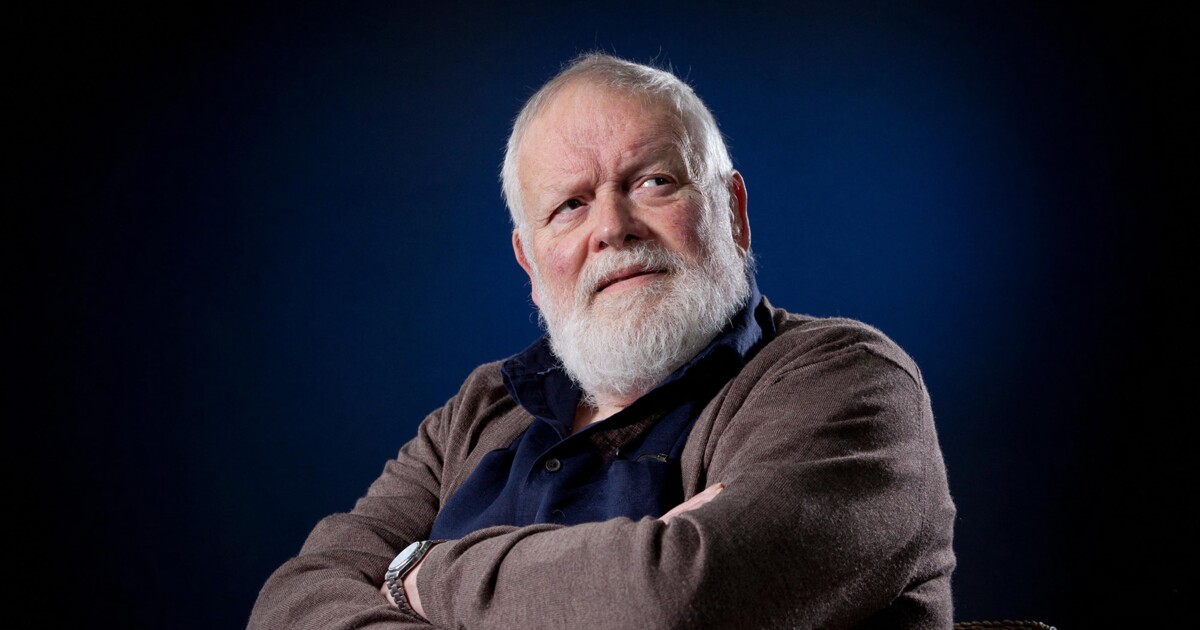
Michael Longley died a year and a half ago, at which point, as Auden put it in his elegy for Yeats, ‘he became his admirers.’ As happens with any great poet, what those admirers had long appreciated as a succession of fine individual poems and volumes unobtrusively reorganised itself into the completed order of a life’s work. Perhaps some foreshadowing of this process was already discernible when he was alive, but Longley was self-deprecating about such things: ‘I suppose that as you grow older some sense of an accumulating “oeuvre” is unavoidable,’ he told Peter McDonald in an interview, ‘but the very word sounds so pompous – you know, those people who talk about “my work”.’ Still, for all Longley’s likeable unpretentiousness, an oeuvre, with the sustained imaginative integrity that implies, is certainly what we have, and it is well sketched in the judicious self-selection, Ash Keys, which appeared a couple of months after his death.
Longley’s achievement was not the product of anything like self-assurance. ‘Almost every day, like needing Vitamin C,’ Edna Longley wrote of her late husband, ‘Michael would ask: “Am I a good poet?” And I would reassure him, perhaps adding: “and a great poet”.’ That Longley repeatedly sought confirmation suggests something fruitfully unassured in his conception of himself and of his art, as though a perpetual risk of failure were somehow an integral part of it. Several of his best readers have picked up on this quality of his imagination: McDonald has written (admiringly) of the ‘apparent fragility’ of the poems, and the critic John Lyon argued that ‘precariousness is a precondition of Longley’s art.’ Longley, who was all too familiar with protracted writer’s block, often spoke of precariousness in the sense that a poem might come but then again it might not. ‘I live from poem to poem, from hand to mouth,’ he said. But, he maintained, ‘surviving the silence – I should say the silences’ is what ‘separates the men from the boys’: properly understood, ‘silence is part of the impulse,’ and the failure of poetry is at once a peril and part of the vocation.
Longley was always drawn to the possibility of peril: he possessed what Eavan Boland called ‘a vision of risk’. The work she had in mind, his first major poem, ‘Epithalamion’, depicts newlyweds ensconced in the refuge of their dark bedroom but conscious that the morning is coming with all its inevitable dangers and losses: ‘The flowers everywhere/Are withering, the stars dissolved.’ Longley had the poem open his first major collection, No Continuing City (1969); it occupied the same slot in his Selected Poems (1998) and does so again in Ash Keys, so it feels like a poem intended to strike a keynote, rather as Seamus Heaney’s ‘Digging’ did as the opener to Death of a Naturalist (1966) and then to the several selected volumes that Heaney went on to publish. ‘Where else could it be placed?’ Heaney asked Dennis O’Driscoll, his Boswell. The contrast between the two signature poems is striking. Heaney finds in the spectacle of his father digging a model for his own poetic enterprise: he is obliged to use his pen where ‘the old man’ used a spade, but in some sense he is continuing in the same task, ‘going down and down’, opening ‘a door into the dark’, an instinct that would culminate in the powerful and disturbing excavatory bog poems of North (1975). We know that Edna Longley gave her husband a copy of P.V. Glob’s celebrated study of Iron Age burials, The Bog People (1965), ‘a gentle challenge’, as Longley recalled; but evidently the book didn’t spark anything: ‘Nothing happened inside my head. Heaney read the book as well and produced his remarkable sequence of bog poems. I didn’t mind.’
Longley’s keynote poem is engaged in quite different business: it is, for one thing, a love poem. He was always insistent that love poetry was at the centre of things: ‘It seems to me the hub of what I do and, if I may pursue the wheel image, out from the hub branch the spokes of other concerns, but they’re related to the love poetry.’ As it happens, he said almost exactly the same thing about Louis MacNeice, identifying one of his most important literary kinships: ‘The hub of his work is his love poetry, and from it branch out like spokes his poems on people, Ireland, friendship and childhood.’ MacNeice’s love poems, like Longley’s, are set in a particular key, once identified by Longley as ‘a typical contrast between the delights of a moment and the knowledge that they cannot last’ – exactly the moment of ‘Epithalamion’, a poem occupying a precious but fraught space between two contrary worlds of experience. ‘The smug philosophers lie who say the world is one,’ MacNeice protested. ‘World is other and other, world is here and there.’ Elsewhere he remarked that his poetry was founded on a ‘basic conception of life as dialectical’, and Longley was also keenly attuned to this.
The early poem ‘Persephone’, for instance, which Longley considered one of his best, has the goddess of Spring watching benignly over the hibernating life of nature at the winter equinox, but the poem’s final sighting is the crafty progress of weasels, stoats and foxes: ‘I can tell how softly their footsteps go –/Their footsteps borrow silence from the snow.’ A world full of the possibility of returning life is at one and the same time a world of wily predators. In a quite different idiom, his no less marvellous poem ‘Alibis’ does something similar, wittily imagining one mode of existence for the speaker as a keen botaniser and musician, settled in poetic seclusion in the country, only to be suddenly struck by the possibility of another life: ‘This idea of myself/Clambering aboard an express train full of/Honeymoon couples and football supporters.’ There is no question of making a choice between these alternatives: it is, rather, a matter of finding an ‘accommodation of different weathers’, which is to say ‘a simple question/Of being in two places at the one time’. There is a heavy irony in ‘simple’.
As with MacNeice, a sense of leading multiple lives is wrapped up with the whole business of Irishness. MacNeice’s parents were from Connemara, but he grew up in Carrickfergus on the north shore of Belfast Lough (where his father was a minister in the Church of Ireland) before he was sent away to schools in England and then to Oxford. MacNeice took a slightly mischievous pleasure in the complications that arose in his sense of national identity; he once began a review with the winning self-description: ‘Speaking as an Irishman of Southern blood and Northern upbringing, whose father was a Protestant Bishop and also a fervent Home Ruler …’ Longley was born and lived most of his life in Belfast, but his parents were from Clapham Common – ‘old-fashioned Tories’ who never lost their accents. He was, in that sense, a paradoxical creature. ‘Edna and I would have liked to have selected Irish names for the children,’ he reflected, ‘but they sounded so phony against my very Anglo-Saxon surname.’ As such a remark suggests, Longley did a good line in rueful self-commentary, and his humour extended to questions of tribal affiliation, as when he recalled his younger self contemplating his future: ‘I wondered if I might be the first Englishman to write Irish poetry.’
Longley once remarked that ‘the result of being brought up by English parents in Ireland is that I feel slightly ill at ease on both islands. I’m neither English nor Irish completely, and I like to think that is a healthy condition.’ But it was evidently sometimes a more difficult condition than ‘healthy’ makes it sound: ‘I was brought up in a house with English voices and I had to go out and find my way.’ ‘I would hate to be considered anything other than an Irish poet, but at the same time I remain true to my Britannic side,’ he said on another occasion, which might imply the more testing, perhaps lonely, predicament that finding your own way might prove. When Heaney edited Soundings ’72: An Annual Anthology of New Irish Poetry, he commented in his introduction on the difficulties of definition: an Irish poet might ‘root uneasily in his origins’, or – he continued with Longley in view – he might ‘crave the privilege of “Alibis”, trying to inhabit two places at one time’. The reference is ‘slightly barbed’, as the critic Michael Allen, a friend of both Longley and Heaney, tactfully put it. Still, as Allen goes on to say, Longley could hardly have been unaware that inhabiting two places at once is exactly what he did in the epistolary poem he addressed to Heaney, depicting both the reality of ‘the sick counties we call home’ and the alternative reality of ‘That small subconscious cottage where/The Irish poet slams his door’, and claiming a common cause that his friendly rival did not recognise: ‘Both would have it both ways.’ At other moments, his difference from Heaney felt more obvious: ‘Not everyone can boast an “invisible untoppled omphalos”,’ he said drily, quoting Heaney’s ‘The Toome Road’.
In his early work Longley’s sense of hyphenated identity sometimes expressed itself in a striking if obviously figurative clinical idiom. ‘I see that I have been schizophrenic on the levels of nationality, class and culture,’ he wrote in his contribution to a 1969 symposium on ‘Strife and the Ulster Poet’. This language of schizophrenia feels dubious now, but it was common currency in the era of R.D. Laing. (In The Divided Self from 1960, Laing mentions in passing the possibility that a writer might put ‘the initial schizoid organisation’ to good use in ‘authentic versions of freedom, power and creativity’.) If what Auden called ‘mad Ireland’ at once politicised and pathologised the condition, Longley was never in any doubt that the organisation of his mind was established long before what he called ‘the sticky intimate violence of our tawdry little civil war’. ‘From an early age, I think I was quite schizoid,’ he reflected in his memoir, Tuppenny Stung (1994). By the age of six or seven he had learned to lead ‘a double life’ and, like Hardy’s Tess, spoke ‘two languages’, one when out and about and another at home, anglicising the ‘rather severe’ Belfast accent he used in the streets when in his parents’ company. He seems to have planned a sequence of poems as ‘an attempt to define schizophrenia’ (of which ‘Persephone’ was a part) and published some fragments in a pamphlet called Secret Marriages (1968). ‘If all this seems very gloomy,’ he wrote in his preface, ‘there is, I hope, an accompanying very tentative reaching out towards the misbegotten and the dispossessed.’ He went on to write superbly about instances of minds undone in poems about John Clare and Ivor Gurney and in the wonderful ‘Mayo Monologues’ of The Echo Gate (1979), as well as the seriously creepy portrait of ‘The Adulterer’ (‘I have laid my adulteries/Beneath the floorboards, then resettled/The linoleum so that/The pattern aligns exactly’) and the no less unnerving monologue of the ‘Love Poet’ (‘I lock pubic hair from victims/In an airtight tin’).
Such acts of impersonation are Browningesque in their fascination with extreme states of mind, and they are entirely successful, but Longley doesn’t typically inhabit such territory: the schizoid energies are usually a much more inward and imaginative affair, a matter of what Longley identified as ‘a lively tension between the Irish and the English traditions’. When he appeared in The Field Day Anthology of Irish Writing in 1991, the headnote (by Declan Kiberd) ventured that ‘Longley may have more in common with the semi-detached suburban muse of Philip Larkin and postwar England than with Heaney or Montague.’ Longley was wounded by the comment. ‘It was very unfair,’ he told a journalist years later, who reported that ‘he still grimaces at the memory of it.’ The observation was not affable, but it pointed to something in Longley that he elsewhere acknowledged to be true. ‘Books of the undeniable stature of Larkin’s The Whitsun Weddings,’ he said, ‘encourage a fruitful schizophrenia in someone trying to write poetry in Ireland.’ He thought The Less Deceived ‘easily the best book of poems to come out of England since the war’, though its coming ‘out of England’ was slightly complicated by the fact that Larkin wrote several of the poems while living in Belfast. Longley continued to regard the book (alongside Ted Hughes’s Lupercal and Geoffrey Hill’s first collection, For the Unfallen) as a milestone, and he remembered his response: ‘A tradition that’s still throwing up poets like Larkin, Hill and Hughes must be doing all right.’
There are traces of Larkin all over the place in Longley. It is clearly a Larkinian persona that suggests itself as the alternative life choice in ‘Alibis’: ‘Clambering aboard an express train full of/Honeymoon couples and football supporters’ is straight out of The Whitsun Weddings. The early poem ‘Graffiti’ (‘these who decorate her lovely crotch/With pubic shrubbery’) is a homage to Larkin’s ‘Sunny Prestatyn’. The beautiful dedicatory poem to The Echo Gate imagines an island the sanctity of which is precariously sustained only because no one ever visits it: ‘Our perpetual absence/Is a way of leaving/All the eggs unbroken.’ Here Longley is attending to the cadence at the end of Larkin’s ‘The Explosion’, the last poem in High Windows, in which a company of miners killed in a pit return from the dead to visit their widows, one carrying the lark’s nest he found on his final journey to work: ‘walking/Somehow from the sun towards them,/ One showing the eggs unbroken’. As such lines make clear, the problem with Kiberd’s formulation is not that he sniffs out Larkin so much as his characterisation of the Larkin he sniffs. Larkin’s verse may begin in the humdrum precincts of the suburban and the semi-detached but it remains perpetually mindful of what one of his Irish poems calls ‘the importance of elsewhere’, another life which, as he puts it, ‘underwrites my existence’. Within Larkin’s idiosyncratic brand of late Romanticism, ‘elsewhere’ can be a place where girls on posters are left unbrutalised (‘She was too good for this life’) and fragile eggs escape damage, as though part of the serenely unravished world of Keats’s ‘Ode on a Grecian Urn’; but it can equally be an unlived parallel life, like that of Mr Bleaney, the previous occupant of the poet’s rented room, or the stricken geriatrics in ‘The Old Fools’ who are ‘trying to be there/Yet being here’. This spoke eloquently to a poet like Longley who instinctively occupied, as Allen wrote, a ‘binarily obsessional personal universe’.
Longley studied classics at Trinity College Dublin in the 1950s, and remembered the experience of walking in and out of the front gate as a movement between worlds: ‘No matter how Protestant, it just cannot avoid being part of Dublin,’ he later said, expressing a characteristic gratitude for the ‘certain sorts of useful kinds of schizophrenia’ with which he graduated. Dublin was a double place in another way too: by his own account, the undergraduate Longley became obsessed with Ulysses, wandering around the city to identify the settings of its various episodes. The organising idea of the novel is that experience is binary or replicative: the events of an ordinary Dublin day in June 1904 are found, on closer inspection, to replay the epic events of the Odyssey, but in a modern key – maintaining, as T.S. Eliot admiringly put it, ‘a continuous parallel between contemporaneity and antiquity’, and in the process inventing a new way of writing that Eliot christened ‘the mythical method’. It was, Eliot went on, ‘a method which others must pursue’.
Longley was among the most distinguished of modern poets to take up the prompt. Some of the poems in his first book, No Continuing City, were ‘filtered’, he said, ‘through the shabby Dublin fanlights’ of Joyce’s imagination. In ‘Odysseus’, his hero reflects on the many women who have punctuated his long journey home, including one ‘playing ball on the sand,/A suggestion of hair under your arms’. (That caught the ‘seedy’ side of Mr Bloom, Longley noted.) But the true fruition of his version of the mythical method came later, starting with the sequence of retold Homeric episodes in Gorse Fires (1991), a volume that marked a triumphant return to publication after several years of silence. Its crescendo, the final poem in the book, is the chilling ‘The Butchers’, a great sustained sentence of 28 lines, which describes the bloodbath that occurs when Odysseus finally makes it back home, and then ends with the ghosts of the murdered being ferried away to the afterlife by Hermes,
who led them
Along the clammy sheughs, then past the oceanic streams
And the white rock, the sun’s gatepost in that dreamy region,
Until they came to a bog-meadow full of bog-asphodels
Where the residents are ghosts or images of the dead.
You can see why Longley found himself shaking when he first read it to his wife. The terrible, archaic Homeric story is interwoven with contemporary Irish geography in which a ditch is called a ‘sheugh’ and instead of the asphodels of Greek mythology (it is almost too good to be true) the plants growing are homely bog asphodels (Narthecium ossifragum), Longley’s favourite flower. ‘I hibernicised it,’ he said.
The Hibernicisation is operating in a grimmer way too. Longley wrote the poem after reading a study about the Shankill Butchers, a vicious Loyalist gang, but you don’t need to know this to see that Homeric violence is being offered as a kind of twin to contemporary Ulster. Longley was acutely conscious of writing what he disparagingly called ‘Norn Ireland and the Troubles Trash’: ‘If one started to write poetry directly out of the situation as it was happening today, yesterday and tomorrow, one would really be just producing versified journalism.’ He did produce some beautiful elegies for the fallen, such as ‘The Civil Servant’ and ‘The Greengrocer’, but usually his verse proceeds by indirection, exemplifying what MacNeice once called ‘a kind of double-level writing, or, if you prefer, sleight of hand’. Perhaps his most remarked-on public poem, ‘Ceasefire’, published in the Irish Times shortly after the IRA declared a ceasefire in August 1994, retells an episode from the Iliad, leaving the contemporary reference almost wholly implicit: ‘I get down on my knees and do what must be done/And kiss Achilles’ hand, the killer of my son.’ It is a fine poem, as committed to the necessity of amnesty as it is honest about its awful price. But it also shows how subtle the effects of the parallel method can be: in the Iliad, Priam and Achilles do indeed make a truce, but it is only temporary; the war soon recommences and Achilles is killed. Longley rarely mentioned that detail when he read ‘Ceasefire’ in public (‘I suppose I was trying not to tempt fate,’ he said).
If the barbarism of the ancient world forms one shadow to ‘the sick counties we call home’, the First World War looms quite as large for Longley. His father had served alongside the Ulster Division at the Battle of the Somme, and Longley often wrote about it in poems which he described as ‘oblique comments on the Troubles’. The connection is more than a biographical contingency: ‘The tragedy of the Somme affects all of Ulster,’ Longley told an interviewer, and his father became somehow exemplary of historical experience: ‘There is plenty of room in Irish poetry for my English father.’
Longley first recognised the parallel in ‘Wounds’, in which his father’s experience of trench warfare is set alongside that of the wife of a murdered bus conductor,
shot through the head
By a shivering boy who wandered in
Before they could turn the television down
Or tidy away the supper dishes.
Captain Longley’s ‘bewilderment’ at the behaviour of the Ulster soldiers at the Somme is mirrored by the bus conductor’s widow’s and also, in a startling act of empathy, by the assassin’s: ‘To the children, to a bewildered wife,/I think “Sorry Missus” was what he said.’ In a way, all violence becomes one violence: it is an expression of what Longley once called ‘the fundamental interconnectedness of all things’.
The maxim, which may appear to have a metaphysical solemnity to it, looks like a quotation, which it is; but it is highly characteristic that it should come from Douglas Adams’s comic novel Dirk Gently’s Holistic Detective Agency (1987). The phrase was brought to Longley’s attention by his wife, and then ‘for reasons numerical and poetical I appropriated it.’ ‘When I read it, people sit and look serious,’ he told an interviewer. ‘And the joke is, it’s terribly funny, it’s meant to be very funny.’ It appears in a poem called ‘According to Pythagoras’, which is indeed a comic poem about claiming authoritative knowledge and the mangled beliefs that the ancients entertained about the animal kingdom (‘did you know that/Hyenas change sex?’). But it is a joke about something that came to matter more and more to Longley. ‘Interconnectedness’ has an ecological ring to it; in the great second phase of his career, this became his defining theme. ‘I hate the term but I suppose in some ways I’m a “nature poet”,’ he told Clive Wilmer.
It is an identification triumphantly confirmed in Gorse Fires, but there are nature poems from the start, and one landscape in particular. ‘Leaving Inishmore’ in No Continuing City, which remembers the end of a holiday on the Aran Islands, is (as Fran Brearton observes) where he first announces his preoccupation with the West of Ireland: ‘Rain and sunlight and the boat between them/Shifted whole hillsides through the afternoon.’ The preoccupation predated that holiday: ‘My English parents introduced me to the western seaboard of Ireland when I was twelve,’ Longley recalled. ‘That changed my life.’ He called it his ‘soul-landscape’. But the real epoch was his discovery in 1970 of the remote townland of Carrigskeewaun in County Mayo: ‘O my County Mayo home-from-home-land.’ He would return there often, always borrowing a cottage from David Cabot, a celebrated ornithologist. His poetry returned there repeatedly too: he calculated that about a third of his poems were set in Carrigskeewaun. ‘I wonder what would have happened to me,’ he once said, ‘if I hadn’t had the chance to go to that remote cottage 25 years ago.’
Auden proposed that a good question to ask of any poet was: ‘What is his notion of the good life or the good place?’ – what he sometimes called (borrowing from Henry James) ‘the Great Good Place’. There is no doubt about the answer when it comes to Longley:
With my first step I dislodge the mallards
Whose necks strain over the bog to where
Kittiwakes scrape the waves: then, the circle
Widening, lapwings, curlews, snipe until
I am left with only one swan to nudge
To the far side of its gradual disdain.
Once more he resembles MacNeice, who reported in a memoir of his childhood that the phrase ‘the West of Ireland … still stirs me, if not like a trumpet, like a fiddle half heard through a cattle fair.’ Longley found himself similarly drawn to the region: ‘finding my way for ever along/The path to this cottage, its windows,/Walls, sun and moon dials, home from home’. It isn’t difficult to see how Mayo and Belfast might have organised themselves into a simple opposition, the ‘West’ and the ‘North’, the one an escape from the other. In The Field Day Anthology, Kiberd remarked on the number of modern Irish poems ‘set on the Aran Islands, or in west Kerry or on the coast of Donegal – all written by artists who act like self-conscious tourists in their own country’. ‘This kind of thinking makes me feel excluded,’ Longley complained. But then people sometimes referred to MacNeice as though he was a tourist in his own country, or insufficiently Irish to be properly at home. Longley took some reassurance from Derek Mahon’s response to that charge: ‘But of what sensitive person is the same not true?’
When MacNeice speaks liltingly of the half-sound of a fiddle caught through the lowing of beasts, he is, at least in part, sending himself up and recognising his version of the West as a well-trodden Arcadia – an aspect of what Patrick Kavanagh mordantly referred to as ‘the Irish thing’. Being a ‘nature poet’ in such a locality is indeed, as Kiberd says, a highly self-conscious affair: the whole point is that you’re not one of the locals, just as Wordsworth was an offcomer in Grasmere. ‘There is a quirky, beautiful pastoral regionalism in Michael Longley’s work that I don’t see anyone else undertaking today,’ Boland said in a review of his first Selected Poems, but ‘quirky’ undersells the achievement of Longley’s pastoral. Like MacNeice, he was fully conscious of the emotional complication that good pastoral writing can accommodate. He was certainly insistent that it wasn’t a question of hiding or seeking not to be disturbed. ‘I am not writing about a cosy community,’ he said from the podium as the Ireland Chair of Poetry in 2010. ‘Nor do I dwell among the calls of waterbirds and the psychedelic blaze of summer flowers to escape from Ulster’s political violence. I want light from Carrigskeewaun to irradiate the northern confusion.’
Pastoral poetry was made for Longley. In its fullest and most developed form, pastoral inhabits two places at once, the beautiful space before you and the world of danger from which you came and which you can never put out of mind. One of Longley’s masterpieces, ‘The Ice-Cream Man’, shows his adaptation of the pastoral method at its most effective. The list of flavours (‘Rum and raisin, vanilla, butterscotch, walnut, peach’) sold by the ice-cream man, murdered by terrorists, is juxtaposed with another list, with which the poem comes to a close:
I named for you all the wild flowers of the Burren
I had seen in one day: thyme, valerian, loosestrife,
Meadowsweet, tway blade, crowfoot, ling, angelica,
Herb robert, marjoram, cow parsley, sundew, vetch,
Mountain avens, wood sage, ragged robin, stitchwort,
Yarrow, lady’s bedstraw, bindweed, bog pimpernel.
‘The murder of the ice-cream man violates all nature,’ Longley said in an interview, and his poem is wonderfully mindful of the traditions of pastoral elegy in which nature would care: ‘Bid amaranthus all his beauty shed,/And daffadillies fill their cups with tears.’ But the poem’s mood is quite free of illusion: the plants of the Burren certainly offer consolation of a kind, though they are heedless of the violence being done elsewhere. Longley could reflect on this powerful sense of mutually implicating but uncomprehending co-existence with complete self-acquaintance: ‘My home from home is in Mayo. But Belfast is home.’ ‘It is important for me to see beautiful Carrigskeewaun as part of the same island as Belfast,’ he said elsewhere. ‘I might be most a Belfast man when I am in Carrigskeewaun.’
‘The recurring Irish landscapes are not simply idyllic retreats from “the nightmare ground”,’ McDonald has written, ‘but oblique ways of understanding it … It is Troubles poetry, in its own way.’ He has in mind lines like these, the absorbed botanical exactitude of which does not preclude an awareness that getting stung is always on the cards:
Its green flowers attract only the wind
But a red vein may irrigate the leaf
And blossom into blush or birthmark
Or a remedy for the nettle’s sting.
Even after the Troubles, a pervasive sense of peril ran through Longley’s poems. There is always the sense, as he put it in ‘Altarpiece’, that ‘We shall all get hurt.’ The natural encounters he evokes are characterised by a loveliness and delicacy that has the same sense of fragility that informs his love poems. (As he says of the ghost orchid, ‘Just touching the petals bruises them into darkness.’)
In time, this sense of danger gathered itself into a new conception, a background sense of environmental crisis. Speaking of the last lines of ‘The Ice-Cream Man’, Longley said: ‘The poem is also, partly, an elegy for the flowers themselves.’ The imaginative attention to natural objects becomes something like the expression of a duty of care: ‘The leveret breakfasts under the fuchsia/Every morning, and we shall be watching.’ The poetry becomes repetitive – there are numerous references to the burial mound in the bay and the ‘obstreperous galvanised gate’, for instance – but this is all quite knowing. The townland becomes established through recurrence in the reader’s mind as something like a habitat, as one might become familiar with a real place. ‘I am writing too much about Carrigskeewaun,’ he begins one poem which goes on to be about the very same place again.
As he grew older, Longley’s poems became shorter and shorter, sometimes reduced to couplets floating in white space on the page. ‘The brevity is a kind of tact,’ he said in self-defence, as though working to find more to say would be to distract from the significance of the subject in hand. Some of his late verse seems barely to make it on to the page at all, as though escaping an encompassing silence by the skin of its teeth:
old age
of the wind
landscape
growing old
The loveliness of such things is a part of their precariousness, what Longley disarmingly called ‘the slightly Japanese, Chinese, feathery, leafy, butterfly-wingy side of my imagination’. Encounters with nature are evoked with breathless absorption:
The one cuckoo at Carrigskeewaun
Calling from alders across the lake
Leaves behind, after a single day,
Solitariness, silence, mute swans.
Longley recognised that one peril of such writing is that it might become merely exquisite. In a handsome poem addressed to Allen he thanked his friend for a critical vigilance that ‘scanned for life-threatening affectation/My latest “wee poem”’. It would be surprising had he avoided such pitfalls all the time, and I’m not sure he did: ‘the sea asters/Purple golden-hearted/Scruffy loveliness’ might almost be Walter de la Mare. But more typically there is a sense of being grounded, quotidian and prosaic (‘I’m thinking of the huge beech tree in our garden’), which mitigates against such a danger. He remained Larkinian enough to be able to begin one poem ‘I open a can of peas,’ and self-ironising enough to write another which duly lamented the arrival of electricity at Carrigskeewaun, while celebrating the domestic virtues it made possible: ‘I mourned the death of gaslight,/But oh, how the electric blanket warmed my soul!’ Often he plays with you, and when you think he has lapsed into unreflective rapture about the West of Ireland, he will pull things back into another register, creating a poem that is, idiomatically speaking, in two places at once:
Oh,
The infinite gradations of sunset here.
Thank you for visiting Carrigskeewaun.
Don’t twist your ankle in a rabbit hole.
I’ll carry the torch across the duach.