‘You made a serious mistake by leaving Gaza,’ my friend Ibrahim used to say. ‘Come back!’ Ibrahim was one of the lucky few. Despite Israel’s blockade – which created the ‘worst economic depression in modern history’, as a World Bank report put it – Ibrahim had found a way to earn a decent living. We studied computer engineering together at Gaza’s Islamic University, and afterwards Ibrahim and a few other friends set up a programming team, with customers in the Gulf, Europe and the US.
Ibrahim got a small apartment in Jabalia, bought an old car, married and had a child. His daily routine was simple: work, the mosque, seeing friends in a café. There wasn’t much to do in tiny, overcrowded Gaza City even if you had money, but he was always upbeat. His main concern was his son, Mohammed, who was showing signs of PTSD. Mohammed didn’t talk until he was three; he had nightmares, wet the bed and had tantrums. By the age of four he had lived through a war, in 2021, and two Israeli assaults – Operation Breaking Dawn in 2022 and Operation Shield and Arrow in 2023. In between bombing campaigns, Israeli drones were always buzzing overhead.
On the morning of 7 October 2023 I tried to call Ibrahim, but the electricity was down. I got hold of him a few days later. ‘I’m sorry I told you to come back,’ he said. ‘You were right not to listen. Please remember us.’ He had to hang up: he and his family were gathering their things because Israel had ordered 1.1 million people to move to the south of Gaza. That’s when Ibrahim realised he had been living precariously all along. In the months that followed, the family were forcibly displaced more than ten times. Each time they followed Israel’s ‘evacuation orders’ and walked under fire to a designated ‘safe area’, before that too was bombed or overrun with soldiers.
The first programmer I know who was murdered in a targeted strike was Haitham. His two children had already been killed by a bomb in Rafah. He and his wife, who had been injured in that attack, fled to the Bureij refugee camp, only to be killed in a direct strike there. Abdul Rahman, the top student in our class, was next. He was killed as he walked into his apartment with his father to collect food; his family were sheltering nearby. Musab, another member of the programming team, was killed soon after in a strike on a UN school.
After Ibrahim and his family left Jabalia, the Israeli army burned his apartment to the ground and bombed his parents’ home; a few months later they flattened the entire city. His life savings evaporated within months as some prices increased more than 6000 per cent. He’s been unable to work because there has been no electricity in Gaza, except for emergency generators, since October 2023 and Israel doesn’t allow computers to be brought into the Strip. Living in a heavily damaged apartment in a bombed-out building is now a luxury. Ibrahim sleeps in an old tent, waking in the night to protect his son from rats and snakes, whose numbers have grown hugely in the rubble and waste. Israel doesn’t allow in the equipment needed to clear and repair the damage, which is not only to buildings and roads but to pipes and sewage systems. These have become breeding grounds for rodents and insects. Around a thousand Gazans have been killed since Trump’s ‘ceasefire’ came into force last autumn. For Ibrahim, it feels as though the world has fallen silent since then.
Ibrahim describes the Hamas-led operation of 7 October as a ‘disaster’, even though he supports the right to armed resistance. Arab mediators have told me that Hamas’s leader in exile, Khaled Meshal, has been using the same word in private. Ahmed Yousef – a former adviser to Ismail Haniyeh, the chair of Hamas’s political bureau until his assassination in 2024 – has been using the word in public. He has also said that Hamas ‘didn’t factor in the consequences’ of the operation. Yahya Sinwar, Hamas’s leader in Gaza, kept the plan secret from the leadership abroad and made the decision with a small number of militant leaders ‘who lack sufficient political maturity’. I have been told that Meshal, too, describes the architects of 7 October as ‘politically inexperienced’. Sinwar, for his part, accused Meshal of running Hamas like an NGO, and refusing to take risks. But even he reportedly admitted, before his assassination in 2024, that ‘things went out of control’ on that day.
Resentment of Hamas among ordinary Gazans is widespread, even if the rage against Israel is much greater. Many people have lost everything since 7 October. Tens of thousands have died. At the same time, many would also say that the situation on 6 October wasn’t much better. The operations Israel liked to call ‘mowing the lawn’ meant that Palestinians were steadily being killed. Two weeks before 7 October, Israeli airstrikes hit Gaza for three days in a row. On 4 October, it was reported that Gazan protesters near the separation fence had come under fire from Israeli snipers. Reflecting on 7 October, some Palestinians in Gaza say: ‘Well, we tried everything else and it didn’t work.’ Non-violence was pursued as a strategy for decades, most prominently during the Great March of Return in 2018-19, when tens of thousands of people, most of them young, would assemble every Friday near the separation fence, making speeches and waving Palestinian flags. Over eighteen months of demonstrations, Israel killed more than two hundred protesters, as well as paramedics, journalists and children, and injured at least 34,000 people. Israeli snipers boasted about how many people they could kneecap in one day – the record was 42. ‘Palestinian non-violence relies on global non-silence,’ as the Palestinian American political analyst Yousef Munayyar put it. But stories in the international press didn’t persuade Israel to change course.
Hamas also tried diplomacy, albeit cautiously. In 1997, Meshal offered Israel a thirty-year truce on the condition that it withdrew from Gaza, the West Bank and East Jerusalem. Israel responded by attempting to assassinate him in Jordan. Ahmed Yassin, Hamas’s founder, offered a ten-year truce in 2003 and was assassinated four months later. Zvi Sela, a senior official in the Israeli prison service who interviewed Yassin on multiple occasions, said in 2009 that ‘if we had tried for an agreement with him, we would have succeeded.’ In 2006, after Hamas won the Palestinian legislative elections and formed a government, Haniyeh, then prime minister, sent a letter to the Bush administration offering peaceful co-existence with Israel based on the two-state solution. In the same year, Yousef put forward a peace proposal premised on establishing a Palestinian state with temporary borders over a third of the West Bank and the Gaza Strip, with the intention that the boundaries of the state would slowly expand through trust-building, negotiation and diplomacy.
From 2008 onwards, Hamas tried to make progress by acting as Israel’s security ‘subcontractor’ in Gaza, as the editor of Haaretz, Aluf Benn, put it. Hamas fighters policed other armed factions and took action against anyone who tried to attack Israel while a ceasefire held. Israel responded by assassinating Hamas’s military second-in-command, Ahmad al-Jabari, in 2012. According to the Israeli peace activist Gershon Baskin, al-Jabari was looking over a draft proposal for a permanent ceasefire on the morning he was killed. Despite this, Hamas continued in its subcontractor role and stood by as Israel conducted airstrikes against Palestinian Islamic Jihad in 2019, 2022 and early 2023. In 2021, there was a surreal event in northern Gaza. Israeli tanks and bulldozers destroyed a strawberry farm a few hundred metres from the separation fence, while armed Hamas militants prevented people from coming near.
Diplomacy, ceasefires, security assistance and non-violent protests achieved little for Gaza. In 2019 Israel temporarily expanded the zone in which Gaza’s fishing boats were allowed (usually three miles from shore, briefly five), permitted a few thousand labourers to work in the West Bank and Israel, eased restrictions on food imports and allowed Qatar to pay the salaries of Hamas civil servants and to give monthly handouts of $100 to 100,000 poor families. These measures would be revoked, it stipulated, if a single rocket was fired from Gaza or protesters approached the fence.
Whenever Gaza went quiet, it disappeared from international news bulletins and Israel escalated its violence in the West Bank and East Jerusalem. ‘They’re right,’ the veteran Israeli columnist Gideon Levy wrote. ‘If Palestinians in Gaza don’t shoot, no one listens.’ Some Palestinians argue that 7 October – and the genocide – put Gaza back on the map and reminded the world of its cause. I’ve heard this sentiment from people within and outside Gaza. One of them was Abu Suhaib, a senior Hamas member I interviewed in Doha in August 2024. ‘We tried everything else,’ he said. But then: ‘If I could go back in time and prevent 7 October from happening, I would.’ Mousa Abu Marzouk, another senior figure in Hamas, was quoted saying much the same in the Washington Post.
Putting the cause back on the map is not on its own a goal or strategy. Gaza becomes temporarily more prominent with each Israeli onslaught. Israel has suffered reputational damage on multiple occasions, most notably during the 1982 invasion of Lebanon. But its image improves each time a ceasefire is signed. We are seeing this now. Despite the continued bombardment and the blocking of any attempt at rebuilding or recovery, Gaza has disappeared from the headlines. Every Western diplomat I’ve spoken to this year has told me that Gaza is a subject no one wants to discuss.
What was Sinwar trying to achieve with Operation al-Aqsa Flood? To break the siege on Gaza? To deter Israel’s pogroms and rampages in the West Bank? To free Palestinian prisoners? To block Israeli-Saudi normalisation? Or to ignite a multi-front war on Israel? Yezid Sayigh at the Carnegie Endowment for International Peace notes that in the documents Hamas issued after 7 October outlining its ‘motivations and contexts’, the authors struggled to articulate what they were seeking ‘in terms of tangible gains – both material and political’. But it is possible to imagine what motivated or triggered the plan. Sinwar warned in 2021 of an all-out regional war unless the humanitarian situation in Gaza improved substantially. His son’s first words, he said, were ‘father’, ‘mother’ and ‘drone’. In 2022, he said that there would be a major war that would change the face of the Middle East if Israel continued its colonisation of East Jerusalem and restrictions on the use of the al-Aqsa mosque, Palestine’s holiest shrine.
Prisoners were one of the most important issues for Sinwar. He campaigned on this in Hamas’s 2021 internal elections, which he won in the fourth round. Sinwar himself had spent 22 years in Israeli prisons. Palestinians like him, who have been released in prisoner swaps, often feel survivor’s guilt. The issue became more urgent for Sinwar after the far-right politician Itamar Ben-Gvir was appointed Israel’s security minister in November 2022. His first act was to pack Palestinian prisoners into tiny cells and enforce starvation measures. In February 2023, he posted a video of himself eating pita bread while bragging that Palestinian prisoners weren’t getting any. In March, Israel’s former defence minister Moshe Ya’alon warned that Ben-Gvir was among those trying to provoke Palestinians into a ‘final war’. Two months later, a Palestinian hunger striker, Khadir Adnan, who was being held without charge, died in his cell after the prison service refused him medical treatment. With Israel’s violence in the West Bank, Jerusalem and in prisons at unprecedented levels, people in Gaza began to complain that Hamas had sold out by seeking to appease Israel in order to keep the Qatari aid flowing. Then, in August, Netanyahu and his cabinet began openly discussing plans for an assassination campaign against Hamas leaders. This is the context in which Sinwar approved the attack.
Hamas hit a harsh reality after 7 October. Iran and Hizbullah were angry that Hamas hadn’t told them its plans. Israel launched a brutal crackdown, kidnapping thousands of Palestinians and arming hundreds of thousands of Israelis and settlers. Despite Sinwar’s hopes of regional support, Arab regimes didn’t suspend normalisation agreements with Israel. Some of them criminalised public displays of solidarity with Palestinians. Others saw 7 October and its aftermath as an opportunity: a cautionary tale to keep their own populations quiet.
The political argument for armed resistance against Israel from within Gaza has diminished among the caged and exhausted population. Many Gazans believe Gaza has done its part and it’s time for Palestinians elsewhere to take up the mantle. The main thing keeping the idea alive is the presence of the IDF and the fear that Israel might resume full-scale military operations. But Gazans also feel abandoned by Palestinian politicians outside the territory, who have done next to nothing to support their cause. If you mention the Palestinian Authority or the PLO to a foreign diplomat or journalist, their only response will be laughter. PA officials, fearful that Israel will take measures against them or unleash a violent campaign in the West Bank, have largely kept quiet. As a friend once said to me, ‘the leadership of your liberation movement is also the leadership of your bantustans.’
In May, Fatah held its Eighth General Congress in Ramallah, a decade after the last such gathering. The conference was supposed to inject new blood into the party, which controls both the PA and the PLO. But attendees were handpicked by the Fatah leadership, and in the elections for Fatah’s Central Committee and Revolutionary Council, Ramallah was allotted 1734 votes (out of a total of 2649), Gaza 386, Lebanon 164 and the entire Palestinian diaspora only 365 votes. Many participants were not Fatah members, but members of the security agencies or salaried employees of the PA. There was further manipulation. Any candidate deemed a risk to the senior leadership was prevented from progressing to the next round, no matter how many votes they received. The new Fatah leadership includes the ninety-year-old Palestinian president, Mahmoud Abbas; his unqualified son Yasser; the single most unpopular Palestinian politician, Hussain al-Sheikh; the chief of the intelligence service, Majed Faraj; and several yes-men or cronies of Abbas and al-Sheikh.
There are ways out of this swamp. One would be Palestinian reconciliation and national unity. Since 2007, Hamas and Fatah have held countless rounds of reconciliation talks – in Egypt, Saudi Arabia, Qatar, Syria, Lebanon, South Africa, Russia, China, Turkey and Yemen. All of them ended in failure. This is unsurprising, not least because the US has always tried to block a rapprochement. A senior PA leader told me last December that if Abbas allowed a single Hamas leader into the PLO, the US would impose sanctions on both the PA and the PLO. In 2020, I met a former senior staffer at the US consulate in East Jerusalem who told me that whenever Fatah and Hamas held talks he would get a call from Washington instructing him to sabotage them. Israel has also tried to thwart Palestinian unity. When the PA signed a reconciliation agreement with Hamas in 2014, Israeli negotiators immediately withdrew from the talks. ‘Prime Minister Netanyahu and his government were using Palestinian division as an excuse not to make peace,’ the PLO’s chief negotiator, Saeb Erekat, said at the time. ‘Now they want to use Palestinian reconciliation as an excuse for the same purpose. This is utterly absurd.’
Things could change if Palestinian elections were held: they would function as a referendum on Hamas and Fatah strategy and might provide a way to produce a legitimate unified leadership. Electoral accountability would also help to mitigate corruption and autocracy. Proportional representation was introduced into the Palestinian electoral system in 2020: if elections were allowed to take place, it’s unlikely either Hamas or Fatah would win a majority, and a coalition would result. Israel will do everything it can to block this. In the run-up to the parliamentary elections due to be held in May 2021, it detained some of the candidates. The head of Shin Bet, Israel’s internal security agency, visited Abbas to demand he cancel the elections. Israel also banned electoral activities in East Jerusalem, where more than 300,000 Palestinians live. Abbas duly postponed the elections indefinitely. The EU has repeatedly emphasised the need for ‘Palestinian democratic renewal’, but this is merely rhetoric. In 2021, diplomats in Brussels told me that the EU was worried that Hamas might win and therefore wouldn’t genuinely push for elections. The US openly opposes Palestinian elections.
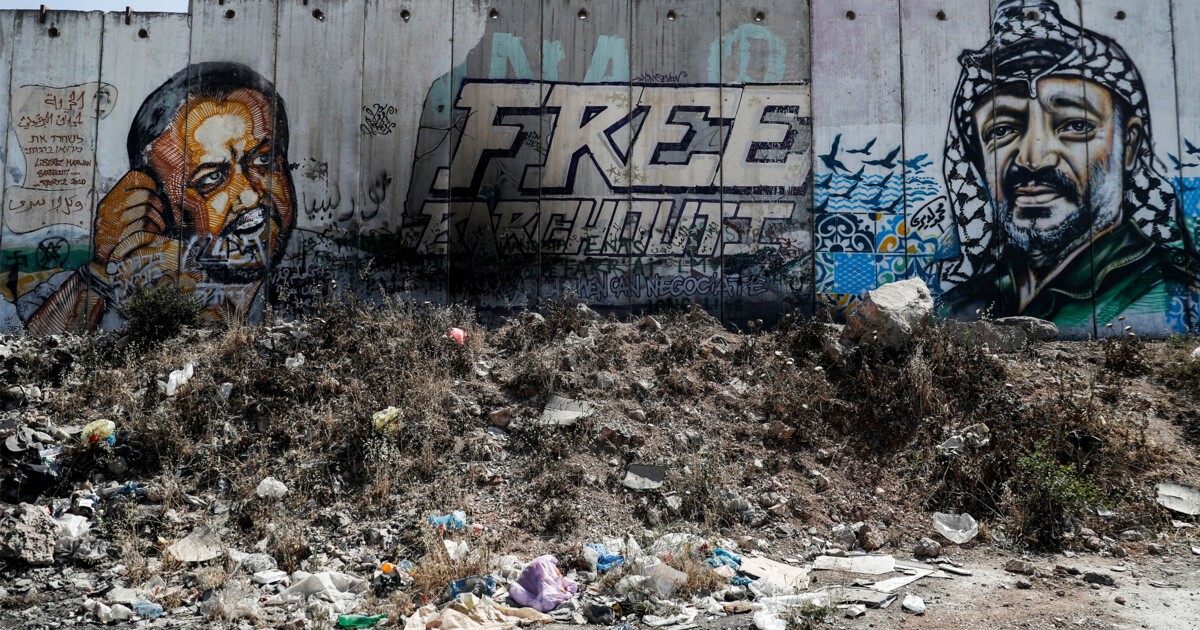
The situation would change, too, if Marwan Barghouti were released. Barghouti enjoys unparallelled popularity and is often described as Palestine’s Nelson Mandela. Like Mandela, he’s far from perfect, but his activism, his writings and his long imprisonment have made him a legend. His power and influence are unique. If I say to fellow Palestinians that killing Israeli civilians is wrong, some would reply that ‘Israel has killed thousands more of our civilians’ or ‘every Israeli is part of the army.’ But when I show them a video of Barghouti condemning the killing of civilians, they will agree with me. Releasing Barghouti would be a step towards unifying the Palestinian leadership and energising the masses. Even Ron Lauder, president of the World Jewish Congress, has recently lobbied for his release, recognising Barghouti as a figure who could stabilise the occupied territories. But that is precisely why Israel will not release him. A source close to the discussions told me that when the then US secretary of state John Kerry asked Netanyahu to release Barghouti in 2014, Netanyahu replied: ‘Barghouti would unify the Palestinians. I would never release him.’
If elections were held, Barghouti could be elected president even if he was still in prison. He is now 67, and has been repeatedly assaulted in recent months by his Israeli jailers, leading to serious concerns over his safety. If he dies in prison, or if Abbas dies in office, it could trigger an uprising across the occupied territories. Israel has a plan in place in the event of Abbas’s death, Operation Sunset, in which the army will be deployed to Palestinian cities and along main roads to paralyse any potential rebellion.
There is another possibility. Palestinians could anoint Barghouti 2.0, a deputy who could represent him, as Desmond Tutu did Mandela. If Barghouti wins the presidency from prison, his deputy could lead the national movement. And the movement would have a figurehead in the event of Barghouti’s death. Or there’s a further option: Palestinians could draft a Freedom Charter like that of South Africa, in order to have a strategy shaped by the public. The Freedom Charter didn’t just articulate Black South Africans’ vision for their future but sent a clear message to their oppressors about what society would look like after the collapse of the apartheid regime. This is a crucial means of creating allies on the other side and makes it more difficult for your rivals to delegitimise your struggle. As Sun Tzu wrote, ‘strategy without tactics is the slowest route to victory. Tactics without strategy is the noise before defeat.’ A successful strategy should be designed to unite the many against the few.