
Here is an antidote to current traps and poisons. People who rescue rather than attack, who move in a physical, not a virtual, world, who don’t morally triage others. Who put themselves in danger without aiming to get famous or on television. Who risk their lives without being paid.
Dominic Gregory has worked as an adviser to literary estates, including Roald Dahl’s, and run a literary festival. His impressive first book, Lifeboat at the End of the World (HarperCollins, £18.99), is an account of volunteering on the Dungeness lifeboat. It’s freighted with quotations from Ford Madox Ford, who thought Dungeness was the end of the world, and Joseph Conrad, for whom it was the first sight of England. Still, Gregory is not floating a cultural boat: his is a record of commitment, physical activity and admiration for colleagues. Lifeboats and their crews get less publicity than astronauts. Gregory explains their arrangements.
Volunteers, once alerted by rocket flares, are now summoned by scuffed and cracked pagers. New recruits are supplied with rope to do knots homework, and practise rescues with dummy bodies made of sacking; they undertake sense-dismantling exercises in blind navigation with tarpaulin-covered windows. Everyone pretends not to feel seasick; peeing is hazardous. Boats carry a French phrasebook, oxygen bottles with masks small enough to fit a baby’s face, body bags. There is emergency chocolate. To sharpen optical focus the wheelhouse is painted black, ‘like the interior of an eyeball’.
About most of the rescues Gregory is brisk but particular. An elderly couple in a broken-down yacht press biscuits on the crew; a woman makes eyes at the coxswain (‘the problem was an open seacock, swamping their bilge’); in failing light a small boy – ‘my mum said I should stay with the boat’ – is scooped from a flimsy inflatable dinghy just in time.
The appeals from crammed small boats crossing the Channel burst in with terrible force. Habitual horrors are plainly stated: women and children, placed in the centre for protection, sit in a gutter of vomit. There are indelible moments: a bundle of rags turns out to be a baby; a teenage boy is heaved aboard by the stumps of his arms. Then there is ‘the one’: a catastrophe. The lifeboat arrives in the night at a place strewn with backpacks and shoes. ‘Between the rubbish we see human bodies with faces down.’ There is screaming. A man clings onto what appears to be a bag but is in fact a corpse. The dinghy folds in two ‘like a mouth closing’. Eleven people die. On shore the crew are heckled as ‘traitors’ and advised not to go outside wearing RNLI clothing.
Dungeness lends itself to metaphor. Its gardens are unfenced so the land seems as borderless as the sea. Laurel and Hardy opened the extension to the steam railway in 1947; the woman who now runs the station shop was once a psychiatric nurse at Belmarsh. Gregory’s book is flavoured by the desert landscape – the pale loom of the power station, the hag stones among the shingle – and by Derek Jarman, whose Prospect Cottage is a pebble’s throw from the lifeboat station. Jarman comes in for some bemused shrugs. One neighbour says he was ‘all right’ but ‘a bit of a nuisance’: he had to ask him to return his anchor. Another thinks the garden – in which Jarman aimed at both English gnomescape and Japanese serenity – is not ‘all it is cracked up to be’. Today, while the back is ragged and unbridled, the trim front space, winding its way through dinky dolmens, looks a bit Lord of the Rings.
More striking, more sea-drenched, is the neighbouring tumble of washed-up pink Crocs, wellingtons and grey flip-flops installed by a litter picker in front of his home, which is made up of two third-class railway carriages and a horse box. The mound is as vivid a response to the ocean as the six-foot bronze statue recently erected on the front at nearby Deal. Modelled on the mid-20th-century pre-radar structures intended to serve as early-warning systems, Michael Bennett’s Sound Mirror sullenly refuses to amplify noise: I’ve kicked and yelled at it. But it holds on its back a transfixing map of wrecks, as densely packed as a map of restaurants in the West End. Here are the names of seven hundred of the two thousand vessels that have foundered on Goodwin Sands – Moon (1625), Susannah Carmichael (1770), Der Wanderer (1867). The ‘ship swallower’, which changes shape like a fairy-tale villain, sets in motion the plot of the Merchant of Venice by grounding Antonio’s ship. In the 1890s it was the subject of reports from the Rev. Thomas Stanley Treanor, a chaplain who went aboard lightships, ‘shaking my dripping sou’wester’, harmonium in hand, making sure that sailors were equipped with a Bible but no ‘mere works of fiction’.
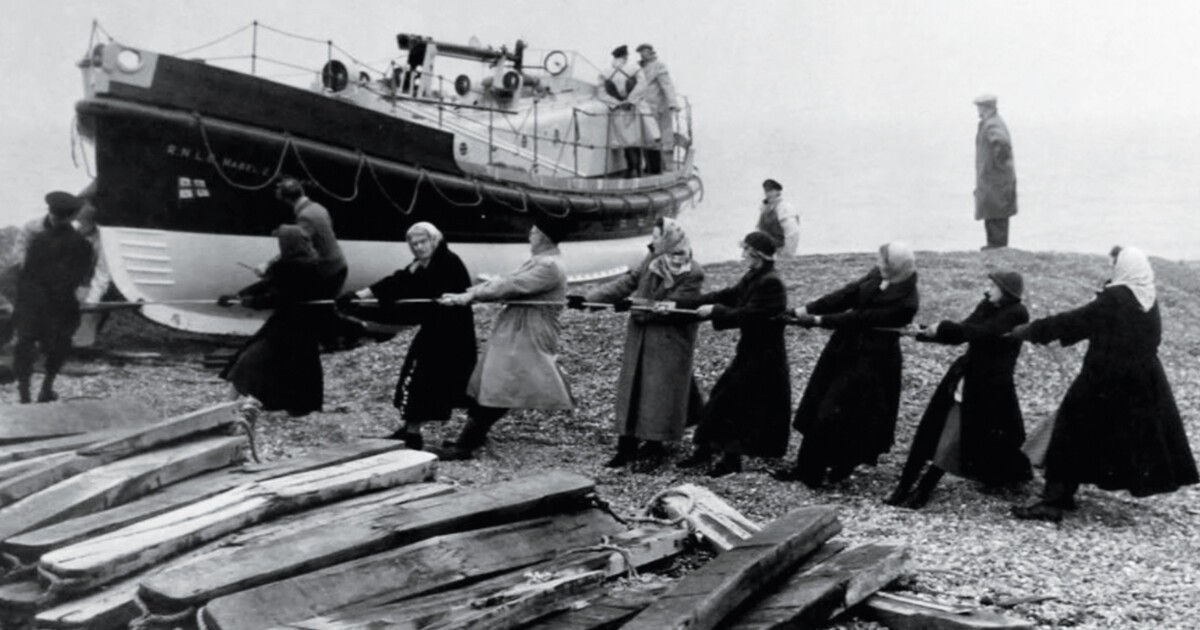
I hope he played ‘Eternal Father Strong to Save’, echoing the swell of the sea, catching at secular as well as holy hearts. Current volunteers deserve this best of hymns, though they don’t need it to give them a sense of purpose. ‘There’s no better feeling than thirty knots with blue lights on,’ says one of the volunteers at Walmer, up the coast from Deal. He wants, paradoxically, to be a fireman, but will always go out on the boats. The crew has included a woman who works in digital marketing, a man who has worked on cruise ships, a television presenter – and someone who was rescued from the sea at the age of four. The country’s last women lifeboat launchers were at Dungeness, where, until the 1970s, they dragged timbers of up to 200 lbs across the shingle to enable the boat to take to the waves.
The day I was hovering by the Walmer lifeboat station there was a ‘shout’. A cluster of cars suddenly arrived. A small boat was slid down the shingle into the sea. Shortly afterwards a larger vessel streamed off towards the pier: someone was missing on the beach; there was a report of a person far out at sea. After half an hour or so everyone came back, relaxed, smiling. What about the person bobbing in the waves? It was a seal. Does that often happen? Yes, it’s the one that goes past most days. The locals call him Neil. Or Neal.