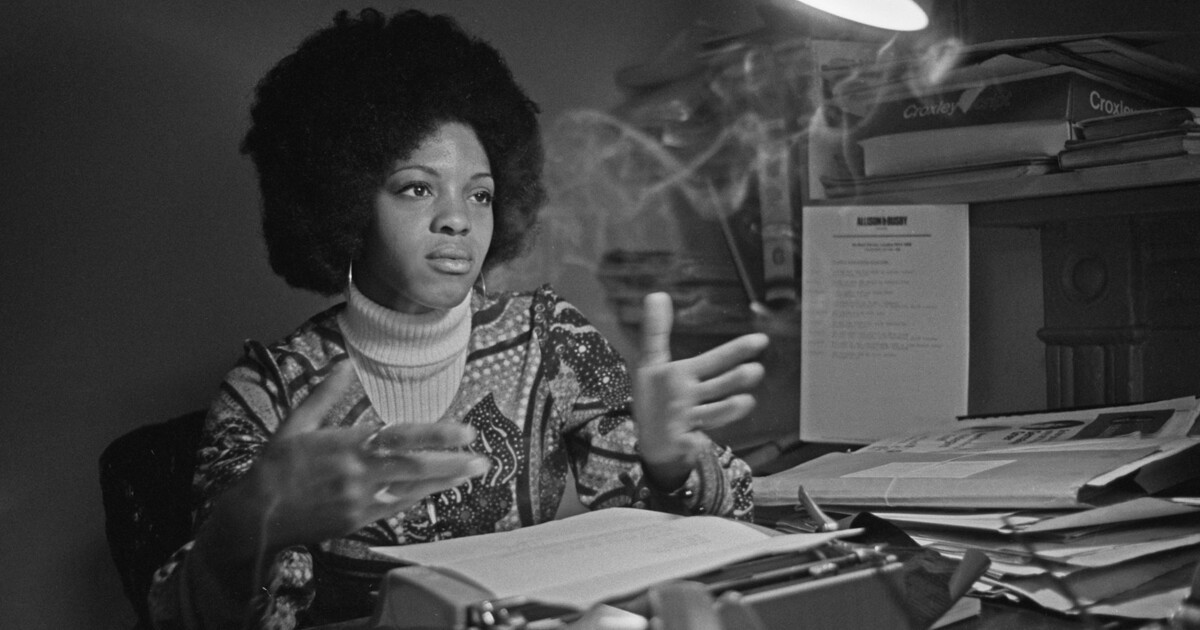
One of the prized possessions in Margaret Busby’s childhood home in Ghana was a steel-grey transistor radio. For much of the year she and her siblings attended boarding school in England, but during the holidays the radio connected her to ‘other cultures, other musics’. In an essay written for the Radio 3 programme Free Thinking in 2008, now reprinted as ‘The Joy of Radio’ in Part of the Story, a collection of Busby’s writings from the 1960s onwards, she recalls what happened when the radio broke. Since spare parts could only be found in Britain, she packed the machine in a ‘smallish coffin-like box ready to accompany me back to London for repair’. At the airport, she was confronted by a young man in military uniform who demanded to see the contents of the box. Busby refused, only to realise that she was surrounded by ‘unsmiling soldiers with guns, monitoring everything and everyone’. She abandoned the radio, ‘along with my illusions of being able to tune out politics with the twist of a knob’.
Busby says that she finds ‘recycling’ information about herself ‘a little tedious’, but her encounter with the soldier seems significant in light of her later career. As one half of the independent press Allison & Busby, she published writers including Buchi Emecheta, Roy Heath and John Edgar Wideman, helping books to move across national borders. In Part of the Story, the routes by which Black culture reaches its audience are rarely straightforward.
In the 1940s, Busby’s father, a doctor from Trinidad who had practised in Walthamstow, moved the family from London to what was then the Gold Coast. Instead of settling in Accra, they lived in the ‘small bush town’ of Suhum. Here, with an ‘overgrown cocoa farm next door’, the children found ‘space, freedom, seclusion and unlimited possibilities’ within ‘the corrugated iron perimeter fence of our compound’. There was no electricity and they had to buy fuel for lamps. On one trip to Accra, Busby witnessed the aftermath of the 1948 national boycott of imported goods, which sparked the fight for Ghanaian independence. She saw ‘people running through the streets, looters carrying bales of white cotton that unendingly unfurled, streaming between them like a gushing river’. By the time Ghana became independent in 1957, she was away at school in England.
In 1961, Busby took up a place to study English at the University of London, having convinced her parents that it would lead to a career in law. Instead, her first jobs were as ‘an assistant to an eccentric Romanian’ who ran an Anglo-French literary magazine from his home in Kensington, a reader in a press-cuttings agency and a writer for an encyclopedia called The World and Its Peoples. After several interviews with publishers in which she encountered open racism, she was hired as an editorial assistant at the ‘old and distinguished’ Cresset Press. She met her future business partner, Clive Allison, at a party in West London in 1965. The two decided there and then to start a publishing house. They hired an office space occupied during the day by Martin Eve’s left-wing Merlin Press (the publisher of E.P. Thompson, Georg Lukacs and the Socialist Register). In the evenings, it became Allison & Busby. Their first venture was three cheap poetry paperbacks by James Reeves, James Grady and Libby Houston; they printed five thousand copies of each and sold them door to door.
It took the success of Sam Greenlee’s The Spook Who Sat by the Door (1969) for Allison & Busby to become commercially viable. A writer friend of Busby’s met Greenlee in Mykonos and learned he was struggling to find a publisher for his spy thriller. The friend directed Greenlee to Busby, who supported him as he completed revisions to the manuscript in London and then pushed for its serialisation in the Observer. On its release, the novel became a bestseller. Greenlee’s book imagines the life of a Black diversity hire at the CIA called Dan Freeman. Secretly a Black nationalist, Freeman uses his newly acquired skills to instigate an uprising by the Cobras, a Chicago gang. At the end of the novel, Freeman decides to expand his insurrectionary project to cities across the US. The Spook Who Sat by the Door was the kind of macho pulp fiction popular in the late 1960s, but in plot and style it also resembles the early work of John A. Williams, whose novel The Angry Ones (1960) skewered the publishing industry for its liberal-sounding but ultimately empty racial politics.
Busby situates herself in a long line of editors and anthologists tasked not only with bringing the work of Black writers into print but with defining the parameters of Black literature. (Toni Morrison, who worked as an editor at Random House before publishing her first novel, is a recurring figure in Part of the Story.) Busby was introduced to African literature through Heinemann’s African Writers Series and Oxford’s Three Crowns Books. She acknowledges the importance of anthologists and editors in championing overlooked or underrepresented writers, but also recognises that their selections sometimes give the impression of being definitive. In ‘Skin Deep’, first published in the New Statesman in 1966, she complains about ‘the agile self-appointed spreaders of enlightenment’ who suffer from ‘I-think-James-Baldwin-writes-marvellously syndrome’ and ignore other Black voices.
Busby is especially attuned to the influence of editors and anthologists during the Harlem Renaissance. The explosion of Black print culture provided Black writers with a wide range of opportunities to publish their work, but it also created the need for new arbiters of taste. The most powerful of these was Alain Locke, whose anthology The New Negro (1925) brought together works he considered representative of the period. Writers did not always regard him as a benevolent force. The poet Richard Bruce Nugent described Locke as ‘a pompous, dictatorial (though learned and knowledgable) little man directing how things should go and who should be publicised as important members of this (his) select group’.
In a review of Marcy Knopf’s The Sleeper Wakes (1993), a collection of short stories written by African American women in the 1920s and 1930s, Busby points out that women were often excluded from accounts of the Harlem Renaissance. The stories in Knopf’s anthology had all appeared in Black periodicals such as Crisis and Opportunity. But unlike the work of their male contemporaries – Langston Hughes, Claude McKay, Countee Cullen, Jean Toomer and so on – women’s writing was rarely collected in book form. Of the fourteen writers in The Sleeper Wakes, only Marita Bonner, Alice Dunbar-Nelson and Zora Neale Hurston had seen their work reprinted. The anthology’s greatest achievement, Busby argues, was its challenge to the notion of a ‘womanless Black literary history’. Knopf’s chosen writers played important roles in shaping the Harlem Renaissance. Georgia Douglas Johnson held a prominent literary salon; Dorothy West was editor of Challenge magazine; Jessie Redmon Fauset, the period’s most prolific female writer, published four novels between 1924 and 1933 while also serving as the literary editor of Crisis.
A historical corollary to the Harlem Renaissance can be found in the development of Black literary culture in Britain during the late 1960s and 1970s. Allison & Busby’s publication of The Spook Who Sat by the Door in 1969 coincided with the appearance of Walter Rodney’s The Groundings with My Brothers, which launched Jessica and Eric Huntley’s Bogle-L’Ouverture Publications. Three years earlier, John La Rose and Sarah White had started New Beacon Books, a Black publishing house that later expanded into a bookshop in North London (it continues to this day).
This period also saw the establishment of new institutions for the production and dissemination of Black literature and arts. The Trinidadian theatre and film agent Pearl Connor-Mogotsi made her name as one of the founders of the Negro Theatre Workshop in 1961. At the Edric Connor Agency (which later became the Afro-Asian- Caribbean Agency), she represented Black artists and filmmakers including Horace Ové. Glenn Thompson, who was born in the US and arrived in London via Africa, the Middle East and Europe, founded the Centerprise bookshop and publishing project with Margaret Gosley in 1971. Like Brixton’s Black Ink Collective, which was established in 1978, Centerprise’s initiatives were often aimed at young writers (Thompson had been a youth worker). In 1976, the Black Liberation Front established a bookshop and resource centre called Operation Headstart on Tottenham’s West Green Road. In 1982, a collective of publishers founded the International Book Fair of Radical Black and Third World Books, which ran for thirteen years and collaborated with other book fairs across the UK and Caribbean.
When Allison & Busby was bought by W.H. Allen in 1987, Busby left to become a freelance editor and writer. The essays in Part of the Story are mostly from these years, when Black women’s writing became her focus. In 1992, she edited and introduced Daughters of Africa, an anthology of work by more than two hundred women from Africa and the diaspora, giving special prominence to little known writers. Her selection put work by African Americans such as Anna Julia Cooper and Lorraine Hansberry alongside that of the Senegalese author Mariama Bâ and the Sesotho-language writer Ntšeliseng ‘Masechele Khaketla.
In pieces from the 1990s, Busby describes her efforts to publish the collected works of C.L.R. James and reflects on the revolutionary writing of June Jordan, who risked her livelihood by advocating for Palestinian liberation. But they also depict a decade in which Black intellectuals could be seen as politically progressive without having to align themselves with radical traditions. In a profile from 1994, Busby accompanies Maya Angelou to an awards show hosted by Essence, the pioneering Black women’s magazine. The magazine had decided to ‘pay tribute’ to the contributions of African American men as part of an effort to embrace ‘unity between the sexes’. Guests included Benjamin Carson, a neurosurgeon who later served as secretary of housing and urban development in Donald Trump’s first administration, and Michael Jackson.
In 2019, Busby published New Daughters of Africa. In her introduction, she calls 1992 ‘that special year’, noting the publication of Morrison’s Jazz and her essay collection Playing in the Dark as well as the success of Terry McMillan’s Waiting to Exhale and the selection of Angelou as the second poet to read at a presidential inauguration. Where once Black writers were pushed to the margins, now they stood close to the centre of power.
In a recent interview with the Financial Times, Busby described herself as a ‘midwife’ of Black writing. The titles of her anthologies draw on Black feminist traditions of literary inheritance, recalling Alice Walker’s In Search of Our Mothers’ Gardens (in which Walker writes about discovering Hurston’s unmarked grave in Florida). For Busby, the ‘mother-daughter relationship’ is more than figurative. While Walker appeared in the original anthology, the 2019 edition features the work of her daughter, Rebecca. Busby refers to the inclusion of writers whose parents were prominent literary figures as ‘pleasing’. To others, it might appear more like nepotism and it sits awkwardly beside Busby’s critiques of the publishing industry.
Busby is now the grande dame of Black British literature, speaking at the London Book Fair and serving on the Booker Prize committee. In her speeches and opinion pieces, she recalls the difficult landscape for Black publishers, editors and writers in the 1970s and 1980s and describes the contemporary situation as only slightly improved. The publishing industry’s occasional attempts at diversity suggest there is a market for Black literature. But for each new opportunity that emerges – an editorial internship, a publishing imprint dedicated to Black writing, a place on a literary festival programme – there is another that has already disappeared or is now under threat. Most often, these losses occur in publicly funded local institutions: libraries, community spaces and humanities programmes at regional universities that neither politicians nor industry leaders are willing to protect.
Feminism may have framed the latter part of Busby’s career but in her introduction to Part of the Story, she compares herself not to Morrison or Walker but to the protagonist of Greenlee’s novel: ‘seemingly obeying orders and doing what was asked’ while ‘trying to infiltrate ideas into what was written’. Busby’s account of balancing the everyday business of writing with the work of maintaining institutions of Black intellectual life could apply to the cultivation of Black literature and its archives more generally. Apart from this brief suggestion of a political agenda, however, the essays in Part of the Story reveal little about Busby’s acts of subterfuge.
One might then return to The Spook Who Sat by the Door and read it in the way the author intended: as a ‘blueprint for revolution’. In one chapter, Freeman visits a gang member who lives in the affluent Chicago neighbourhood of Hyde Park. Pretty Willie is a light-skinned man who writes protest poetry and propaganda. When Freeman learns that Willie is taking classes at the university but has no interest in obtaining a degree (his studies are part of his cover), Freeman finds himself arguing for the importance of education. He doesn’t invoke the University of Chicago, the home of Milton Friedman, but rather his grandmother, who was ‘just delighted’ to see him with his ‘head in those books’. ‘My grandmother used to say to me: “Get that education, boy.”’ This digression must have appeared hopelessly naive on the cusp of the 1970s. But one can imagine that the end of Willie and Freeman’s conversation would have been gratifying to Busby. Freeman declares that for his grandmother, ‘those books were symbols of freedom … and she was right about that, too.’