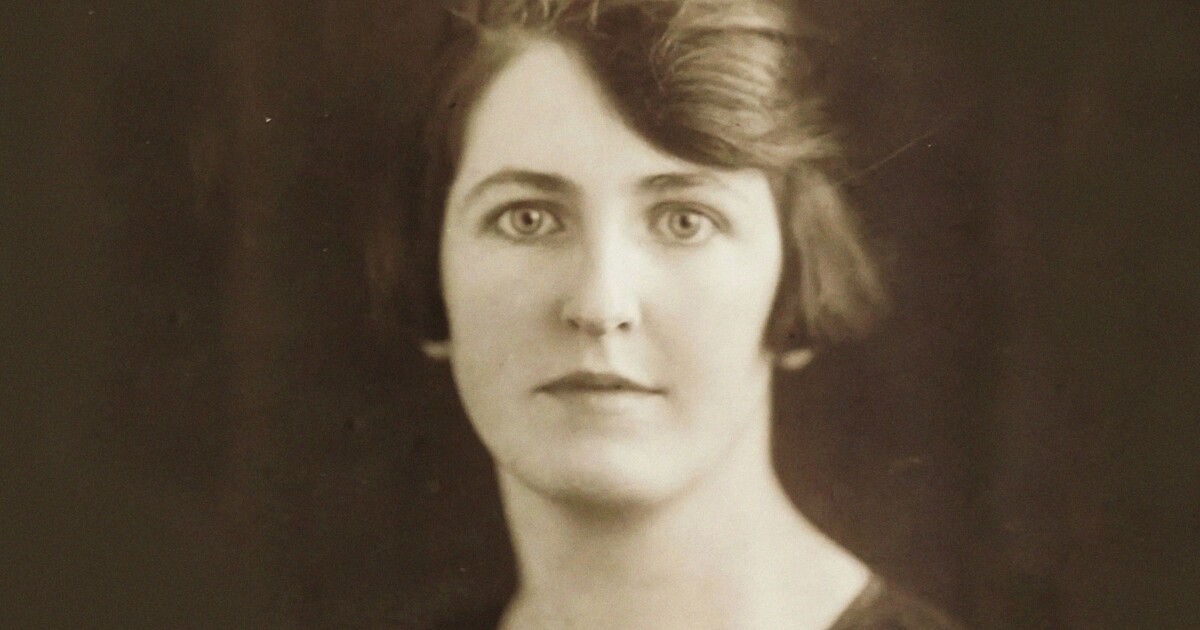
‘Ihave no journalistic ability,’ Malachi Whitaker wrote in her memoir, And So Did I (1939), ‘and could not tell a good story to save my life.’ By this point she had published four collections of short stories with Jonathan Cape. In a review of her first book, Frost in April (1929), Vita Sackville-West called her a ‘born writer’ and praised her stories as ‘economical, unsentimental and absolutely convincing’. She also compared her to Katherine Mansfield, while conceding that Whitaker’s ‘characters are taken from a very different world’. That world was Whitaker’s own: provincial, northern, working or lower-middle class. Born Marjorie Olive Taylor in 1895 on the outskirts of Bradford, Whitaker was the eighth of eleven children. (She was later known as the ‘Bradford Chekhov’.) Her father, a bookbinder, was her earliest patron and critic. He paid sixpence for her first poem, but dismissed her second: ‘You’re too late, lass. Shakespeare said this first, and much better.’ From then on, as Whitaker recalled in 1935, she would look at anything she wrote, ‘grow certain that somebody else had done it better, and tear it up’.
Whitaker left school at thirteen and went to work as a machinist at Muff & Taylor, her father’s workshop. She continued to write, burning whatever she wrote, until, during the First World War, she sold ‘a set of windy martial verses’ to a Christmas card company. In 1917 she married Leonard Whitaker, who was serving in the army. After the war he became an entrepreneur. His early ventures were unsuccessful – the young couple lived in a tent for a time – but he later became co-owner of a profitable textile factory. Whitaker’s first manuscript was a ‘business novel, which, fortunately, fell overboard from a Channel steamer’ – or so she claimed. It was only in 1926 or 1927 that she wrote a story which felt truly her own: ‘Not an imitation. It was mine.’
That short story, ‘Sultan Jekker’, is not her finest. It follows a labourer who lives with his two ‘violently jealous’ lovers. The characters are cartoonish – oafish, screeching – and the melodramatic ending involves a stabbing in the neck. Still, you have to be thankful that Whitaker finally produced something she could stand over. She sent it to the Adelphi, where John Middleton Murry accepted it for publication. When Whitaker visited the Adelphi offices with her husband, it became clear that the editors thought he was the author. In her memoir, Whitaker doesn’t explore her reasons for choosing her male, Old Testament pseudonym, but she does mention reading the Bible voraciously as a child (relishing ‘the rolling sound of the sentences’, scouring it for ‘words like hell and devil’). To her contemporaries, the reasons for taking a male pen name would have been self-evident.
Murry told Whitaker that if she had enough stories for a collection (which she soon did) he would help to find her a publisher. The stories in Frost in April explore the lives of farmers, navvies, florists, young women on trains, mothers, children, destitute aunts – characters with exceedingly English names like Albert Shepherd, Arthur Proyle and Mimmy. Whitaker’s prose is direct, sometimes sinister and always acutely observed. Take the second story from the book, ‘Old Abraham’, about a retired farmer called Mr Mick who worked his first wife to death, then married a sturdier model who bore him six children, ‘before she, too, turned her face to the whitewashed wall of their joint bedroom’. One day Mr Mick visits a dignified widow, Mrs Aspland, accidentally interrupting her tea. He finds himself falling in love as he watches her eat. Everything you need to know about Mrs Aspland is contained in two telling details: she cleans her own house even though she can afford domestic staff and she sucks on peppermints during chapel sermons.
Although they are narrated, without exception, in the third person, the stories in Frost in April lay characters bare. Whitaker paints swift portraits: the aunt with ‘a dirt-line … just beneath her chin, as if she had only washed her face so far’; the mother terrified of every sound except the comforting tick of the clock; the young woman embarrassed by her high and firm breasts. These characters are lonely, often guilty, frightened. Most of all, they want. Whitaker’s fiction is remarkable for the specificity of her characters’ desire. Arthur Proyle is drawn to the way Mimmy’s frizzy hair lifts away from her neck, how it contrasts with ‘the dark smooth locks of Edith, his wife’. A little boy covets a tin canister, illustrated with robins, on his neighbour’s mantelpiece. Yet the object of desire is always withheld or withdrawn. When a farmer’s youngest daughter gets engaged, secretly, to her lover, he catches his death of pneumonia after coming out every night to see her. In a Whitaker story, it is dangerous to want. It makes you vulnerable.
Sometimes this gives Whitaker’s fiction the flavour of a fable or fairy tale – be careful what you wish for – but her writing is too closely tied to time and place to feel unreal. She writes of ‘the astonishing beauty of the industrial north’, the ‘blue-grey landscapes’ of ‘rolling hills, the mingling of smoke and cloud, the white steam from the dye-houses, the cobbled streets and houses of blackened stone’, or of a ‘grey-green marsh, sickly with meadow-sweet’. She knows this landscape through and through, just as she knows the smell of glue on a gilder’s apron and the ‘rusty iron stove’ that sits in a jobbing printer’s workshop.
Whitaker’s second collection, No Luggage?, was published in 1930, followed by Five for Silver (1932) and Honeymoon & Other Stories (1934). Again, we meet unfaithful husbands, lonely children, young girls eager to grow up fast. Reviewing Five for Silver, H.E. Bates wrote that Whitaker’s third volume ‘reveals all the qualities of her first and second books, with no advance upon their maturity and, except in an odd story or so, no falling away from it’. There’s certainly a familiar shape to Whitaker’s short fiction. When you read her four collections – 78 stories – in quick succession, they begin to echo one another. But you can also sense Whitaker pushing herself in new directions. She tackles increasingly difficult subjects: single motherhood, abortion, infertility, domestic abuse, grooming. She experiments with voice, dipping into the first person, stream of consciousness, overheard dialogue. Her imagery grows stranger. Take ‘X’ from Honeymoon & Other Stories, a predecessor to Shirley Jackson’s Gothic novel We Have Always Lived in the Castle (1962):
I slept in the same room as my sister until she died. Not only in the same room, but in the same bed … My sister and I were quite unlike. She was big and fair and athletic … I am little and dark, and very, very thin. You would not notice me but that I have some good teeth. They are large, like white acorns, and I cannot quite close my mouth because of them.
Whitaker is interested in class dynamics. In ‘Triumph!’ we meet a man employed by a gentleman’s outfitter who considers himself ‘socially above’ his brother, ‘a grocer’s assistant in a large store’. In ‘Courage’ we learn the difference between an ‘eight o’clock job’ (making paper ornaments) and a ‘nine o’clock one’ (in an office), which requires a smarter coat. When Isabel Allat arrives for her first day at work, the head clerk explains that the positioning of the coat pegs denotes the office hierarchy. According to him, the office boy ‘doesn’t exist yet. He’s only been here a couple of weeks.’ Later Isabel’s boss tells her that the clerk ‘is not – Miss Allat, I grieve to tell you this – but he is not a gentleman. Miss Allat, he goes to funerals in a bowler hat.’ It is these small differences – where you stand in relation to those around you – that matter most.
After Honeymoon & Other Stories Whitaker collaborated on a satirical memoir with her friend Gay Taylor. The Autobiography of Ethel Firebrace, published anonymously in 1937, is about a self-important and histrionic author whose books include Tinsel Paradise and His for an Hour. Firebrace, who has ‘seen all, heard all and said all’, traces her life from girlhood at ‘Quodlington’ to ‘Glorious Widowhood’, via ‘Contacts Literary and Social’. Whitaker and Taylor seem to have written the book mostly to amuse themselves, but it can also be read as Whitaker’s anti-memoir. Firebrace finds writing easy. Her first novel arrives ‘like a gleam from heaven’, her heart leaping ‘forward to the day’ when she would be ‘acclaimed one of our foremost novelists’. Whitaker’s own memoir, by contrast, thrums with uncertainty.
And So Did I, recently reissued by Boiler House Press, is anchored in the day-to-day: family trips to the seaside, visits from friends, drinking hot milk in the early hours, listening to the gramophone. At times Whitaker slips into discussions of her early life – her relationship with her parents, the death of her brother from consumption, her experience of poverty – but it’s mostly non-linear. ‘I am one of the few remaining people who think that time is orderly,’ Whitaker says at one point, ‘and that it goes right on and not backwards and forwards. It is only when you stop to think about it that queer things happen.’
The book was written in 1937-38, by which time Whitaker and her husband were living comfortably at Bolton Old Hall. After struggling with infertility (though Whitaker speaks of her ‘barrenness’ as a comedy rather than a tragedy) the couple adopted two children: Michael, pseudonymised as ‘Nick’ in the book, and Valerie, who appears as ‘baby’ or ‘Jane’. Whitaker paints a pretty picture of domestic life. She writes about the family doctor, a friend, calling round for his birthday present on ‘baking day’: the ‘loaves in their tins on the hearth in front of a hot fire’, the children ‘on the hearthrug’, the baby ‘clean and beautiful in her long, white nightdress’.
And yet, at the age of 42, Whitaker had already begun to think about mortality. She compares growing older to ‘going down the falling arc of the circle’. Writing about a recent operation, she recalls vanishing ‘quietly’ under anaesthesia, longing ‘to get into the blackness’. Afterwards, she watches her scar fade to ‘the mauve-white colour of the flower we call the milkmaid’. At another point, she has the bones of her toes straightened. She surveys her father in a hospital ward with ‘bland indifference’. He ‘has always been a complete stranger’, and his subsequent death brings no heartache. In the next paragraph Whitaker’s thoughts turn to the place she ‘would like to be buried’: ‘the clouds and sunshine of April I want to have over my bones. How quickly bones and stones crumble.’
The book begins with an arresting statement: ‘Yesterday, I saw an accident.’ A man is hit by a car in a London square, ‘flung into the road with a heavy, smacking sound’. Whitaker then decides ‘to take up my long-abandoned search for God and the Truth’. This search continues throughout the book, while Nick reads quietly beside her and the baby tries to play with the typewriter. She envies an ‘ardent Roman Catholic’ she once knew: ‘Oh, to believe in something so much that you will get up every morning at half-past six just to go into a church and pray!’ But prayer, for Whitaker, feels like drinking from an empty glass. She can only imagine arriving at spiritual enlightenment accidentally, ‘say if I should be paralysed’.
Occasionally she longs for something to knock time out of its slow march – a meteorite, a wild storm, an ocean tide sweeping over the housetops – but she also delights in everyday things. ‘Life itself is difficult, full of unfinished ends and unfinished thoughts,’ she writes. But ‘I am glad to see young creatures, and leaves, and patterned beetles and snowflakes, and to savour the taste of each season.’ Whitaker finds solace in having lived, having been ‘ever born’. The title of the memoir comes from Coleridge’s ‘The Rime of the Ancient Mariner’:
The many men, so beautiful!
And they all dead did lie:
And a thousand thousand slimy things
Lived on; and so did I.
These lines are spoken ruefully by the mariner – death would be release – but there’s also something defiant here. We slimy things live on.
And So Did I received mixed reviews. ‘It is not easy to find any particularly attractive or enduring qualities in this personal record,’ one critic remarked in the Manchester Guardian. Another, writing in the Spectator, concluded that it consisted of ‘damp comments and scrappy reminiscences’ and was ‘worthless’. The poet and critic Kathleen Raine said she found the book ‘undisciplined and disconnected and self-indulgent’ and couldn’t finish it because of Whitaker’s ‘grasshoppermindedness’.
There are certainly moments when Whitaker appears to be wittering on for the sake of it: ‘It astonishes me to think how very rarely bath water is just right.’ Yet the value of And So Did I lies precisely in its grasshoppermindedness. ‘The whole book is at once deliberate and capricious,’ Elizabeth Bowen wrote in the Listener. ‘It is thus nothing if it is not a work of art.’ Whitaker interweaves past and present, Bowen said, ‘with a detachment that almost eliminates the first person. She seems to achieve the split we all dread or hope for; she seems to stand in the dark looking in through a lighted window at her own figure by the lamp.’ Hugh Walpole compared the experience of reading the memoir to discovering the first volume of Proust or Virginia Woolf’s Orlando. ‘I shall push and push it into people’s laps until I am 92,’ he wrote to Whitaker, ‘in which year I am going to die of a rheum.’
Whitaker was right to say she ‘could not tell a good story’. Her talent lies in character portraits rather than plotting, and the strengths of her memoir are much the same as those of her fiction. The descriptions in And So Did I are meticulous: pub meals ‘eaten at a table so well-scrubbed that it sinks in the middle like a butcher’s block’; surgeon’s overalls shining ‘like iced cakes’; the ‘laithes and mistals’ of the Yorkshire countryside. An entire person will be captured in one phrase: her housekeeper, Delia, is ‘nearly too handsome to live’; the owner of a Paris hotel has ‘the meanest face I ever saw on a woman’; a friend comes to visit wearing a hat that ‘reeks of personality’. The memoir has a precursor in ‘This Side of the Door’ from Honeymoon & Other Stories. Written as a diary, it constitutes another introspective search for meaning, at once detached and embedded in daily life:
It is so cold outside. There will be people walking aimlessly along Charing Cross Road, having earache, with nowhere special to go. Other people, drinking, climbing mountains, making up prescriptions, talking to themselves in trains; yet I know of nothing, of nobody in the world but myself.
Both Catherine Taylor (in the introduction to the new edition) and Valerie Waterhouse (in the afterword) read And So Did I in the context of the impending war. This feels somewhat strained. Communism and fascism are mentioned only fleetingly in the memoir and in an abstract way. When Whitaker and her husband talk about meteorites landing on an English town it’s an amusing hypothetical (‘What a marvellous death – biff!’). Their doctor friend, who calls round for his birthday present, will be killed in Dunkirk. This edition also comes with an appendix, ‘Still Another Wild December’, first published in the Listener in 1939. In this essay, Whitaker still can’t convince herself that England is at war – not with the ‘misty yellow dusk settling like a cobweb’ over the trees and her children ‘playing happily and madly on the stairs’.
Whitaker was disappointed that the memoir sold only a thousand copies and called it a ‘financial flop’. Waterhouse speculates that the war was partly responsible for its failure: the book ‘felt suddenly outdated’. In a letter to Charles Lahr, the owner of the Progressive Bookshop in London, Whitaker blamed Cape for the poor sales. Either way, the memoir heralded the end of her writing career. She published a few new stories and essays in magazines, as well as two collections of selected stories, but no substantial fresh material. Whitaker was hospitalised with mastoiditis during the war; a few years later, her husband left his textile business and fell ill, and the Whitakers’ comfortable life at Bolton Old Hall was no more. The family moved from house to house, buying and selling property to raise money, until, after Leonard’s death in 1965, she moved in with Gay Taylor for four years. Whitaker died aged eighty, in 1976, after a brief illness. Her Times obituary noted that she’d had ‘no less than 38 homes’.