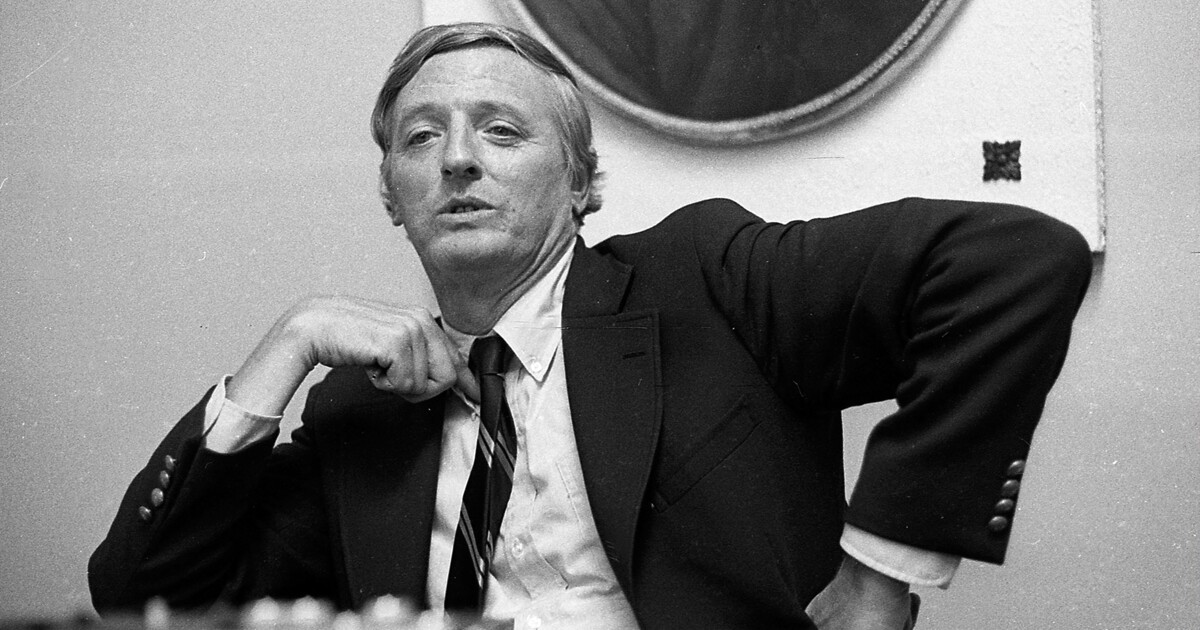
Anti-communist dandy, scourge of Ivy League administrators, magazine chieftain, amanuensis to Joe McCarthy, father-confessor of the Nixon White House, Ronald Reagan consigliere: is it any wonder that William F. Buckley is still the patron saint of the American right? For more than half a century, he supplied a gloss of coherence and glamour to a movement sorely lacking in both. With his mid-Atlantic drawl and slaloming locutions, he held out the suggestion that being a conservative was a daring and possibly even romantic position in American political life. On television and in his syndicated newspaper column, he fired back at the liberal mandarins, in between Côte-Rôtie-fuelled lunches and yacht races. The American right had better minds on its side, finer writers and more formidable strategists, but no better entertainer.
Yet Sam Tanenhaus’s thousand-page biography of Buckley provoked discontent in right-wing reviewers (once they had given it a ‘Washington read’ and searched for their names in the index). Not all the facts of the life were convenient. What appeared to be a career on the permanent offensive looked somewhat different when viewed at longer range. The same Buckley who swooned over McCarthy was already defending Truman’s record in the 1960s. The same Buckley who wrote hymns to racial segregation in the 1950s later called for a Black president. Was it not embarrassing that this libertarian crusader derived much of his income from appearances on public television and that his chief professional ambition was to write for the New Yorker? Worst of all, Buckley anointed as his official biographer not one of the faithful, but a liberal Jew who became the editor of the Book Review of the New York Times, which, it transpires, was the only newspaper that Buckley cared about. Was he merely a baroque conduit between the right and the establishment centre? Was his life a piquant reminder that they are often only inches apart?
Buckley was born in New York, but was a son of the South. His mother came from Louisiana high society. His father, William Buckley Sr, grew up a poor Irish-Catholic in Texas and made a career as an oil speculator in Mexico, where his claims depended on the backing of Porfirio Díaz’s dictatorship. During the Mexican Revolution of 1910, when Maderista insurgents from the north and Zapatista peasants from the south closed in on Díaz, Buckley Sr paid for Winchester rifles to arm the counter-revolutionaries. He never recovered from their failure. His biggest grievance was that Woodrow Wilson’s administration had supported Mexican liberals instead of American businessmen. With nothing left for him south of the border, he moved to the bucolic town of Sharon in northwest Connecticut. There he built the family hacienda, Great Elm, staffed it with Mexican servants, took out a large loan from a French bank and settled down to raise a family in which William Jr, born in 1925, was the sixth of ten children.
Great Elm was a hive of reaction. At the dinner table William Jr excelled at parroting his father’s opinions. The children were taught the sins of progressivism, and learned to snub Franklin Roosevelt, who lived across the Connecticut border and had been assistant secretary of the navy under Wilson. Left to their own devices, the older children’s idea of a prank was to burn a cross in front of what Tanenhaus calls a ‘popular Jewish resort’. The Buckleys hosted parties where Fats Waller played and Sylvia Plath danced. The guests were Mexican exiles and oilmen, along with representatives of a new species in the American landscape, the ‘libertarian intellectual’. Henry James had foreseen the type in The Bostonians in the character of Basil Ransom, proud ex-Confederate contributor to the Rational Review, full of passionate intensity about how to harmonise hierarchy and freedom. The Buckleys’ favoured ideas-and-values man was the editor of the Freeman, Albert Jay Nock, sworn foe of ‘democratism’, who considered most of his fellow countrymen to be ‘sub-human raw material out of which the occasional human being is produced by an evolutionary process yet unexplained’.
Buckley made his name as a campus activist. In the lead-up to the Second World War, Yale had been the birthplace of the America First Committee. Dedicated to keeping the British Empire on a short leash and America out of the war, but also to controlling the ‘virgin continent’ of Latin America, the pressure group was backed by businessmen with similar interests to Buckley’s father. With its criticisms of the missteps leading to the First World War, it was also able to attract as junior members Jack Kerouac, Kurt Vonnegut, Gore Vidal, Chester Bowles and John F. Kennedy. The right wing of the organisation was awash with antisemitism and Charles Lindbergh worship, but most of its followers eventually accepted the task of defeating Nazism. Arriving at Yale after the war, Buckley and his fellow conservative students knew that they faced a more unifying foe in Soviet communism. Buckley strutted the campus as a full-time anti-communist impresario. Robert Silvers, a Yale contemporary who later became the editor of the New York Review of Books, told Tanenhaus that Buckley ‘was so superior, so commanding’. He kept an aeroplane near the campus and employed a secretary to assist him as editor of Yale Daily News. When Henry Wallace, the Kremlin-curious US presidential candidate, visited New Haven, Buckley and his friends dressed as proto-beatniks holding a sign that read ‘Give Russia the Atom Bomb’, and intended to release some doves, but failed to find ‘an opportune moment’. They were more successful at blocking interracial dances.
But the main enemy Buckley identified – making a lasting contribution to the American right’s playbook – was the university itself. Yale presented itself as a school for Christian gentlemen, and the mottoes of churchmen graced its Gothic Revival façades. In reality, as Buckley demonstrated in God and Man at Yale, the bestselling exposé he published in 1951 after graduating, the campus was crawling with Keynesian professors. After breaking the shocking news that the teaching staff didn’t take the particulars of the New Testament seriously, the book became apoplectic about the injustice and impracticality of income tax. ‘Individualism is dying at Yale,’ Buckley declared, ‘and without a fight.’ The polemic owed its success in part to his father’s bankrolling of the publicity. It also signalled a new manoeuvre in American politics. Buckley’s primary antagonists were not card-carrying campus communists – who were at least forthright in their convictions and few in number – but the legions of liberals who passively absorbed socialist values. In its woundedness, its preference for ad hominem assault, its business ideology rounded off with Bible-speak, its parlour logic and censoriousness, God and Man at Yale was ahead of its time.
After Yale, Buckley trained with the CIA. Posted to Mexico, he posed as a businessman looking after his father’s oil concessions. His supervisor was Howard Hunt, the future Watergate burglar, with whom he spent most of his time socialising and drinking in Mexico City. Buckley’s only assignment was to edit the memoirs of the Peruvian ex-communist Eudocio Ravines. The main lesson he picked up was that ex-communists were a valuable resource. A career as a CIA operative, however, held no appeal. Buckley felt more at ease in the limelight than the shadows.
One figure on the national stage held a particular attraction for Buckley and the collegiate right. In the early 1950s, Senator Joseph McCarthy of Wisconsin emerged as the most uncompromising of anti-communist zealots, unafraid to name names and intent on rooting out subversives in the US government. At first this made him an isolated figure in a Republican Party that chose Dwight Eisenhower as its candidate for president in 1952 (over Robert Taft, Buckley’s preference). Eisenhower could just as easily have run as a liberal Democrat. If they continued along this course, Buckley believed, the Republicans would lose their identity: McCarthy was the lone corrective to this drift. Buckley and L. Brent Bozell, his brother-in-law and collaborator from their Yale days, became McCarthy’s speechwriters and in 1954 published McCarthy and His Enemies.
McCarthyism was more important for Buckley than its human vessel, though he supported McCarthy well beyond his public demise. Tanenhaus describes an extraordinary scene when Buckley, camped out in McCarthy’s house in Washington, was summoned in the middle of the night by the senator to pore over a map of China, ‘lost’ to the communists. In 1954, Buckley gave a speech at the Waldorf Astoria in honour of McCarthy’s aide-de-camp, Roy Cohn, whose crude tactics were seen (including by Buckley) as contributing to their patron’s downfall. Later in life Buckley distanced himself from McCarthy’s legacy, but his calculations in the 1950s made sense: anti-communism was the only creed capable of binding American conservatives, and McCarthy had grasped that earlier than most. ‘He knew exactly who McCarthy was and what his uses were,’ Tanenhaus writes. ‘The carnal hunt for enemies within, the unmasking of their apologists and allies, real and more often fanciful, brought together diverse factions of a weak and fragmented movement in the growing war against the New Deal and its aftermath.’
In order to consolidate McCarthyism in the absence of its figurehead, Buckley did what enterprising intellectuals with a family fortune do: he founded a magazine. In 1955, the first editorial of National Review announced its intention to stand ‘athwart history, yelling STOP, at a time when no one is inclined to do so, or to have much patience with those who so urge it’. Where precisely history was meant to stop was not specified. What united the right was a programme to roll back the advances of American labour at home and communism abroad. But how was Buckley to staff a right-wing propaganda organ in Manhattan? One obvious talent pool suggested itself: ex-communists. Along with family members including Bozell and Buckley’s sister Priscilla, the magazine would be edited by operatives who had cut their teeth in interwar Europe. There was Willi Schlamm, a Jewish former Austrian Communist Party militant and veteran of Die Rote Fahne, who coined the term ‘liberal establishment’ and helped train the magazine’s fire on a fixed target. There was James Burnham, Trotsky’s favourite American correspondent, who had metamorphosed into an anti-collectivist cold warrior. There was Frank Meyer, who had been deported from Britain for organising communist students (he also found time to date Ramsay MacDonald’s daughter), and was subsequently a CPUSA agent at the University of Chicago. Meyer theorised the project of National Review as a ‘fusionism’ that would harness libertarian values in the service of a traditionalist society. Then there was Buckley’s old professor from Yale, the combative Willmoore Kendall, the inspiration for Saul Bellow’s ‘Mosby’s Memoirs’, who argued that the project of the magazine should be to defend majoritarian consensus over the abstract rights that favoured minorities.
Buckley succeeded in bringing these unlikely figures together in part because he too, despite his Ivy League pedigree, could be seen as an arriviste in the WASP enclaves of Manhattan. He was a Catholic after all, and had prepped at Millbrook, not Andover or Groton. Among the last to join the masthead of National Review were Russell Kirk, author of The Conservative Mind, who avoided listening to the radio for fear of being infected by modern life, and Whittaker Chambers, an ex-CPUSA agent who brought an apocalyptic sensibility to its pages. Not all of the magazine’s notable contributors were veterans. Buckley knew he had to find new writing capable of withstanding the emerging counterculture, and himself made occasional sorties behind enemy lines, going so far as to drop acid with Burnham at a showing of the Swedish erotic film I Am Curious (Yellow). The staff writers he collected included the former seminarian Garry Wills, who became a revered liberal chronicler of American politics; a promising Harvard dropout, John Leonard, who became a leading literary critic; and a young caption writer at Vogue called Joan Didion. All three ended their careers writing for the New York Review of Books.
One of the problems National Review faced in the 1950s was that America possessed only the rudiments of an anti-liberal conservative tradition. Just five years before its founding, Lionel Trilling had declared that liberalism was ‘not only the dominant but even the sole intellectual tradition’ in the US. The right had a handful of outlets, including the libertarian Freeman, the anti-communist newsletter Human Events and the American Mercury, edited by H.L. Mencken, who died the year after National Review began publishing. But however much Buckley longed for it, the US had no ancien régime. This didn’t stop him and his colleagues from looking to the Confederacy as a stand-in. National Review made the nascent civil rights movement its most consistent enemy. In 1957 Buckley spelled out the magazine’s position in an editorial called ‘Why the South Must Prevail’. Blacks, he argued, must be prevented from gaining the full franchise in the Southern states:
The central question that emerges – and it is not a parliamentary question or a question that is answered by merely consulting a catalogue of the rights of American citizens, born Equal – is whether the White community in the South is entitled to take such measures as are necessary to prevail, politically and culturally, in areas in which it does not predominate numerically? The sobering answer is Yes – the White community is so entitled because, for the time being, it is the advanced race.
Segregationism remained gospel at National Review well beyond the end of Jim Crow. The Freedom Riders of the 1960s were compared to Nazis in its pages. Despite the private misgivings of editors such as Wills and Bozell, Buckley rarely strayed from this line. In 1965, the year of the Selma to Montgomery marches, he debated with James Baldwin at the Cambridge Union, where he declared that Baldwin’s very presence in the chamber demonstrated the beneficence of Western civilisation. Baldwin carried the argument, but afterwards regretted that he had only raised the profile of the ‘intellectuals’ James Bond’. What Baldwin and other contemporaries didn’t know, but Tanenhaus has discovered, is that the Buckley family clandestinely funded a segregationist newspaper, the Camden News of South Carolina, in the mid-1950s. What’s surprising here is that the Buckleys felt it necessary to cover this up.
In foreign affairs , National Review was defiantly imperialist. Buckley supported every rearguard colonial war, from Portuguese Goa to French Algeria to the Belgian Congo. The old right in America retained enough antisemitism to decry the creation of Israel, which, in its early years at least, looked alarmingly socialist. Buckley presided over the movement’s shift towards Zionism, an about-face that began when Israel proved its bona fides as a colonial state by enlisting in the Franco-British attempt to seize the Suez Canal. But it was the Vietnam War to which Buckley devoted countless columns and television appearances in the following decades. The US, he believed, could not afford to repeat the mistake of ‘losing’ China, or settle for an unhappy draw as in Korea. ‘I think we should have tried everything we could to overthrow China,’ Buckley told the perennial socialist candidate for president, Norman Thomas, in a debate in 1966. ‘Chiang Kai-shek should have been permitted to establish a beachhead in China and encouraged a revolt.’ In Indochina, anything short of total victory over Hanoi counted as defeat.
Although Tanenhaus takes pains to show that Buckley’s hard line endured much longer than is commonly thought, he still rehearses elements of the familiar tale that Buckley cleaned up the American right and purged it of its ‘lunatic fringe’, including the John Birch Society, whose leader, Robert Welch, believed Eisenhower was a Soviet agent. But if Buckley and colleagues such as Burnham distanced the movement from the kooky views of Welch and company, they did so not on account of their extremism, but because the Birchers were unreliable on Vietnam, opposing it as a ‘phony’ war in which both sides were marionettes of the Kremlin. Even after publicly denouncing Welch, Buckley sought privately to repair relations.
In their attitude towards Vietnam Buckley and National Review scarcely differed from America’s liberal establishment, urging only that the war be prosecuted more vigorously. The communists had been routed in Malaya and Greece – why not in Vietnam? Buckley repeatedly expressed his disappointment that American youth quailed at the firebombing of villages in South-East Asia, when earlier generations had lost no sleep over the destruction of Dresden and Hiroshima. Unsurprisingly, he sought to dramatise his differences with liberals, and a striking number of episodes of his television show Firing Line, which ran for 34 seasons, were dedicated to the subject. Buckley argued on air that however kindly Ho Chi Minh may have seemed in the 1940s, the sheer number of Vietnamese people seeking refuge from repression south of the 17th parallel surely justified US intervention on humanitarian as well as anti-communist grounds (this argument proved influential on the human rights movement in the 1970s).
Buckley ran rhetorical circles around many of his opponents, exposing the self-satisfactions of the mainstream. But he also performed an inadvertent public service by inviting on his show a considerable number of Black radicals and figures from the American left. A favourite tactic was to skew conversations with ill-fitting historical analogies, then to press distinctions so fine that clarity became impossible. Another was to taunt guests until they lost their cool. Here is Buckley goading Noam Chomsky in 1969, reprising his performance against Gore Vidal a year earlier:
Buckley: You also say that you hate yourself for not having come to that position [complete opposition to American involvement in Vietnam] earlier.
Chomsky: Yeah, I do. I think that was a very great, great mistake.
Buckley: Well, I hope to give you a little solace in the course of the evening, but the reason I do raise this and I rejoice in your disposition to argue the Vietnam question especially when I recognise what an act of self-control this must involve.
Chomsky: It does, sure, it really does. I mean, I think it’s the kind of issue [both talking simultaneously] …
Buckley: And you did very well, you did very well.
Chomsky: Sometimes I lose my temper, maybe not …
Buckley: Maybe not tonight. Because if you would, I’d smash you in the goddamn face.
Occasionally, Buckley’s guests beat him at his own game. Huey Newton once shot back a question that made him wobble: ‘During the Revolution of 1776 … which side would you have been on?’
Along with his TV show and his syndicated newspaper column, Buckley found time to stand for mayor of New York in 1965. It began as a lark when National Review ran a joke cover proposing ‘Buckley for Mayor?’ In the wake of Barry Goldwater’s defeat, however, the campaign became a mission to show that liberal Republicans like Richard Nixon were no longer the only option for the right. Buckley ran as the leader of the Conservative Party against his fellow Yale Republican John Lindsay. He called for the abolition of unions, tough policing, welfare restrictions, bicycle lanes and a New York Disneyland. The campaign is remembered for the quip he made when asked what he would do in the event of victory – ‘Demand a recount!’ Buckley only won 13 per cent of the vote, but his circus-style campaign enchanted white working-class voters in Queens and other outlying boroughs (a fact perhaps not lost on a 19-year-old Donald Trump). More significant still was his brother James’s senatorial run of 1976, which led to federal limits on campaign spending being found unconstitutional by the Supreme Court on free speech grounds.
Tanenhaus slightly exaggerates the influence that Buckley exercised over Nixon, a president with unmatched anti-communist credentials. In fact, Buckley distrusted him, less for his policy on Vietnam than for his opening of relations with Mao’s China. Buckley accompanied the press corps on Nixon’s first trip to Beijing and came out firmly against rapprochement. If it had to happen, then at the very least full independence for Taiwan should be part of the package. But no:
Richard Nixon – his glass raised high to Mao Tse-tung, toasting to a long march together, he and we, likening our two revolutions to each other, landing at Andrews to impart the information that the Chinese people greatly esteem their government – may yet emerge as the most flexible man of the century, perhaps even as the most deracinated American who ever lived and exercised great power.
When Watergate consumed Nixon’s presidency, Buckley stayed close to his former CIA instructor Hunt, another casualty of the scandal. But he felt little compunction in denouncing Nixon. When Nixon’s ‘enemies list’ became public, Buckley joined with the liberals and called the administration ‘fascist in its reliance on the state as the instrument of harassment’ and ‘altogether ruthless in its dismissal of human rights’. As Tanenhaus shows, Ronald Reagan, who occasionally cast his eye over National Review, was in some ways even more of a disappointment. National Review was never for the Reagan administration what the New Republic had been for Woodrow Wilson. In the 1980s, the right seemed to fall victim to its own success: once the ‘Volcker shock’ and Reagan’s mop-up operation had crushed American labour, it was deprived of a domestic foe and became increasingly fragmented. Buckley could still occasionally offend – declaring, for instance, at the height of the Aids epidemic that sufferers ought to have numbers tattooed on their buttocks – but Reagan’s free-market fundamentalism outstripped his own. By the following decade, despite the rising tide of blue-blazered shock troops who made up the audience at Firing Line recordings, he often favoured populist tribunes such as Pat Buchanan over the Republican elite.
Tanenhaus dashes through the latter decades of Buckley’s career, though the brevity is not unwarranted: National Review had already started losing traction in the 1970s, as publications such as Commentary turned to the right. Buckley increasingly lived off the fumes of his celebrity. He was at ease trading barbs with Woody Allen, and his high camp theatrics were compared to Andy Warhol’s by Hugh Kenner, a National Review colleague. By the turn of the millennium, National Review had been supplanted by William Kristol’s Weekly Standard, a neoconservative cheerleader for the Bush administration. Buckley then bungled the editorial succession, handing his magazine over to a series of mediocrities after his retirement. It still limps on, recently celebrating its seventieth anniversary with an issue full of nostalgic tributes to Burnham, Meyer and Buckley.
One of the curious features of Buckley’s life, as Tanenhaus notes, is his distaste for actual politics. He only seems to have talked about political affairs when paid to do so, and was privately much more interested in classical music and literature. Christopher Hitchens used to say that, after any public encounter, Buckley avoided conversation at all costs, and rushed out like an actor off a set. His books functioned as reminders that he was still writing rather than as anything more significant. Tanenhaus at one point likens a tedious account of a sailing voyage to Melville, but admits that Buckley, outside of his spy novels, mostly produced ‘non-books’. The biography benefits from viewing Buckley more as a networker than as an intellectual.
A recent vogue among liberal commentators in America exhorts the likeminded to ‘know your enemy’, which is meant to entail reading the books the American right produces, in a self-flattering projection of shared intellectual seriousness. But the reason Buckley never wrote a work to stand alongside the productions of Russell Kirk or Allan Bloom is that he was too close to the tradition he yearned to repudiate. Excluding abortion rights and gay marriage, Buckley eventually adopted every major liberal position of the postwar years, with varying lag-times. Tanenhaus might have reflected more on the reason Buckley chose him as his biographer, when not long before he had passed over David Frum and David Brooks as potential successors at National Review because they were Jewish (and perhaps even more unpardonably, Canadian). The reason seems to be that Buckley didn’t want a hagiography by one of his entourage that would only interest the faithful, rather than attracting the liberal audience he held in higher esteem (and whose number his most talented staffers would ultimately swell).
Tanenhaus’s belief that Buckley was the herald of a distinct political tradition can be explained in part by his having spent his career in American journalism, where it pays to magnify the drama of the two-party system. Tanenhaus’s cri de coeur, The Death of Conservatism (2009), lamented the Republican Party’s refusal to play a more constructive role in opposition and thereby contribute to a healthy democracy. Buckley’s major contribution was to burnish the mystique of this system. From its inception, National Review staked out the frontiers of dissent from the liberal centre. Buckley’s periodic outrages sustained an illusion of opposition, concealing the extent of common ground, and performed a favour for Americanism by presenting what was in effect a unitary ideology as a battle of ideas, thus satisfying a public demand for a choice between political alternatives.
The final chapters of Tanenhaus’s Life are scenes out of Balzac. We see Buckley delighting in being edited by William Shawn of the New Yorker at the Algonquin Hotel. We see the arch-Catholic McCarthyite Bozell end his days working in Mother Teresa’s Aids hospices. We find Buckley on his deathbed in 2008, setting up Google alerts so as not to miss any last morsel of his renown. He told his family to hold his funeral at St Patrick’s Cathedral in Manhattan ‘if I’m still famous’. Not long before the end, I met Buckley at a book party in the penthouse apartment of a New York socialite. Uncannily, he appeared to emerge like a living squire from the painting by Joseph Wright of Derby that hung on the wall behind him. Beet-red in the face, wearing a tan suit and flanked by acolytes from Dartmouth, he ‘debouched’ from the hallway with us and asked about my college magazine, flashing his blue eyes and his dentures when I told him it was called the Criterion. Did I know that as a young man he’d once gone hat in hand to T.S. Eliot’s office at Faber asking for his support for National Review?
Almost everyone I’ve been able to track down who went to that party is now a dedicated Trumper. When Trump first came to power, it was common among the Republican old guard – including Buckley’s son, Christopher – to contrast Buckley’s elegance and moderation with Trump’s vulgarity and extremism. The evidence was invariably Buckley’s essay in 2000 for Cigar Aficionado, in which he observed that the nation was vulnerable to demagogic forces, though he thought that Trump at least would never hold high office. But did anyone lay the groundwork for MAGA more than Buckley? Would he, even in his prime, have denounced Trump for his authoritarian slide as he did Nixon? It seems unlikely. Buckley only ever discarded elements of the radical right when they had lost their charge.
MAGA’s debt to Buckley has not gone unacknowledged. In a debate during the Republican presidential primaries in 2016, Ted Cruz thought he had Trump on the ropes, winning cheers for his winking references to ‘New York values’ and his remark that ‘not a lot of conservatives come out of Manhattan.’ He didn’t realise he had just set Trump up. ‘Conservatives actually do come out of Manhattan, including William F. Buckley,’ Trump replied. Then it was on to New York values in the wake of 9/11:
And the people in New York fought and fought and fought. We saw more death and even the smell of death, nobody understood it and it was with us for months; the smell, the air. And we rebuilt downtown Manhattan and everybody in the world watched and everybody in the world loved New York and loved New Yorkers. And I have to tell you that was a very insulting statement that Ted made.
With a little help from Buckley, Trump clinched the nomination.