Art historians were once preoccupied with periodisation. In the 20th century, Fra Angelico’s work, which spans the late 1410s to the early 1450s, was variously described as Gothic or Renaissance, with its gold grounds and hieratic poses as well as its perspectival constructions and naturalistic expressions. His exclusively pious subject matter made him seem conservative; but his treatment of space and composition could be read as progressive. Did he belong to both eras, or somewhere in between, or did he move from one to the other? Today Angelico’s relationship to both the Gothic and Renaissance traditions – in all their overlapping glory – is treated as a framework for analysis rather than a subject for debate. This attitude informs the current exhibition of his work in Florence. Fra Angelico (until 25 January) is a sprawling monographic survey organised across two sites: the Fondazione Palazzo Strozzi and the convent of San Marco (now a museum), where Angelico lived for almost a decade. It is distinguished not only by the rarity and number of loans secured but also by the wealth of scholarly endeavour shaping its curation.
Fra Angelico was born Guido di Pietro around 1395 in a hamlet in the Mugello, a region thirty kilometres north-east of Florence. By 1417 he was in Florence itself and already working as a dipintore, according to a document recording his admission to one of the city’s lay confraternities. Around 1420, he entered the Dominican Order, soon after taking the name Giovanni, and completed his year-long novitiate at the convent of San Domenico in Cortona, Arezzo. Once he became a friar, Angelico’s career as a painter took off: he received a steady stream of commissions both from within the order and beyond it. One advantage of his dual calling was that he could work without having to follow the rules or pay the fees of the painters’ guild. For the next fifteen or so years, based at the friary in Fiesole, he produced altarpieces, reliquaries and illuminated manuscripts for church communities and individual patrons, primarily in Tuscany.
In the late 1430s, following building work led by the architect Michelozzo on the San Marco complex, Angelico embarked on a five-year commission to produce dozens of frescoes to decorate the convent, of which he was by then a member, as well as an altarpiece for its church. Sponsored by Cosimo de’ Medici, the project marked the start of Angelico’s extended patronage by Florence’s de facto rulers. Also impressed by his work at San Marco was Pope Eugenius IV, who, in 1445, summoned Angelico to Rome to fresco the chapel used for papal conclaves in the now demolished Old St Peter’s Basilica. The following year, the pope apparently offered him the position of archbishop of Florence. Angelico declined, perhaps worried that the politicking of the bishopric would get in the way of his painting. He continued to work for his Medici and papal patrons in the final decade of his life, moving between Florence and Rome, where he died in 1455. Almost immediately after his death, he began to be referred to as pictor angelicus; Vasari coined the name ‘Fra Angelico’ a hundred years later. In 1982, he was beatified by Pope John Paul II, which is why Italian audiences now call him Beato Angelico – not just angelic, but blessed.
With more than 140 pieces on display, the exhibition has enough material to chart the full arc of his career. The works are arranged broadly chronologically, with occasional thematic groupings. Angelico’s depictions of the Virgin and Child appear in almost every room, providing a constant against which to read his stylistic development over the decades. These figures become weightier, seeming to occupy real space, as he models their bodies with light and shade, and though there is not yet tenderness between mother and child, the Virgin does at least seem aware that someone is sitting on her lap. The characteristics of the Angelican Virgins – round faces with luminous skin, expressions of careworn grace and lightly flushed cheeks – remain unchanged, however.
The curators have not shied away from the early years of Angelico’s career, still the most contested part of the scholarship. The exact dates of his birth and his arrival in Florence are not known, which, in turn, makes the dating of his earliest paintings problematic. And in 15th-century Florence, just a few years meant the difference between leading the innovations in painting and following in their wake. The curators adopt the recent shift among scholars towards earlier dating of Angelico’s first paintings, and on display are three of his works dated to the second half of the 1410s. These small-scale devotional images were produced before he entered the Dominican Order, when he was still just Guido di Pietro. In general, works from the 1410s for which the attribution to Angelico is in doubt have not been included, producing a smaller but more stable core than the Metropolitan Museum of Art’s exhibition had in 2005. One surprising inclusion is the San Marco Museum’s Thebaid, a long, narrow painting displaying vignettes of hermits’ lives scattered across a rocky landscape. Not only is the attribution to Angelico uncertain, some art historians have recently suggested that it might be an 18th-century imitation, based on an autograph composition now in Budapest.
A greater difficulty for the curators concerns the representation of Angelico’s time in Rome. His most prestigious commissions there, for successive popes, are either lost or immovable, frescoed onto the walls of the Apostolic Palace. On display are two pink-purple parchment drawings, executed in brown ink and white gouache, either by Angelico himself or by a member of his workshop, which are thought to be designs for a reliquary derived from the lost frescoes of the Holy Sacraments painted for Eugenius IV. Bold and slightly unstable, with energetic bursts of hatching and cross-hatching, they provide an insight into Angelico’s draughtsmanship at the height of his career. Also included is his work for the wider papal court, among which is a gold-ground Crucifixion painted in the final years of his life, probably for Cardinal Juan de Torquemada. The painting draws on the rare iconography of St Bridget of Sweden dripping burning wax from a candle onto her shoulder as a reminder of the blood shed by Christ; it belongs to a private collection and has never before been shown in public.
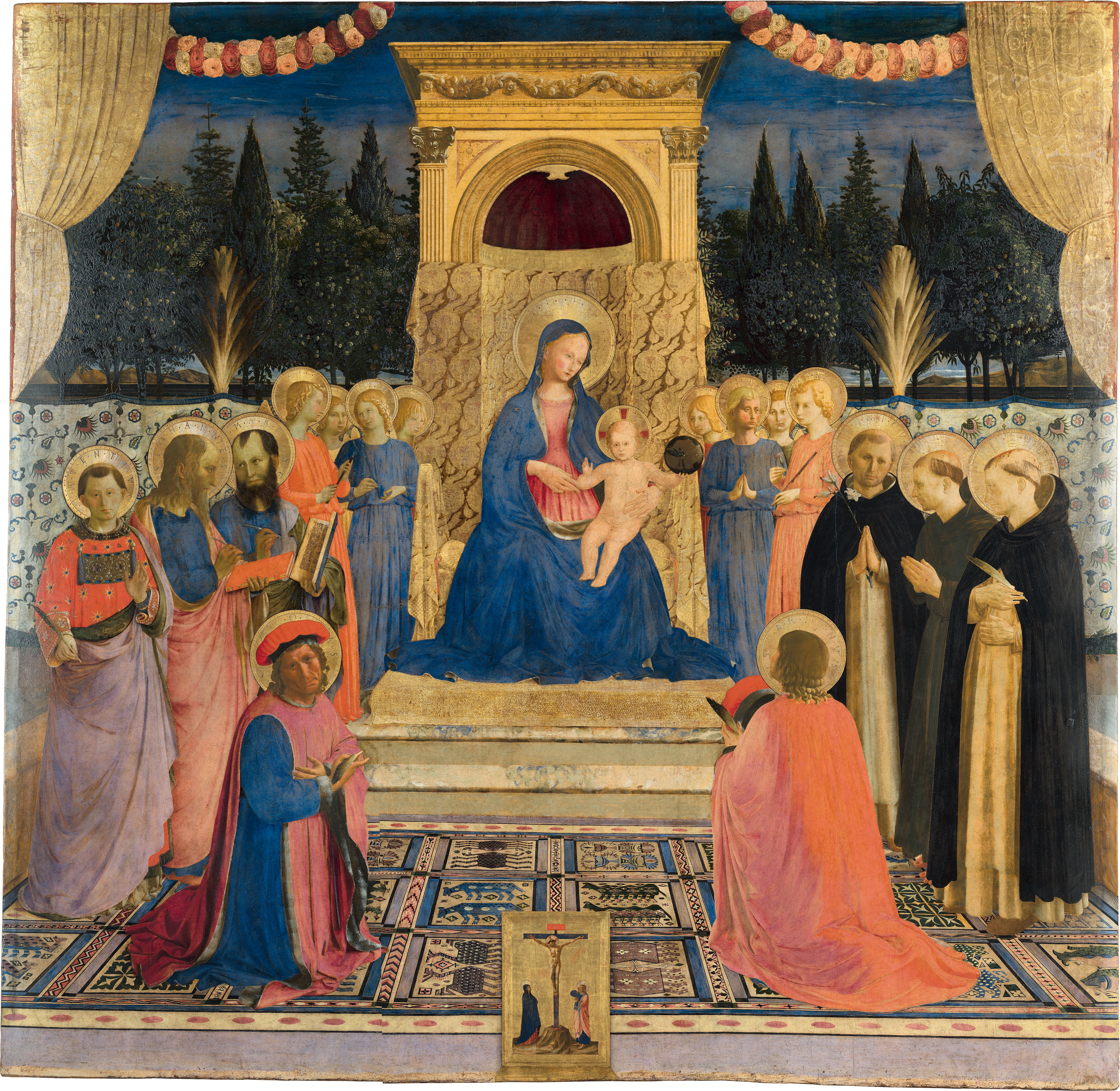
‘Virgin and Child Enthroned’ from the San Marco altarpiece (1438-42).
The danger of a monographic exhibition is that the artist appears in a vacuum. There is also the risk, of course, that padding a show too indiscriminately with the work of other artists will obscure its primary subject. The curators have focused their contextualisation on specific aspects of Angelico’s development. First come the painters of the previous generation who influenced his late Gothic beginnings, especially Gherardo Starnina and Lorenzo Monaco (‘the Monk’); then his contemporaries of the 1420s and 1430s, including Masaccio (‘careless Tom’), with whom Angelico developed ‘the new language’ of figuration; and, finally, the younger artists with whom he competed and collaborated in the last fifteen years of his career, including Filippo Lippi, Francesco Pesellino and Benozzo Gozzoli. A room devoted to three monumental cut-out Crucifixions – by Lorenzo Monaco in c.1420, Angelico in c.1430 and Pesellino in c.1450 – neatly captures the evolution of Florentine painting, as its proponents grappled with the best way to depict Christ’s anatomy and the reactions of onlookers.
Faced with a parade of flushed Madonnas and anguished Christs, it would be easy to think that Angelico was somehow apart from the intellectual and interdisciplinary advances we associate with the Renaissance. Yet he was incorporating many of these innovations into his practice. The principles of linear perspective are evident in the box-like spaces within which Angelico began to set his scenes. In his Last Judgment from the Florentine church of Santa Maria degli Angeli, the rows of empty tombs from which the blessed and the damned have just emerged hurtle towards a vanishing point like train tracks, bisecting the composition. The curators suggest that the panel was originally placed above a doorway; if so, this central recession would have appeared even more pronounced as viewers moved towards the threshold. Recent infrared imaging of another panel revealed that, before beginning to paint, Angelico ruled the orthogonals and incised along them the outlines of the buildings he intended to include.
He also drew on contemporary architectural developments as he began placing the figures of his altarpieces within unified, fictive environments rather than in polyptych compartments. After spending time in Rome alongside architects including Bernardo Rossellino, Angelico absorbed the vocabulary of classical revival into his work: in his last major altarpiece, painted around 1450 for the Bosco ai Frati church in his native Mugello, the Virgin and Child sit within a scallop-shell apse, while the flanking saints stand in front of a wall articulated by a frieze, aedicules and Corinthian pilasters. Angelico looked to sculpture to give his figures the appearance of greater three-dimensionality. The exhibition places his works alongside statues by Dello Delli, Luca della Robbia and Michelozzo, among others, and discusses his close relationship with Lorenzo Ghiberti, whose bronze doors for Florence’s Baptistery were an enduring influence. (Some scholars have suggested that Ghiberti even supplied Angelico with clay or wax maquettes to use as models for the figures in his paintings.)
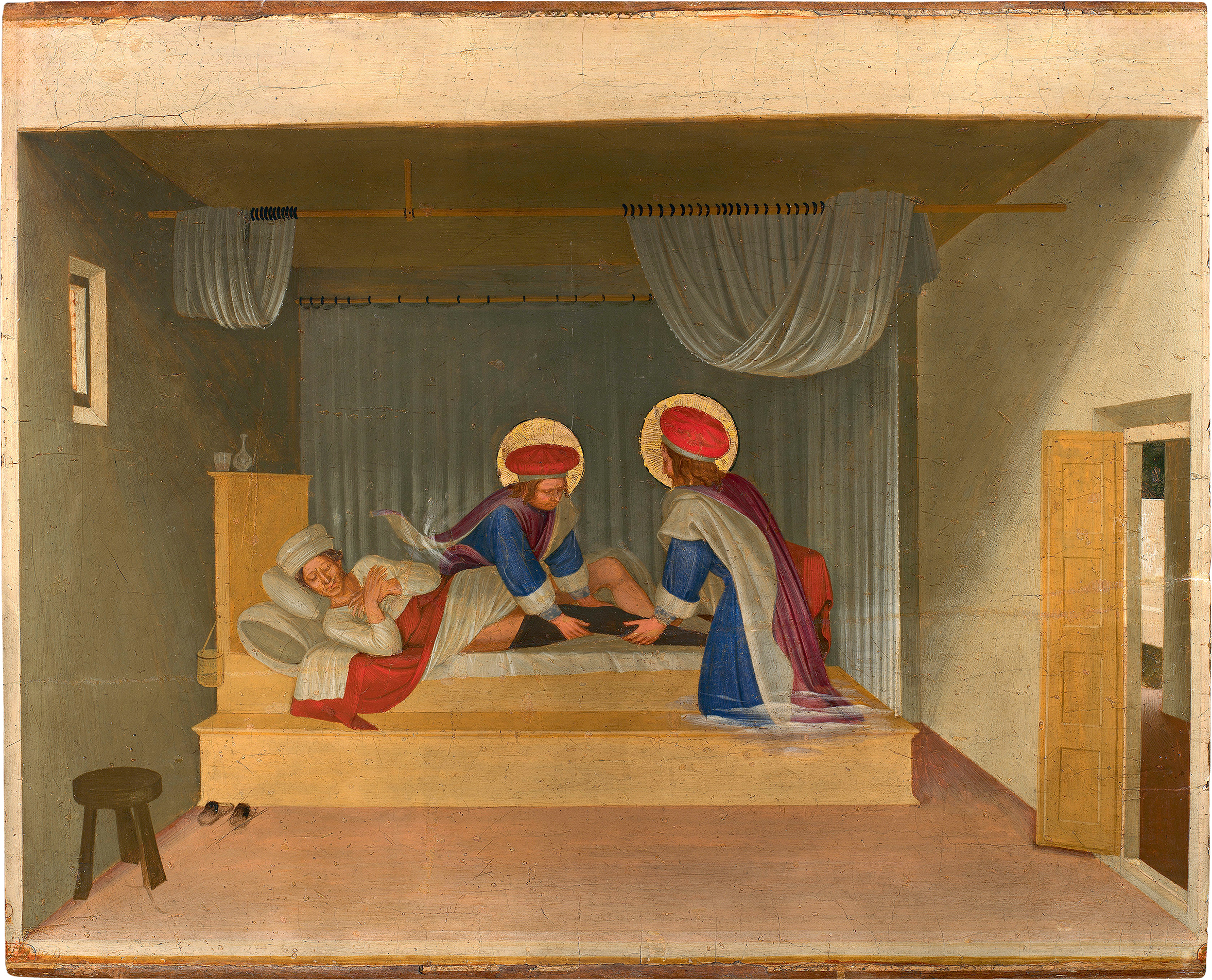
‘The Miracle of the Black Leg’ from the San Marco altarpiece (1438-42).
One of the exhibition’s greatest achievements is its reassembly of fragmented altarpieces. The Napoleonic suppression of religious houses in the early 19th century, combined with a growing taste for Angelico’s art, led to the dismemberment of several of his altarpieces and the sale of their fragments to collectors around the world. The curators have spent years negotiating their temporary return to Florence, allowing many of the most significant altarpieces to be displayed in their entirety – or near entirety – for the first time since they were broken up. In anticipation of the exhibition, several altarpieces have also undergone cleaning and conservation treatments.
The most impressive reunion in the exhibition is that of the altarpiece Angelico painted for the church of San Marco, commissioned by Cosimo de’ Medici and his brother Lorenzo, which the curators describe as ‘the first truly Renaissance altarpiece’. It now exists in eighteen pieces – the central panel remains intact, but the lower predella register has been divided into individual scenes and the lateral pilaster panels into separate saints – drawn from eight different collections, including the National Gallery of Ireland and the Minneapolis Institute of Art, as well as San Marco itself. The curators succeeded in securing seventeen of the pieces for the exhibition and have installed them together on a single wall, arranged to reflect their original relationship to one another. The main panel is set back from the other fragments, reflecting a new theory about the depth of the predella box, inferred from the width of the side panels. When you see the panels reunited in this way, it’s easy to understand why Pope Eugenius IV summoned Angelico to Rome following their unveiling on the high altar of San Marco in 1443.
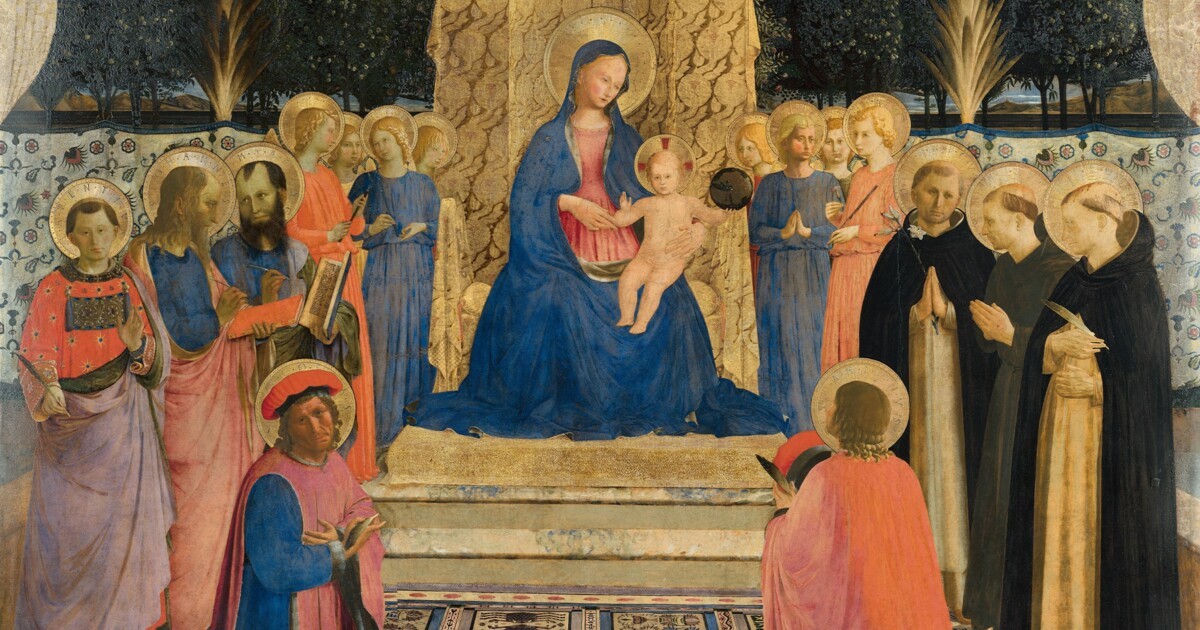
The main panel, showing the enthroned Virgin and Child surrounded by angels and a gathering of Dominican and Medicean saints, is beautiful, clever and slightly hectic. It is one of the earliest sacre conversazioni, altarpieces in which the figures interact with one another and share a unified space; here they stand on a spectacular Anatolian rug, patterned with geometric motifs and stylised beasts, its border woven with the Medici ball device. The rug may have been an actual Medici possession, an expensive import that Cosimo wanted to show off, but it also alludes to the recent rapprochement between the Eastern and Western churches. The composition is built around a central recession, with the saints arranged along the orthogonals so that the Virgin and Child form the vanishing point. The Christ Child, in a Salvator Mundi pose, holds a tiny globe on which the landmasses of the Mediterranean can just be made out. In the foreground kneel the physician brothers Cosmas and Damian, the Medici patron saints, distinguished by their red caps. Cosmas looks out at us, pointing towards the Virgin and Child in a classic Albertian technique of viewer engagement. Cosmas’s head, modelled in dark shadow and slightly too frontal for his torso, was probably intended as a crypto-portrait of Cosimo. Most striking of all is the small gold-ground Crucifixion panel that appears to be propped against the painting, casting a convincing shadow onto the picture plane. Angelico is reminding us that, however real the world he has conjured may seem, it is only wood and pigment.
The predella scenes – their sequence now confirmed through wood-grain analysis – narrate the life, martyrdom and afterlife of Cosmas and Damian (in addition to a central panel which depicts Christ’s entombment). As Christian doctors, the brothers devoted themselves to healing the sick at no cost, but in the first scene, Damian violates this principle by accepting three eggs as payment from a grateful patient. In the subsequent scenes, the brothers endure a series of torments as punishment for their Christian proselytising – drowning, burning at the stake, crucifixion – before finally being beheaded. In the penultimate scene, depicting their burial, the repercussions of the egg incident emerge: Cosmas, aggrieved by Damian’s flouting of their principles, requested that he be laid to rest separately from his brother. Yet at the burial, a camel miraculously speaks: a curling banner of text unfurling from its mouth declares that the brothers belong side by side in death. The final scene depicts one of the brothers’ posthumous miracles: the bizarre Miracle of the Black Leg, in which a deacon with a diseased leg receives a transplant from Cosmas and Damian, who appear to him in a dream. However, they use the leg of a recently deceased man from Ethiopia, leaving the deacon with a mismatched limb. Each scene of the predella is a discrete miniature world, a carefully wrought space alive with drama and anecdotal detail, while the series as a whole is bound by a quiet coherence of scale, colour and light.
The altarpiece was removed when the church of San Marco was remodelled in the 17th century. The adjacent convent, meanwhile, has survived largely as Michelozzo designed it in the 15th century, and its walls still bear the frescoes Angelico painted while a friar there in the early 1440s. With several assistants, he decorated its chapter house, one of its cloisters and each of the 44 cells that comprised the friars’ dormitory on the first floor with Crucifixions, Annunciations and other moments from the Passion of Christ and the Life of the Virgin, chosen in accordance with Dominican theology. The convent has been a state-run museum since 1869, although a handful of friars continued to live there until 2018. As the second site of the Fra Angelico exhibition, the convent-museum presents just one curated gallery and the invitation to move through its frescoed spaces, largely unmediated.
To see Angelico’s art in situ, and in such abundance, is an extraordinary experience – and one that is not limited to the exhibition. These works are activated by their context, literally in some cases: several scenes are set in spaces that look like the convent itself, with its restrained classical style and plain stuccoed surfaces, creating a sort of mise en abyme, while in the sacra conversazione Angelico painted in the dormitory corridor, the oblique shadows cast by the columns align with the direction of light from the real windows. You can walk along this corridor and peer into each cell, taking in the frescoes – some austere, some almost lavish – that once guided the devotion of its occupants. The convent and its art encourage a sort of contemplation different from that of a museum. Henry James, who visited in 1873, put it well: ‘You may be as little of a formal Christian as Fra Angelico was much of one, you yet feel admonished by spiritual decency to let so yearning a view of the Christian story work its utmost will on you.’