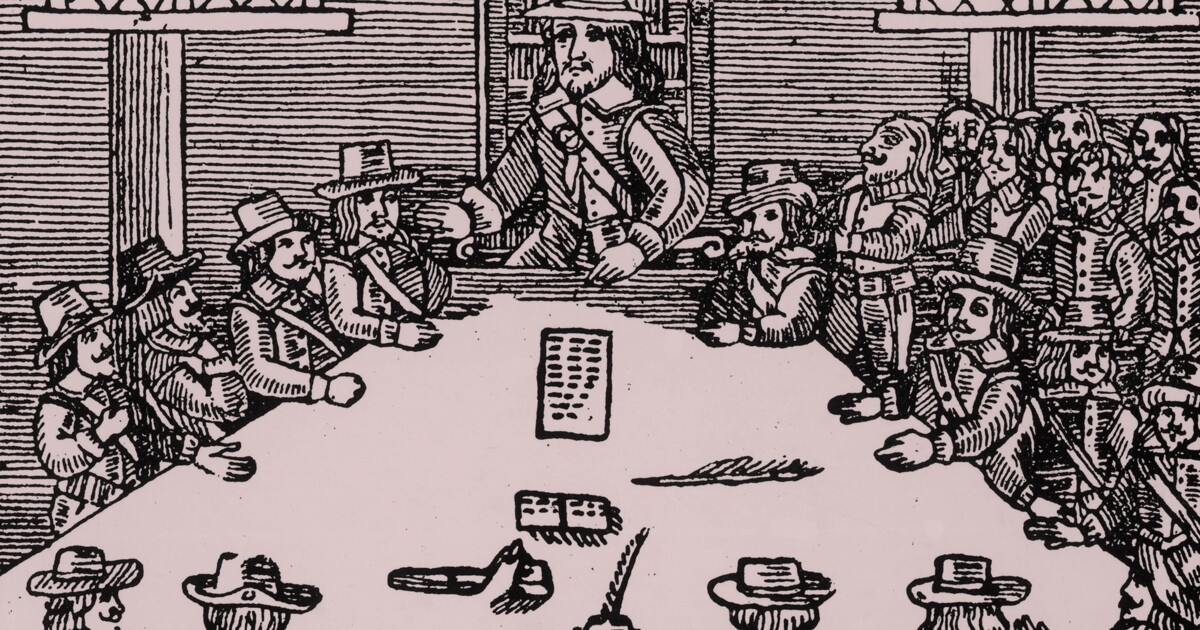
Calvin’s Case (1608) is, as one of its judges, Sir Edward Coke, put it, ‘magnum in parvo … a matter of great consequence upon a slender subject’. The case concerned whether a Scottish child could inherit property in London. King James VI of Scotland had acceded to the English throne five years earlier, and this was the first test to establish whether a Scottish subject, in this case the young Robert Calvin, had the same rights in England as James’s English subjects. The judges decided – or rather, affirmed – that in English common law, subjecthood was acquired through birth in the country (jus soli), rather than through parental descent (jus sanguinis). And so, as subjecthood appertained wherever you were in the monarch’s dominions, Calvin was an equal subject in both England and Scotland. This concept of subjecthood soon applied in England’s infant colonies, including in America, where, after the Revolution, it became the basis of American citizenship.
Jus soli subjecthood in the United Kingdom ended with the 1981 British Nationality Act, in accordance with which a child born in the UK and its territories would only become a British citizen if at least one parent already held citizenship or settled status. Jus soli still holds in the US, incorporated into the constitution in 1868 by means of the Fourteenth Amendment, whose ‘citizenship clause’ states that any child born on American soil and ‘subject to the jurisdiction’ of the US automatically becomes an American citizen. The amendment reaffirmed the older common law rule and swept away the Dred Scott ruling of 1857, with which the Supreme Court had denied citizenship to Black Americans free and enslaved. Birthright citizenship in the US was settled law for more than a hundred years, reaffirmed in statute and in cases such as United States v. Wong Kim Ark (1898). On the first day of his second term, however, Donald Trump signed Executive Order 14160, ‘Protecting the Meaning and Value of American Citizenship’, which rescinded citizenship from any child born to an undocumented mother or to a mother present in the US on a temporary visa, part of a wider package of measures intended to strip rights from migrants and their families. ‘I hate to call it birthright citizenship,’ J.D. Vance said. ‘It’s a loophole that now exists in our immigration system that rewards illegal aliens just because they have a baby in the United States.’
It was relatively straightforward for the British government to end birthright subjecthood: statute overrides common law. It is less easy for those seeking to end birthright citizenship in the US, since the courts cannot overrule the constitution. The Trump administration had to prove that the Fourteenth Amendment had been misinterpreted. For eighteen months, Trump’s executive order was subject to legal challenge, first in the district courts and then at the Supreme Court, which ruled last month (in Trump v. Barbara) that the order was unconstitutional. The arguments reached back to English common law and to historical interpretations of allegiance and domicile.
Calvin’s Case was controversial at the time, not because it affirmed birthright subjecthood, but for what it said about the rights attendant on it. On becoming king of England, James wanted to ensure that his Scottish subjects held the same rights as his English subjects when on English soil. As he understood it, allegiance was owed to him personally, so it followed that his Scottish subjects would become subjects in England – and vice versa. ‘As Honour and Privileges of any of the Kingdoms could not be divided from their Sovereign,’ he told Parliament in 1604, ‘so are they now confounded and joined in my Person, who am equal and like kindly Head to you both.’ Parliament and English lawyers thought differently. The rights of subjects in England were understood not to depend solely on monarchical will; rather, these rights were contained in, and enforceable through, the common law. The monarch and his or her subjects had obligations to each other: subjects owed allegiance, and in return the monarch protected and upheld their legal rights. For many, the coronation oath was the guarantee of this mutually beneficial relationship. John Rastell, a legal publisher, wrote in 1527 that the monarch ‘shall grant to hold the laws and customs of the realm and to his power keep them and affirm them, which the folk and people have made and chosen’.
As a result of this constitutional impasse, James was unable to secure the naturalisation of his Scottish subjects by parliamentary means and so turned to judge-made law. In Calvin’s Case, the judges obligingly found that Scots born after James’s accession to the English throne were also his subjects in England: they owed ‘natural allegiance’ to the monarch. Coke’s judgment explained that ‘natural’ allegiance was indefinite, pure and irrevocable. There was no element here of the contractual, legalised form of allegiance asserted by opponents of Scottish naturalisation (and valued by some of the other judges on the case). However, Coke also tried to retain elements of the rights-bearing status of English subjects, by asserting that such allegiance conferred not just the ‘natural’ protection of the king, but also the ‘legal’ protection of English laws.
Coke’s fudge did not go unnoticed and was exploited throughout the century by English subjects seeking to protect their rights. Nathaniel Bacon, a lawyer and legal writer, wrote in 1651 that the case was ‘a knot of Opinions’ that ‘alters the fundamental nature of the Government of this Nation from a Common-wealth to a pure Monarchy’. But even when radical thinkers denied that allegiance was due to a monarch, jus soli remained the basis for rights. The Leveller Richard Overton wrote in Vox Plebis (1646) that the rights granted by Magna Carta inhered in birthright citizenship: ‘This word, liber Homo, or free Man, extends to all manner of English people … of England (which is every man born in the Realm).’ During the Putney Debates of 1647, participants disagreed profoundly about who had the right to suffrage, but all agreed that rights adhered in ‘the people of this Kingdom, distinct and divided from other people’. The ‘people of this Kingdom’ were those ‘born in England’.
Disputes about Calvin’s Case in the US in recent years have not been concerned with the rights of subjects. The main interest has been whether Calvin’s Case, and English common law more generally, guaranteed birthright citizenship. On this, Coke’s judgment is clear and drew on established legal principles. From the late 15th century, legal writers such as Thomas de Littleton had noted that children born abroad were ‘out of the allegiance of our sovereign lord the king’ and therefore out of ‘the king’s protection’, and ‘out of help and protect by the king’s law or by the king’s writ’. To be born a subject was to have access to the rights of subjecthood. In the 16th century, ‘Egiptians’ (that is, Gypsy, Roma or other Traveller people) were forbidden from entering England, subject to deportation, forfeiture and, in some cases, execution. By contrast, ‘Egiptians’ born on English soil, or English subjects who had chosen to join Travellers, were merely ordered to leave their ‘naughty, idle and ungodly life’.
There is copious evidence that this rule was widely understood, even if the local and national authorities often attempted to overrule it – usually in pursuit of cash. When it was challenged, the legal advice on the status of children born in England remained consistent. In 1613, the Privy Council redrew the agreement that governed the migrant community in Norwich in order to reduce the ‘excessive liberty which the said Dutch men have assumed unto them’. However, they excluded the children of migrants, noting that ‘a great part both of the Dutch and Wallowne congregations are natural subjects born in England,’ and so should have ‘all such liberties of trading and merchandising within the said city as any Englishman’. In 1626, Charles I sought legal advice on whether second-generation migrants could be forced to pay the double customs charges laid on migrants. The legal advice was clear: children born in England were ‘natural Englishmen’ and therefore entitled to all the ‘freedom of a Subject’.
Just as the judges in Calvin’s Case made legal contortions to interpret the law in a way consistent with existing legal principles and the desires of the new monarch, so have supporters of Trump’s effort to abolish birthright citizenship. Clarence Thomas, one of the dissenting judges, noted that ‘the president’s initiative [has] generated a groundswell of new scholarship.’ Lawyers and scholars including Ilan Wurman, Randy Barnett, Samuel Estreicher and Rudra Reddy have worked – through law review articles, op-eds and amicus curiae briefs submitted to the Supreme Court – to fashion Calvin’s Case into something usable by the administration. But the legal principles and practices of 17th-century England present a significant problem. To provide an evidential basis for the illegitimacy of birthright citizenship, Trump’s supporters have focused on the phrase ‘subject to the jurisdiction’ in the Fourteenth Amendment, and argued that this excludes those present ‘illegally’ or only on temporary visas. But there were no border controls in early modern England – they were only instituted fully after the 1905 Aliens Act – and so there was no ‘illegal entry’ at that time, though certain peoples, as in the case of ‘Egiptians’, could be banned from entering.
The Calvin’s Case judgment did outline a schema of different types of allegiance, and therefore rights and protections, which would apply to those born outside the monarch’s dominions. All migrants owed ‘local’ allegiance while they were resident in England: this meant, broadly, that they were subject to the law, but not automatically entitled to its protections. Those born in countries whose monarchs were ‘in amity’ with the English monarch could rely on prerogative protection, the law of nations and rights under treaties. Those from countries ‘in enmity’ could not access protection; ‘infidels’ were born into a state of ‘perpetual enmity’, which meant they were, as the lawyer Edmund Wingate put it in 1658, ‘utterly dis-abled to maintain any action’.
Coke seems to have been anxious to ensure that any possible exceptions to birthright subjecthood were answered. He noted that children born in England of ambassadors, or of soldiers in invading armies, were not subjects, as their parents did not owe ‘local’ allegiance. These same provisions exclude a minority of children born in the US from citizenship today. Arguably, according to Coke, the children of ‘infidels’ born in England, if they continued to follow their parents’ religion, would not be subjects, since they were continuing as ‘perpetual enemies’. These were the only exceptions, and within decades, for Jews at least, the difference between ‘infidel’ and Christian migrants had, so far as the law was concerned, become insignificant.
Clarence Thomas, in his dissenting opinion, picked up on the work of scholars who suggested that birthright citizenship was contingent on the status of migrant parents: that they should hold ‘primary allegiance’ to England, testified to by domicile. In practice, though, the status of migrant parents – whether from countries in amity or enmity – had no bearing on the rights of their English-born children in the 17th century. England was at war with France in the 1690s, but the Aliens Act of 1698 allowed the children of migrants, including French migrants, to inherit property. Indeed, it made no mention of parental affiliation or local allegiance: the child of a migrant born in England was a ‘natural born Subject’. The question of whether the children of ‘infidels’ could access the same rights was settled in a 1722 legal opinion by several judges on whether Jews could hold property. Clement Wearg, who would go on to be solicitor general, stated that when infidels ‘are Aliens, they are subject to the Incapacities of Aliens … if born in England, they are intitled to the same Civil Rights with Persons of other Persuasions … born in England.’
The Supreme Court found Trump’s executive order to be unconstitutional by the narrowest of margins, with four justices dissenting. The trend in recent years has been for countries to do away with, rather than affirm, jus soli. Ireland abolished the practice in 2005 after a referendum; Australia, New Zealand and India have all revoked it. As the history of Calvin’s Case shows, citizenship – or subjecthood – are never uncontested, or uncomplicated. But law is not the only element in determining citizenship: the actions of those who interpret or challenge the law are just as important. While Britain remained a member of the EU, thousands of children were born to parents who had emigrated to the UK from other European countries. Their citizenship was contingent on the meaning of ‘settled’ in the 1981 Act, which encompasses all those with no time limit on their residency. In 2000, the Home Office determined that it required at least one parent to have been awarded indefinite leave to remain. In 2006, it was narrowed further, to one parent having been granted permanent residence. This brought into question the citizenship of children born in the earlier period, which was resolved only in 2023, when the British Nationality (Regularisation of Past Practice) Bill affirmed in law what was already established by custom, that those children, having been regarded and treated as British citizens, were British citizens. There is anyhow provision under the 1981 Act for children who do not qualify for citizenship at birth: any child born in the UK who is still living here on their tenth birthday is entitled to become a citizen, though this is often an onerous process. Calvin’s Case did not go so far as to extend English subjecthood to Scots born prior to James’s accession, the antenati, for fear this would lead to an influx of ‘hungry Scots’. Francis Bacon, however, argued that a ‘magnanimous nation’ was ‘ever liberal in point of naturalisation’. ‘In such sort doth the law of England open her lap to receive in people to be naturalised.’