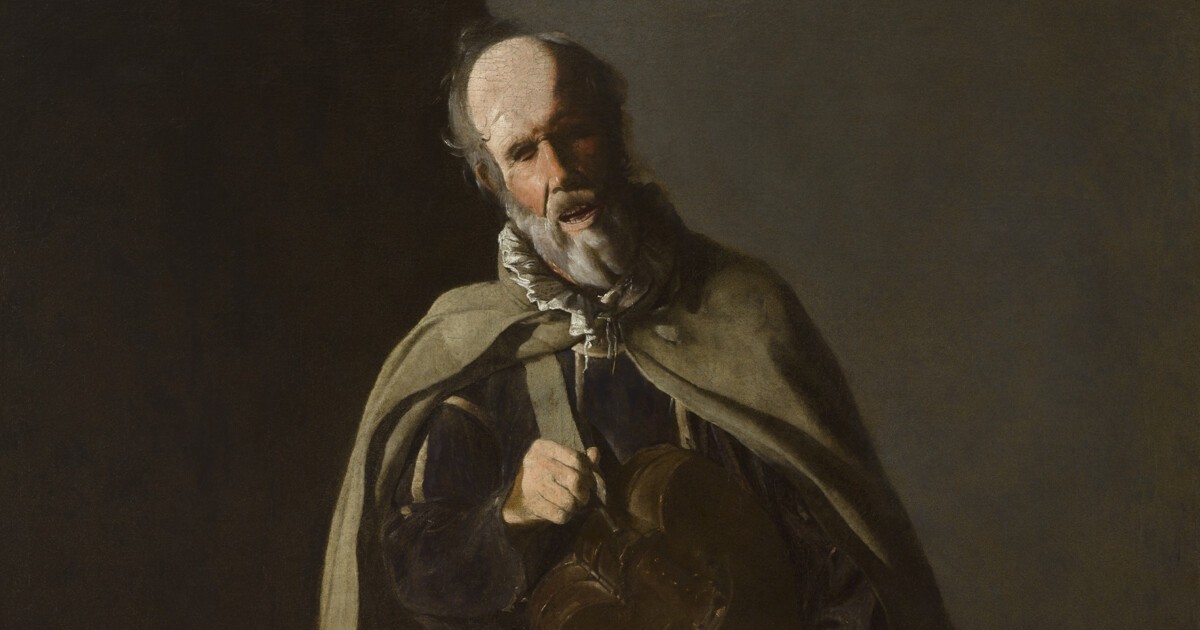
The man on the canvas stands five foot four, in other words nearly life size. You stand no further away from him, to judge from the angle at which you view the dog at his feet. The two as it were confront you. You can almost smell him, this weathered blind beggar. You can almost hear him: his hollering, his hurdy-gurdy’s abrasive dense drone. And you are watched – but unsettlingly, by eyes on a lead, those of the little ratter who stares up from the floor. Georges de La Tour’s scan of the visual field is a stark, bold testing out of basic facets of experience. What is it to face another human, when that person cannot see you? What are humans if not tall bipeds, with heads that dangle above a distant ground? Bipeds with voices, though: animals that intone. In a smaller studio exercise, also from the early 1620s, La Tour observes those animals at feed. A needy old couple guzzle bowls of peas, alms that the painter has supplied them with. Hunger rules them, yet they’re not entirely bowed: the woman glares back at him, even as the food is at her mouth.
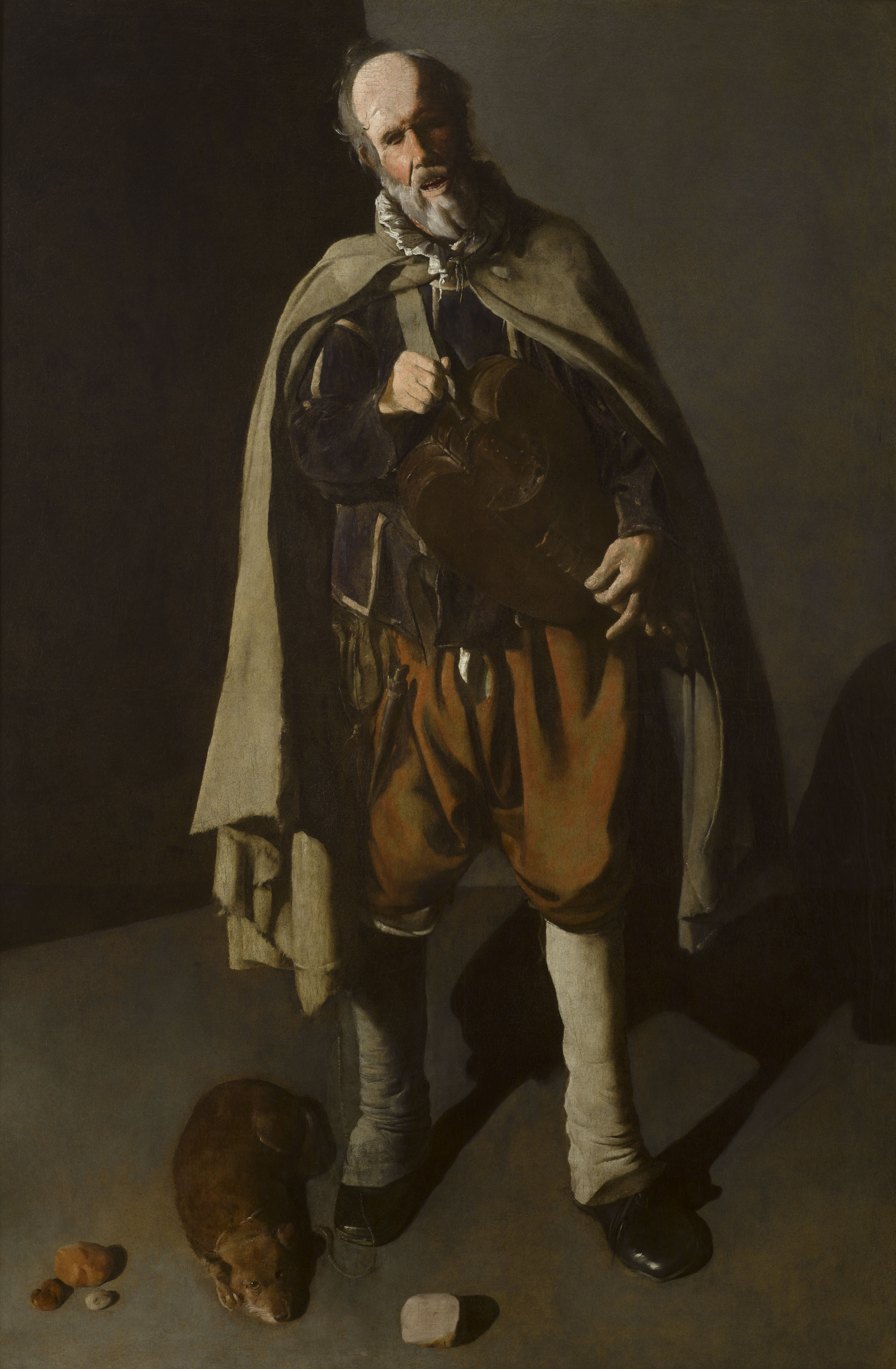
‘The Hurdy-Gurdy Player with a Dog' (c.1622)
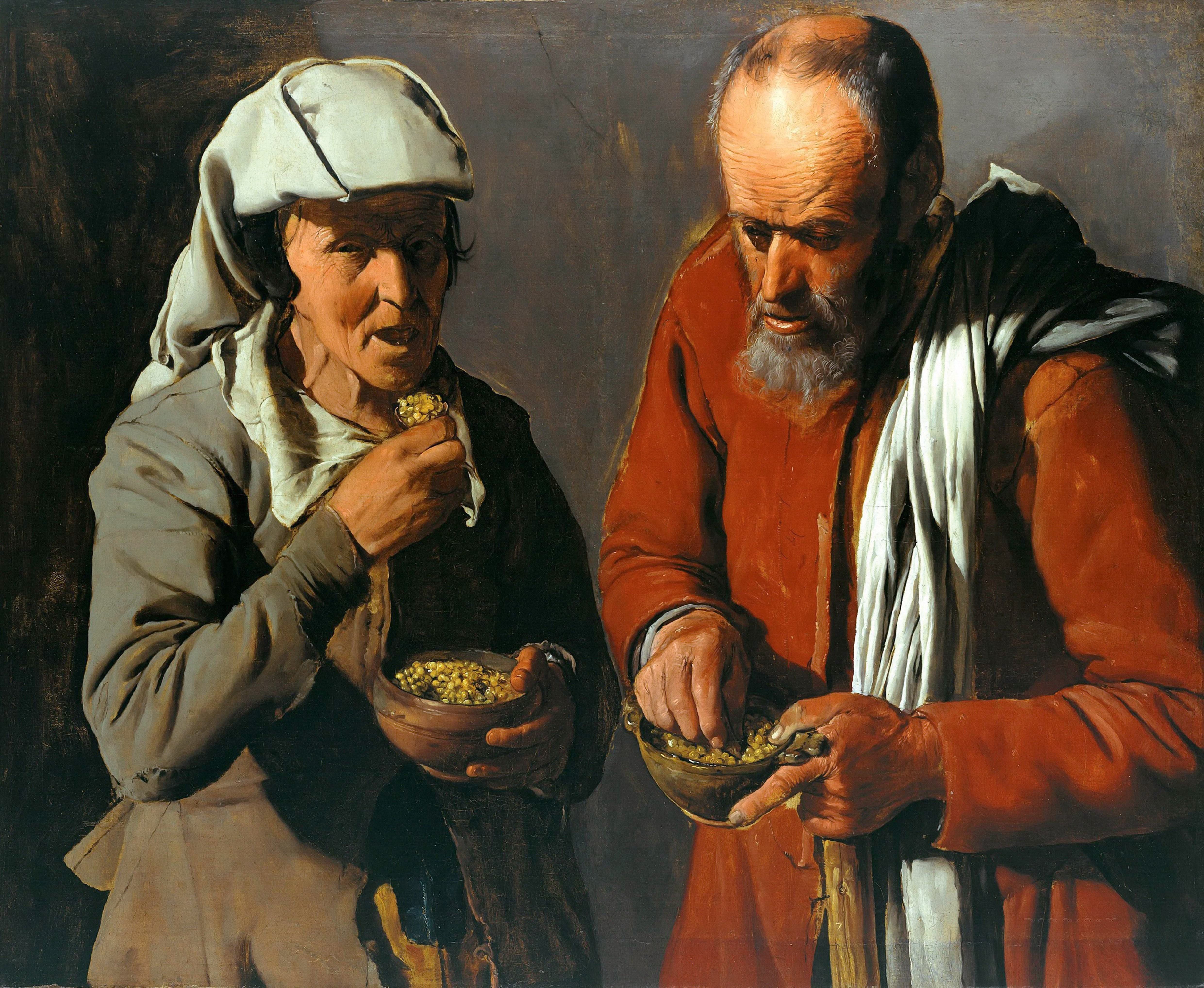
‘The Pea Eaters' (c.1920)
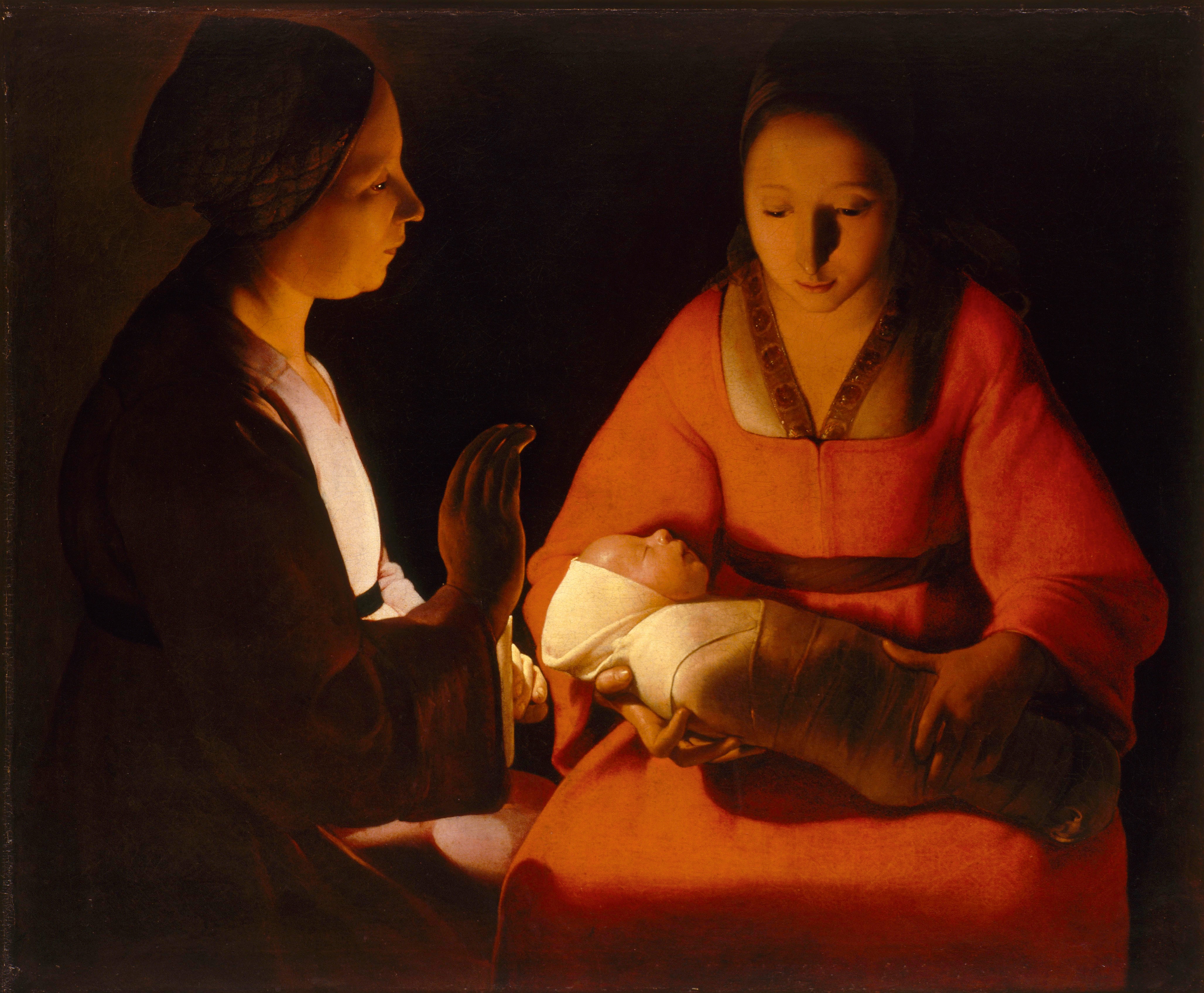
‘The Newborn Child' (c.1647-48)
These experiments are of their nature social. There was a pattern to follow for the young artist with a father in the Lorraine corn trade and a wife with connections in the duchy’s court. It runs back to the Limbourg brothers’ pictures of feudal peasantry from two centuries earlier: in the middle lands between France and Germany, high art’s overview involved looking down. A snigger, even a shudder was in order: the current exhibition at Paris’s Musée Jacquemart-André, Georges de La Tour: Entre ombre et lumière (until 22 February), includes for comparison an etching by Jacques Bellange, a Lorrainer of the preceding generation, in which a rabid hurdy-gurdy man is strangling a fellow beggar. But La Tour takes on lowlife imagery with eyes reattuned by the Caravaggesque revolution that had just swept Europe. (A contemporary cousin to his canvases would be The Waterseller of Seville by the young Velázquez, in London’s Apsley House.) Empirical evidence is to the fore. Symbolic intent is part suspended, subsumed within plays of light against dark that are at once natural and metaphysical.
This agenda allows for respect: observer and observed are on the same level. Furthermore, for a rapport, it would seem, in the case of La Tour’s blind musician, since he served as a model for at least four other somewhat smaller paintings. And the suspension of connotations is only partial. Majestic in scale, the clamorous greybeard challenges us almost as a prophet might: a Wunderlicher Alter, ‘strange old man’ like the hurdy-gurdy player at the desolate endpoint of Schubert’s Winterreise sequence. Over the decades till his death in 1652, La Tour would return repeatedly to ambiguities such as these. He becomes the painter par excellence of immanence, of the divine that is in us rather than above us. The shuttle between sacred and secular runs either way. The Paris exhibition features a commissioned set of half-length apostle portraits in which saints’ attributes conjoin with scratchily specific ‘wrinkled faces of peasants and bearded beggars’, as Pierre Curie, one of the curators, puts it. It also includes a tall canvas in which a young woman sits alone by candlelight, eyes fixed on some tiny item her thumbs compress as her nightdress falls loose to reveal her breasts. What does she squeeze? The Servant Girl with the Flea is the title supplied, but the art historian who instead proposed a rosary bead responded appropriately to the gravity of her demeanour.
And to the steadiness of La Tour’s attention. He cares for this exposed female without slavering: beyond an exercise in looking at her, he seems to arrive at one in feeling with her. That impression arises from his economy of means. You would not know that immediately around La Tour, for much of his career, the Thirty Years’ War was raging, spawning horrific scenes recorded by his fellow countryman Jacques Callot. La Tour dwells on an indoor world occupied by human figures, their clothing and whatever accessories are immediately to hand – chief among them, lit candles. White, black, ochre and vermilion, often the only colours on his palette, kindle a reliable warmth: his brushes use them to explore varieties of surface, but do so without ostentation. Those figures are ‘forms constructed on a surface, on a ground devoid of relief’: Gail Feigenbaum, another curator, is here contrasting them with the more three-dimensional bodies in Caravaggio’s chiaroscuros. Forms obedient to a certain formalism: over against that girl in her nightdress, a red chair-back set flat on to the picture plane bears out Feigenbaum’s claim that the compositions have ‘an abstract conception’.
It would be good to know whether La Tour ever directly set eyes on a Caravaggio. Most academics now think it unlikely that his career began with a study trip to Italy. And it would be good if we could close in on the spaces in which he operated. When local potentates hung large canvases such as The Hurdy Gurdy Player with a Dog in their châteaux, did trends in Catholic spirituality nudge their purchasing? One of the wall texts in the exhibition cites lines from Les Ténèbres, a 1624 publication prompted by the Lorraine poet Henry Humbert’s loss of his eyesight. But on further inspection, this clue may be misleading. Humbert’s verse sequence is a set of howls against his descent into ‘appalling night’. By contrast, La Tour’s darknesses are affirmative ushers to concentration.
We know at least that their reputation spread to Paris, where Louis XIII admired the nocturne St Sebastian Tended by St Irene, so that by 1639 the 46-year-old La Tour could claim the title of Peintre du Roi. A year earlier, French armies had torched the town of Lunéville and with it La Tour’s home and an unknown quantity of his work: but his allegiance remained evidently to the force that was extirpating Lorraine’s sovereignty. The little else that we know of the public man is not appealing. A 1646 deposition from Lunévillians, complaining of an ‘odious’ neighbour who let his dogs loose ‘as if he were the local lord’, suggests that La Tour reserved his compassion for the studio. One reason we don’t know much is that two years later, with the foundation of the Académie Royale, French fashion veered decisively away from Caravaggesque picture-making, meaning that a practitioner in that mode from a recently acquired province was completely forgotten. It was not till 1915 that Hermann Voss began to reassemble his oeuvre. The subsequent upswell of enthusiasm for this new ‘Old Master’ more or less tracked that for Caravaggio, re-evaluated from the 1920s by Roberto Longhi.
The present show follows others in the Jacquemart-André that were devoted to Caravaggio himself and to Artemisia Gentileschi, another interpreter of his legacy. In the museum’s cramped little galleries, La Tour is tailored to a somewhat constricting pattern. Unable or unprepared to borrow his most adventurous mid-career paintings, the curators of Entre ombre et lumière cleave to his ‘tenebrism’ and introduce for comparison further exponents of that early 17th-century vogue. The Met’s The Fortune Teller and the Louvre’s The Cheat with the Ace of Diamonds would have expanded our sense of La Tour: his gifts in fact reached to sumptuous and intricately plotted comic drama. As it is, the paintings in the show that come closest to the nuanced repartee of plays from a couple of decades earlier – say Twelfth Night or Henry IV Part I – are by a Fleming in Paris called Adam de Coster and a dazzling anonymous who, identified only by his lodging in Rome, gets labelled ‘Il Pensionante del Saraceni’. These and five other exhibits turn on the biblical episode in which Peter denies Jesus. The gospel text specifies a courtyard at night and a maid who knows he’s lying: its additional ‘servants and officers’ become, in the painters’ hands, a tavern gang, a turbid, torchlit gaggle of sinners. Bad faith, you come to feel, was an itch this era loved to scratch.
There is no such restlessness about the works that dominate the display. In them, La Tour flattens time, just as he flattens space. The candles illuminating his repentant Magdalene and indeed his own repentant Peter look never to gutter. Action and change are precluded, because, from La Tour’s religious perspective, these figures stand for ways that we permanently and necessarily exist. For want of sound knowledge of La Tour’s own frames of discourse, I think across from these solitaries in their frames to other occupants of the period’s interiors: Descartes with his door shut and his stove lit in 1619, rethinking the nature of thought, or the everyman of Pascal who could only be happy if he knew ‘how to stay quietly in his room’. Essentialise, reduce – those are the shared agendas. It’s not exactly that La Tour’s work is of an invariant grain. There is a long journey from the youthful handiwork of The Pea Eaters – a raw and urgent transcription of facts before the eye – to the smooth and precisely calibrated volumes of The Newborn Child, a work dated to the painter’s final few years. Yet one question runs throughout: how is it that human beings be? Bipeds grounded in nutrition and reproduction: light-takers, light-makers, love-vessels. Let this nativity be all nativities. Look, no haloes!