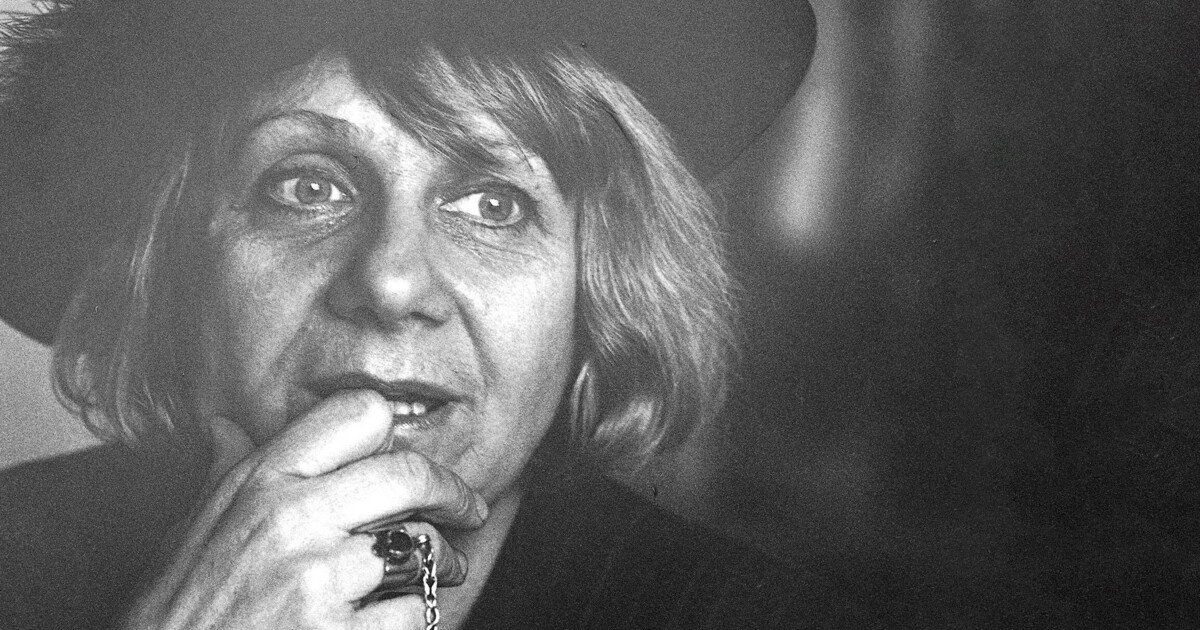
‘Who’s Afraid of Ludmilla Petrushevskaya?’ was the title of an essay that appeared in a Russian émigré literary journal in 1984. Petrushevskaya’s stories – short tales of doomed romance and family conflict set within cramped Soviet apartments – were domestic, small-scale, so why weren’t they being published? By 2009, things had shifted. ‘With the death of Solzhenitsyn,’ her translators Anna Summers and Keith Gessen claimed in the introduction to There Once Lived a Woman Who Tried to Kill Her Neighbour’s Baby: Scary Fairy Tales, ‘it would not be an exaggeration to say that Petrushevskaya is Russia’s best-known living writer.’ Her feelings about the Russian canon remain complicated. She loves Gogol and early Chekhov. She hates Gorky and Tolstoy (‘a graphomaniac’). She admits few influences and even fewer heirs (she says she hasn’t heard of Vladimir Sorokin or Victor Pelevin). Asked to name five great novels, she refused: ‘I’m not a reader, I’m a writer.’
Her work has its origins in the homespun epics of what she has described as Russia’s ‘women Homers’, whose folklore she collected ‘on trains, in queues, in hospitals, at bus stops’. The habit of being what she calls ‘a listener’ started early. Her grandmother knew ‘practically all of Russian literature’ off by heart, having been told by her own father that she would need to have a way of entertaining her fellow prisoners when she ended up in a penal colony. As a child, Petrushevskaya listened to an adaptation of War and Peace on the radio, and when each episode ended her grandmother would continue exactly where it left off, word for word, though the little girl much preferred her recitations from Dead Souls. It was a mixed inheritance. ‘I think it was my grandmother that made me a writer,’ Petrushevskaya told the translator Bela Shayevich in the Paris Review last year. ‘You must have loved her very much,’ Shayevich replied. ‘I didn’t.’
Petrushevskaya was born in 1938 in the Metropol Hotel, an Art Nouveau pile that became famous for housing a number of revolutionary families. In her memoir, The Girl from the Metropol Hotel, she outlines her Bolshevik pedigree. Her great-grandfather Ilya Sergeevich Veger was an early member of the Social Democratic Workers’ Party and an ‘erstwhile defender of the oppressed’; her grandmother’s brother Vladimir helped orchestrate the revolution of 1905. Her grandfather Nikolai Yakovlev was a linguist and a colleague of Roman Jakobson (Yakovlev spoke 11 or 23 languages, depending on which of Petrushevskaya’s accounts you believe). Her grandmother was courted by Vladimir Mayakovsky (he called her ‘the Blue Duchess’) and, she tells us, edited the Great Soviet Encyclopedia with Lenin’s sister Maria Ulyanova. Her aunt Vava was ‘the prettiest student in the Armoured Transport Academy’. As a teenager, Petrushevskaya’s mother, Valentina, ‘a naive, serious-minded and completely innocent girl’, was besotted with a portrait of the young Maxim Gorky.
Until the late 1930s the Veger family had a busy and pleasant life, visiting their dacha in the Silver Forest and going to meetings of the Moscow Linguistic Circle. But, like many members of the intelligentsia, they fell foul of Stalin’s purges and in the spring of 1937, a year before Petrushevskaya was born, three of her grandmother’s siblings were arrested along with their spouses; only one survived. The family had become ‘enemies of the people’. As a result, Petrushevskaya’s father, a classmate of her mother’s and a man from whom she says she inherited nothing at all except ‘a kind of peasant fortitude and practicality, an ability to survive’, publicly disowned Valentina in front of their fellow students when she was pregnant with his child. (He later married her, but it didn’t last long.) When Petrushevskaya was a toddler they came home one day to find the Metropol apartment sealed up: ‘The door handles were encircled with wire, and on the wire hung a lead seal. If they had returned an hour earlier they would have been taken.’ When war broke out, they evacuated to Kuibyshev (now known as Samara) on the Volga in a cattle car.
Much of The Girl from the Metropol Hotel has the feel of a fairy tale, with its contrast between grandeur and poverty and its recurrent image of a small girl adventuring in the dark. The brisk chapters have a charmed quality, a sense of peril and magic. In one, Petrushevskaya almost drowns in the Volga and is saved by a woman who mistakes her for a puppy. In another, she scales Kuibyshev Opera House and begs to be let in: ‘No mummy, no daddy, please Comrade, take pity on an orphan!’ A kindly lighting technician opens a hatch so that she can stand on the catwalk to watch the evacuated Bolshoi Opera perform The Barber of Seville. After her mother left Kuibyshev for university, riding back to Moscow on a train during the winter wearing just a sundress, Petrushevskaya spent the rest of her early childhood with her grandmother and her aunt. They were still pariahs. Banned by their neighbours from using the bathroom or kitchen in their communal apartment, they foraged in the bins at night for food. One evening Petrushevskaya found her grandmother in a pool of blood in the hallway: a neighbour, having seen her in the bathroom, had hit her on the head with an axe (she survived). Petrushevskaya’s prose style is straightforward and matter-of-fact, but the experience of going hungry works its way into her sentences. She hopes that what she eats will transform itself into something better. She is fed a ‘pastry’ that is actually a slice of white bread; she eats cherry-scented glue in the belief it’s flavoured with real fruit. Hunger does induce changes: her grandmother, suffering from starvation-induced oedema, towers over Petrushevskaya’s ‘bone-thin body like a mountain’. When she suffers oedema herself, a boy shouts: ‘Look, a gal knocked up!’ But anything that is available to eat remains stubbornly itself: crushed cabbage leaves, potato peel, stale crusts.
When it was warm enough to be outside without shoes, which she didn’t have, Petrushevskaya would beg for food. She made a show of it. At first she sang, ‘like Édith Piaf … cheesy, lowbrow numbers beloved by washerwomen and lumpen proletarians’, but when her repertoire ran out she would tell a story: Gogol’s ‘The Portrait’, lifted from her grandmother. It was a winning routine. In the small square outside her apartment, she was a hit:
The children were stunned. One time, someone gave me a slice of black bread. Another, a shy little boy approached and said his mama wanted to see me … We all walked up the dark stairs, a door opened, and a woman with a face wet with tears offered me a green open cardigan that I put on immediately. Everyone rejoiced at my acquisition and looked me over with pride, as if I were their successful creation.
When Petrushevskaya was nine her mother took her back to Moscow. Valentina worked, but the family continued to live in immense poverty, and Petrushevskaya continued to be moved around, from underneath her uncle’s kitchen table to an orphanage, then to a children’s sanatorium. In the sanatorium, at night, she honed her tale-telling skills by making up scary stories, which, she says, are ‘the only kind of story that people really listen to. Humour doesn’t cut it, or romance, or lyricism – no, no, no. Only terror works.’
She studied journalism at Moscow State University, which she hated for its emphasis on ideological conformity. (‘“Theory and Practice of the Soviet Party Press and the Foreign Communist Press.” God. I couldn’t force myself to cram for this.’) She spent the 1960s as a reporter in TV and radio, and it was while working at the magazine Krugozor that she began to pay attention to the life stories of average Soviet citizens, becoming obsessed with the direct, unvarnished way they spoke about their lives, aborted love affairs, dead relatives, suicide attempts. They would say ‘things like: “I had a braid down to my ass tied up in a baby-blue ribbon.” A real-life epic poem.’ She tried to get Krugozor to publish her anonymised, fictionalised versions of these stories, but it wouldn’t do so without adding real names and identifiers. She refused and left the magazine. After a brief stint working for Soviet Central Television – ‘a complete farce … our boss was a spy’ – she took freelance work translating, editing and writing book reviews and children’s stories. (The children’s tales are wonderfully errant things, deadpan Thurber-style fables in which various creatures indulge in extremely adult vices. In one, Edward the Leopard spends a suspicious amount of time around some mice and is forced to take a paternity test. In another, Mstislav the Bedbug and Maxim the Cockroach recreationally huff pesticides.)
By her late twenties she was a widowed single mother. Her first husband, Evgeny (‘a saintly man’), was paralysed in an accident and died six years later. They remain, she says, ‘in constant contact’. The difficulty of those years – trying to keep food on the table, caring for her child, her husband and then her mother, who had been diagnosed with schizophrenia – gave her a subject. ‘Those years of struggle and loneliness opened my eyes,’ she told Sally Laird, her first English translator. ‘I started writing properly only when I discovered about suffering – not suffering on my own account, but fear for a beloved being.’ Her mother wrote all over newspapers in an indecipherable script; Petrushevskaya scribbled her stories down at night in the bathroom so as not to wake anyone in the crowded apartment. Like Anna Akhmatova before her, she believed the miseries of the Soviet people were too pitiful to go unrecorded. ‘I felt the life of ordinary people enter me and demand some outlet. The doors were closed to most ordinary women; I wanted to open them at least a chink.’
‘Marisha … do you have enough sheets to sleep with my husband? Mine are all ruined.’ This is the kind of voice that entered Petrushevskaya: sarcastic, bawdy and concerned with domestic affairs. The sheets are ruined because the husband boiled them to remove his semen stains, but the stains have ‘cooked’, and his ineptitude is indicative of the gender relations in her early fiction – an exasperated stalemate. The women are tired and overworked; the men are at best feckless, unfaithful or prevaricating over their PhD theses; at worst, they are murderous, abusive and drunk. If they are none of these things they are usually dead (in some cases without knowing it yet). Sex is often a humiliating business: ‘During army service Dima had acquired theoretical knowledge, which he now applied. The grandmother never left the room.’ But the Soviet mandate that required Muscovites to have a residence permit kept the marriage plot thriving. In ‘Chocolates with Liqueur’, Nikita, serially guilty of marital rape, attempts to poison his wife and children so he can inherit her apartment and dacha. (The story ends with Nikita dead from his own poison and his wife, Leila, taunting his ‘hag’ of a sister about her syphilis diagnosis.) In ‘Hallelujah, Family!’, Victor, who thinks of himself ‘not as a future father but simply as a facilitator of another abortion’, makes explicit the association between women, pleasure and property: ‘Victor entered Alla like she was his old home. Everything was familiar – the smell, the skin … Victor couldn’t get enough of it. You just don’t age, he kept telling her in the dark.’
Petrushevskaya’s stories share with fairy tales what Angela Carter described as an ‘unperplexedness’, later glossed by John Bayley as meaning that the story ‘knows what it is doing and where it is going, but neither knows nor cares what it means’. This is quick-fire fiction: the telling of the tale is all, and it should be as fast and efficient as possible. ‘When I started writing properly,’ Petrushevskaya has said, ‘I stopped trying to imitate and wrote just as simply as I could, without metaphor or simile, in the voice people use to tell their story to another person on the bus – urgently, hastily, making sure you come to the point before the bus stops and the other person has to get off.’ They are lean, swift things, rarely more than ten pages long. Some of them begin at the end – ‘There once lived a girl who was killed, then brought back to life’ – or offer a vague synopsis: ‘Vera turned sixteen, and nothing but scenes followed, one after the next.’ This emphasis on efficiency puts some of the stories too much at the mercy of incident, a pile-up of names and thens and theres and whens and whats and nexts and laters.
Not many of the monologues that made Petrushevskaya famous are included in the three collections Penguin published in the early 2010s, which is a shame, because it is in them that her chatty, colloquial tone works best. In some of the third-person tales it can be wearing: in translation at least, the reader will at times feel like a confidant and at times that they’re being talked at. But how else could you talk? ‘Official Soviet language,’ Petrushevskaya says, ‘was for podiums, radio, television, government reports. If you started talking like that in real life, you’d be whisked off to an insane asylum on the spot.’
In 1969 Petrushevskaya took some of her stories to Aleksandr Tvardovsky at Novy Mir, the editor who had secured Khrushchev’s approval for the publication of One Day in the Life of Ivan Denisovich seven years earlier. He turned them down, but noted: ‘Withhold publication, but don’t lose track of the author.’ She tried other magazines, but the result was the same. Solzhenitsyn’s depiction of the camps had been useful to Khrushchev’s de-Stalinisation drive, but there was no political capital to be gained from a frank portrayal of conditions inside postwar Soviet apartments, Petrushevskaya’s own ‘mini-Gulag’. According to Laird, her subversiveness had to do with the way her stories ‘pointed to problems of the human heart … that were beyond the help of ideology or sound economy or government fiat’. She has little interest in dissidence, and her stories will disappoint anyone looking for overt statements about Soviet policy. ‘All my life the only task I’ve set myself was to survive as a writer and as the mother of my children,’ she told Laird. ‘It was only when I started writing that I came into direct conflict with the system – a system which rejected what I wrote absolutely.’
That rejection continued for most of the 1970s and 1980s. In the mid-1970s she began to write plays, which were staged in underground productions in the kinds of apartment in which they were set. ‘Of course everyone understood that it was a great compliment to have your work singled out for banning – it was a sign of quality. Public praise of any kind was the mark of the devil, we all knew that instinctively.’ Her plays brought her to the attention of the Moscow cognoscenti, and made her realise how much attention her unpublished stories had attracted. People would come up to her, holding out papers to be autographed; they would tell her that they had read her stories in samizdat. Later in her life, a journalist told her that, as a child, he had fallen asleep to the sound of his father typing them up. She had nothing to do with the clandestine distribution of her work – ‘the higher-up editors may have been against me, but the people beneath them had good taste’ – but it is of a piece with the harried, furtive character of the stories, scraps of narrative exchanged in the dark. She told Laird that her goal when writing was ‘that the story will get passed on, and that’s the beginning of folklore – not traditional folklore, with all its embellishments and repetitions, but city folklore, that unrecognised murmur of city people that goes on all the time’.
By the mid-1980s, a couple of her plays had been published and properly staged, but aside from a couple of short stories her fiction still hadn’t appeared. Eventually, frustrated that glasnost hadn’t reached her yet, she wrote to Gorbachev: ‘I won’t live to see my book published, help me!’ He didn’t read the letter, but a lackey did: ‘Someone calls me from the Department of Prose. He said: “I got your letter.” I said: “I didn’t write to you.” He said: “Everything goes through me.”’ He told her she had to wait, that there was a ten-year list of dead men whose work had to be published first. Piqued, she went to Viktor Ilyin, secretary of the Union of Soviet Writers and a former KGB officer, who pulled the necessary strings. Her first collection of stories, Bessmertnaya lyubov (‘Immortal Love’), was published in 1988, almost twenty years after she first approached Novy Mir (an English translation by Laird appeared in 1996). The first run of thirty thousand copies sold out, queues trailed out of bookshop doors, copies were smuggled away to sell on the black market. ‘Perestroika was in full swing.’
Vremya noch, Petrushevskaya’s first novel, followed in 1992. (It was translated by Laird in 1994 and is included in Summers’s translation as ‘The Time Is Night’ in There Once Lived a Mother Who Loved Her Children until They Moved Back In.) Anna Andrianovna, a poet, is struggling to keep her home in order while attempting to care for her dependents: her continually pregnant daughter, Alena; her adult son, Andrey, recently out of prison; Alena’s angelic young son, Tima; and her schizophrenic mother, whom she had committed to hospital seven years earlier. The novella is revealed at the beginning to be a series of diary entries found by Alena after Anna’s death, titled ‘Notes from the Edge of the Table’. Anna’s life is difficult and precarious – she writes responses to submissions for a publisher and performs poetry readings at children’s camps – and her monologue is vicious and self-pitying. Her resentment at what she sees as her children’s slovenliness and entitlement generates plenty of cynical aphorisms about family life: ‘Men are like road signs; children mark chronology’; ‘Love them – they’ll torture you; don’t love them – they’ll leave you anyway. End of story.’ Anna understands herself to be a typical long-suffering Russian matriarch, but her righteous anger combined with her belief in her own self-sacrifice has destroyed her relationship with her children, whom she treats alternately with contempt and adoration. Alena, who like Anna has had several illegitimate children, is the prime target of the sniping. Her children are ‘fat bastards’ and ‘a pack of brats’ and Anna buys them the ‘ugliest’ presents. Anna berates Alena for her spots, ‘greasy hair and bags under her eyes’, and revels in the ‘power of insults’ to reduce her daughter to tears. She even writes a commentary on Alena’s descriptions of her sex life:
I was standing in the shower, weeping, in the apartment of our deputy director, a serious man in glasses. Suddenly he climbed into the tub; I barely had time to toss my wet panties over the shower curtain. He looked at me in silence, panting heavily, while I was weeping, pleading that he must go, that he’ll be late. I could no longer imagine myself without him and just wanted this moment to last forever.
(Mamma mia. What is this, could somebody please tell me? Next to her I’m a little lamb. And this is her second man. Men must sense her willingness to flop on her back as soon as they so much as glance at her.)
Anna is told that her mother is to be moved out of hospital and into an asylum. She is faced with a dilemma. If she consents, she will lose her mother’s pension payments; if she refuses, she will have to bring her mother back home along with ‘that hell – the screams, the arguments, the smell, the faeces’. Despite concluding that ‘no pension would ever make up for all of that,’ Anna, partly feeling guilty, partly desperate and partly hoping that the addition to the household will push Alena out for good, decides to go and collect her mother. The final – and most brilliant – movement of the book documents her gradual dissolution as she desperately tries to get to the hospital before it’s too late and her strident way of talking collapses into frantic, anxious babble.
Oh God it’s so heavy, they’ve probably taken her by now what am I rushing for it’s one o’clock already the ambulance will have come it’ll be icy inside she’ll be well on her way I’ll arrive and oh my God everything’ll be locked up the staff on leave the painters inside already, they’re the worst dressed men in the world, I’ve often noticed, house painters, how many years since I last refurbished this place, oh oh oh oh no point even thinking about it will you let me get by young man I’m about to drop ah thank you good sir I greatly appreciate …
This is Laird’s translation. She has the edge on Summers in terms of rhythm, and her run-on sentences better convey Anna’s disarray than Summers’s more neatly punctuated version.
As well as being very funny (‘come on comrade, give me another shove will you, oi’), the sequence is rich in pathos, conveying the pressures of everyday life: the difficulty of carrying lots of things at once; the desperation at forgetting something or being late; the humiliation of crying on public transport. In Laird’s translation, when Anna returns home, having surrendered her mother to the asylum, she picks up her pen: ‘time to talk and to write it all down, write as I’m doing now.’ We are reminded that what we read as unmediated thought just a couple of pages before was a written reconstruction. But there is no one to talk to. Anna’s apartment is empty and her family are gone: ‘All the living have left me.’
Kidnapped, Petrushevskaya’s most recent novel (published in Russia in 2017), opens uncharacteristically, with a history lesson on post-Soviet Russia’s ‘frenetic 1990s’, ‘when Russian ships insured by Lloyd’s carrying ferrous metal were lost at sea, when billions, let’s just say, of union assets … vanished into offshores, when entire Style Moderne and Empire palaces in Moscow, which had belonged, by tradition, to the municipal party committees, were sold for a song.’ This primer is in some ways a bluff – the novel only very briefly touches on the fall of the Soviet Union – but it sets the tone for a story concerned with scams and shady dealing, and the chaos that follows in their wake.
At its most basic (and it’s very complicated), the plot is a swapped-at-birth tale, the story of two boys called Sergei Sertsov, whose mothers meet in a Soviet maternity ward in the 1980s. One of them is ‘honest Masha’, a sweet, ardent young woman whose parents are ambassadors and who is expecting a child with her school sweetheart, a third Sergei Sertsov. Masha has married Sergei, an aspiring diplomat, so that he can get a placement in a country called ‘Handia’ (evidently India) – only men with Moscow residency permits are considered for such jobs. Alina, a poor student who has been dropped by the father of her child, is Masha’s neighbour on the ward. She is envious of Masha’s cheerfulness and privilege – the fruit boxes and magazines sent by her family. Alone and without support, Alina ‘didn’t want anything. She didn’t want to read books about raising infants. Most of all, she didn’t want the baby.’ She resolves to give up the baby for adoption, but when Masha dies in childbirth, Alina is struck by the disparity of the two baby boys’ prospects: ‘Her baby would end up in a children’s home and live the life of an orphan. While dead Masha’s baby would go to Handia and live like a tsar.’ She swaps their name bracelets, a switch that sets off a series of others as characters plot their own self-advancement in a series of increasingly bizarre schemes. These include, but are not limited to: bribery, fraud, theft, embezzlement, fake deaths, sham marriages, emigration to Handia, emigration back to the USSR, fortune-telling, disguises, kidnap and attempted murder.
Kidnapped could be seen as an opening up of Petrushevskaya’s fiction, the end of a style associated with a particular way of life in a now defunct state. In the post-Soviet world there are a greater number of people for her to listen to: Petrushevskaya has said that her aim with this novel was to record ‘each of the characters’ dialogue in their own distinct dialect, with all their different mannerisms’. But other than a slurring, alcoholic cleaner and a man who says ‘bitch’ a lot, these distinctions have disappeared in Marian Schwartz’s translation, flattened into sarcasm, something exacerbated by the omniscient narrator’s frequent sardonic interjections (these include, bizarrely, lines from Good Will Hunting). This uniform tone, combined with the convoluted plot, makes the novel less fun than it ought to be. It would be wrong to expect Petrushevskaya to write about cramped Soviet suffering all her life, but the best of her work concerns the disturbances within supposedly discrete, contained things – apartments, families, a single voice. Kidnapped’s expansion into new space dilutes her powers.
Now 87, Petrushevskaya lives in Vilnius and claims she has given up writing: the war in Ukraine ‘put an end to my profession’ since she is no longer interested in what her countrymen have to say.
I have always written about my people … I felt sorry for them, the drunks and wretches … But now I don’t feel sorry for my people – invaders, thieves and rapists, murderers of children and destroyers of other people’s lives – or their hateful families, their wives and mothers … I will never write about them or for them.
She doesn’t blame the Putin who awarded her the State Prize (she renounced it in 2021) for this. ‘That was a different Putin,’ Petrushevskaya told the Paris Review. ‘It isn’t him any more. I can tell. The original Putin was probably murdered. Now there are six other people sitting up there, his doppelgängers. Everyone knows this. They all have different ears. Those aren’t the ears of the Putin I met.’ She now focuses on cabaret singing, which she began at 69, and painting.