Bottom trawlers drag heavy metal gear and nets that can weigh several tonnes across the seafloor, scooping up almost all life in their path.
This damaging form of fishing has specific severe impacts across the marine ecosystem and is rampant in areas designed to safeguard some of Britain’s most beloved wildlife such as puffins and porpoises, the new Oceana UK report Trawled and Mauled has revealed.
READ: THE CATCH
Currently, there are no UK marine protected areas (MPAs) designated for whales, dolphins or porpoises that are fully protected from bottom trawling across the whole site, and only two for seabirds.
Seabirds
This is out of the total 113 MPAs that should be providing safe havens for these species, and only covers an area of sea the size of the Isle of Wight.
Clive Mills, a Sussex fisherman, said: "I used to have my own trawler, and I'd be out there all day and night. I could see with my own eyes the damage being done.
"It's not just what you land, it's what you kill. It's the destruction that bottom trawling does, on a massive scale. If we did it on the land, you would literally stop it overnight. People would be up in arms and there would be uproar.
"But because we can't see it, we let it happen. We've just got to look at what we're doing now. We need to change what we're doing. We need to look it in the eye and start fishing for the future."
Professor Emma Sheehan, from the marine ecology department at the University of Plymouth, said: "Bottom trawling harms seabirds and cetaceans in many ways, directly and indirectly.
Threat
"Animals can become trapped in fishing gear, suffering an agonising death. But many of the impacts occur through changes to the wider ecosystem. Bottom trawling ravages habitats, removes prey and generates intense underwater noise.
"Seabirds and cetaceans sit near the top of marine food webs. Their survival depends on healthy ocean ecosystems.
"Marine protected areas are designed to conserve vital ecosystems and species and allowing bottom trawling within them undermines the very purpose of their designation."
Hugo Tagholm, executive director of Oceana UK, said: “The deep harms caused by bottom trawling are not limited to life on the seabed. Harbour porpoises, puffins, terns and countless other animals need healthy habitats and abundant prey. The government simply cannot claim that these areas are protected while allowing destructive trawling inside them.
“Areas designated to protect some of our most iconic species are still allowing a destructive activity that the government’s own assessments identify as a threat. This raises a serious question about the credibility of the UK’s marine protection measures and the true extent of its ambitions.
Disrupting
“The UK has promised to effectively protect 30 per cent of the ocean by 2030, but there is a risk of bold targets being reduced to little more than blue washing. If we are serious about meeting that commitment, protection must exist in practice not just on paper.”
The government’s own assessments identify bottom trawling as a threat in 75 per cent of these MPAs, although Oceana UK’s report brings together evidence of harm which indicates that to fully safeguard these species, all MPAs should be entirely free of this destructive type of fishing.
Analysis of satellite tracking shows that one harbour porpoise sanctuary, the Southern North Sea Special Area of Conservation, suffered 30,936 hours of apparent bottom trawling in 2025. Adding up to 1,289 days packed into just one year.
By destroying and disrupting seabed habitats, bottom trawling can cause populations of prey species like sandeels to dwindle. These small fish provide crucial food for whales such as humpback and minke as well as seabirds like the kittiwake.
Destruction
The heavy equipment also creates underwater noise as it scrapes the seabed and generates clouds of disturbed sediment. This disrupts feeding both for species like dolphins and porpoises that rely on sound to hunt, and seabirds such as puffins and terns, which use sight.
The government has committed to a public consultation on how to manage bottom trawling in five MPAs designated to protect seabirds and cetaceans. Oceana UK’s report highlights that to fulfil their purpose, bottom trawling should be fully banned across these areas, the NGO says.
The case for banning bottom trawling in MPAs extends beyond the impacts on wildlife. According to Defra, 80 per cent of fishers in England agree that the conservation and restoration of the marine environment is important for their job security.
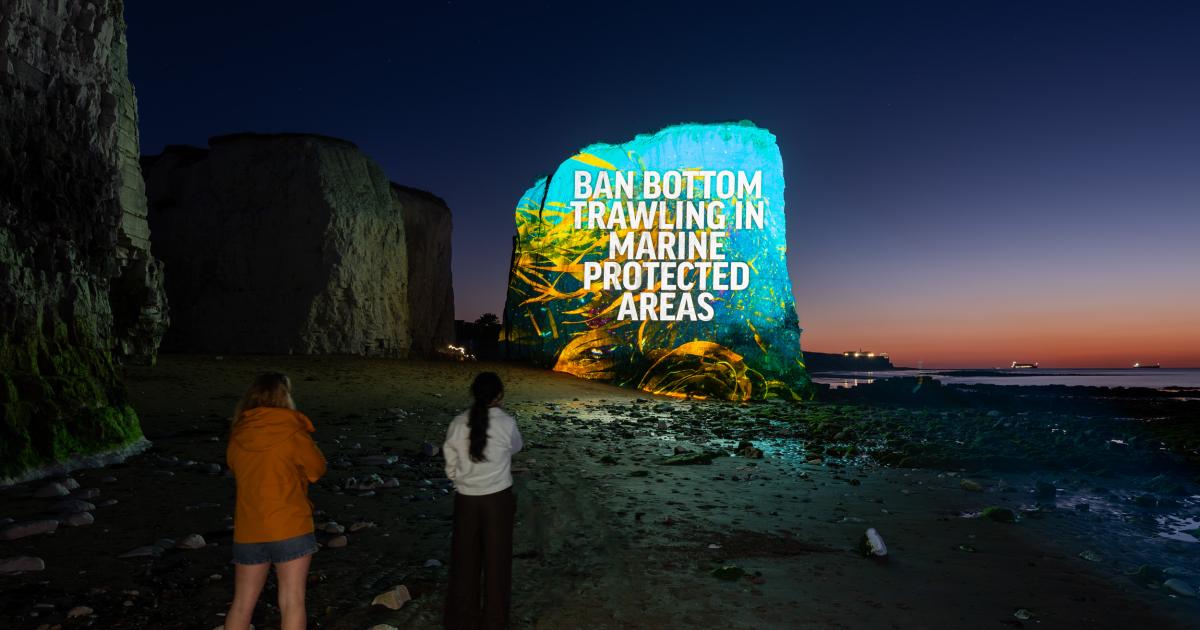
To mark the launch, Oceana UK commissioned a large-scale projection on the white chalk cliffs of Botany Bay, which looks out over an MPA that is home to the amber-listed little tern. Footage of bottom trawling transformed the cliffs into a powerful reminder of the ongoing destruction.
This Author
Brendan Montague is an editor of The Ecologist.