This story was originally published by Inside Climate News and is reproduced here as part of the Climate Desk collaboration.
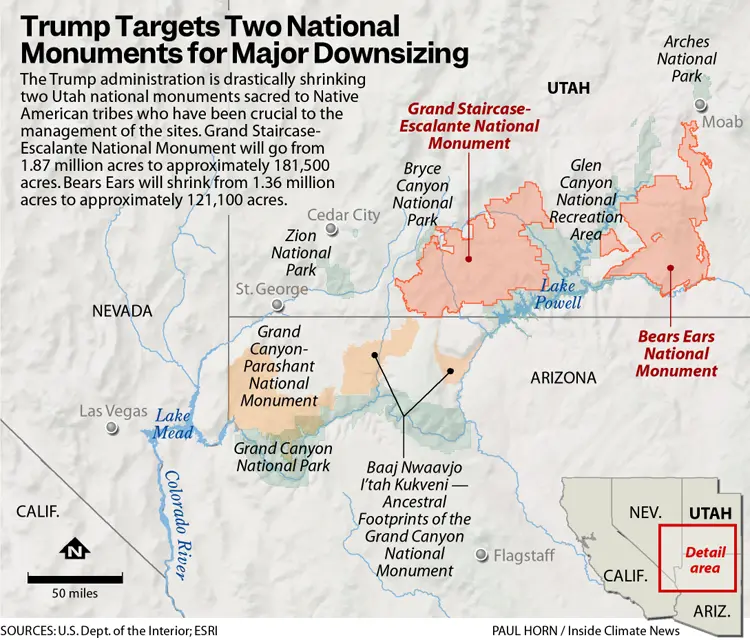
Monday morning, Bears Ears and Grand Staircase-Escalante National Monuments stretched across over 3 million acres of public lands in southern Utah, protecting some of the country’s most remote landscapes and scores of archaeological sites sacred to local tribes. By that evening, President Donald Trump had cut the monuments to just 302,600 acres.
While the two executive orders gutting the monuments and their protections repeat an action from the first Trump administration that was reversed by President Joe Biden, Monday’s reductions go far further than before.
In December 2017, Trump signed proclamations to reduce Bears Ears National Monument from 1.3 million acres to roughly 228,000 acres, an 85 percent reduction, while Grand Staircase-Escalante was cut nearly in half, from 1.9 million acres to about 1 million. Monday’s executive orders cut the monuments to less than a quarter of what was left after the previous shrinking of the monuments.
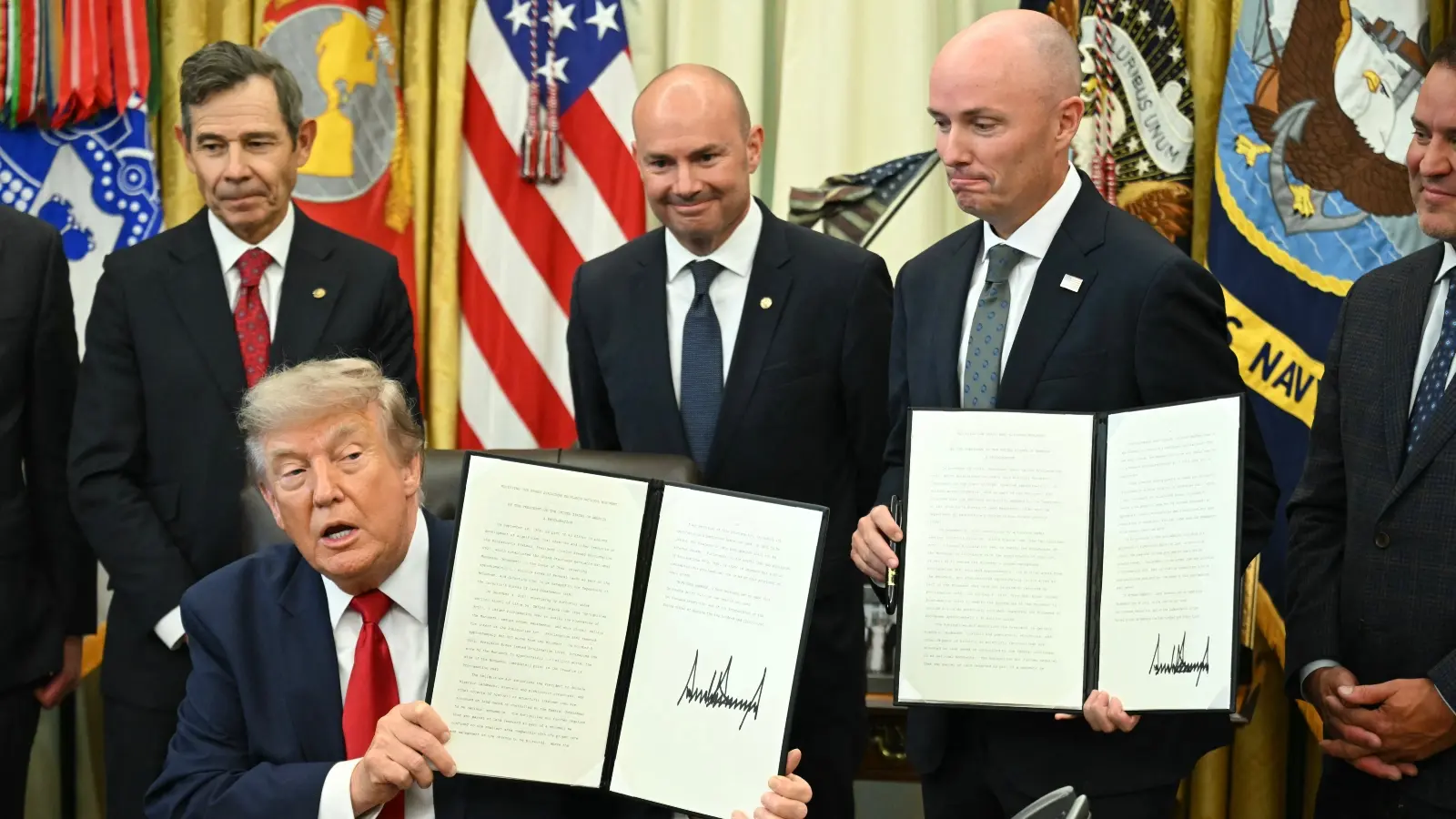
Flanked by Utah Republicans, Trump said in signing the executive orders that new restrictions made it virtually impossible to hunt, fish, or even walk on the monuments, which is not true. Both are accessible to visitors, including for hunting and fishing.
Trump’s executive orders will take effect in 60 days. Shrinking the boundaries of the monuments, the orders state, will better align with the administration’s goals for public lands: opening them up to extraction.
The orders say the decision puts power back in the hands of local communities, despite its disbanding and terminating of an inter-tribal working group for Bears Ears that led co-stewardship efforts at the monument—the first of its kind, and the result of years of advocacy from local tribes. Tribal officials said they were not consulted about the decision to reduce the monuments.
“[Trump is] saying the quiet part out loud. He’s being honest: I’m doing this so that we can mine and drill and graze cows,” said John Ruple, a law professor and program director at the University of Utah’s Wallace Stegner Center for Land, Resources, and the Environment. “We’ll see if the American people think those are the best uses of national monuments, and we’ll see if courts agree with that, too.”
Davina Smith-Idjesa, a member of the Navajo Nation and part of both monuments’ inter-tribal coalitions, said reading the proclamations was a reminder “of genocide and that tribes are expendable” in the U.S.
Uranium mining in the Four Corners region left members of her family sick and dead, she said after the signing of the executive orders, and now the prospect looms of these sacred areas being made available for extraction again.

“Bears Ears is at my back door,” she said during a press conference Tuesday morning. “This is not a political talking point for me. This is home. My ancestors knew this land. My family knows this land. I know where our people go to pray, to gather medicines, to gather food and to heal. This is our grocery store, our medicine cabinet, our classroom, our church. And I need people to understand: You cannot take a pin, draw a line through the landscape, and tell us what remains should be enough.”
Ruple said there is little political upside to the decision, and polling consistently shows Americans support the monuments and the protection of public lands. Attacks on public lands, including Grand Staircase-Escalante, in recent years have consistently failed.
The Antiquities Act, he said, makes clear that presidents have the power to create monuments, but not rescind them. That power rests with Congress.
The executive orders come after a June decision in the 10th Circuit Court of Appeals that reversed a district court’s opinion to dismiss a lawsuit from the state of Utah attacking the Biden administration’s restoration of the borders of Bears Ears and Grand Staircase-Escalante National Monuments after Trump first shrank them. The lawsuit also targets the powers of the Antiquities Act of 1906, which allows presidents to create national monuments. It was signed by President Teddy Roosevelt, who later used it to protect the Grand Canyon as a national monument before it later became a park.
“If you go and eviscerate these two monuments, now I suspect we’re going to see the Department of Justice go into the district court and say, ‘Look, this case is moot. The monuments have been reduced by every inch that were restored and the Biden proclamations have now been undone,’” Ruple said.
Environmental groups and tribal leaders who have long advocated for the protection of the two monuments vowed to continue fighting to protect them. Both were vital to the creation of Bears Ears, which is the first and only national monument co-managed between the federal government and local tribes.
Last time the Trump administration shrank the monuments, Earthjustice, representing a coalition of environmental groups and tribes, sued over the decision. The organization vowed to do so again.
The executive orders came as no surprise. Last March, the Trump administration announced it would eliminate California’s Chuckwalla and Sáttítla Highlands national monuments before removing language announcing that decision from a White House fact sheet. Then last June, the Department of Justice issued an opinion that the president has the power to review and eliminate national monuments.
Project 2025, the policy roadmap for a second Trump administration coordinated by the conservative Heritage Foundation, has called for reducing the size of those national monuments and others — and even suggested repealing the Antiquities Act of 1906.
In a press call Tuesday in response to the executive orders, Democratic members of Congress condemned the proclamations for prioritizing public lands for mining rather than for the American people, expressing fear that other protected areas could be targeted next and that cultural and religious sites could be vandalized.
“This is a trend coming from Donald Trump and from this administration,” said Senator Ben Ray Luján, a Democrat from New Mexico. “While these monuments are in Utah, they belong to all of us across the United States.”
“The administration is on the wrong side of history here, ignoring the voices of Tribal Nations, local communities, and the millions of Americans who want these places protected for future generations,” said Tracy Stone-Manning, Wilderness Society president and former director of the Bureau of Land Management under the Biden administration, in a statement. “As our nation marks 250 years, these public lands should be handed down, not over to drilling and mining interests.”