The Low-T Issue
Self-styled War Secretary Pete Hegseth has a problem with low testosterone. It’s left him suffering from what you might call an acute crisis of masculinity. And I’m pretty sure that he caught it from Teddy Roosevelt.
Bear with me. I’ll explain.
Last week, the Trump administration’s preening, strutting, wanna-be he-man announced a new mandatory annual screening for troops age 30 and older, including women, for testosterone deficiency. Troops under 30 can volunteer to be screened, and anyone with low hormone levels will have the option to receive testosterone replacement therapy.
“It’s about restoring and optimizing your natural capability,” said Hegseth, by ensuring “you have the biological foundation required to sustain the fight” on the “brutal and unrelenting” modern battlefield. Like all Hegseth initiatives, he linked it to “lethality” — now the animating feature of his life. He called topping off troops’ testosterone levels a “sacred duty.”
Anyone who has observed Hegseth for more than 15 seconds in the last 15 years could tell you the man is riddled with deep insecurities. His quest to fully transition the Defense Department to what he calls “The High-T Department of War” is just the latest manifestation of nagging anxieties about himself and the wheel-spinning, never-winning military he leads.
Poor Pete’s woes have been piling up since he headed off to college at Princeton, if not before. Hegseth acts like he was drafted against his will by the Ivy League and escaped it by joining the Army National Guard as an infantry officer in 2003. He fondly recalls guarding “Islamic assholes” at Guantánamo Bay, Cuba, alongside “hard-working, God-fearing, America-loving middle-class men” whom he contrasts with “millionaires at Princeton,” a school he derides whenever he can.
Stuffed in Hegseth’s Army-issue green duffle bag when he arrived at Gitmo was a sheet of plain white copy paper inside a black plastic frame with a quote from his hero, former President Teddy Roosevelt. This long love affair with TR has continued over the decades. Pete wrote a ridiculous 2016 book, “In the Arena,” based on the “timeless truths of Teddy Roosevelt’s iconic ‘Man in the Arena’ speech” from 1910. And he still references that speech to this day and routinely works Teddy into his public remarks whenever he can.
Last year, Hegseth wanted the Pentagon to cut ties with the Boy Scouts of America because, he believed, “the organization once endorsed by President Theodore Roosevelt” had strayed from their mission to “cultivate masculine values.” (He later bullied the Scouts into submission.) And just last month, he talked up TR to U.S. troops in Cuba — where Roosevelt fought during the Spanish-American War — using his hero as proof of America’s right to intervene “in the affairs of Latin American nations.”
No one more exemplified the anxieties of privileged men of his time than Teddy Roosevelt, who grew up in the swirl of post-Civil War America in which urbanization, industrialization, a new emphasis on “brainwork,” and new technologies led to a crippling novel condition dubbed neurasthenia: nervous exhaustion, or a deficiency of “nerve-force.” This affliction was “modern and originally American,” according to the then-most influential expert on the now-archaic medical diagnosis.
Rich, white Anglo-Saxon men like Teddy professed complete cultural, racial, and sexual superiority but grew extremely anxious it was being stolen from them. (Yes, you guessed it: Immigrants, radicals, and independent, unduly educated, or otherwise unruly “new” women were prime culprits.) Men were fast becoming feeble and feminized; only through manly endeavors like weightlifting, hiking, hunting, sports, horseback riding, and excursions into the wild could they counteract the debilitating effects of over-civilization. Roosevelt, for example, transformed himself from a frail, sickly weakling who was called a “sissy” by peers and “Jane-Dandy” by the press into a man’s man via boxing, shooting, wrestling, and travel out West, where he reinvented himself as a cowboy.
The scholar Yeonsik Jung summed up the neurasthenic age nicely, writing: “Channeled through the medical knowledge of neurology, it made American men’s racial, sexual, and spatial anxieties function to act out their racist, misogynist, nativist, and imperialist impulses which legitimized exclusionary political techniques toward the racial and sexual others such as the U.S. imperial expansion in the 1890s and 1900s.” These white American men had to win back, as another scholar put it, “the potency of their violent masculinity—their ability to out-savage the savage” on the American frontier before turning overseas to places like the Philippines, Haiti, and Nicaragua. Roosevelt’s own expansionist imperialism and his campaign against “race suicide” were firmly rooted in this toxic ferment. When the United States initially failed to annex Hawaii after a group of missionaries and pineapple plantation interests took over and set up their own government in the 1890s, for example, Roosevelt called the reluctance “a crime against white civilization.”
The framed quote Hegseth stuffed into that Gitmo duffle, which he also took to the forever wars in Afghanistan and Iraq, are lines from “The Man in the Arena” speech:
Am I striving valiantly?
Is my face marred by dust and sweat and blood? Am I spending myself in a worthy cause?
Am I daring greatly?
Am I in the arena?
“Spending myself” is an intriguing phrase here that’s key to my diagnosis of Hegseth. I’m not a medical doctor, but long ago I studied the intersection of medicine and masculinity in the late 19th and early 20th century en route to my Ph.D. A great panic of the era surrounded what historians came to call the “spermatic economy,” the belief that a man’s semen was a finite reserve of vital energy — like money in a bank account — and “spending” this essential life force through masturbation or excessive sex would leave him depleted, leading to nervous exhaustion’s below-the-waist variant: sexual neurasthenia. (President Donald Trump, who espouses pseudoscientific claptrap about good and bad “genes” also reportedly believes humans are closed-loop systems that, like a battery, have a finite amount of energy.)
Such fin de siècle fears of debilitation led to “rejuvenation” cures like French physiologist Charles-Édouard Brown-Séquard injecting himself and others with crushed guinea pig testicles — launching the field of “organotherapy” — and Austrian physiologist Eugen Steinach’s surgical procedure, a partial vasectomy to restore vigor which found favor with patients from psychoanalysis founder and noted head case Sigmund Freud to William Butler Yeats, the Nobel Prize-winning Irish poet. (“And what rough beast, its hour come round at last, Slouches towards Bethlehem to be born?”)
Hegseth is heir to this utter nuttery — obsessed as it was with limits on semen spending and banking one’s virility. His hysteria over the military becoming “effeminate” has led him to conclude that those who wish to “master the profession of arms” must have their testosterone tanks topped off. And he claims, without evidence, that pumping troops full of this hormone — which people of every sex and gender produce — will improve “combat readiness.” Hegseth also thinks his new policy will make troops “strong, resilient and capable.”
But while testosterone is tied to muscle mass, it isn’t linked with actual strength. A 2019 study found that men who received injected testosterone while engaged in intense exercise and a restricted diet — meant to mimic “strenuous military operations” — did not see gains in strength or endurance; a 2022 follow-up also found no increase in physical performance. Moreover, supplementing testosterone actually signals the body to shut down its own natural production, which can shrink the testicles and reduce one’s sperm count. (Paging Dr. Steinach!)
Hegseth believes you can measure manhood by testing testosterone, the same way he believes you can kill your way to victory on the battlefield.
Hegseth appears to believe more is better, advocating for a “high T” fighting force. But high levels of testosterone — which is currently classified as a controlled substance with potential for abuse — can lead to acne, balding, breast tissue growth, impaired ability of the heart to pump blood, infertility, erectile dysfunction, and increased risk of death.
Of course, it’s hard to say what’s normal if you’re testing millions of healthy people. Testosterone levels can change depending on when a patient is tested, whether they have recently eaten, exercised heavily, or are sick, among other factors, Dr. Alvin Matsumoto, a professor emeritus at the University of Washington School of Medicine, recently told The Intercept. For example, in about a third of men whose testosterone initially tests low, a second test produces a normal result. Tests also have high inter-lab variability. On that front, doctors usually assess testosterone levels only when symptoms of low T appear, and less than 6 percent of men between 30 and 79 actually have a deficiency.
Last week, a group of senators called out Hegseth for his bizarre obsession with troops’ testosterone, noting his department “provided no evidence that this sweeping new policy will improve force readiness or health, nor has it explained the scientific basis, costs, or risks associated with implementing it across the force.” They also pointed to “recent repeated efforts to redefine military culture around an exaggerated conception of masculinity.”
Exaggerated masculinity is an apt description for Hegseth. In his 2024 book, “The War on Warriors,” he bemoaned a plot to manufacture “soft men, and a weak military.” He describes an effort to make the armed forces “fatter,” “slower,” and “effeminate” by those “obsessed” with “neutering our military,” and delves into the dangers posed by “Pentagon pussies.”
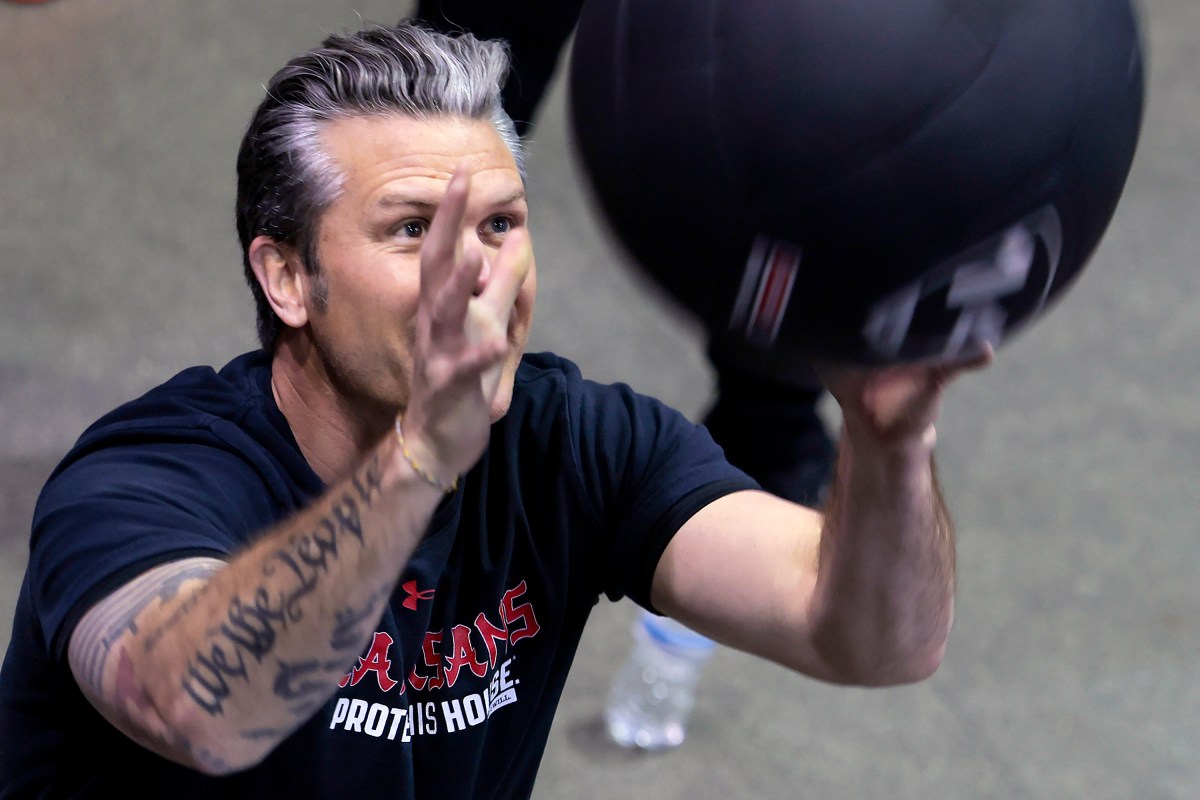
After 18 months of crackpot policies and puerile posturing at the helm of the War Department, Hegseth’s hysteria has only grown. Like Roosevelt, Hegseth is forever struggling to display his manhood through physical exertion — posting videos of himself engaging in humiliating fitness challenges. Similarly, he’s been propping up America’s long-sagging martial prowess by beating up on the likes of Venezuela, attacking elementary school kids in Iran, blowing up unarmed boats packed with civilians in the Caribbean Sea, and threatening tiny Cuba, where his hero Teddy won fame for a Spanish-American War charge up San Juan Hill.
“Speak softly and carry a big stick” was Roosevelt’s foreign policy prescription. But from the war against the Houthis last year to the war on Iran today, Hegseth has found that his stick just doesn’t measure up. The resulting insecurity has led the emasculated War secretary to fire women and Black men from top leadership positions, block the promotion of women military officers, banish transgender service members, and denounce “fat generals and admirals” and “females” whom he believes “can’t meet the same combat arms physical standards as men.” He has now added low-T troops to the list of scapegoats for his department’s underperformance, instead of examining his failings as a leader.
Hegseth believes you can measure manhood by testing testosterone, the same way he believes you can kill your way to victory on the battlefield. It’s part of a mélange of flaccid fallacies and fantasies that seem to dominate the worldview of a man who paid $50,000 to a woman who accused him of raping her, whose former sister-in-law accused him of “abusive” behavior toward his second wife, and whose own mother once called out the fact that he “belittles, lies, cheats, sleeps around, and uses women for his own power and ego.” And as America’s wars go south, Hegseth has become ever more unhinged and his public tantrums more pronounced. “You have Trump derangement syndrome!” he snapped at Michigan Sen. Gary Peters this week, after failing to admit earlier claims about victory in the Iran war were premature.
Hegseth is exactly where he wants to be — “in the arena” — even though it’s abundantly clear his crisis of masculinity is becoming a catastrophe for his department, the rest of America, and great swaths of the globe, from the Caribbean to Iran. All the testosterone in the world isn’t going to win America’s wars, achieve Hegseth’s dream of turning “soft men” hard, or transform “Pentagon pussies” into something more in line with his fantasies, much less cure the crushing insecurities swirling in the brain of America’s fragile war secretary and the deep deficiency that has long plagued him.