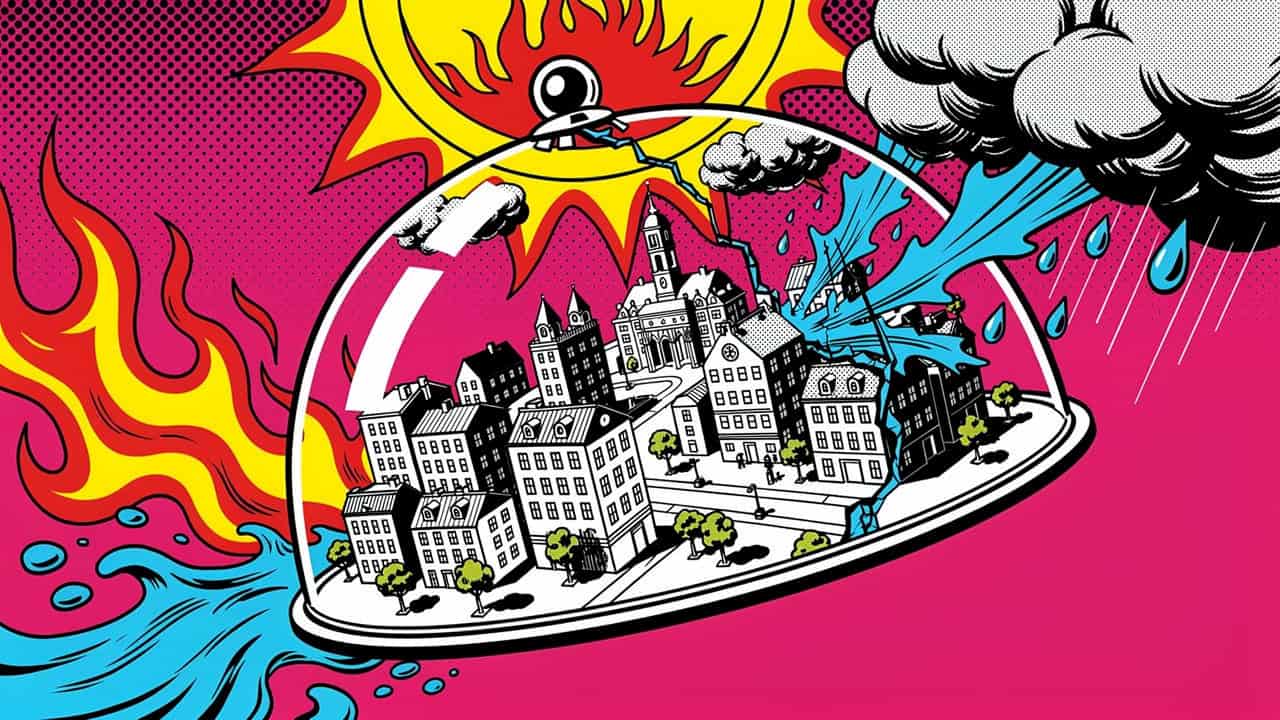
- A machine we built: The urban heat island is not weather handed down from the sky but design handed down from us, which means it can be redone.
- A season, not an event: Europe is warming at roughly twice the global rate, and the summer of 2026 broke national temperature records in Germany, Britain and Barcelona.
- Shade as social justice: Heat falls hardest on people in badly insulated flats, outdoor workers and those with no green space within reach, so adapting a city is a decision about whom it protects.
- The right’s historic irresponsibility: Dismantling the European Green Deal would leave the continent hotter, poorer, less competitive and more unjust, all at once.
- A continental adaptation strategy: Europe needs to finance thermal retrofitting, set standards for public space and back nature-based solutions, on the scale of the single market or NextGenerationEU.
A city is a machine for concentrating heat. Pack in enough asphalt, glass and traffic, seal the ground beneath dark surfaces, strip out the trees and the shade, and the result runs several degrees hotter than the land around it — holding the day’s heat deep into the night and leaving people unable to sleep. Meteorologists call it the urban heat island. For most of the last century it was a nuisance. As Europe’s heatwaves multiply and the baseline temperature keeps climbing, it is becoming something else: the line between a city that is merely uncomfortable in summer and one that, for a growing share of the people living in it, is turning unliveable.
The crucial thing about that machine is that we built it. This is not weather handed down from the sky but design handed down from us — and design can be redone. That is the difference between a catastrophe that merely happens to us and a problem we can actually govern.
The summer of 2026 removed the last excuse for pretending otherwise. Western Europe endured its hottest June on record. Germany’s national temperature record fell on three consecutive days, topping out at 41.7C. Britain broke its own June record three days running, the first time in half a century.
In early July, my own city, Barcelona, reached 40.5C at the Fabra Observatory — the highest reading in 112 years of measurement. By one early estimate, more than 20,000 people died across the continent in a single week of late June; the official European mortality monitor has since confirmed at least 10,000 excess deaths, the overwhelming majority of them over the age of 65. Behind those figures sit the things no chart shows: emergency wards past capacity, wildfires, roads buckling in the sun, flats where the temperature never falls far enough to allow rest.
Europe is the fastest-warming continent on the planet, heating at roughly twice the global rate. The heatwave has stopped being an event and become a season. Science abandoned the conditional tense long ago. This is not a threat approaching from the future. It is the climate we already inhabit.
Progressive Thinking on the Big Issues of Our Time
Read by policymakers, academics and journalists in 100+ countries.
And precisely as the continent bakes, a large part of the European right has chosen this moment to walk away from the evidence. Politicians who a few years ago accepted the case for an ecological transition now drift, day by day, into the denialism of the far right, treating the European Green Deal as the scapegoat for every grievance and the scientific consensus as an inconvenience to be waved away. It is a historic act of irresponsibility. There is no version of prosperity on a continent that becomes unliveable each summer. Tearing down the climate agenda would leave Europe hotter, poorer, less competitive and more unjust, all at once.
Europe must therefore keep cutting emissions. Every tonne of carbon dioxide we avoid is warming we spare ourselves, and decarbonisation remains the master tool. But mitigation alone no longer describes the whole task. The defining project of the coming decade is to redesign the places where we actually live for the climate that has already arrived. And here, oddly, is where climate politics stops being an argument about parts per million in the abstract and becomes something you can see from your own doorstep.
Redesign means treating the urban fabric itself as infrastructure for survival — as decisive, in a heatwave, as any hospital or power line. Buildings retrofitted to stay cool without melting the grid; roofs and façades that are green rather than black. Shade designed back into the street on purpose, rather than left as the quiet privilege of wealthier districts. More trees, and better placed. Pavements that reflect heat instead of hoarding it, and ground porous enough to drink the water when the rain finally arrives as a flood. Green corridors to let the air move. Climate shelters within a few minutes’ walk of every front door. And the data to find the most dangerous streets before the next heatwave, not after the funerals.
Because heat is not democratic. It comes hardest for the person in the badly insulated flat, the one who works outdoors, the one with no green space within reach. To adapt a city is not only to make it greener. It is to decide whom it protects — which makes shade, in a hotter Europe, a question of social justice as much as of urban planning, and its absence a quiet form of inequality.
Barcelona has spent years leaning into this: the superblocks, the green axes, the widening tree canopy, the network of climate shelters, less asphalt and more shade, a public realm built to guard people’s health rather than merely move their cars. None of it has been frictionless. A transformation on this scale provokes genuine argument and demands constant correction, and my city is no exception. But it grasped early what much of Europe is only now discovering: that climate change is also fought with a design brief, in the ordinary geometry of a street.
Europe should make that a continental priority. As it once built the single market, Erasmus and the NextGenerationEU recovery fund, it now needs a European strategy for urban adaptation: financing the thermal retrofitting of buildings, setting standards for public space, backing nature-based solutions, and standing behind the towns and cities on the front line, which almost never have the budgets to match the task. This is not municipal tidying. It is industrial, health and social policy at once, and it is exactly the scale of ambition at which Europe has always been at its best.
We cannot stop next summer from touching 40C again. What we can still decide is what it finds when it comes: cities engineered for the century that has ended, or cities prepared for the one we are living in. The buildings and streets we lay down over the next 20 years will still be standing in 2100. To design them by the measurements of the past is to condemn them to obsolescence before their doors open.
That choice — unglamorous, made in planning offices and municipal budgets rather than at summits — will be one of the defining political decisions of our time.
Help Keep Social Europe Free for Everyone
We believe quality ideas should be accessible to all — no paywalls, no barriers. Your support keeps Social Europe free and independent, funding the thought leadership, opinion, and analysis that sparks real change.
Social Europe Supporter
— €4.75/month
Help sustain free, independent publishing for our global community.
Social Europe Advocate
— €9.50/month
Go further: fuel more ideas and more reach.
Social Europe Champion
— €19/month
Make the biggest impact — help us grow, innovate, and amplify change.