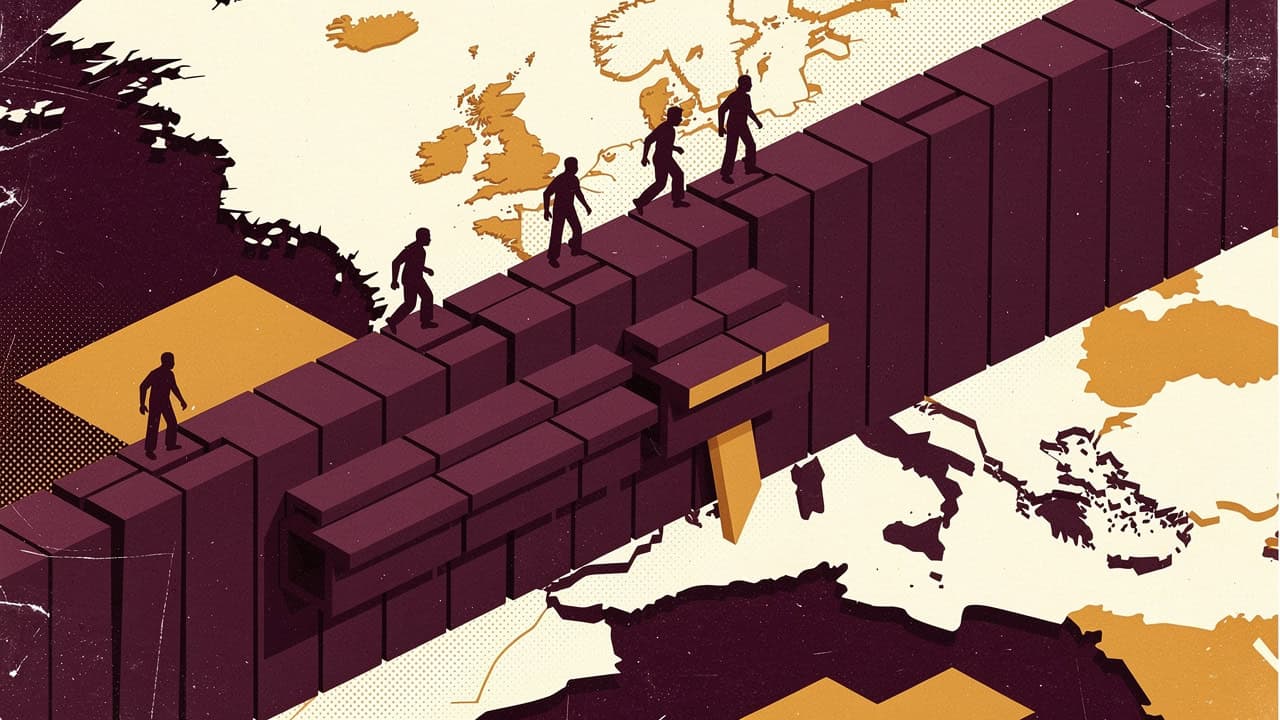
- An accident, not a plot: A Supreme Court ruling, Throne Day celebrations, and crowded holiday beaches converged to open the border — no manipulation was required.
- Echoes of 1989: Like the fall of the Berlin Wall, the Ceuta crossing was unplanned, unintended, and capable of altering Europe’s trajectory.
- A wall built by democrats: Unlike the Berlin Wall, raised by a dictatorship, the barrier at Ceuta was erected by western Europeans who profess democracy and humanism.
- The strategic stakes: Escaping the grip of Trump and Putin will require new allies in the southern Mediterranean, not fortification against them.
- France decides: Next year’s vote will help determine whether Europe’s xenophobic and authoritarian drift is decisively halted.
With a little hindsight, the fall of the Berlin Wall in 1989 seems the event most comparable to what unfolded in Ceuta in late July, both in the events themselves and in their origins: a confluence of circumstances — unintended and unplanned — that produced a major geopolitical rupture capable of altering Europe’s trajectory.
Yet their consequences are likely to be diametrically opposed: on the one hand, the peaceful reunification of a continent amid the rapid spread of democracy; on the other, the reinforcement of the wall that already divides the two shores of the Mediterranean and the acceleration of Europe’s drift towards xenophobia and authoritarianism. Fortunately, however, the worst is never certain.
A convergence of circumstances
Almost four decades ago now, on 9 November 1989, Günter Schabowski, then the secretary of the Central Committee of the East German Communist Party responsible for media affairs, mistakenly announced at a press conference the immediate lifting of restrictions on East Germans’ travel abroad. That night, tens of thousands of them rushed towards the crossing points between West and East Berlin, strictly divided by a wall since August 1961. The East German border guards, overwhelmed and without official orders, eventually let the flood of people through. The Berlin Wall had fallen; the German Democratic Republic (GDR) would follow a few months later, along with the entire Eastern Bloc and, ultimately, the Soviet Union itself, dissolved in late 1991.
That unexpected event stunned Europeans — just as Ceuta has stunned them in recent days. No one had planned or intended it, even though it belonged, of course, to the long history of the gradual erosion of the GDR and the Eastern Bloc. Yet it changed the course of European history.
Progressive Thinking on the Big Issues of Our Time
Read by policymakers, academics and journalists in 100+ countries.
The same is very likely true of the events in Ceuta. At their root lies a ruling delivered by the Spanish Supreme Court on 29 June prohibiting “pushbacks” — the immediate return, without any assessment of their situation, of people reaching Ceuta by sea. The decision was widely shared and amplified on Moroccan social media, kindling disproportionate hopes among a young population with few prospects. At the end of July, the Moroccan security forces usually deployed in strength around Ceuta were mobilised instead for the Throne Day celebrations, which mark the anniversary of King Mohammed VI’s accession to the throne on 30 July, a public holiday in Morocco. This year the ceremony was held not in Rabat, the capital, but in M’diq and Tetouan, barely 25 kilometres from Ceuta, assembling the full spectrum of the Kingdom’s elite. Meanwhile, thanks to the holiday, a significant portion of Moroccan youth was flocking to the famous beaches adjacent to the Spanish enclave.
This convergence of circumstances triggered the mass movement the world then witnessed. The outnumbered and overwhelmed Moroccan security forces let the crowds pass. The Moroccan government took no emergency measures: there was simply no question of disturbing the King and the Moroccan establishment during the Throne Day celebrations, which were to proceed without disruption.
An unlikely manipulation
There has been much speculation that the Moroccan government encouraged young Moroccans to cross into Ceuta to punish Spain for Prime Minister Pedro Sánchez’s visit to rival Algeria on 20 July. In 2021, the Moroccan authorities had indeed claimed to have facilitated a similar incident after Spain admitted an ailing Polisario leader to one of its hospitals. But the damage inflicted on King Mohammed VI’s image, in Morocco and beyond, on the very day of the Throne Day celebrations makes such a hypothesis highly unlikely.
The possibility of interference by the United States or Israel has also been raised — countries eager for revenge on Sánchez, the European Union leader most hostile to the policies of Benjamin Netanyahu and Donald Trump in the Middle East. They have undeniably capitalised on the difficulties he has faced in Spain and elsewhere in Europe since the mass crossing into Ceuta. But no evidence of such interference has emerged, and none is needed to explain the events.
The most likely cause of what happened in Ceuta, as on 9 November 1989, is a combination of circumstances — even if these, too, belong to a longer history: Morocco’s deep social crisis, marked by a large, educated youth deprived of prospects, and the mounting tensions stoked on the far shore of the Mediterranean by the “Fortress Europe” migration policy pursued by EU leaders.
There, however, the similarities between Ceuta and Berlin end. The Berlin Wall was built by a communist dictatorship in the service of the Soviet occupiers. The wall at Ceuta, though it bears a strong technical resemblance to the Iron Curtain of grim memory, was erected by us, western Europeans — who are supposed to be committed democrats and humanists.
Whereas East Germans had been eagerly awaited and hoped for over decades in Berlin and West Germany, young Moroccans are rejected outright and without appeal by a majority of Europeans, just like their brothers and sisters from the rest of Africa. And yet, in truth, their way of life, the cost of their labour, and their level of education differ little more from ours than did those of eastern Europeans after the fall of the Wall.
The reunification of Europe up to Russia’s borders had seemed a natural project, one that western Europeans embraced without difficulty — even though such a unified Europe had never in reality existed outside the short-lived empires of Napoleon Bonaparte and Adolf Hitler which nobody regrets.
The Mediterranean, by contrast, has bound together the peoples of its shores for millennia; yet any idea of rapprochement with the other side now strikes a majority of European Union residents as an existential threat graver even than those posed to Europe by Vladimir Putin and Donald Trump.
So much so that Europeans — in France and elsewhere — increasingly cast their votes for a racist and xenophobic far right that admires these autocrats and would join forces with them against all those whose skin is not white enough. Yet to escape the stranglehold of Trump and Putin, the future of democratic Europe will depend in no small part on its ability to find new allies in the southern Mediterranean.
Although the episode has had virtually no lasting impact on the number of migrants entering the European continent, the fear must be that the Ceuta affair — unlike the fall of the Berlin Wall — will accelerate Europe’s withdrawal into itself, sharpen the xenophobic and racist drift already at work, and push Europeans still further towards accepting the surrender of their democracy and freedoms. But the worst is not always certain: it will fall to the French people, in particular, to shoulder the heavy responsibility of deciding next year whether to put a decisive stop to this deadly trend.
Help Keep Social Europe Free for Everyone
We believe quality ideas should be accessible to all — no paywalls, no barriers. Your support keeps Social Europe free and independent, funding the thought leadership, opinion, and analysis that sparks real change.
Social Europe Supporter
— €4.75/month
Help sustain free, independent publishing for our global community.
Social Europe Advocate
— €9.50/month
Go further: fuel more ideas and more reach.
Social Europe Champion
— €19/month
Make the biggest impact — help us grow, innovate, and amplify change.