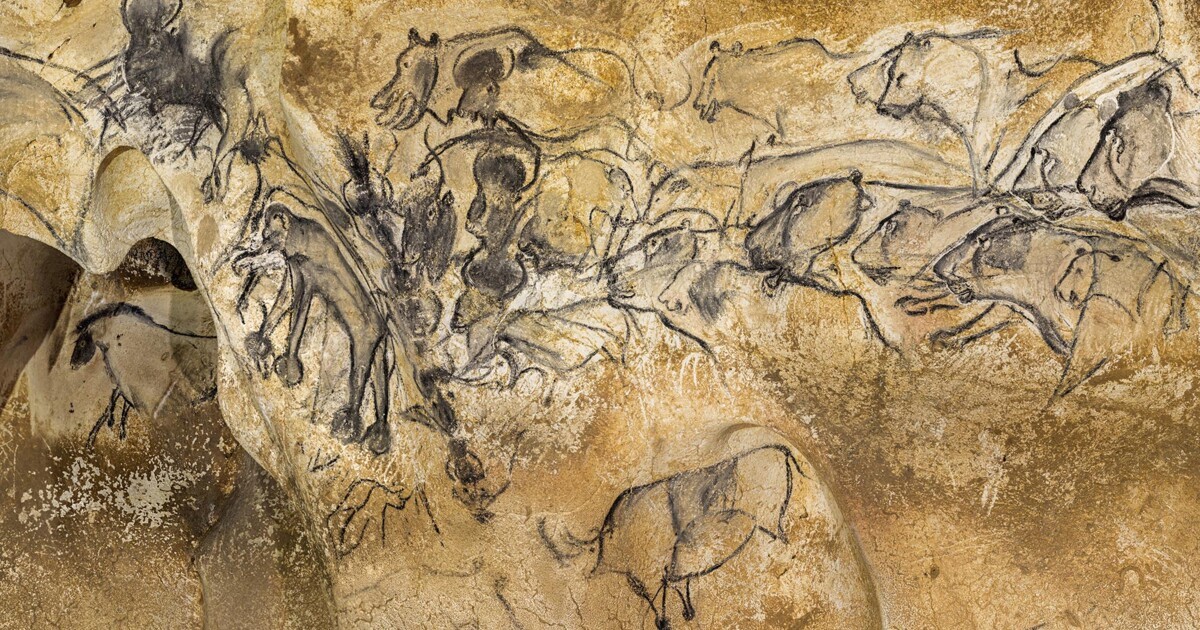

End Chamber at Chauvet, © J. Clottes / MC, courtesy of the Centre national de Pré-histoire / Ministère de la Culture.
Whatever depiction was in the beginning, 37,000 years ago on the walls of the Chauvet cave, it wasn’t much like this essay’s first illustration. All-over lighting? Fixed point of view? Darkness all but dispersed? I don’t think so. But bear with the high resolution while I justify my choice of opening noun.
‘Depiction’ is a strong term. The word, as distinct from some broader idea like ‘image-making’ or ‘visual representation’ or even ‘picture’ will be used from here on to indicate a kind of picturing in which a reciprocity of figures and field looks to have been important to the maker. Field as in ‘force field’ or ‘field of vision’. ‘Figure’ meaning ‘representation with an immediately perceivable shape’ but always with an edge of suspicion about the distinctness, the well-formedness, of any single representation. Hence my worry about the photograph. The dictionary quotes Pope: ‘That destroyer of fine figures … common sense’. Pope was thinking of clever figures of speech, but I think his verdict applies to figuration in general, especially if we press on the meanings of ‘common’ and ‘sense’, as I shall.
The to and fro between figures and field that constitutes depiction is clear enough – too clear – in the photograph. At Chauvet, depiction was already what picturing had become. Look at the way the artists have organised the meeting of the line of beasts with the cleft in the cave wall – the little cave within a cave, which doubles in the illusion as a hilltop or defile. Look at the difference of pace and depth and solidity of the group – the procession – before and after. The overall being-together of shapes and objects and intervals between them, and their arrangement within some kind of spatial surrounding: that seems to be what these artists most wanted to capture.
I’m happy with the notion that figure and field here are abstractions (operators) meant to trigger a ‘reality effect’. The Chauvet painters are entirely aware that they are making a world as opposed to reproducing one. The difference between two and three dimensions, for a start, is played with at every point on the wall. But clearly these artists, like most artists, wanted the world they made to be enough like the world out there for the changes they made to it – the conflations and idealisations – to strike home.
The field and the figures’ obedience to it, then, were realities created by the work – fluid, spellbinding, no doubt ambiguous (whatever the boundaries and focus of such a concept might have been to Aurignacians), and above all an invitation to … what, exactly? ‘Form’? Mastery? Intricacy? Invention? Accuracy? Truth to life? Truth to life as a cave dweller might wish it? The stampede of time stopped in its tracks? (Goddamn it, look at those rhino horns!)
By the time Chauvet was painted the figure-field dialogue, and its power as an organiser of possible worlds, had clearly been the subject of long theory and practice. These are sophisticated performances. The word ‘mannerist’ might even apply to them. Overlapping, intersection and juxtaposition, seeming transparency (or maybe not … maybe what the artists were interested in was a kind of ‘seeing in relation’ that had nothing to do with ‘light shining through’), doubling, theme and variation, repetition to the point of overload: the grammar of vision is being riffed on by masters.
None of this – this revelling in an idiom and pressing it to the limit – makes it easy to decide exactly what the artists may have understood by the fields they made, and why the belonging or not-belonging of a creature to any one of them counted for so much. It’s hard enough to find words to specify the various kinds of containment, or belonging together, or intricate totality we think we glimpse in what we have. As for what the totalities meant – we’re in the realm of guesswork.
No doubt, to return to my opening negative, the distinctiveness of each figure (strung out in a procession, part of a crowd of overlapping beasts, enjoying its own cave within a cave etc) and its coming into being ‘in’ the field is misrepresented by the photographs, with their carefully equalised illumination. And don’t think we are able to imagine the way the walls may have been lit in the first place with any confidence. Flickering lamps and torches? Darkness punctuated by magicians’ flares? A vast oxygen-sucking bonfire? Quite probably all three on occasion – but manipulated how? Directed to how many spectators, in what kind of context, with what accompaniment? For what?

Hillaire Chamber, © A. Frich /CNP/MC, courtesy of the Centre national de Pré-histoire / Ministère de la Culture.
Who, after all, without the evidence, would ever have imagined that the depictions humans made 37,000 years ago were anything like the ones we’ve discovered? So why do we think these humans’ lighting systems are any more amenable to our guesswork? Or the habits of viewing that went with them? The practices of present-day ‘comparable’ communities strike me as a very poor guide. We have at different times labelled such groupings Indigenous, Marginalised, Tribal, Primitive; all names, tabooed or not, that circle around some kind of rearguard action – societies (cultures) on the defensive in a pitiless present. But at Chauvet, just look, the arrogance of achievement is unmistakable. The architectural historian Sigfried Giedion thought the paintings in the caves – he did not know Chauvet when he wrote, but Lascaux and Altamira were enough – celebrated the superiority of the world of beasts. His thesis, which was politely ignored, has much to recommend it. In the warm pockets of the Ice Age, the thunder of woolly rhinos going past must have spoken for itself. (Such animals were very little hunted, so the bone heaps suggest. No wonder.) But the Chauvet masters knew one thing the rhino and mammoth couldn’t do. There was a strange kind of action on the world in which human superiority, maybe uniqueness, was undisputed – already gloried in. It was there on the walls. Humans were able to represent the mammoth, make a convincing likeness of it. Was that ability driven by envy or homage? Was it a way of borrowing the giant’s strength, or a means of (fantasy) domination?
Fantasy domination, we now know, was eventually the road to the real kind. But I side with Giedion: we should not assume that representation was in the beginning a demonstration of power or superiority. Ours is apparently the only species that has ‘formed a picture’ of its place in the panoply of animals. I guess we have to concede that the picture became one adjusted to domination, exploitation, condescension, godliness. But that took time. Perhaps the most precious aspect of the caves is that they preserve a picture in which hierarchy and human-centredness don’t look to have been the organising assumptions.

A hunting scene at Tadrart Rouge.
This is more than a question of subject matter. If we follow Noam Chomsky and his school, as I do, the linguistic capacity in human beings just is the ability to order structures (phonic, syntactic, semantic) hierarchically. I want to argue later, when I compare depiction and language, that the effectiveness of depiction depended – and goes on depending – on no such ‘preference for the pyramid’, even if we define depiction as aiming at interdependence of forms, being-together, totality. If hierarchy is the condition of complexity and precision in language, and I think Chomsky has made the case that it is, something more like equality and overlap – let’s call the organising principle ‘reciprocity’ – is what generates complexity and precision in a depiction. Hierarchic ordering in a depiction is a surface quality, present or absent at will. Reciprocity, on the other hand, is what depiction is.
Hierarchy and human-centredness are faces of the same coin. How thoughtlessly most of the literature on consciousness conflates consciousness and self-consciousness! It is the difference between the two that matters, and that the survivals from the Upper Palaeolithic allow us to think about.
The cave paintings at Chauvet, Lascaux and Altamira are not like the images that survive from twenty or thirty thousand years later – the better known, more ‘advanced’ Neolithic period. Partly this may be due to accidents of preservation. We have relatively little three-dimensional work from the Upper Palaeolithic, but the surviving sculptures seem to tell a different story from the paintings. The tiny (and crude) Venus of Hohle Fels, for instance, carved from a mammoth’s tusk, looks to have been made around the same time Chauvet was being decorated, though in a culture which most likely had no contact with the southern caves.

The Venus of Hohle Fels.
A world apparently oriented on women’s bodies coexisted, then, with the world of beasts. Figures comparable to the Hohle Fels nude, made in bone, stone or ceramic over thousands of years from Chauvet onwards, have been unearthed in many parts of Europe. Many are astonishing. What their meaning and purpose was is unknown. But between the Palaeolithic Venuses and the various upright or seated ‘goddesses’ of the Neolithic there does seem a passage, a preservation of skills, a rough agreement about how to make an effective effigy. In the realm of depiction, the opposite is true.
If what had come down to us as our earliest pictures of the world were scenes like those from Çatalhöyük and Tadrart Rouge, wouldn’t our sense of human history be more secure? Don’t these look like elementary, ‘primitive’ beginnings – of an art that became, by more or less predictable stages, the one we now have? Animals may still occupy centre-stage on occasion, but they are now safely established in their being-for-us. What matters in the Tadrart panorama is the body, the two-legged uprightness of the hunter and his weaponry, co-operation in killing, the acts and intentions of people like ourselves.
How can it have been, is the question, that a wholly different tradition of picturing preceded the Neolithic, with all the evidence the cave paintings suggest of an elaborate development before 35,000 BCE? (I say ‘elaborate’, but this does not necessarily mean ‘gradual’. We have no clue how long Chauvet’s idiom took to devise.) Granted, again, the differences of medium, circumstance, preservation, we still face a baffling discontinuity between Chauvet’s idea of depicting and Çatalhöyük’s. The difference is so great that words like ‘decline’ or ‘degeneration’ don’t touch it: we seem to be looking at two kinds of mind. Did the Neolithic artists, for a start, have the least idea of interaction between figure and field? Let alone a complex one: one whose pressures and paradoxes could be used to make space, suggest proximity and scale, establish primacy, intimate speed, danger, commotion – in short, make bodies present in a world. What is a rock face for the masters of Tadrart Rouge? Are the figures on it anything but signs? Are signs susceptible of occupying – that is, being convincingly ‘in’ – space? Or even of shouldering three or four dimensions aside, leaping into dream space, in the way of Chauvet’s lunging lion heads or its horses’ beautiful muzzles? I don’t think so. They all stand still, these rock face signs, existing nowhere in particular. They’re too busy signifying ‘running’ or ‘letting fly an arrow’ to be parts of a world.
It’s hardly likely that the makers of Chauvet and Altamira saved depiction for the deep darkness of caves. (I agree it’s possible – but such an unlikely preference would have issued from a truly weird cosmogony or social system or view of what depiction was for. Again, the depictions themselves and their placement are so unexpected that weirdness could be the fact of the matter. I think we should circle back and back in interpretation to these objects’ sheer unlikelihood.) Inevitably we wonder what these artists’ above-ground picturing was like. Were procession, stampede and intermingling subjects reserved for the darkness? What kinds of surface did artists favour when they worked in daylight? Natural or prepared? How different was their daylight idiom from the drawing we see underground? One can imagine that the emphasis on animal outline was partly a response to cave lighting conditions, though recognition of (loved or feared) objects by means of silhouette is anyway built deep into visual perception. The cave walls obviously encouraged ‘one thing after another’, though it’s clear how much the artists enjoyed working against the paratactic. Fields are built around some notion of fusion, of totality. The Chauvet artists seem to have had immense confidence in their viewers’ visual abilities – their interest in the visual, their ability to see a rhyming line or a sudden move from opaque to translucent. After all, attentiveness to animal forms in movement, to shifting shadows, to tricks of the light, was not in this culture an esoteric skill.

The Altamira ceiling.
We know nothing for certain about the cave artists’ capacity for speech. But we have to assume that they had language, and presumably as sophisticated a language as the one on the cave walls. There’s a side of me that would like to think of the Chauvet speakers as envying the mastery and flexibility of the description on the walls. They may have done – I’ll come to that. But surely it makes no sense to think that the envy was born of linguistic backwardness. Language, I shall posit from here on, was depiction’s rival, probably its enabling condition. Everyone at Chauvet – well, almost everyone: there must have been a few sufferers from mutations in and around FOXP2, the language gene – was a virtuoso when it came to ‘raising’ and ‘embedding’ and finding the right word. Grammar came naturally.
Having stressed how little we can be sure of 37,000 years ago, I now offer a series of hypotheses concerning speech and depiction in the Aurignacian world. They are an outsider’s speculations, meant to bring a set of questions into focus – to propose that these may be the questions, and that so far they’ve hardly been put. The questions are about language and visual depiction as coexisting forms of life. By that I mean two specific and different ways of being, two ‘views’ of what human being consists in, two kinds of encouragement to act, manipulate, assess, stand back from, investigate, see as a whole, think-of-oneself-in-relation-to. These two forms of life, linguistic and pictorial, were no doubt by the time of Chauvet deeply enmeshed. But enmeshing doesn’t equal peaceful coexistence. Any more than, say, the sacred and the secular over the millennia to follow. (Was anything sacred to the Aurignacians? Hard to say.)
The drift of this essay is to say that in the contest of faculties depiction has not been given its due. But beware of visual bias. We are language animals, and so were the Aurignacians. Language wins. Power comes out of the barrel of a larynx. That still leaves us, however, with the lions and horses of Chauvet and the ceiling at Altamira. We need, I think, a better picture of what kind of answer to language this rival idiom represented. And a better picture of what it was in language that produced such a non-language in reply.
My picture of spoken language and humanity is borrowed in essentials from Chomsky. Which is to say that, however we want to stage our ignorance of the original ‘steps’ towards speaking in common, and whatever elements of bricolage and social improvisation (not to say failure) we want to admit into the mysterious emergence, the evidence suggests that language depended on some kind of distinct rearrangement in areas of the brain. Some language mutation. Of course, the mutation was not ‘for’ or ‘towards’ language – natural selection is a process without direction or purpose – but it made it possible for language as we know it, with all its complex commonalities and rules and protocols, to become a possible kind of behaviour. Do we call language a kind of behaviour or an apparatus of cognition? Is it driven by a need to communicate with others or by an essentially ‘inward’ recognition of new power and clarity in the sorting of thoughts, concepts, intentions? Chomsky wanted us to guard against the assumption that better organisation of thought equates, or even leads, to better communication. Alas.
No one is suggesting, as I understand it, that actual language-behaviour resulted from a single mutation or even a discrete series of brain changes. But Chomsky does think that one relatively simple neural rewiring was needed for the whole extraordinary structure of grammar and reference to be possible at all – or to take the improbable form it did. (The one we live in and find natural.) It must have been, he argues, something like the hardware/software set-up that allows our computers to ‘merge’. That is, the ability to take a pattern of sound that is already deemed to mean something by its user – a meaning agreed to by others – and combine it with another pattern so that the two don’t simply add up but make a new meaning, a new ‘set’. I select the unlovely phrase ‘child language acquisition theory’, which cropped up in my reading, as an example. Each word has its place in a possible sentence: each word is an element of syntax. But with each additional word a new unit of meaning is formed: ‘child language’ is a concept, not an addition sum of ‘child’ plus ‘language’. And then ‘acquisition’ waits, as it were, for the what of its preceding nouns to give it purchase and force. By the time we reach ‘theory’, complexity becomes something close to self-reflection. The difficult language property called recursion – for Chomsky the feature that distinguishes language from all other cognitive faculties – is at stake. Language here turns on itself, and takes its own operations, the strange unities and hierarchies it has generated, as a matter it can (maybe must) bring to the surface and ‘say something about’.
Three propositions follow from this picture of language that are relevant to depiction. First, it is probable that speaking ‘took off’ among Homo sapiens dramatically, at a pace unlike previous changes in the species’ way of life – the power and scope of the new capacity, once tried on for size, sweeping all before it, gathering devotees, enabling all kinds of commonality and excitement and success. Second, the power of language hinged on its internal coherence and its power to generate more and more statements, appraisals, ways of seeing, ideas that overturned previous ideas; and basic to that generative energy was the ability (the necessity) to turn on itself, come to consciousness of its own procedures, ‘take up’ a previous package of meaning and subsume it in a further, more complex and self-critical one. But third, and crucially, for all these reasons language was enclosure. It was a great thing to think with, as Chomsky has it, but not necessarily such a great thing with which to think about what in the world – in the world that isn’t language – you may be thinking about. Language generates possible worlds: their relation to the actual one can quickly come to seem ‘complex’, which can quickly come to mean tenuous, secondary, inessential to real thought, real language-use.
My idea, essentially, is that the cave art of the Upper Palaeolithic was an answer to this deficiency. The answer was unthinkable without the hegemony of language; it came out of language’s power, and specifically its power to reflect on that power’s limits; and the extraordinary flowering of the answer (flowering and then withering, seemingly, in the Neolithic, leaving behind few traces of its brilliance and humility) is the best symptom we have of what it must have been like to live in the new, all-conquering world of speakers, rules, assent, ideas. Depiction was non-language in its full, not ‘first-steps’, being. Revelling in its capacity to not speak back – to be about things in a way that speakers would never be able to approximate.
It is as an answer to speech that depiction makes best sense. It allows us to think of many of its distinctive features as belonging together, ‘necessary’ elements of a counter-language. The fascination with the linear, one-after-another (sentence-like) arrangement of shapes, for a start – but, equally, necessarily, the continual pressure put on and against that one-after-another. The creation of a centripetal or centrifugal field. The lack of hierarchical organisation, either explicitly or as an underlying structural principle. The dissolution of each and every phoneme in the visual sentence by means of overlap, seeing through, overload, syntactical nonsense and disobedience, leakage, unclarity where clarity is expected and sharpness of focus where the field seems to demand fading, ambiguity, distance. And above all a continual unnerving presence of things – an incessant proximity, a here-and-now to visualisation, a refusal to obey the rules of large and small, near and far, before and after. Or rather, a refusal to naturalise any such conventions – they come and go as possibilities on the ceiling, part of the total conjuring act, the reaching out to appearances before they begin to be ‘objects of thought’.
In a non-word, depiction is excursion – occurring together, not depending on one’s place, moving on, non-reflection, never looking back … in answer, most deeply, to language’s recursive power, its essential turning on itself, its wrapping of users inside its world. ‘Cursive’, if we think about the derivation of this family of terms, is a kind of handwriting, free-flowing, rounded, continuous. Its root is the Latin ‘to run’, and in it the pen never lifts from the paper: it’s a writing that rounds continually on itself, asking the writer to keep writing whatever happens, keep up with the flow, fill in the gaps with ink. A precursor is a forerunner. If you’re discursive you run, maybe ramble, from topic to topic. To call someone’s reading excursive usually means you find it desultory. As applied to thought in general the word is less negative: Dr Johnson talks of ‘an intelligence … excursive, vigorous, and diligent’. Excursion was originally a wider notion than going on holiday. ‘The action of running out and forth; escape from bounds … An outburst; a sally; an escapade.’ I look again at Chauvet’s charging beasts and think the word can apply literally and figuratively – it describes the scene the artists have chosen, but also the whole attitude to figuration displayed on the wall. Excursion (depiction) raises the pen from the paper. It reaches out, it does not return to itself all the time, its aim is a kind of discourse that is interrupted – touched – by the objects it describes.
The world exceeds us. It comes to us out of darkness. The cave is the universe, the nightly presence of that unknown glitter. What is it, this blackness? Where are they, the lights? Are they, is it, plural or singular? Where are we? The caves are a kind of shelter, but just as much a miniature of what we are sheltering from. Why do the beasts seem at home in the darkness, whatever it is? They panic (at such moments they are most like ourselves), but why is panic not their nightly visitor?
What on earth is the blackness that comes inside our skulls at night? Why can’t we escape from it? And why is it full of images, images that deceive? Let our depictions answer back. We’ll make a world on the walls that looks just like the world in the daytime, we’ll have the world continue in darkness, not the awful, laughable parody of the world – this flashing up of images of fear and power from nowhere – that is our nightly visitor.
I know the new speakers call them ‘sleep’ and ‘dream’. The words lack power. Whatever they are, the night visitors don’t bend to our wishes when we name them. Perhaps depiction will be a more effective magic.
One moment in the Chauvet stampede strikes me as the most extraordinary, improbable piece of imaging to have come down to us from the deep past. It is the point in the End Chamber where the bison herd turns and escapes (maybe) from the lions giving chase. From the evidence of photographs, it’s clear that the final line of escaping bison – and line it is, head after head in vertical succession – happens at a turning point in the rock surface. Not a sharp angle, but enough of a fold for the upright infant mammoth next door to be a figure firmly in its own cave space. The procession of bison heads swerves downwards along the slight ridge in the rock. It is triumphantly separate from the herd to the right – almost a solid wall, a bulwark, a signpost to safety. But of course it is hemmed in by the herd, by their heads and bodies still in profile. At more than one point it isn’t clear which is which, profile or full-face. The two may be colliding. They may even have turned on each other.

Bison Escape in the end chamber (Lions Panel) © A. Frich /CNP/MC, courtesy of the Centre national de Pré-histoire / Ministère de la Culture.
Here is the moment, I’m saying, at which the masters luxuriate – almost pedagogically – in the very nature of depiction. Their delight in convergence and overlap of shapes; the set-piece discontinuities of viewpoint; the mad multiplication of rhyming lines; the ‘reversible cube’ switching between positive and negative, black and white, solid and space; the field filled to bursting with figures jostling for room; and the lordly toying with the idea of reversal become escape from the crush, disappearance from the scene … This is an art of high abstraction, but in the service of a shameless ‘reality effect’. ‘Disappearance from the scene’ equals entry on stage, in front of the torches, here where we are.
I want, to repeat, to think of the depictions on the cave walls as an answer to language, and of the line of escaping bison as a demonstration of depiction’s ability to twist and reframe the illusion at will, and in doing so reveal its machinery – its syntax, if you like. Here’s what depiction is! The force of that demonstration derives in great part, I’m convinced, from its implied negative: Here’s what language is not. To justify that conviction I have to say more about what these image-makers – these users of language 37,000 years ago – may have thought and felt language was. What was using language like for them? How did speakers, in the first heydays of speech, conceive of language’s limits? What was their notion of ‘whereof one cannot speak, thereof one should be silent’? And in the silence, what ‘things more apparent than words’ did they see as depictable?
Speech was still a marvel, I’m proposing. This is speculation on my part, I realise, and crucial to my argument. It is clearly not provable. The best evidence for the world of feeling that language-users inhabited in the Upper Palaeolithic is the paintings they left on the cave walls: that’s one reason we need to look more closely at them. Many words will be found in the future, no doubt, to give an idea of experience as pictured in the End Chamber, but it’s safe to say they will come from the opposite end of the semantic spectrum to ‘ordinary’, familiar, taken for granted, ‘seen under a description’ and therefore holding no surprises. Astonishment at the world – at the pace and size of things, at human powers and animal strengths – could hardly be writ larger than here. To describe, at Chauvet, is to take one’s breath away. I dare say magic of some sort was part of the scene – the spells and stories of seers and soothsayers, pitting their chosen media, sights or sounds, against objectivity, predictability, routine. Astonishment was part of everyday life. Language-users knew that language too was a kind of magic and were taken aback all the time at what their language could do, at what patterns of thought and action it was capable of crystallising, clarifying, criticising, changing. Speaking, to repeat, was a wonder not a ‘given’. It was reshaping the world of Homo sapiens irrevocably, but it was not yet backed by the whole battery of language’s solidification and self-perpetuation – sounds become script, stories become words-of-the-gods, time itself taking on the linearity of the sentence. History lay ahead. The place of language in the human world was not yet decided. Language was sound for the Aurignacians. And think of how speaking must have sounded in a world still filled – dominated – by animal and meteorological music: birdsong, wind in the treetops, claps of thunder, thudding hooves, the roar, the hiss, the grunt, the growl, the scream. And that dreadful half-human behaviour, the laugh.
Ilook at a landscape painting on my wall (a good one) and again ask myself: why did making a likeness of the world come to matter so much and be done so well? The question has been sidelined or trivialised, I think, as a result of the eventual total triumph of the language-animal, and its preference for signs that are of or for things not like them. Likeness, says the community of signifiers, is a relatively insignificant part of the world of inquiry. It stays on the surface. It takes appearances for truths. Signs that are of or for things admit their artificiality: they are immediately participants in a practice of inquiry, a search for equivalents and criteria of relevance, criticism, self-reflection. Likenesses think they’ve solved the problem of how things are when a shade of ochre looks the same as the light on a bison’s thigh.
As a good modernist I warm to much of this. Likenesses can be trivial and deceptive. But so can speech acts. Supposing we ask again: why do certain likenesses, or traditions of likeness-making (the Upper Palaeolithic, the Tang and Song, the sixth-century Greek, the line from Giotto), come to matter so much, and then be subjected to centuries of imitation and variation? My answer would be: because the question of what the world is occurs naturally as an aspect of human affairs – especially in the early stages of human society – and likeness is an obvious starting point for inquiry. It is a way to bring the question under control. A good likeness stops the world in its tracks. It invites us to go on looking, even as the bison turn and disappear. Turning and vanishing can be shown to have a shape, an outline, a substance. And therefore depiction makes it possible to ask, a little less instrumentally, a little more objectively, what the world is like. Speaking, especially in its first aeons of conquest, is too busy doing things – changing things, rethinking things – to be so simple-minded.
Was language singular or plural for the Aurignacians? (‘Aurignacian’ is a useful totalisation, but how much diversity was contained in the totality is an open question.) Had Babel already happened? Surely. ‘Language’ may have been in its early stages, but the stages had stretched through millennia. And hearing the speech of others who aren’t, in your view, real speakers at all has always been, and remains, a distasteful experience – maybe because it presents language, for a moment, as something made not inhabited. Our language can’t possibly sound like that! Babble, the bar-bar of barbarians, jabber, gibberish, yakety-yak … Still, for all our so-called cultural relativism, a special kind of hostility is reserved for the noise of another linguistic community. Think how preposterous – how tuneless, how self-serving, how unaware of their own ugliness – the ‘first’ languages must have seemed to those not speaking them. Initially (unnerving thought-experiment) how they must have appeared to those still at home in the world of call and response, unable or unwilling to learn the new ways. Then, ages later, how speech ‘came across’ to one group of language-users encountering another, in a world of distances and group isolation, listening for the first time to the arrivals’ clicks and barks and labials. In a word, let’s think again about the unlikeliness of speech.
In the world of the caves, was speaking conceived (experienced) as something more like dreaming than ‘communication’? Perhaps. The two states had yet to be separated – linguistically, conceptually. They share so much. Chomsky’s point about the ‘inwardness’ of language, and its power as an instrument of thought – thinking things otherwise, taking an otherwise impossible perspective on the world – is relevant here. Dreaming, to repeat, or something like it, may well have preceded language itself, perhaps as a means for the mind to stay partly awake in sleep and stay on terms with its percepts and concepts. Perhaps sequences of images in sleep prepared the way for sequences of sound, propositions. But dreaming is a constant travesty of ‘how things are’. Language, when it came, may have seemed almost like dream’s instrumentation, its invasion of the waking day.
It may be that Palaeolithic art survives mostly in caves because that’s where perishable things would survive. But it may be that the deep caves were chosen as a place for elaborate murals because their makers and audiences wanted them to survive. Maybe the cave walls were meant as containers of a miniaturised universe, where the flux of existence could be fixed, looked at from the ‘inside’ of existence (which inevitably is where we feel we are) without that meaning that the truth of things was their passing by and vanishing, dying, deforming. An anti-cinema.
And no doubt the cave container was also filled with sounds – chants, orchestrated rhythms, words in an echo chamber. Perhaps the pictures on the walls were part of a grand staging of the contest of faculties. Well, not a contest exactly, but an arena in which languages and non-languages – dance, too, and music – could be displayed in relation to one another, seen for what they were, seen for what they could and couldn’t do.
Language, to say it again, was already the runaway creator of species-being; but that made it all the more possible – more interesting – to press at the nature of those other means of representation it was subduing or enriching. (Is ‘merging’ here the right word?) Language is a form of life that comes to know it is one, and that there are others. Language knows it is a hegemon (a bully) – a dreadfully effective enforcer of the dimmest kind of consensus. I am suggesting that from near the beginning language must have been conscious of its double face: generator of new actions and understandings, but at the same time a conveyer belt of conformities, repetitions, un-thought. Speaking was (as it remains) a means to avoid experience, or to give it a form whose very ‘structured infinity’ is a magic spell, a machine for making everything fit. Linguists exult in the infinity of statements that a true grammar makes possible. But the ‘infinity of statements’ is also a way of putting mere multiplicity aside: openness and ambiguity, I mean, undecidability, the vertigo of choice. Nothing is so horrible as the sound of group certainty and assent – the sound of men subscribing to a proposition.
And, of course, this recoil from language’s self-sufficiency is made possible by language. It was language that propelled – celebrated – the elaboration, magnification and perpetuation of non-language left to us on the cave walls. Language incited non-linguistic self-consciousness, experiment, expertise. It created the conditions necessary for the emergence of naturalism or illusionism, which are, all the evidence suggests, more or less the opposite of the procedures and purposes of most visual sign-systems before or since. (‘Before’ is a problem, obviously … but the evidence from Twin Rivers, Berekhat Ram, Blombos Cave, Shanidar and so on, fragmentary as it is, offers no real hint of preparatory steps towards Chauvet, if by that we mean even the faint beginnings of point-by-point observation and description. There must have been such steps, as I’ve said: Chauvet cannot have come out of the blue. But it’s not unreasonable to think of the line of illusionism preceding Chauvet as happening in a rush, relatively speaking, over hundreds of years, not millennia – evolution by jerks.)
This isn’t an essay with a conclusion, but the best way to be inconclusive is to end with Chauvet’s single depiction of a human being, if it is one. I’m deliberately leaving aside the occasional representations in the cave of a woman’s pubic hair and vulva, with nothing else shown. These are signs, right enough. Of course, depiction is constantly accompanied by signing, and in some way (which we’ll most probably never get to know) emerged from it. Chauvet has its quota of spots and dots and handprints. The sex signs point forward to the Neolithic. That is why it’s important to me that the one complete Homo sapiens in the cave is a correction of a sign – a sign converted into a depiction. Or, shall we say, a refusal of sign-language, and an ushering-back of sign – singularity, recognisability, wish-fulfilment – into the reciprocities of the pack.

Venus and Bison-man in the end chamber © C. Fritz and G Tosello /MC, courtesy of the Centre national de Pré-histoire / Ministère de la Culture.
I propose here a ‘reading’ of the marks made on the down-hanging rock in the End Chamber: the marks often titled ‘Venus and Bison-Man’. The title is Disney+. But isn’t what I’m going to do almost as bad? Surely an attempt to describe and interpret the cluster of forms on the rock by someone like me, who hasn’t stood by the pendant and experienced its scale, hasn’t moved round it and tried to assess the changes of figure produced by changing points of view, guessing all the time at intentions – surely my reading is a shot in the dark? I put it forward nonetheless, mainly as a way of opening the question of what a reading of such a depiction has to take into account. Others, I hope, will take the question and confront the reality.

‘Venus and Bison-Man’.
The investigators at Chauvet tell us that the pubic triangle and the petering-out legs were the first things drawn, taking advantage of the rock’s phallic down-hang. And they say that the lines and fill-ins that expand or encroach on this first sign for woman (if that’s what it was) were additions, done in a separate session or sessions, and apparently taking care not to overlay what was already there. This was a charged decision, given these artists’ delight in overlap and seeing-through. To the left of the woman – but remember the curve of the inverted rock cone continually alters our sense of what is where – are crisp lines that go to form a big cat. Whether the cat too is female, taking for herself one of the sex sign’s legs and even pubis, looks to me left open to interpretation, as does the question of whether the pubic triangle becomes a void underneath the predator’s tensed chest. To the right of the woman things become ominous. Or is it comic? (Comedy is in the air. The first sex sign, after all, was clever. Whoever did it had an eye for nature’s nudges and winks.) What appears to have been drawn there, reading from the top, is a bison’s head and over-muscled neck and shoulders. But again, as the rock surface turns – and surely the artist intended this from the start – the bison expands to fill the pendant, and fuses with the sex sign’s right leg. ‘Fuses’ is weak: the beast is surely standing on the leg and there’s the suggestion of another to the right; the figure seems to lour over the other forms on the rock, over the pubis, over the lioness. No doubt it’s hard for a viewer 37,000 years later not to see the interaction as menacing – sexualised. Bison and lions are natural enemies. (Notice the trio of lions back on the cave wall opposite the down-hang. They’ve turned against the tremendous leftward flow of the pride because, I think, they are defending themselves against another giant bison behind them.) But when, as here, the bison flows out and down the inverted cone, becoming a figure that ends up looking two-legged, overbearing, upright, encumbered by its own monstrous strength, then even the ‘Bison-Man’ title is excusable, as long as the hyphen is understood to explain nothing – nothing about the specific form given here to human-animal conjunction, interference, possession, reciprocity, dis-identity. In a word, the name tells us nothing about the depiction.
The photographs of the End Chamber at Chauvet (some of them) make it look as if the bison-man is a viewer – the ideal viewer – of the great stampede of lions and bison just across the cave floor. The hanging rock is an observation post. Again, the set-up seems more like a joke to me than a key to the mysteries. I know jokes are serious.
Oh, and you want to know if the bison’s a shaman, a man wearing a bison mask? Sorry, I can’t tell you. Would it make a lot of difference if it was? Haven’t we got enough to do, working out what shapes we are seeing on the turning surface, and which we were meant to see, without lunging for a big interpretative noun? It’s like the speakers’ invention of ‘sleep’ and ‘dream’. The words haven’t helped us much with the darkness.

End Chamber Panorama, © A. Frich /CNP/MC, courtesy of the Centre national de Pré-histoire / Ministère de la Culture.