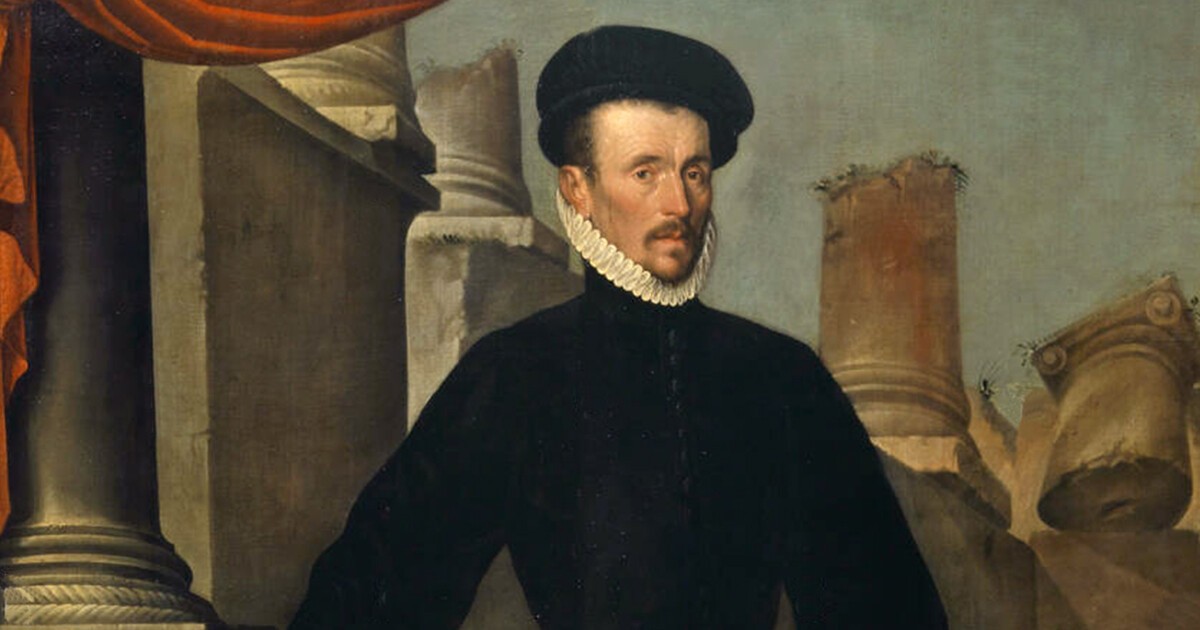
One morning in October 1552, Felix Platter left his hometown of Basel for Montpellier, where he was to study medicine. He was fifteen years old. Things started to happen to him, and he wrote them down in his Tagebuch, his daybook. When Felix was an old man – an important physician and intellectual in Basel – he reworked that teenage diary into a longer memoir, filling in his earliest childhood memories, as well as more sombre reflections on his adult achievements and disappointments. But the sections on travelling to France and studying there retain all the freshness and awkwardness and charm of his daily adolescent writing – the intensity of life suddenly expanding beyond the confines of childhood. It’s this section, translated from a Swiss dialect of early modern German by Seán Jennett, that has been republished. (The rest remains available only in German or French translation.)
Like many committed diarists, Felix seems to have been evangelical about the practice. Before he reworked his teenage diary into a memoir, he convinced his father, Thomas, to dictate his own autobiography; this was in 1572, when Thomas was in his early seventies. (‘Now I have, according to your desire, dear son Felix, written the beginning and progress of my life up to the present time,’ Thomas concludes his book, ‘as well as I could remember it after so many years; but certainly not all, for who would be able to do that?’) Felix urged his much younger half-brother (also called Thomas) to keep a diary, too, which he did from 1595 to 1600, recording his own adventures at medical school in Montpellier, as well as his travels to London. The Platter diaries have long been known to historians, partly because of Emmanuel Le Roy Ladurie’s immersive microhistory of the family, The Beggar and the Professor, published in English translation in 1997. In his introduction to Beloved Son Felix, Stephen Greenblatt writes that ‘keeping diaries and writing autobiographies did not become a widespread practice until the mid-17th century.’ Felix’s diary was precocious, just like him.
The arc of family fortunes told across the three Platter diary-memoirs is astonishing. Thomas the Elder was born into poverty in the Swiss Alps, where he worked as a goatherd as a young child and seems to have subsisted primarily on crumbs of rye bread and milk, stored in a basket strapped to his back. He remembers being with another ‘little goatherd in the wood’, wishing that he could fly beyond the Alps. And he did. Through a combination of grit and luck, Thomas became a humanist teacher and printer in Basel, a scholar of Latin, Greek and Hebrew, and sent his ambitious son Felix off to become a doctor, with Thomas the Younger following in Felix’s footsteps. In his travel diary, Thomas the Younger remembers seeing a production of Julius Caesar at the Globe, an event unimaginable from the vantage point of his father’s childhood.
Memoir-writing entails a self-consciousness that keeping a diary does not. Thomas the Elder’s autobiography, and the beginning and end of Felix’s book, are shaped. Both texts were compiled by old men making sense of the ‘progress’ of life as best they could, and are attempts to find patterns and prefiguration and plot. Thomas’s memoir takes the shape of a Renaissance rags-to-riches adventure story; Felix’s autobiographical writing searches for signs of his calling to be a physician in his earliest childhood. He remembers as a little boy in Basel the way his father ‘made me admire [the doctors] as they passed on horseback in the street’. He also watched the butchers work: ‘Tell me what miracle the butcher will find in you,’ Felix whispered to the cattle and the lambs before they were slaughtered.
As a medical student in Montpellier, he attended every dissection at the university. He loved the drama of it. He describes cajoling a monk to help him dig up a corpse in a cemetery in the dead of night and transporting the body back to the anatomy theatre. The grave-robbers worked up an appetite and ate chicken cooked with cabbage. ‘We got the cabbage ourselves, from the garden, and seasoned it with wine supplied by the monk.’ Felix incorporated his teenage diary into his memoir knowing what would happen in the end: the starry career as a physician; the scholarly contributions to the study of anatomy, of the retina, of psychiatric disease. But in his adolescent diary, we see the traces of the other loves of his life, before medicine won out. Food, girls, violence, clothes: it’s all recognisable to anyone who has ever been, or been obsessed with, a teenage boy.
Felix loved to eat. When he was little and his sister died, he stole the pears that had been laid out on a bench in her death chamber and hid behind the stove to eat them. At his last supper with his mother before he left for medical school, she prepared ‘a roast rabbit and quail, which I had reared myself, and which she had killed on my account’. He eats roast chestnuts and black bread and cheap wine with a gang of bandits at a roadside inn. Later, after a dinner during which he had embarrassed himself by making errors speaking French, a servant girl ‘came to offer me a large pear … but I was overcome with shyness and left without accepting it’. During his first Lent in a Catholic city, he ‘learned how to cook eggs in butter on a piece of paper’, because he didn’t dare contaminate a pot. Catalan, his landlord in Montpellier, was a converso, and Felix learned to eat cabbage soup with his fingers just like him.
At Lent, he recorded that he ate haddock, sole, tunny, mackerel, sardines, lobster, lettuce and chicory salad, onions cooked in syrup. He badly missed cheese. At school he ate pork with a little mustard, but never in Catalan’s kosher home. On Shepherd’s Day, he ate ripe cherries and figs, sold by the pound. On St Lawrence’s Day, he cut down black grapes the size of plums, and his landlady ‘hung up a great number from the ceiling of my chamber’. On St Bartholomew’s Day, he saw onions bound with strings piled high in the square. He played the lute for his friends and took payment in almonds. He sent a crate back to his father in Basel containing pomegranates, oranges, dried grapes, figs – the fruits of the Mediterranean South. He gave a German traveller some figs for his breakfast, which the foreigner mistook for pomegranates: by that time Felix was worldly enough to find the mistake funny. In Cabanes, he drank a wine so thick ‘that I wrote in my notebook with it’. Only a committed diarist would attempt that. He ate a pâté made from cat meat (his friends assured him it was rabbit). On one occasion he ate cuttlefish and spider crabs, and someone complimented the shape of his nose.
And when he came to compile his memoirs, he remembered his wedding feasts in perfect detail (there were two, one at midday and one in the evening): a first course of tripe, meat soup and chicken, followed by boiled carp, then roast meats and Black Forest game and fishcakes, followed by pastries. He served Rang wine, from Alsace, which packed a punch: ‘Dass dich der Rang anstoss,’ the saying went – let the Rang hit you. The ten-year-old fishmonger’s daughter wore pearls in her hair. Felix composed a long and (he says) humorous poem about the classification of spoons for after-supper entertainment. His mother was so thrilled that Felix had finally married, she burst into song while relieving herself: the bathroom shared a wall with the newlyweds’ bedchamber.
In Felix’s descriptions of food there is also a story of religious difference and of confessional violence. Felix was a Protestant in Catholic Montpellier, lodging with a Jew who had been forced to convert. Grapes and olives and pomegranates were new to him, but so was the delicacy needed to navigate religious diversity: where to eat sausages and when to eat fish, and how to cook over paper during Lent – all of it mattered. He knew it mattered because he saw dissenters executed regularly. He understood that what you ate revealed what you believed. He witnessed a Protestant led from Lyon to be burned with the straw already fastened on his back. On the outskirts of Montpellier, he saw ‘pieces of human flesh hung from the olive trees’; ‘this sight gave me a curious sensation.’ In one entry he notes the first blossoming of the pomegranate trees, and that five Protestants had been burned. ‘We only just missed bumping into a corpse that was hanging from a branch,’ he records.
Le Roy Ladurie wrote that Felix’s response to religious violence in his diaries is ‘rather cool’. In his foreword to the new edition, Greenblatt wonders how Felix managed to ‘stay sane’ amid such horrors and accounts for the diary’s jarring contrasts – astonishing confessional violence next to musings on the olive harvest – as ‘simply the way the world worked’ in the 16th century. But diaries, especially the near daily kind kept by Felix as a teenager, are by nature dissociative. The details and the memories pile up and the connective tissue between them can be elusive even to the writer. When I read his diary, I see Felix confronting again and again the tremendous sensual novelty of southern France: its Catholicism and its Mediterraneanness.
The Annales historian Fernand Braudel defined the Mediterranean world as stretching ‘from the northernmost olive tree to the northern limit of the palm tree’. Felix crossed that boundary. He records his first sight of olive trees, the way French peasants knocked the fruit off the branches with long sticks (at first he thought they were lances, and was afraid). He notes the silvered seashells filled with sugary almonds and, on Mardi Gras, boys wearing sacks of oranges around their necks and throwing them at the pretty girls. ‘I was very surprised to see rosemary growing in the fields as freely as the juniper does with us,’ he writes on one of his first days in Montpellier. ‘There were marjoram and thyme as well, filling the fields, and so common that no one pays any attention to them. Rosemary is used for heating, there is so much of it.’ He watched the peasants strap bundles of rosemary to the backs of donkeys and send them into town; the herbs burned in the city’s hearths. Imagine the fragrance. And he saw the sea for the first time. He swam and then covered himself in sand that had been warmed by the sun.
The trick of diary-writing is to let the embarrassing and unflattering bits live on the page, to resist the impulse to tidy them up or, worse, to omit them altogether. Felix was unusually good at such unsparing record-keeping. After suffering explosive diarrhoea at a roadside inn, he notes that the innkeeper complained the next morning that the walls had just been whitewashed. Once, another innkeeper’s daughter leaned in to kiss him, but he was too shy to kiss her back, and everyone laughed at him. In Montpellier, he was thrilled to bring a doctor’s daughter to a ball but slipped in the mud and splashed her dress with dirty water; she had to go home to change. He writes with obvious pleasure about a new pair of red breeches – ‘slashed and lined with taffeta and pleated so low that I almost sat on the gathers’ – but they were so tight he couldn’t bend over. He learned to dance in the French style, and promptly got his spurs caught on the hem of a girl’s dress and took a tumble. ‘I was so stunned,’ he records, ‘that I had to be helped up.’
Such unselfconsciousness makes it difficult to keep in mind that Felix’s diary is not some kind of transparent window onto his soul. As a young child, his older sister tormented him with rings made of chicken gizzards, and from that time on he had a terrible fear of anything ‘round and perforated’, even the ‘bobbins of spinning wheels’. But this was hundreds of years before our post-Freudian theories of what constitutes the self and the ways the psyche leaks out onto the page. Historians have long debated whether and how selfhood was imagined differently in the early modern past. In The Civilisation of the Renaissance in Italy (1860), Jacob Burckhardt argued that individuality was an invention of the era: in medieval Europe, human consciousness ‘lay dreaming or half-awake’ under the collective illusion of faith and kinship; but during the Renaissance ‘man became a spiritual individual, and recognised himself as such.’ Historians have argued with Burckhardt ever since: placing the development of self-conscious interiority earlier, or later; suggesting that early modern concepts of selfhood were collective, too; and that our own modern sense of self – highly individualised, bounded, stratified, only gradually and incompletely revealed even to ourselves – would have been alien to Felix and his contemporaries. Whatever the contours of the early modern self, the art of its expression seems to have become increasingly compelling to writers of the period. Felix’s diary is a particularly early, youthful and winsome example.
Felix became a doctor in Basel, a professor at the university, the owner of a handsome and ornately painted house in town. He was also a collector and opened a renowned museum in his home that displayed all kinds of natural and anatomical objects, some of which he had collected during his adolescent travels (he charged an entrance fee; Montaigne visited). Seashells, rare plants, fossils, stones; a wild ass and a marmot: all were on view. He was a keen botanist and assembled a herbarium, nine volumes of which are held in the Burgerbibliothek in Bern. The manuscript pages are pressed with flowers, grasses and herbs of all kinds, with Felix’s careful handwriting denoting their names. Their green stems have faded into gold with the passing of several hundred years, and there are little clumps of roots with the dirt still clinging to them. Some of these samples were collected during his time in Montpellier, the living landscape of the Mediterranean South brought home to Switzerland and preserved.
The volumes of Felix’s herbarium have been digitised, and I spent some time looking through them. It’s not so different from a diary: taking something alive and untangling it, sweeping away some but not all of the dirt, pasting it down to the page. Felix was unusual, I think, in being the sort of person who could turn his ferocious appetite for knowledge inwards as easily as he directed it outwards – onto plants, food, clothing, bodies. He wants to prove that he was destined to become a doctor, but I think he was destined too to be a diarist – another sort of dissector of the insides of life. When he whispered to the animals, asking what miracle was hidden inside them, he was also asking himself, anatomising his own passions and desires and foibles in the pages of his diary. And yet for all the force of his curiosity I’m not sure his life was any less elusive to him. His diary is remarkable not for exposing the hidden contours of his psyche, but for the aliveness of his impressions of the tastes and smells and sights of his new life. He catches all the intensity of adolescence – that feeling of seeing the world for the first time – and pins it to the page.
There were hailstones as large as eggs. There was Little Annette dancing through the night on thick Catalonian carpets, so as not to wake her neighbours. There were hideous executions, and there were serenades under windowsills. There was a flirtatious girl in pantaloons of yellow silk, and there was the girl who ate so many chestnuts in one sitting that she had to be given an enema. There was also the girl with such a long nose that her lover couldn’t kiss her, ‘especially since he too had a nose of respectable size’. There was a ram from Barbary with a plaited tail. And there was his mother greeting him at the door when, after his years away at school, he finally returned home to Basel. She was weeping, and wearing, ‘as the fashion was then, a green apron with a bib above, and white shoes’.