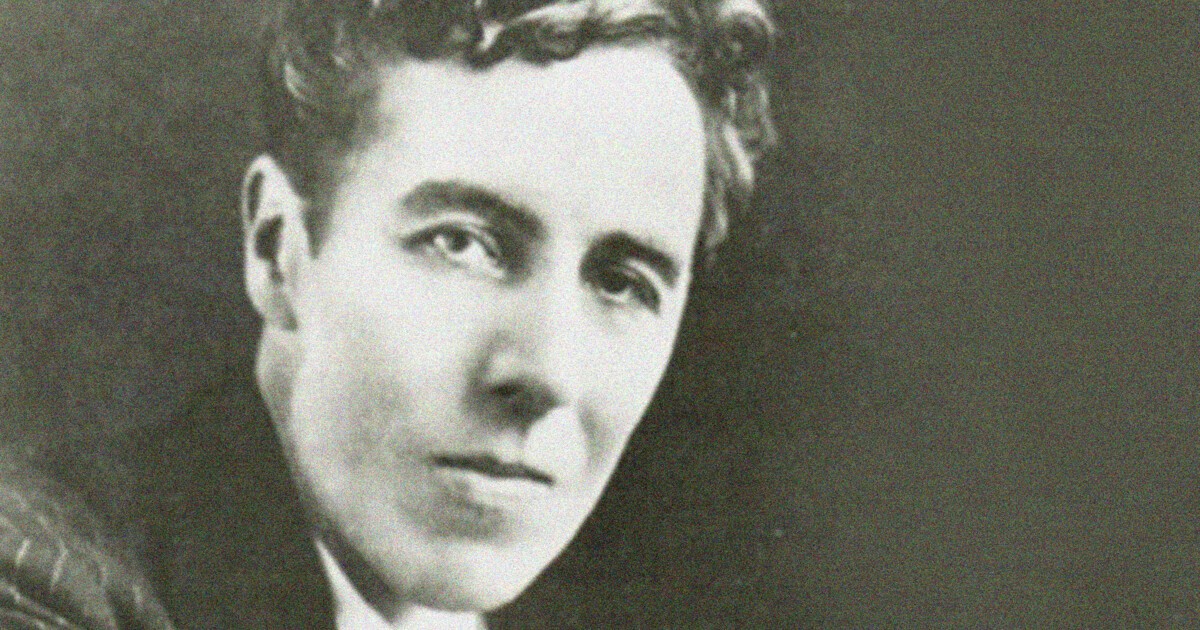
Ronald Firbank died on 21 May 1926, of pneumonia, in the Hotel Quirinale in Rome. He had lived alone for much of his adult life, and it seems likely that he died alone too – he had sent away the nurse who had been engaged to look after him. This detail comes from the only published account of the circumstances, by Lord Berners, who considered himself Firbank’s ‘only friend in Rome at the time’. In a brief memoir published four years later, he gives us the last recorded image of him alive. He describes how a few days earlier he had motored out with Firbank to Lake Nemi, twenty miles south of Rome, and that almost his last impression of him was ‘seeing him ambling down the precipitous streets of Genzano followed by a crowd of children shouting “Ridolini! Ridolini!” … From time to time Firbank would stop and scatter handfuls of nickel coins, a proceeding which only tended to aggravate the situation.’
‘Ridolini’ was the Italian nickname of the wildly popular American film actor and director Larry Semon, who was three years younger than Firbank; he worked on several occasions with Laurel and Hardy, and specialised in cartoonish gags, often in Chaplinesque bowler hat and stylised white make-up. In The Dome Doctor, released in 1925, he played a hairdresser, and there his dandyish dress and camp gestures have some similarity to images of Firbank, and to accounts of his unusual undulating walk. The children in Genzano found funny what was involuntary in Firbank, not knowing if it was a performance or not. Semon’s fame was such that he had different nicknames in Italy, France and Spain, his slapstick an international language. Firbank, a lifelong traveller between these countries, had no public recognition, and so a poignant contrast lurks in the children’s spontaneous mixture of mockery and celebration. They of course had no idea who he was, and would go to their graves without ever having heard of him. But for a few hilarious minutes, scrambling for unexpected gifts, they thought Ronald Firbank was someone very famous.
Firbank’s fame since his death has been tenuous, and eclipsed. In histories of British literature he has been largely ignored, though his influence was extensive and profound. The persistence of the term ‘Firbankian’ – to mean high camp, fantastical, irrepressibly queer – is oddly detached from any close attention to his work. It can be hard to persuade even perceptive and dedicated readers of English fiction to tackle Firbank: they demur and defer, perhaps misled by his tone into thinking him unserious, or else embarrassed by his subject matter. In my experience, few academics in English departments have much idea of his books, though the growth of queer studies has brought him some new prominence. To a small number of writers he has continued to mean a great deal. He was just forty when he died, and had published six startlingly original novels, as well as a few shorter tales and a three-act play, The Princess Zoubaroff, which he never saw performed; his last completed novel, Concerning the Eccentricities of Cardinal Pirelli, came out a month after his death. None of his books sold more than a few hundred copies in his lifetime, and their rarity no doubt enhanced their cult-like importance for certain readers. It was as ‘a cult’ that he described his standing in England to Carl Van Vechten, who engineered Firbank’s launch in America in 1924. But the popular success Van Vechten promised has never quite come about.
My interest in Firbank has taken up exactly half of the hundred years since he died: a fact of no consequence but pleasing, somehow, to me. I was nudged in his direction by my graduate supervisor at Oxford, John Bayley, a wonderfully subtle and wide-ranging critic who as far as I’m aware never wrote about Firbank himself. I was embarking on an MLitt thesis looking at the way gay British writers, in the early and mid-20th century, had negotiated the necessary concealment of their sexuality in their work, and at the ways in which it was nonetheless expressed. Some figures were obvious and central. E.M. Forster, who had died five years earlier, enjoying a conspicuous posthumous coming out with the publication of Maurice in 1971 and The Life to Come in 1972, was in the frame from the start. It’s now axiomatic that Forster was gay, and his sexuality is doubtless a part of any new reader’s understanding of him. But in 1975 no one had explored its implications for his work in general, and a lot of my sense of the wider terrain at that time was a matter of hints, of still private knowledge, of joining up widely spaced dots. The partial decriminalisation of homosexuality in 1967 had opened up new possibilities, but the thaw was gradual. Michael Holroyd’s great biography of Lytton Strachey, published that year, was prophetic of an unembarrassed candour about gay lives, rather than a response to new freedoms; P.N. Furbank’s Life of Forster was still two years in the future, and other biographies that had already appeared, including Miriam J. Benkovitz’s of Firbank in 1970, fell far short of the human, cultural and critical insight of Holroyd’s Strachey. But Benkovitz was my first guide to the Firbank landscape, and thus of some importance to me, and no doubt to everyone who’d been hungry for information about Firbank for the past four decades. It was only later that I found out how much of the information was wrong.
When Bayley first mentioned him to me, I’m not sure I’d even heard of Firbank. But I went to Blackwell’s, where several copies of The Complete Firbank were waiting to be bought. This was the Duckworth edition of 1961, reissued in pinkish covers in 1973, and suggestive of an interest, both steady and renewing, in Firbank’s work. My impression was that he was indeed current, and on through the later 1970s, up to the time when Brideshead Revisited was being filmed in Oxford and good-looking students dressed in wing-collars and boaters were darting down Broad Street as extras, enjoyment of Firbank’s wit and camp was in the air, a generational thing, and a sophisticated taste that looked back quite naturally through Waugh to the writer who had been so formative of him.
Moreover, Brigid Brophy, an intelligent and determined presence as novelist, critic and campaigner through the 1960s and 1970s, had published her Prancing Novelist in 1973. The contemporary standing of a writer, reviewer and radio regular becomes hard to convey quite quickly after their death; but Brophy’s particular, doggedly witty presence was a powerful and persuasive one. Certainly her effect on me was life-changing, not only as an educator in a particular aesthetic of discipline, economy and omission (as expressed in her books on Mozart, Beardsley and Firbank), but as an advocate of animal rights: it is thanks to an unanswerable essay of hers in the LRB of 21 May 1981 that I haven’t eaten meat for the past 45 years. In Prancing Novelist, Brophy took up Firbank in refutation of the many shortcomings, both of research and of interpretation, in Benkovitz’s recent biography, and in her dartingly relentless way she expanded her argument for him as one of the great writers of the 20th century. Her own research was not extensive, but her understanding of the work and period was profound, and a generally dependable basis for the many speculations in which she seeks and suggests Firbank’s meanings, references, associations and chains of thought. She analyses him as a supreme designer, and her procedure is a calculated reversal of a tradition (if that’s not too strong a word) of dismissing him as frivolous, as well as a criticism of lukewarm, conditional champions such as Forster, of the ‘why break a butterfly upon a wheel?’ school, with its various shades of reluctance to take him seriously. Brophy’s subtitle, ‘A defence of fiction in the form of a critical biography in praise of Ronald Firbank’, hints at an unFirbankian cumbersomeness in the ambitions of this book, which is nearly six hundred pages long, but every word, as always with Brophy, is meant. Her fragmentary and incessantly cross-referencing text can be confusing and exhausting but Prancing Novelist retains to this day a foundational importance for all who are interested in Firbank, and who do take him seriously; in the mid-1970s it was also defiantly and mind-openingly new.
Iwish I could recapture now the exact sensations that attended my first reading of Firbank – pursued chronologically through the eleven works contained in that 765-page compendium, which was a little bit shorter than a Dickens novel, but organised page by page, and book by book, on thrillingly different principles. There was certainly much that escaped me, and the texture, the sheer technical originality and obliquity of the earlier novels in particular was a challenge, more akin to reading difficult modernist poetry than any novels of this period I’d read – though I had of course already studied Ulysses and Jacob’s Room, both were still seven years in the future when Vainglory was published in 1915 by a writer never once alluded to in my seminars, reading lists or exam papers.
Quite naturally, as with any truly original writer, one had to learn how to read Firbank. A certain clue-seeking and backtracking habit was necessary, and part of the fun. There is a chapter in Vainglory of mysterious exclamatory dialogue in which Firbank takes nearly three pages to reveal where the scene is taking place (an outdoor amphitheatre in a garden at nightfall), as well as who all the speakers might be. The truth dawns on you, and the effect, itself rather like stealing into a theatre in the middle of an unknown play, is one of interpretation, of imaginative collaboration, of sign-reading and supposition: though with a novel we have the luxury of immediately rereading, and seeing how Firbank’s apparently unnaturalistic technique also crystallises something about our apprehension and construal of real life, as the mind’s eye adjusts to the bizarre realities of human behaviour and the mystery of others’ thoughts and motivations. This was something no one had attempted so boldly before, and was to be a persistent theme.
There is a scene in Caprice (1917), where Sarah Sinquier, on her first full day in London, has learned that Mrs Bromley, who she’d hoped would coach her as an actress, has dropped dead the night before. Sarah wanders off bewildered and, ‘nearly fainting from inanition’, drifts into the Café Royal; this was a locale familiar to Firbank, and associated with many artists and writers including Wilde, but to the innocent young woman it is a crowd of strangers. It was Joe Orton, one of a later generation to acclaim and emulate Firbank, who called him ‘the only impressionist in the English novel’ – a painterly analogy I wouldn’t want to press too far, though he surely shares the Impressionist desire to convey sensory experience with a new immediacy through a technique that simultaneously sharpens sensation and blurs detail. The description of Sarah entering the Café Royal is also a lovely analogy to the reader’s experience of penetrating this innovatively organised text:
Everyone seemed to be chattering, smoking, lunching, casting dice, or playing dominoes.
She advanced slowly through a veil of opal mist, feeling her way from side to side with her parasol.
It was like penetrating deeper and deeper into a bath.
She put out her hand in a swimming, groping gesture, twirling as she did so, accidentally, an old gentleman’s moustache.
A mere Impressionist wouldn’t have allowed himself that last note of comical absurdity.
Sarah finds a seat, and in another very Firbankian moment, ‘the realisation of her absolute loneliness’ overcomes her, and she bursts into tears. Slowly those surrounding her try to console her, none yet named, though she hears one of them addressed as Serephine. One young woman recommends a dramatic conservatoire in Croydon, though Sarah is at a loss how to get there, and recoils from mention of the Underground. It’s a shimmer of barely comprehensible fragments, the speakers all unallocated, though some are already forming designs on this vulnerable young woman – ‘“Never mind, Precious,” the fat man crooned. “You shall ride in a comfy taxi-cab with me”’ – until one speaker is suddenly given a name, and emerges from the chorus like a wicked mezzo to the heroine’s soprano: ‘“No; indeed she shan’t,” Mrs Sixsmith snapped. “You may rely on me, Ernest, for that!”’
It’s as if we ought to know who this Mrs Sixsmith is, and so ought Sarah, since she’s the recurrent figure of the deceitful agent, the protector as exploiter, introducing the young ingénue to a world of theatrical connections and possibilities while picking up almost uncannily that she has run away from the safe and respectable provincial deanery of her upbringing with purloined pearls and family silver, which Mrs Sixsmith promptly undertakes to sell for her.
I think that what I loved from the start about Firbank was not only his highly aestheticised world but the way so many of its characteristics come straight (if that’s the right adverb) from the real world, acutely observed – seen and heard. Firbank’s radical fragmentary technique grew in perfect symbiosis with the essential novelist’s genius for noticing and remembering details, many of them written down on the now lost blue cards and long strips of paper described by various friends, and accumulated in the extant notebooks. His fictional ambience of the glimpsed and overheard surely draws deeply, too, on the domestic milieu of his mother and her friends and of his younger sister, Heather, whose talk, visits and preoccupations were pursued at a remove from the worldly business normally thought the province of the male novelist. In such conversations, scandals were conveyed in pained or excited hints and allusions, screened from the child by the mother (from whom in the course of time the son would screen so much of his own often faraway life). The whole pages composed of fragments of party dialogue, a feature already of Vainglory and its immediate successor, Inclinations (1916) – ‘there came a babel of voices’, or ‘a murmur of voices’, or ‘a confusion of voices’; in Valmouth (1919) ‘a jargon of voices’, as if all conversation resolves into a specialised code – are both a pure expression of his method and a distillation of his deeper perception of the nonsense, irrelevance and jabbering cross-purposes of social intercourse.
I found Vainglory both beautiful and quotably funny, and in its quirkily fractured depiction of life in a Trollopean cathedral town I think I first felt the inseparable mixture of celebration and mockery that characterises all Firbank’s work, the quintessence of camp, of course, though heard here in many registers. His humour, when it isn’t simply sexual innuendo, turns on bathos, on the rapid juxtaposition of high and low, the flight of fancy and the thump to earth. Here is Lady Anne Pantry, the bishop’s wife, musing on Ashringford Cathedral:
And the cathedral was very perfect indeed. How admirable, through the just sufficient drapery of the trees, were the great glazed windows that flashed like black diamonds in the sun. The glass, indeed, at Ashringford was so wonderful that sticks and umbrellas were left (by order) at the door …
Lady Anne looked up at the large contented towers and fetched a sigh.
They were lovely.
Without veiling her eyes, they were as near perfection as she could conveniently bear. Placed at the end of the tennis lawn too, they had saved her from many a run.
Reading through the first four novels now, I see much more clearly how experimentation is an inherent property not just of each book, but of the oeuvre, rapidly developing through the war years. Like other writers with a very strong stylistic stamp, Firbank can easily be thought of as doing just one thing. Henry Green, who learned much from Firbank’s experiments, is another example, the impression solidified by the confusable gerunds of his titles, Living, Loving, Doting. But, like Green’s books, Firbank’s are in fact technically quite distinct from one another, responses to exacting self-imposed challenges. Vainglory, much Firbank’s longest book, has the characteristic personal warmth of a certain kind of first novel, a confidence, untested but justified, in making a private world public, with a bold declaration of particular interests and observations – he explores his terrain with no preconceptions as to length, but a keen pleasure, as he spreads his wings, in getting everything in. It’s a book saturated in artistic reference, not quite to the self-conscious degree of the earlier, as-yet unpublished Artificial Princess, but the abundance of painters, writers, composers and performers – Tiepolo, Greuze, Puvis de Chavannes, Racine, Verlaine, Cimarosa, Gluck, Yvette Guilbert, Nijinsky – invoked by Firbank and his characters infuses the whole book with the tone of someone taking their cultural bearings and declaring their allegiances. You can feel him enjoying his sense of command of a large private kingdom, in which he makes the rules and is just as free to break them. And in the process he does something extraordinary. Technically there had been nothing so radical in the English novel since Tristram Shandy, 150 years earlier.
But then the technique of Inclinations, published fourteen months later, is notably different, the book being written almost entirely in dialogue, again oblique and unexplained at the start, where we’re eavesdropping at once on a conversation between an unknown number of people about a further unnamed person, but clarifying as the book pursues its astonishingly economical course, with the rich quaint atmospherics of Vainglory left behind. (From now on the novels would be about twenty thousand words long.) The lesbian theme latent in the first book now shapes the whole narrative, though the narrative is half-hidden, conducted in jumps, and as far as Miss O’Brookomore, the travelling biographer, is concerned, also goes wrong. The homosexual plot is trampled under the oblivious hetero one, as young Mabel Collins, the object of Miss O’Brookomore’s passion, meets an Italian count, marries him and bears his child. The point of rupture, the famous short chapter made up simply of eight cries of ‘Mabel!’, is a score without expressive markings: the readers of a dozen audiobook versions might make different decisions about its sequence of emotions, its proportions of comedy and pain.
After this, Caprice, the slightest of the novels, further adapts the dialogue-based technique, as is apt for a book about the theatre, and has sequences built up imagistically, with dabbed-in notation, as in the description of Sarah penetrating the Café Royal. The strange rooftop world – Soho, I always imagine – of the actors’ dwellings, where laundry is being done, the sky lit up by nearby theatre signs, with a view down into an Ursuline convent next door, is a magically modern piece of urban scene-setting, theatrical London as a lived-out fantasy, the glamour less of the stage than of the backstage, the world of theatre folk. The reader never gets to see Sarah open in Romeo and Juliet, though we are there for the nail-biting build-up, Mr Smee as Friar Laurence blind drunk and believing he’s in The Tempest or possibly Three Sisters instead, and in the next morning’s papers we read the magnificent guest list (‘Dismalia Duchess of Meath-and-Man’, ‘Lord and Lady Lonely’, ‘Lady Lucy Lacy’ etc, a routine of pure onomastic exuberance, of a kind which recurs in several of the novels) and see the reviews. What we don’t quite see or understand until later is the moment when Sarah meets her unexpected and sadly ludicrous end, brought about by two traps: the mousetrap on which she trips, and the trapdoor through which she falls into a well beneath the stage.
To turn from the perilous fragmentation of Caprice to Valmouth is to sense from the opening paragraphs a decided change of attack, from a scenic structure of scintillating glimpses to the most solid and expansive storytelling Firbank has yet attempted – a relished old-fashioned manner made the vehicle for a completely unconventional kind of contemporary fairy tale. What if a particular south-western English resort were to have a climate of the kind found in Southern Europe or the subtropics, the favoured zones of Firbank’s own migrations, closed off to him during the long isolation of the war? What if this beneficent climate enabled those fearful of an early death, those dreading, as Firbank did, the ‘sad far shores of forty’, to live on to centenarian age? And what then of their inclinations and caprices, with the possibilities of an erotic life protracted indefinitely by the enabling presence of Firbank’s first major Black character, the masseuse Mrs Yajñavalkya? Gay and lesbian innuendo forms part of a much more sexualised narrative than Firbank had attempted before. If the difficulty of the earlier novels was in part, like other modernist experiments, a means of concealing subversive matter from the uninitiated, the comparative approachability of this novel suggests an increasing boldness in the face of public scorn and indifference.
One thing that struck me very quickly fifty years ago was how removed these sexually unorthodox experiments were from Forster’s struggles with gay subject matter, going on at just the same time. By making the novel a structure of bright fragments, Firbank aestheticised it, and in the aesthetic realm the normative claims of morality are relaxed. His difficult inconsequential manner is part of a bigger subversion of the novel, and what is in many ways a homosexualisation of it. He didn’t do this by writing a ‘gay novel’ like Maurice, or like those that Gore Vidal and James Baldwin would later write in The City and the Pillar and Giovanni’s Room – novels in which the homosexual condition is itself the subject, with an unusual dominance of maleness. For Forster a forthright novel on homosexual themes was a legal impossibility, something that couldn’t happen ‘until my death and England’s’, as he put it. Firbank’s dodge, especially in his earlier novels, all set in England, was not to write about relations between the sexes at all – indeed to establish as a theme the separation of the sexes. Male gay couples are, to the knowing eye, pretty clearly what they are, but from the start Firbank’s strategy, or perhaps simply his instinct, was to write almost entirely about women, who move in an atmosphere where friendship borders constantly and quite naturally on stronger passions. His investment in the female world is surely unparalleled among male novelists of any stature. In the postwar books, all of them written and set abroad, things are rather different. In them the death of England, the imaginative liberation from English custom, cliché and hypocrisy, is engineered and celebrated in a very personal and defiant fashion.
Despite the general slackening of public interest in Firbank in the second half of the century since his death, the centenary of his birth did not pass unnoticed: a number of articles appeared, and the late Jonathan Fryer organised a series of talks in the café of a Buddhist centre in Croydon, one of which was by me, though I have no idea now what I said. In January 1986, the Tatler asked a dozen writers for their views on Firbank. Angus Wilson: ‘R.F. is one of my few really admired novelists. Do squeeze my name in as a devout admirer if you possibly can.’ A.N. Wilson: ‘I have never been able to read more than about three pages of Firbank – never seen the point of him at all.’ Sadly they couldn’t ask Edmund Wilson, who in 1949 had published what remains one of the best essays on Firbank ever written; but happily there was Sandy Wilson, who recalled critics’ shocked reactions to the characters and their activities in his 1958 musical of Valmouth: ‘These people never seemed decadent to me. They were charming, they were witty – a little eccentric perhaps, but perfectly harmless – and above all alive. Seeing them come into being on the stage was one of the happiest moments of my life.’ Alan Bennett (whose opinion I was curious to hear): ‘All I know (and have read) of Ronald Firbank is that his grandfather built the Settle-Carlisle railway.’ Michael Frayn: ‘Unreadable.’ Kingsley Amis: ‘Perfectly sums up in himself what I can’t bear about one of the two main kinds of novel I can’t bear. Saul Bellow does the job for the other kind.’ All the respondents were men, except for Brigid Brophy, who thought Firbank would have liked being featured again in the Tatler, since ‘frivolity was his medium’, but hailed his as ‘the most cogent literary architecture since Jane Austen’s … he is still, as well as the most inspired, the most avant-garde of 20th-century novelists.’
I don’t think it’s meaningless to note that the positive reactions are all from queer writers, and the negative ones not – and though I certainly wouldn’t want to segregate admirers and detractors too strictly along such lines, there is an evident sense of gay men in particular being susceptible to Firbank’s wit, naughtiness and worldview, and of straight ones being bored or even repelled by these things, or for other reasons feeling it important to be seen as rejecting them. It’s evident that Firbankianism was from the start both a technical and a moral quantity. In the generation who were first strongly influenced by Firbank, Evelyn Waugh constitutes the most striking case of this duality.
Waugh’s essay, written at the time of the first collected edition in 1929 (for which Firbank had allocated funds in his will), is the first intelligent appraisal of him by a major fellow novelist and invaluable testimony to the impact Firbank’s formal innovations and humour had made on the generation of writers emerging in the decade after the Great War, among whom Waugh listed Van Vechten, William Gerhardi and Ernest Hemingway. For Waugh, Firbank was a liberator, the person who had seen how to take the novel forward as a form. His technique, Waugh perceived, was compositional rather than narrative: ‘His compositions built up, intricately and with a balanced alternation of the wildest extravagance and the most austere economy, with conversational nuances.’ At the same time, Firbank does not write the ‘novel of conversation’, since there is rarely any significant exchange of views: ‘From the fashionable chatter of his period, vapid and interminable, he has plucked, like tiny brilliant feathers from the breast of a bird, the particles of his design.’ This insightful, sophisticated essay is one of those moments where you see a live spark leap from one generation to the next. Waugh was just getting going on Vile Bodies at the time – a novel whose first part is one of the most Firbankian texts produced by any other writer, showing an influence so strong that it had to be tamed (and is tempered already in the latter parts of the book), though Firbankian principles of economy and absurdity, the way people react and talk at an oblique angle to their meanings, remained operative in Waugh’s fiction until the end.
Thirty-three years later, when the seven completed chapters of Firbank’s last and most unbuttoned novel, The New Rythum, were published, the literary editor of the Spectator had the bright idea of asking Waugh to review it, and got the following postcard in reply: ‘I am sorry to say that your kind invitation to review The New Rythum reaches me thirty years late. In youth I was fascinated by Firbank. Now I can’t abide him. E.W.’ Interviewed around the same time by Julian Jebb for the Paris Review, Waugh was asked about his influences, and named in first place P.G. Wodehouse, while also acknowledging a debt to Hemingway and ‘the way he made drunk people talk’ in The Sun Also Rises. Pressed about Firbank, Waugh acknowledges nothing, and again says, ‘I can’t read him now’; asked why not, he says: ‘I think there would be something wrong with an elderly man who could enjoy Firbank.’
Casting a taste for Firbank as a slightly shameful youthful indulgence of course says much about Waugh and his late persona (this ‘elderly man’ was 59 at the time; he would die at 62). Fundamentally, he seems to have relished Firbank’s subversions of form and technique, but soon repudiated those other, inseparably related subversions, which made Firbank’s style the intimate and inevitable outcome of his peculiar, dissident personality. The perversities and obduracies of Waugh’s later persona are legendary; he increasingly favoured assertion over argument or self-explanation. His own queerness and susceptibility as a young man were repudiated by the dogmatic, landowning father of seven.
Did religion come into it too? The year after he wrote his praising article, Waugh converted to Catholicism, which Firbank had done 23 years earlier. This might have made a sympathetic link between them, but their understandings of Catholicism were evidently far apart. Firbank several times repeated to Berners the line, ‘The Church of Rome would not have me and so I laugh at her,’ referring, with typical obliquity, to his having been rejected in his whimsical attempt, in 1909, to join the Guardia Nobile in the Vatican. In fact the Catholic Church formed a rich and continuing focus for his study of human frailty and delusion, and he writes of it, from Vainglory to Cardinal Pirelli, with a blend of satire and sweetness. A yearning for God, both observed and expressed, is a persistent thread; in the last two years of his life, after the death of his mother, he found new consolation in prayer, and professed himself moved by the mystical element in religion – a tendency that had always been present. But consulting a psychoanalyst in 1921, he found, besides the relief of being ‘understood from top to toe without prejudice’, that ‘my chief regret at present is that I have no Religion.’ Waugh, who relished his own prejudices, was asked in the Paris Review interview if the Catholicism of Brideshead Revisited expressed a reverence for established institutions, and replied, ‘No, certainly not. I reverence the Catholic Church because it is true, not because it is established or an institution.’ Firbank’s more troubled and ironical relation to the church was far from Waugh’s later taste, and that irony saved him from some of the errors of taste Waugh was to make in Brideshead itself.
In 1930, the year after Waugh’s article, Duckworth published Ifan Kyrle Fletcher’s Ronald Firbank, A Memoir. This was a remarkable commission: Fletcher was only 23 when he was approached to write it, and had written nothing of substance before. He was the son of an antiques dealer in Newport, Glamorgan, and at the age of eighteen he had set up a bookshop in the basement of his father’s business. Newport was a Firbank family centre, where Firbank’s grandfather, a Durham miner who made a fortune as a railway contractor, had bought an ancient manor house and built a new one; various inherited properties in Newport would be a source of income and anxiety for Firbank in the years after the death of his father, a Unionist MP knighted by Edward VII, in 1910. Fletcher’s father had met Firbank once but Ifan never. The memoir was supplemented by the recollections of four men who had known Firbank (Berners, Osbert Sitwell, Augustus John and Wilde’s son Vyvyan Holland), but as Fletcher explained ten years later, in a letter written to the dance critic Richard Buckle,
Duckworths considered it an advantage to have the body of the memoir written by someone who had never even seen him and when I came to do the job and found how many people shied violently when approached I think I understood what Duckworths meant. Many of the letters I received from people while I was doing the book are amusing and a few contain information I did not use because it was heavily marked CONFIDENTIAL.
Fletcher’s implication is clearly that people who had known Firbank did not want to be publicly associated with his queenery, and such reactions are traceable throughout the memoir. Those who had seen, met or befriended Firbank tended to remember the experience, whatever their ambivalence, and it’s clear that for decades the legend of this rarely encountered exotic was inextricably fused with impressions derived from his writings. It’s droll how surprised and pleased Firbank was when people recognised him. At several points in his postwar travels he writes to his mother that someone – it might be a hotel porter, or a museum attendant – remembered him from a decade earlier: ‘Ecco Signor Firbank!’ His pleasure gives us each time a glimpse of his loneliness, but his surprise can hardly have been completely genuine: it’s clear that no one who met him ever forgot the peculiarities of his manner and movements. Even his friends, as Berners admitted, could feel embarrassed by him. As he says in his contribution to Fletcher’s book: ‘To become a friend of Firbank’s was no easy matter. One had to take a good deal of trouble. There was one’s own shyness to be overcome as well as his.’ Of their first meeting, he says, ‘I found him decidedly embarrassing, and in those days I was still young enough to resent being embarrassed.’
C.W. Beaumont, a bookseller on the Charing Cross Road, wrote a vivid portrait of Firbank, a regular customer:
His hands were white and very well kept, the nails long and polished, and what was unusual in a man is that they were stained a deep carmine. I might mention that before my wife and I learned his name we always spoke of him as ‘the man with the red nails’ … All his joints seemed to be loosely attached, like those of a marionette, and his movements in fact closely resembled those of a marionette, the controlling threads of which had been slackened. In short he was a decidedly limp specimen of mankind … His tastes in literature were rather ‘ninetyish’ … His stock question on entering was: ‘Have you anything in my line today; you know, something vague, something dreamy, something restful?’ … all the books he liked he termed ‘restful’. Even a study in the baroque such as Beardsley’s Venus and Tannhäuser he would term ‘restful’, although the normal male would doubtless consider such a work, on the contrary, disturbing.
Note the scarcely suppressed unease, bordering on contempt, beneath the thin humour and the heterosexual norm against which Firbank is measured and found wanting, as the tone veers between the sergeant-majorish (‘he was a decidedly limp specimen’) and the psychoclinical (‘although the normal male would doubtless consider such a work, on the contrary, disturbing’).
Beaumont considered himself well disposed to Firbank and even Fletcher calls this ‘a charming description’, but it seems to me to encapsulate the ambivalence to which even Firbank’s admirers have often been prey: the sense that a distance has to be kept from his flamboyance, from the intensity of a self not merely undisguised but insisted on, languidly and nervously and unceasingly. A degree of bravery and defiance was perhaps necessary not merely to befriend but to praise Firbank and risk aligning oneself with the sexual ethos of his world. Those who did so tended to be fellow exotics and eccentrics such as Berners or the Sitwells, or figures insulated to some degree by money and social status, such as Nancy Cunard. Firbank’s most sympathetic friends were women.
Firbank’s literary reputation, both in his lifetime and the years immediately after, was distinctly coloured by differing responses to his impenitently evident homosexuality. It formed the foundation of the small cult among queer people he has never lost and that found early expression in the high-camp epistolary flirtation launched by Van Vechten in 1922: ‘Dear gay genius,’ he wrote to Firbank, ‘To say that you are a sensation in New York is to speak modestly. All the world is reading you, quoting you, buying you, admiring you. You are almost a “best seller”.’ Since Firbank’s books existed only in tiny editions and had not actually been published in the US, this was obvious persiflage, of which Firbank was properly wary, though it did not prevent him entering into the spirit: ‘You ask for personal details – Well, I usually write with purple ink … I am older than this, but only admit to nineteen,’ and so on.
Van Vechten was excited by what he called ‘subterranean’ passages in Firbank, and thirty years later wrote, ‘Almost all of Firbank is quaint reading and enough to make your hair, even pubic hair, stand on end once you understand it.’ This he clearly thought a rare but desirable effect. The subterranean Firbank resurfaced in the queer writers of the New York School: Frank O’Hara, John Ashbery and James Schuyler. But the bestsellerdom promised by Van Vechten never happened, and Wilson, in that important 1949 essay, lamented that only three of Firbank’s books had been published in the US in his lifetime, and that since his ‘death in 1926, he has hardly been read over here’. Wilson’s optimistic title was ‘A Revival of Ronald Firbank’, which to longtime Firbankians will have an air of forlorn recurrence.
In 1924, Firbank was invited to write a preface to the American edition of what is perhaps his masterpiece, The Flower beneath the Foot, which had come out in England, to general incomprehension, the year before. He welcomed the opportunity, he said, to answer the prejudice about his ‘supposed depravity’, though he was obviously aware that his ‘depravity’, however many people it put off, was also a key element in his appeal. In a letter to his mother, he described James Joyce as ‘almost as corrupting to good morals as me!’ It’s striking to see this language repeated in the British press soon after his death. The TLS review of the five-volume edition called his work ‘cynical and corrupting’: ‘pointless and often obscene’ in its indulgence in ‘certain repellent themes’ – themes never named and sounding all the worse for this fastidious vagueness.
I have what must be a rare copy of a bibliography of Firbank’s first editions by Percy Muir, published two years earlier. In his preface Muir retails a few second-hand stories, showing already the inflationary nature of anecdote, in which a single recorded act is presented as a habitual eccentricity and its absurdity exaggerated. Of the books he is more or less contemptuous:
The French ‘pastry’ which he created and called stories and plays cannot claim a great place in contemporary literature, but its individuality, its exotic esotericism and its very perversity are characteristic of the man himself. Untrue as it would be in the ordinary accepted sense of the term, his work is in this very strict and literal interpretation, a human document.
The books’ sole claim on our interest, that is to say, is as evidence of their author’s perverse pathology. This attitude explains Arnold Bennett’s strange remark that the collected edition ‘can be read easily and without shame or humiliation’. I think on balance I wouldn’t want ‘can be read without shame or humiliation’ blazoned on a reissue of one of my own books.
The American preface – brief, pointedly frivolous, and with candid descriptions of the author eyeing up handsome young men in Algiers – is the only public statement Firbank made about his work (it’s notable that in this modernist era of manifestos and bold declarations, he never wrote a literary essay or reviewed a book or joined in any published discussion of other writers). And since his publisher reproduced it (most unusually) in facsimile, it further personalises the pronounced queerness of this novel, his second to appear in the US, just six months after the first. (This was his dazzlingly concise West Indian tragicomedy Sorrow in Sunlight, whose title Van Vechten, with a view to American sales, had regrettably persuaded him to change to something now unprintable. Firbank reverted to his own beautiful title when the book was published in England eight months later.) The rejection of Cardinal Pirelli by Brentano’s in New York on ‘religious and moral grounds’, in early 1925, shows how quickly a wariness developed about him. Again it is vaguely expressed, an anxiety about the ‘outspokenness of the book regarding the life of the Cardinal and particularly church matters’, which according to Benkovitz they feared would ‘alienate its bookstore clientele’.
And yet the emergence, in this preface, of the queer writer in propria persona, bears witness to the new licence Firbank felt enabled to take in his two final projects. The last of them, The New Rythum, is a specific embrace of American freedom, set in New York, a city imagined by Firbank (who had never been there) with a new breadth of naughtiness, a mood of letting his hair down which tantalisingly suggests a direction as a jazz-era writer he might have continued in had he lived. Its liberties are tonally different from those of the richly European, Catholic world of Clemenza, his transfigured Seville, and of Rome itself, in Cardinal Pirelli.
In this novel he turns away from the female characters who had always been at the centre of his work towards a presiding male – not a central consciousness in any Jamesian sense, or even in the sense that Sarah Sinquier provided in Caprice, but a portrait of a man seen cubistically at several stages, which shifts towards the end into a rich interior monologue. The extraordinary eighth chapter, where Pirelli is in retreat at the remote and ‘slowly decaying monastery of the Desierto’, has always struck me as one of Firbank’s most personal sequences, where we discern beneath the portrait of the prelate the author himself. The monastery’s ‘gardens made for suffering and delight’ reprise a theme that runs throughout his work. It is the Edenic garden in a fallen world, the garden of rich childhood associations and the innumerable gardens and parks of European cities where the lone traveller strolls, sits, collects his observations and himself. Drink had long been a solace for Firbank, and a solvent of loneliness, and so it is for Pirelli.
The Desierto of course is the desert, the wilderness, and the super-elegant and worldly cardinal is out of his orbit, gazing at the appealing lights of the city on the plains below: ‘Dear beckoning lamps, dear calling lamps, lamps of theatres, cinemas, cabarets, bars and dancings; lamps of railway-termini and excessively lit hotels, olé to you, enchantress lights!’ Here again is the feverish sadness of the night-time city that Firbank evokes in the postwar novels – the apostrophe to the city lights burning with a melancholy sexual charge. For now, however, Pirelli has fled from the world, and from the ‘malice and vindictiveness of men’, and in the old monastery he gives himself up to the semi-random reflections at which his author excels.
Firbank is a poet of solitariness, who understands how large a part of our lives is given over to idle speculation, reminiscence and the associations evoked by what we see and hear. He often chases a thought into a surprising decorative epiphany, or slides, like the half-focused mind, between different tones, humming a line from a hymn or a popular song, or echoing the quaintly poetic formulae of fairy tales and works of piety. So Pirelli wanders in the garden, and his memories, plans and reflections, ranging from former mistresses to points of theology, are woven into Firbank’s rich but sparing evocations of place, colour and light. We recognise the things Pirelli shares with his creator: personal vanity (should he have a henna shampoo?) and feminised dandyism (he wears ‘a creation of dull scarlet crêpe, a cobweb dubbed “summer-exile”’); a relish for the taboo, and a not unrelated sense of persecution. And at this point too Pirelli’s sensual yearnings seem to merge with Firbank’s to envelop young Chicklet, the boy who will lead him, in the book’s final pages, to a literal defrocking and his dying naked in the cathedral as dawn breaks. The mood of mortality (‘Ahi; this death …’) intensifies the isolation; and after dusk, as Pirelli gets progressively drunker, Firbank draws on a deeply personal register: ‘It’s queer, dears, how I’m lonely,’ the cardinal confides to the old portraits by Zurbarán hanging on the wall. ‘The evenings are suicide.’
Collecting some of my thoughts about Firbank, I’ve wondered about his presence in my adult life, through the 35 years that Bertram Park’s photo of him has hung in a tutelary way above my desk. He hasn’t, for what it’s worth, influenced me in any technical fashion I’m aware of. Yet his example has always been inspiring, as that of few other writers. His was an intensely singular life, shaped by the demands of his own genius, which was what saved him and gave it motive and meaning. And he did nothing by half, with a bravery about who he was and what amused, excited and moved him that is made all the more striking by the small scale, the precision and concision of his books. This claiming of freedom and assertion of personality could only be exemplary to any gay artist in the post-1967 world, and had dimensions of the positively heroic in Firbank’s own.
There’s an episode in the increasingly far-flung postwar years that seems to me to take us as close as possible to Firbank in the service of his art. His only full-length play, The Princess Zoubaroff, was published in 1920. It is set in Florence, and forms a hinge between the English novels and the postwar international ones. In terms of theatre history it forms a complex link between Congreve, Wilde and the early comedies of Noël Coward, who must have drawn from it for both Private Lives, staged ten years later, and Design for Living in 1932: Firbank’s play is, among other things, very risqué and advanced. When it was published he was able to make his usual deadpan montage of review extracts to advertise it, some ambiguously praising its ‘malicious chatter and fashionable slang’, the presentation of his ‘entirely odious people’ and his ‘almost pathetic … endeavours to be wicked’: ‘Young men with side-whiskers and maids in Assyrian jumpers are raving about Mr Firbank’s audacities.’ But could such audacities ever be presented on stage? Firbank seems to have thought so, and his mother loyally sought out angels. He sent a copy to the great actress Mrs Patrick Campbell, who he hoped might play the princess. His inscription reveals that, as well as being an incorrigibly bad speller, he was already far away, both mentally and geographically, from the scene of the play and the culture in which it might have been produced: ‘For Mrs Campbell with the Author’s Complements Tunis 1921’.
He was travelling in North Africa, long favoured by European homosexuals and offering the weak-lunged Firbank a further immersion in benign dry heat. He went into some of the wilder and more dangerous desert areas of Tunisia expressly to glean details, ‘some useful things’, for the short tale he was planning, ‘Santal’. And his letters disclose the more complicated, bitter truth behind the image propagated, with his compliance, during his lifetime and after, the sprezzatura of a well-connected international traveller. His friend Coleridge Kennard wrote in his introduction to The Artificial Princess, published posthumously in 1934: ‘He had no difficulties to contend with … For him no wearisome and protracted disputes with publishers who think only in terms of an author’s “public” and £ s d. He had adequate private means. Mr Grant Richards accepted his books with alacrity.’ Hardship is a relative concept, but what emerges from the letters is constant financial worry, recurrent overdrafts and a travelling life so frugal and disciplined it takes on at times the atmosphere of a prolonged anxiety dream. The anxieties were also of course professional; Richards accepted his books with what alacrity he did because Firbank paid every penny of their production costs. As an author Firbank lacked the simple encouragement of critical acclaim or financial reward; after a decade with Richards he had ‘never made yet a sou’ from his writing. The Flower beneath the Foot cost him £200 to publish, more than £8000 today. It may have seemed like it to some, but it would be absurd to call this vanity publishing: in a less dedicated artist it would fundamentally have damaged his self-esteem.
‘Solitude I adore,’ Firbank wrote to his sister, Heather, but clearly his weeks in the desert were a confusing as well as a brave adventure. He stayed in tiny inns in small towns unlit at night, frightened by wild dogs, assailed by fleas and with the constant threat of being robbed or even murdered. ‘The evenings [in Kairouan],’ he writes, ‘are perfectly ghastly’; and in Sfax, with ‘no light to read by and nothing to do’, we see him set down the phrase that will come six years later to the lips of Cardinal Pirelli: ‘the evenings in these little towns are suicide’ – a phrase which might be a fashionable extravagance, but which opens onto real darkness. There are the intense raptures of solitude too, cultivated almost to exaggeration, as when he spends whole mornings perched at the top of a minaret gazing into the desert. And there are unexpected glimpses of his dustiness and shabbiness, the Mayfair dandy reduced to darning his socks, in a silence broken only by the baying of dogs. He had entered into the life of the nomad in a surprisingly intense way. In the process he found and wrote ‘Santal’, and conceived, in a characteristic longing for elsewhere, one of his finest books, The Flower beneath the Foot. ‘Solitude I adore, but I do not think without a very definite object it is good for one, as all isolation unfits one for “society” making it very difficult to return.’ He never, in any meaningful sense, did.
In 1926 Heather lost the last of her three brothers. The eldest, Joey, had died of drink at the age of twenty in 1904; Hubert, the third son and the only one to marry, died nine years later, at 26, of cirrhosis of the liver. Ronald, the frailest, and also a heavy drinker, had just made it to forty. I don’t know if it was Heather who composed the epitaph on his tomb in Rome: ‘Pray for the Soul of Arthur Annesley Ronald Firbank Who Entered into Rest on 21st May 1926 Far Away from His Country,’ but it’s a slightly odd one, not only in omitting any mention of his age or when he was born, or indeed what his country was, but in that plaintive and perhaps even reproachful last phrase – not simply ‘far from his country’ but ‘far away from his country’. Well, it’s the mourner’s feelings, not the corpse’s, that any such inscription perpetuates, but we may note that being far from his country was what Firbank liked best, a practical necessity that became the mainspring of his art. ‘Far Away’ was the title of an exotic Nineties-ish ‘impression’ Firbank had written at the age of eighteen, one of his earliest surviving manuscripts, composed on the headed notepaper of The Coopers, Chislehurst, his childhood home. Heather surely regretted that the brother she was closest to had been so far away for so much of the subsequent period, but a century later his lonely journeyings are a cause for sympathy, wonder and gratitude.