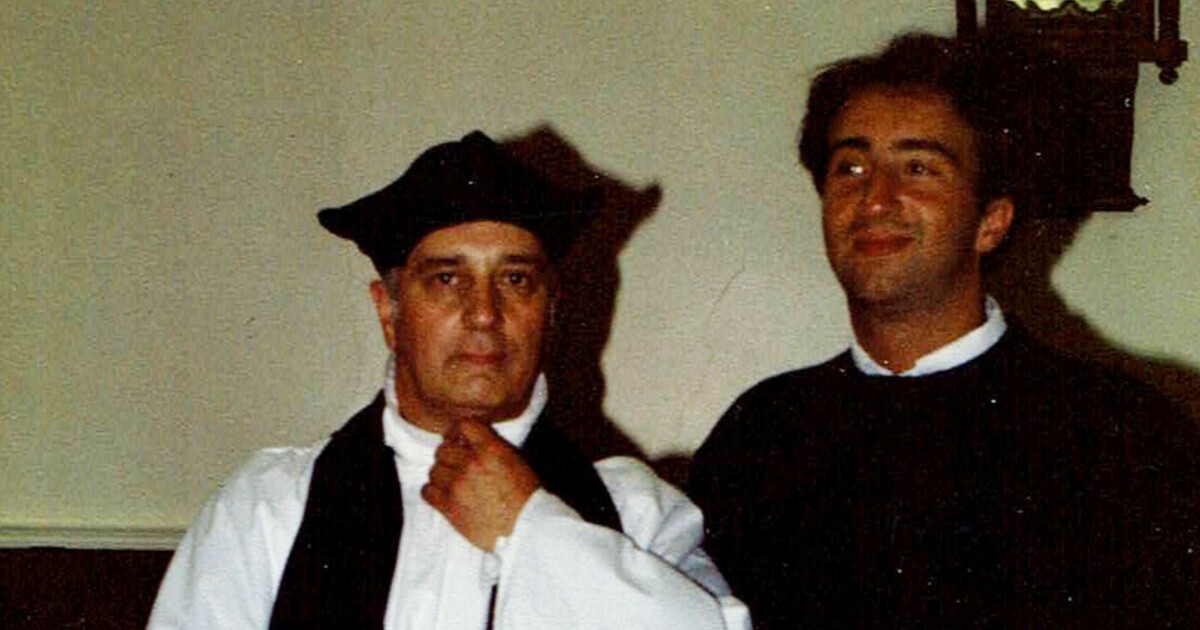
Durham, 1973. I was eight years old. There was a strange atmosphere in our house. Someone was visiting our father at the weekend, but no one would tell me, or Angus or Anna, my elder brother and younger sister, who it was. A certain heaviness in the air suggested perhaps a doctor or priest. More likely, in those days, an aggrieved bank manager. The information, finally delivered on the morning of the great day, was intriguing: ‘Father’s sister will be visiting,’ our mother said, ‘you won’t meet her, so there’s absolutely no reason for you to come out of your bedrooms.’ This was exciting, not because I was interested in suddenly possessing an aunt, but because the news suggested my father also had parents, a childhood, a school, a birthplace. Our father was a wiped slate, and this didn’t seem strange because it was all we knew. He was our wiped slate.
When the doorbell sounded on Saturday morning, I crept out of my bedroom and installed myself at the top of the stairs, which looked straight down to the hall. I could count on my mother’s absence, so there was no risk of reprimand. My father opened the front door, there was a quick wheel of sunlight, and my aunt entered. I remember nothing much about her except that she was slim and dark-haired, with darkish skin. I do remember that she stopped at the foot of the stairs and looked straight up at me. My father ushered her into his ground-floor study – not the sitting-room, but his study, as if he’d now become the priest, doctor or bank manager and his sister the petitioner guaranteed a private consultation. I suppose Irene spent about an hour with her brother Dennis. The whole thing was an anti-climax.
Forty years or so later, when I tracked down my 89-year-old aunt, I was moved that she remembered seeing me on the stairs. At that moment, she had felt sad – because, she said, ‘you looked exactly like my brother, like Dennis when he was that age.’ She told me that at their meeting she had mentioned their parents, William and Eleanor Wood, who lived a short train journey away in London, and whom my father hadn’t seen for a decade. She had come to ask him to get back in touch with them. ‘And it was very strange. Dennis just calmly said, “Oh, yes,” as if I was talking about someone else’s parents, not ours. Not his.’
In those days, when we were young, most things weren’t strange. It wasn’t strange that our mother told her three children we couldn’t call her anything but ‘Mother’ (‘Mummy’ was the sole exception) and our dad anything but ‘Father’, even when this made us sound like children in a palace or a 19th-century novel. The world might say ‘Mum’ and ‘Dad’, but the world was vulgar and pagan. It wasn’t strange that if I claimed I’d had ‘good luck’ in something I was immediately corrected, again by my mother, to being thankful I’d been ‘blessed’. It was not yet strange that we went off to long evangelical weekend retreats in Northumberland, where grown men and women wept and writhed, raised their arms to the Lord, played guitars, and spoke in tongues.
And it was not yet strange that this essentially fortunate family was so weirdly asymmetrical. On my mother’s side, there were the usual things: grandparents and cousins, photographs, heavy unwanted pieces of furniture and a family tree whose skimpy branches our parents were equally interested in tracing. On my father’s side, there was nothing. Just ‘Father’, who had no past and who existed only with us and for us. He was English, he was from East London, he had been a student at Queen Mary College at the University of London, he even had the faintest residue of his original London accent, an unreliable cockney ricochet. But the leads stopped there. He never spoke about his childhood or parents. He had no parents, no siblings, no real identity until he met Sheila Lillia and married her. We three children had come out of her; we were shaped by what Mother wanted us to be. So our father, too, must really have been birthed by her. Her gigantic force of will made his creation by her seem quite inevitable.
When I picture my mother, what I see now is her thin narrow body and its acute physical tension. She was rigid with ambition. She shared this with Mrs Thatcher, along with a few other similarities. I was always a bit embarrassed when Margaret Thatcher appeared on the television in the 1970s and 1980s; I felt I was watching a close relative. My mother was ambitious only for her family and not the entire nation, but still, it sometimes seemed an accident that she taught at the local girls’ school in Durham and was not actually prime minister. Both women held themselves with a kind of asthmatic stiffness (my mother was, in fact, asthmatic); they spoke with careful, ‘proper’ English accents, as if the accent were being marked in a difficult exam. In both women, control seemed like controlled anger; even their happiness was strenuous. ‘I’m enjoying this!’ That was Mrs Thatcher in the House of Commons in 1990, during her last, tormented speech as prime minister, and she bellowed it twice, to convince us that she was, truly, enjoying herself. But what I hear is my mother’s tense enjoyment.
Each woman had a weak but strong chin, an apparent impossibility she achieved by leading with that weak chin, forcing it forward. They both walked impatiently – short, hurrying officials. Both were from religious, puritanical, non-conformist families (Sheila Lillia was Scottish Presbyterian, Margaret Thatcher an English Methodist), both thought of society as a ladder to be virtuously scaled, regarded their modest social origins with mixed pride and shame, and both married accommodating men named Dennis.
None of us paid any attention to what Dennis Wood desired, nor did he tell us: he just wanted what she wanted. Where she was thin and tense, he was wide and pliable. She strode everywhere fast; he moved moderately and deliberately. He often looked down at the ground, or let his eyes shyly slide away from ours. Mother’s accent was achieved, an effort of social will; Father’s was placeless and classless. Where she burned with will, his was cool or dormant. She was sociable, he had no friends, only hers. She nibbled at her food (‘a little and often’), he hurried his down, working with wordless focus at his heaped plate. Father’s lifelong appetite for food was perhaps his only expressed desire; he struggled with his weight for most of his life. It extended into the kitchen: Mother didn’t want to do the cooking, so Father did all of that. She never learned to drive, so he did all of that too. Mother found it stressful to hold us when we were tearful babies; she handed us off to Father, who was apparently magically good at calming us, something I discovered many years later in Northampton, Massachusetts, when I saw him easily soothing my six-week-old daughter. Confident he could manage any task, he mastered many. He made an elegant Scandinavian-style coffee table which I now own, wired the house’s lighting, hung reams of wallpaper, mended the car, cut our hair every three weeks with electric clippers, was the sole operator of the family sewing machine (all our trousers were taken up by Father, all our school name-tapes sewn on by him).
His calm imperviousness was his secret resource. His absolute lack of ego, his indifference to what others thought of him, his ability to lose himself in any task, made him a very unusual man of his generation; he had absolutely no concept of male authority or of any traditional division of domestic work. He never ‘held the floor’ like other dads. He was the anti-patriarch: he was perfectly happy to be our father and our mother. Cooking and sewing and holding crying babies were simply things anyone could do, and do well. He radiated a beautiful message: domestic incompetence was obviously unmanly. He cooked every night of our lives and never once complained even of being tired or bored by it. Indeed, he never complained about anything, and in all my life I never heard him speak with hostility or malice about a single person.
His mild, even temperament – almost a lack of temperament – was a gift to us. Life with Mother was like having an invalid in the house; we stepped around her ‘moods’ with great respect. Her asthma could play up at any moment, and seemed related to those moods, a nervous state the family called ‘getting all wheezy’. I remember walking up the long hill after school, a little boy hand in hand with her, day after day, aware that it was a race against that hill to get her home before her breathlessness overcame her. If only I could get her home, then she could sit down and I could bring her a glass of water, something I loved to do and which, I think, she loved me to do, and then her lungs would ‘calm down’. I had a kind of bodily sympathy for my mother, a closeness, because I too got breathless: I inherited her asthma, her weak lungs. We loved the A.A. Milne rhyme she recited to me in those days, it joined us together and we were both flattered by it:
James James
Morrison Morrison
Weatherby George Dupree,
Took great care of his mother,
Though he was only three.
But it was my father who really took great care of her. ‘Come on dear, now don’t get worked up,’ was the usual gentle warning, or more stiffly if he thought he was rebuking us (though he never actually rebuked us): ‘You’ve upset your mother, who’s quite worked up.’ You couldn’t know if Mother was going to be the same from day to day. Father of course never got ‘worked up’, except about the danger of Mother getting worked up. He was as calm, genial and phlegmatic at the very end of his fatherly life as at its beginning.
Father did so much for us, he was so constantly present, that when I was small, I wondered if he had any occupation other than being a father. Yes, he went off most days, having dropped me and my younger sister at school, to something he called ‘the department’. At ‘the department’, he had ‘colleagues’, referred to only by their last names (‘Barker and Bowler’), which sounded like something from Tintin, and he also had ‘students’. But what he did at the department seemed a kind of secretive nothing, idle espionage, because he didn’t talk about it, and because at home he acted as if his time was not at all precious, as if his time existed only to be generously squandered on us. He told us that his PhD thesis, which he’d written at Glasgow University in the 1950s, was on ‘the wing mechanism of the stick insect’, and this too seemed a kind of impossible fiction, an invention of his unique temperament. And anyway, he had no childhood, no past, no friends past or present, no other identity outside our home.
Princes Street , where we lived, was a steep hill, from the top of which you could see a bit of the great grey ghost of the cathedral that shadows the whole of Durham, and also, depending on the season, the turret of the old castle, which is part of the university. We were a short walk from the railway station, and from a massive Victorian viaduct that cuts right across the edge of town. All day and night, express trains pulled out of that station, along that bridge, north to Edinburgh, south to London. At night I could hear the locomotives moving out and I loved to imagine those yellow-nosed beasts, tilting slightly as they carefully rounded the high viaduct, columns of blackened smoke jetting from their louvred blue roofs. The lovely laboured howl of the British Rail Deltic diesel engine, so slow to anger. And then the passenger carriages with all their lit windows, like a city on the move to a bigger city.
From my bedroom near the top of the hill, I looked up and down our street and could identify nearly every house by its incomprehensible academic specialisation. We lived in a university enclave, almost a company street (though with a markedly impoverished employer). The Woods were zoology, my dad’s discipline. On either side of us were sociologists – the chain-smoking Brooks family to the left (unusually for that time, both husband and wife were academics) and pipe-smoking Dr Kaim-Caudle and his wife to the right, famous for their austere and comprehensive ‘spring cleans’. Further down the street was the shy young man Dr Hale, who taught Middle Eastern studies and who would timorously, unconvincingly say ‘Inshallah’ at every opportunity. At the bottom of the hill lived pallid, ancient, hostile Dr Wright, a classicist, more precisely the ‘University Reader in Classical Epigraphy’. My friend William and I treated him cruelly, once smashing our Chopper bikes into his grocery bags, which he’d left on the pavement outside his house. We didn’t consider Dr Wright, with his frightening pallor and unfathomable occupation, to be exactly real. He was Mr McGregor from the Peter Rabbit tales, or one of those old men in Edward Ardizzone books who shake their skinny fists at naughty children and weakly yell ‘Confound you!’ A world in which adults didn’t much credit the reality of children could work the other way round, too.
At the top of the hill lived a distinguished theologian, C.K. Barrett, rarely seen and only ever known as ‘C.K. Barrett’, which made him sound more like a shop than a human. Next to him lived another equally distinguished theologian, Professor Charles Cranfield, and his lean family. The Cranfields were fearsomely ascetic. Mother held them up as great examples of Christian obligation and modesty, especially ‘the Cranfield girls’, twin daughters who both eventually became ministers in the Church of Scotland. ‘You must try to be more like the Cranfield girls,’ Mother would often say. The Cranfield sisters had ‘very good teeth’; Mother used ‘very good teeth’ as compensation, a kind of make-up prize for deficiencies in looks or charm. Teeth aside, their Christian simplicity sounded absolutely horrible, more like a form of punishment for misbehaviour. The Cranfields didn’t own a television and made Christmas deliberately drab by allowing only socks and handkerchiefs as gifts, while eating sausages rather than turkey.
And if you had peered into the windows of our house, what would the Woods have looked like?
Dennis, Sheila, Angus, James, Anna.
Angus was five years older than me, and in my memory is always coming and going, rarely in one place, always engaged in the mysterious business of being older. He was serious and clever, short-sighted and self-possessed. He had dark hair, olive skin, spectacles, and as he grew up was developing the large, bony, somewhat root-like nose that he and I (but not my sister) inherited from our mother. He was prodigious. At his ninth birthday party, he calmly told Nigel Corner, the richest boy at school and son of the owner of North East Steel Seating, who’d been boasting about having an indoor swimming pool installed at his house, ‘Nigel, we don’t all possess your amenities.’ At ten, he somehow got lost in Newcastle, found his own way back to Durham on the train and mysteriously brought home a packet of fresh fish, sole no less, for supper. He easily accomplished things that flustered and irritated me: mathematics, Latin, Airfix models of Spitfires, going to church. I was messy, careless and short; Angus amiably nicknamed me ‘the cretin’. I felt much-loved, and had learned from an early age that charm was a reliable currency. Angus was quieter than me, neat, sensible. Birth order had selected him, poor pioneer, to fight my battles, to be the bulwark that protected me from parental censure (which only ever meant maternal censure, of course).
Anna was two years younger than me. She wanted to join her brothers in everything they did. Despite going out and working, despite her great faith in education, Mother reserved most of her jealous esteem for ‘my sons’. Mother dressed Anna in girlish frocks with panels of filigree smocking and brushed her hair with violent downward strokes, as if she were cancelling something. Was I my sister’s protector, her bulwark? In those days, I spent more time with her than with Angus. On cold winter mornings before school, when our own rooms were frosty, Anna and I would dress together in front of a narrow ugly gas fire in my parents’ bedroom. We hunted for treasure in the garden, or rode our bikes to the ‘obelisk’, an abandoned stone needle in a field at the end of our street, once owned by the university as an observatory. We built ‘dens’, rough dug-outs in the garden which we furnished with bits of unwanted carpet and cardboard, a transistor radio without batteries, chipped cups and saucers. Sometimes we played ‘Mastermind’, in which, seated in my darkened bedroom, I shone a Habitat Anglepoise lamp on Anna, Gestapo-style, while subjecting her to ridiculously difficult general knowledge questions.
Materially and economically, we were a modest family, pinned into our circumstances by religious austerity, the sensible prejudices of postwar thrift and meagre teaching salaries. Summer holidays were, without exception, never taken abroad but always in some damp rented croft on the Isle of Skye, one of those houses damp enough to give me a nasty bout of pleurisy. (Mother was seventy years old when she first set foot on a plane, to visit me in Washington DC.) No restaurants, except on those Scottish holidays. There weren’t any restaurants in Durham anyway, so that settled it. Clothes repurposed, darned, patched. Fabrics, furniture and appliances of provoking longevity – childhood was the era of unkillable Aertex shirts, cars that took several minutes to start, much optimistic slapping of the TV, hot water that quickly ‘ran out’.
We were driven onward by my mother’s disappointment and ambition, by her fierce identification with her children, by her angry love, and saved from chaos and rage by the great mercy of my father’s serenity. And we lived, more or less happily, in a red-brick family home with large bedrooms and a primitive kitchen and no central heating upstairs and a yellow laburnum in the garden that sent withered propellors to the ground every autumn – the kind of draughty ‘good’ house that poorly paid provincial British academics used to be able to afford.
University salaries were notoriously low. Several of Dennis’s colleagues supplemented their income by marking A-level biology exam papers in the summer. The more you marked, the more the school exam board paid you. Father took on boxloads of such work. The precious papers, passports to the futures of all those British schoolchildren, were delivered to our house by a private van service, which seemed glamorous. Meanwhile Mother got a Saturday job at a local shop, Ivan Corbett Books, near the bottom of Elvet Bridge.
The bookshop job was clearly impossible: Mother lasted six months. When it came to money, reduction and hope seemed the surest approaches. Certain careful phrases now entered the family consciousness: ‘a difficult conversation with the bank manager’, ‘time to tighten our belts’, ‘when our ship comes home’ and my favourite, a command known as ‘FHB’, which stood for ‘Family Hold Back’. Mother announced it on the day guests arrived for a dinner party, like the annual Christmas gathering: ‘Children, there’s not a great deal of the casserole to go around, so FHB tonight.’ I liked that it was code, that it was our code. It sounded like an upper-class game, it had the well-worn confidence of fancy children’s literature. And I loved when Mother whispered the secret to me later, at some critical moment during the party: ‘Remember, go easy – FHB on the casserole.’ I sometimes use it with my own family, in an ironic way, if I’ve misjudged the portions for a dinner party, or when the wine’s running out. But of course my parents hadn’t misjudged the portions and weren’t being ironic. Nor did they drink. ‘FHB’ was merely the opposite of Jesus’s miracle of the loaves and fishes: a concession to the unchangeable reality of limited resources.
Money was in short supply because my parents’ salaries couldn’t possibly keep pace with Mother’s ambitious lunacy. She was nine years old, she later told me, when she first decided she would send her children to the best boarding schools, and decided that if she had boys they would go to the very best – they would ‘go to Eton’. Imagine the willpower needed to fulfil such ambition. Mother had, of course, no connections to that school: she didn’t come from the class that went to it, she came from the class that prepared boys for it. She and my father had nothing extra, only the money they could earn. And the effort wasn’t academically necessary: the Royal Grammar School, fifteen miles away in Newcastle, sent bright kids every year to Oxford and Cambridge. Had my parents ever stopped to sketch out the likely costs on the back of an envelope they’d have recoiled in terror and ripped the thing up like an ominous Tarot card. Over the years, the fees would bankrupt them.
But reason was never the point. Mother was enacting, through her children, a gigantic frustration with the cards dealt her, a deep restlessness with the ordinary. Neither of her parents had gone to university. Her father, Vincent Lillia, was an unassuming and not very educated man who had worked as a ship’s engineer. In old age he was elegant, slight, with brownish skin. He liked eating tripe, and had a hernia, and sat a great deal, prefacing his gentle requests with ‘While you’re on your feet, could you possibly bring me … ?’ He and his wife, Catherine, known as Queenie, had retired to a red-brick villa in Bournemouth; and later, so as to be close to Mother, moved up north to a sandy-coloured bungalow in a village just outside Durham, a pleasant cul-de-sac of identical bungalows called ‘The Paddock’. In the evenings, Granny and Grandpa stolidly watched unimproving television: Sale of the Century with Nicholas Parsons, and Uri Geller bending spoons, and a middle-aged man called Dick Emery who dressed up as a woman and whose catchline was: ‘Ooh, you are awful … but I like you!’
But Mother had an uncle, James Graham, her mother’s brother, a clever Scot, who had studied medicine at Edinburgh University then had a distinguished career, first as a doctor and then, after the Second World War, as a medical administrator in the new National Health Service. Uncle Jimmy had made a bit of money, mainly because he’d never spent it. To be a doctor was an almost sacred calling for Mother.
Not ‘Dr Sheila’, however. Like many women of her generation, she spoke through her children; she lived out, through us, a fantasy both selfless and deeply narcissistic. It was undeniable, as she often reminded us, that she had sacrificed immensely to send us to expensive schools. She had pauperised herself, she had ruined her health for us. We must never forget it. There was no higher praise, no fiercer weapon in Mother’s lexicon, than the dread term ‘self-sacrifice’. She was at religious war with the self, which was viewed, with Christian hostility, as a mob of secular appetites and spoiled hedonism. ‘Self, self, self is all you think about,’ she told me when I was an adolescent. ‘Your entire philosophy is selfishness.’
It took me a long time, I suppose a whole childhood, to understand the way ‘self-sacrifice’ can also be a stealthy form of self-fulfilment. That the self and its wants never really dies, because the religious death penalty on the self is actually a morbid life sentence with the self. In this regard, ‘Eton’ always meant much more to Mother than it could mean to anyone around her. It was entirely bound up with her sense of self, it was the element, the world, the sign of that world, that she had dreamed of and carried with her since childhood. It was the allowable worldly gift for a profoundly unworldly and religious woman, allowable because she couldn’t want it, at least officially, for herself. I imagine that ‘Eton’, the school that only admits boys, had from girlhood represented a desire to live a completely different life from the one she had been born into, a freer life, a chance to become her precise opposite: a well-off, irreligious, insouciantly confident boy.
If the decision to send her sons to Eton was made long before we were born, the business of getting Angus and me there started well before we reached the age of thirteen. In those days, parents interested in ‘putting a boy down for Eton’ did so around the time of the child’s birth, by writing to a prospective housemaster and making a visit: essentially, the forced commerce of an arranged marriage. So at some point in the summer of 1967, two years after my birth, my parents drove south from Durham to Windsor to meet a genial classicist called Charles Impey who was preparing his house list well in advance, in time for the late 1970s. The car journey was long and hot, in those days seven or eight hours. Absurdly, they took me with them, in their arms, so that Mr Impey could see what he would be taking on, in eleven years. The Eton schoolmaster was charming, urbane. They were impressed that he was so wonderfully welcoming, that he gave them so much of his time, especially since he received them in black tie and dinner jacket, because an hour later he, lucky fellow, was going off to hear Così fan tutte at Glyndebourne.
Surely my parents were intimidated by the whole prospect, and their gratitude to Mr Impey for giving them so much of his valuable time was partly gratitude for a generous helping of Etonian noblesse oblige. Because there’s another detail to this story, a subplot which my parents used to tell as farce. In those days, my father had only a single suit, or perhaps only one good suit. In preparation for the Eton visit, he took it to the dry cleaner’s. The day before the journey he went to collect it, only to find the shop door locked. It was ‘early closing’ day – curse of the times, and as I recall from childhood, atrociously moveable feast. Alarmed, he went home. Could he possibly wear something else? Sheila was firm. Nothing else would remotely do. They were going to Eton, after all! This was a disaster.
There was a solution. Didn’t Mrs Bell live above the shop? Could Dennis go round and get her to open up for him? He did exactly that, and the day was saved.
I liked the story when I was young, but now there’s something touching, even painful about the picture of my parents grubbing around in panic in order to look ‘respectable’ and ‘decent’, so that they could send me, eleven years later, to the kind of school that would give me the confidence not to worry about such trifling petit-bourgeois scruples. The true aristocrat, after all, would have met Mr Impey as an equal or possibly as his superior, but never as his inferior. The aristocrat wouldn’t have been embarrassed to turn up in muddy wellies and frayed old corduroys from New & Lingwood. The accent would have done all the work, not the clothes. It was the school’s task, along with a few other things, to teach me such knowledge.
But first Angus, who was five years older than me, was sent off to Eton. He was thirteen now, a very bright all-rounder, and we were all a bit in awe of his precocious seriousness. At bedtime, he lay in his narrow bed, large dark-framed NHS specs on his long nose, and perused his Eagle comics with the utmost attention. From my bed, with the lights off, I could hear him downstairs in the sitting room, expertly moving through his scales on the piano, followed by a fluent rendition of Für Elise. As expected, he got an academic scholarship to Eton, which exactly halved the fees, though his placement was an exquisite financial torture: he came sixth in the list, while the top five boys paid no fees at all. At Durham Chorister School, which we both attended, the headmaster gave thanks by letting the whole school take a half-day holiday, the equivalent of slaughtering a pig in celebration and inviting the entire village to the feast.
I missed Angus when he was away and studied his path, since his, though probably lacking the academic honours, would be mine. Within a couple of years, though, I was missing not just my brother but home itself. I sang well, I played the piano, and I’d now started lessons on the trumpet, with a jovial plump man who told me to blow down the trumpet ‘just like you’re spitting paper pellets at the school bully’. One morning, Richard Lloyd, the cathedral organist, a man who like my father never got angry, auditioned me at his grand piano and offered me a place in the cathedral choir. I was ten years old. Despite the name, most of the boys at the Chorister School weren’t choristers. They went home every day, as I and my brother had done. To sing in the choir was a kind of indentured servitude which involved a commitment of practice and performance seven days a week, and this discipline demanded boarding; with such work, I would pay my way as a boarder. The chorister was on call for daily services (three on Sundays), including of course the busy festivals of Easter and Christmas, when he would have to stay over at school.
The decision was mine, easily made.
We sang Evensong every afternoon at 5 p.m. (with the exception of Thursdays), and there was the weekly excitement of seeing my mother at the back of the great church, waiting for me. She would quietly wander in towards the end of the service, and loiter in the ghostly grey shadows. I knew that reliable silhouette, I knew so well the slight disappointment of her attire (I wanted her familiar coat and bucket bag to be more glamorous than they were), offset by the thrill of her bodily presence. She came every Monday afternoon, on her way back from teaching, and always took me for a glass of lemonade in the cathedral café before I had to return to school. As I was leaving, she stuffed gifts into my satchel: chocolate, an improving comic (Look and Learn), fresh socks.
A blessed holiday from school; much needed, because our existence inside it, by contrast with life in the cathedral, was a primitive confinement, where boys were housed and herded as a single suspect population. The regime’s power rested on its absolute control of the child’s body. This didn’t seem strange to the thirty or so kids, aged between seven and thirteen, who boarded there; we had little sense of the autonomy of our bodies anyway. In the mornings, we were woken in our dormitories by the school’s most popular teacher, Cyril Watson (‘Clag’). Just after seven o’clock, Clag marched into our large dark room full of single beds, like a formidable ward nurse committed to the hygiene of sunlight, and briskly opened the curtains: the light was invariably northern-grey. He stood in the middle of the room as we stirred, and then theatrically announced the first item from the BBC radio news, with those embellishments that made his history lessons such fun. We looked forward to these daily cables from the outside world. ‘Good morning boys! It’s Monday, 7.05. The BBC announces that the PLO has hijacked an Air France plane. Two hundred and forty-eight aboard, four hijackers armed to the teeth. A tricky situation indeed! I will see you all shortly in the washrooms.’ One morning he announced: ‘Good morning boys, the pope has died! He was found early this morning in his bed. A book was open on his chest – heart attack.’ And then he added a solicitous but oddly cheerful, ‘Sorry, Lynch,’ to the only Catholic in the dorm. Lynch, a heavy sleeper still humped under his blankets, appeared unmoved.
Dressed only in our pyjama trousers, we filed into the washroom, where Clag stood ready. After we had washed our faces and brushed our teeth, we lined up in front of him, aware now of his tangy breath, the seasoning of dandruff on his jacket, the sharp smell of his Cossack hairspray. He inspected each of us like cattle, pulling out our ears, asking us to bare our teeth, checking the backs of our necks. There was nothing sexual about these investigations; everything was straightforward, implacable and upbeat, one of the reasons Clag was popular.
Things were less straightforward with the Reverend Canon John Grove, a bachelor clergyman in his sixties who had been the school’s headmaster for two decades. Even by the modest standards of the day, the monotony of Canon Grove’s dress was striking. I never saw him in anything other than his black ensemble, consisting of an old black suit, black Oxford shoes, and a priest’s plain black stock, the whole funereal costume relieved only by the stiff white circle of his religious collar, glowing round his neck like a fallen halo. He also had black spectacles with very thick lenses, of the kind that seem not an enablement of sight but an impediment to it, and a black pipe which he coddled with long palavers of filling and lighting and burning. The constant pipe, the clouds of fragrant-fetid smoke, his terribly blotched and stained and toughened skin, and the ancient black clothes – the whole effect was somehow posthumous and ashy, like something turned into cinder.
He was a warm and brilliant Latin teacher, who used mnemonic catchphrases to enliven our classes. He also had a great interest in young boys’ bodies. In the evening, at shower time, Canon Grove would do his own peculiar version of Clag’s morning inspection. He sat on a bench near the open showers, pipe in mouth. As each of us emerged, we had to stand in front of him, water streaming off our naked bodies, officially to prove that we were clean. Of course none of us had any illusions about the real motive – Grove peering in scholarly fashion, with short-sighted intensity, at our enigmatic genitals.
When you reached the final year, you could skip the showers and take a bath in the headmaster’s own bathroom. Baths were timed for a quarter of an hour each. Every fifteen minutes, one boy got out, and another got in. The water was never changed; hot water was added to the slowly thickening mixture, in the way that Mother sometimes ‘topped up’ the teapot at home. The atmosphere was quite civilised. In his own bathroom, Canon Grove was relaxed, and sat on a cork-lined stool, sucking away at his pipe and chatting pleasantly to each bathing boy. Then it was time to get out. ‘Fifteen minutes, Wood, time’s up! Warburton, you’re next.’ Once you’d climbed out of the deep bath, you had to present your naked self for ‘weighing’. Each of us stood in turn on a set of old-fashioned scales, while the headmaster, sitting directly in front of us, appraised our general well-being. The conceit was that he kept a weekly record of our changing weight – ‘for health purposes’. In a peculiarly pedantic way, probably because he was a little embarrassed by the nakedness not so much of our bodies as of his own desire, he would frown at a little red notebook and take a long time writing in it with a short pencil. ‘Now, let’s see. What was it last week? Five stone and five pounds exactly. And this week … ah, you’ve put on half-a-pound since last week, Wood! Well done.’ And then you could get dressed, albeit still within the spread of his gaze.
We didn’t tell our parents about Canon Grove. He retired in 1978, a year before I left the school, and went to live in a cottage on South Street with a view of the magnificent cathedral directly across the brown curving river. For many years, into my early twenties, I was encouraged by my parents to ‘keep up with old Grove’ – to visit him at his cottage during the holidays. I’d hand him a tin of his favourite Three Nuns pipe tobacco. Then the two of us would have lunch. These meals, private parodies of the school-food experience, were prepared in the mid-morning by a housekeeper I never met and kept warm for an hour or two on Hostess hotplates. They followed an unvarying pattern: first, sherry in the fugged sitting room (‘dry or Amontillado?’); then, in the large kitchen with its beautifully distracting view of the cathedral and river, we’d eat stewed beef with tinned new potatoes and tinned green beans, followed by crackers and Primula cheese, a creamy vulgar ointment you squeezed out of a metal tube, and which I loved. Conversation, always formulaically about old boys, was also squeezed from a tube: ‘Are you too young to have known Fenton? Hmm? Before your time? A poet now. He won the Newdigate. Was Atkinson also before you? Apparently he is now a comedian. On the television. What about Stancill? Hmm? I gather he’s gone back to teach at Bloxham.’ All accompanied by the familiar rigmarole with the pipe. As I was leaving, there were feeble attempts at flirtation, easily defused. ‘You must come and spend a night here with me. All you’ll need to bring will be your toothbrush, absolutely nothing else.’
Canon Grove went to his grave untouched by rumour, though his ghost got a nasty shock in 2013 when 23 men, pupils at the school between the late 1950s and mid-1960s, went to the Durham police with complaints of sexual abuse. By the time I encountered him in the late 1970s, he was reduced and almost elderly, an unthreatening eccentric whom we could joke about. McNeaney, a boy famous for his relentless obsession with the Bermuda Triangle, one day christened him ‘Groper Grove’, and that was that: we didn’t need to talk about it, we knew the nickname made him safe, held him at bay. As he held himself at bay, too. We probably felt a little sorry for him; his voyeurism, which appeared to know its limits, was the expression of a desire so fundamentally timid it was almost wistful. After all, once the lights were out in the dorms, we boys were able to touch each other’s bodies with freedom, if we wanted to; we were able to convert voyeurism into touch. Our first sexual experiences – clumsy, fearful, needy – were with each other. In that context, Grove’s frustrated desire, always hovering on the edge of the forbidden, perhaps struck us as poignant.
Perhaps; though I may be thinking backwards too cleverly. The fact is that most of us liked him, even respected him, and for whatever complicated reasons, we didn’t tell our parents or even discuss the situation with one another. Indeed, I enjoyed, for the first time in my life, a kind of worldly knowledge that I could hoard as a secret advantage over my religiously ‘innocent’ parents. The private knowledge of Canon Grove’s special interests was fundamental to that advantage. Decades later, when Tony Blair became prime minister, my mother recalled that the Blairs had been familiar figures in Durham in the early 1960s, just before I was born. Leo Blair, Tony’s father, taught law at the university; Mother taught Tony’s sister at the girls’ high school; and young Tony had gone to the Chorister School.
‘And you know,’ Mother continued, ‘when Tony’s father had his terrible stroke and almost died, and poor Tony was still at the Chorister School, Canon Grove was very kind to him.’
‘Ah, was he?’
‘He became a kind of second father.’
‘Did he?’
I had no reason to doubt the headmaster’s kindness. I didn’t disagree, exactly, with my mother’s rightly generous assessment. I was 32 years old. I might have said something, might have started a long, grown-up, disabusing conversation about Grove’s mixed motives. Instead, I merely nodded and kept quiet.
I didn’t foresee how distinct these two young selves, one at school and one at home, would become, that this division would be as fundamental as any could be in a life: the division between the secular and the religious, between the worldly and the godly.
The Christianity I grew up with was fundamentally ascetic. We were taught to fear God rather than love Him. Punishment was understood better than salvation; besides, salvation was understood as salvation from a punishment that lurked horridly for those who weren’t saved. From Mother we learned very early that there were right ways and wrong ways of doing all things, and that the wrong ways were not merely mistakes but mighty, perilous errors. My untidy bedroom was not just untidy, but ‘unworthy’ of a properly Christian life, an example of what she called ‘poor stewardship’. Mother could imbue the word ‘wrong’ with a thousand overtones. It was obviously wrong to lie. But it was also wrong to listen to Led Zeppelin, as Angus now did. It was certainly wrong to gamble; it was probably wrong to play cards, though no one ever put this to the test in our family anyway. It was certainly wrong to have any interest in ghosts or the paranormal. It was wrong to watch certain things, probably most things, on television. The Cranfield girls from up the street, who had no interest in rock music and didn’t have a telly and wore long skirts, lived ‘as one should’.
We didn’t separate Mother’s moral strenuousness from her equally strenuous social aspiration. She wanted her children to be morally successful, to get, as it were, the best possible marks from the Great Examiner. This constant moral work, this always strenuous life, was a ladder. As you climbed your way through life towards heaven, flying devils, black satanic cherubs, shot arrows at you. Many climbers fell off and beneath you there was a boiling sea full of those who had lost the fight.
Every Sunday was like a long, dull wedding, in which we got dressed up and married again to Christ. The day only improved once we were out of church. Sunday lunch was generally the best meal of the week. Father disappeared into the kitchen as soon as we got home, and, following an unvarying weekly rotation of beef, pork, or lamb, produced what was always known as ‘the roast’. The heavy meat smell rose to the bedrooms and clung there. ‘The roast’ was accompanied by roast potatoes, glistening, amber, nugget-like – always superb. Cauliflower was boiled into surrender and then cruelly finished off with a smothering white sauce (‘essentially just a roux’, Father reassured us). Gravy the colour of dark tea. The whole meal quite irresistible. Once lunch and dishes were over, Father would spread himself in righteous repose on the sitting room sofa and listen to his changeless cycle of great composers, as unfailing as the beef, pork, lamb. Beethoven, especially the piano sonatas. Schubert, especially the lieder. Haydn, especially the string quartets. When I think of those Sundays, I remember not the mornings but the afternoons, not the tedium of church but the noble boredom of the Viennese tradition, the cool equilibrium of the piano; and especially Dietrich Fischer-Dieskau’s liquid baritone: Fremd bin ich eingezogen, Fremd zieh’ ich wieder aus.
Mother’s Christian faith always made sense to me, because it was so clearly shaped and shadowed by social and moral anxiety, and as a result seemed (surely this was just my fantasy) to be on the verge of faithlessness; as if her constant social anxiety were matched, pound for pound, by theological anxiety. But Father’s faith, like everything about him, was a smooth mystery. It didn’t come out of anxiety, it involved a radical optimism. He believed God had changed his life, and he believed God could change yours.
But what life? He had no life, he had had no past before he met Mother. There was nothing before. So how could a nothing be converted or ‘saved’? Father would claim that had it not been for his Christian faith, he would have been ‘full of sin’ – ‘greedy, avaricious, sex-obsessed, lustful for power, selfish, vain’. He strongly believed this; in later years it was the conversion story he told again and again, always with the same wicked attributes triumphantly avoided. This was hard to believe. Father’s temperament, or lack of it, that patient, genial, steady impersonality, that reliable uniformity of manner, that unemphatic presence which could amount to an absence – we knew his peculiar atmosphere so well, and I don’t think it crossed his children’s minds that he had ever been any different. He had always been just like that.
This was the unspoken joke of our childhood: our difficult, always-religious mother needed to be improved by Christ and clearly wasn’t; while calm Father, once apparently a non-believer, didn’t need to be much improved by Christ and probably hadn’t been. He just happened to have been born with a good number of the gentle, so-called Christian virtues. He was absurdly patient, without pride or ego; he instinctively turned the other cheek; he thought of others before himself and cared little about the world and its ambitions. The religious obliteration of ‘self’ that Mother demanded (‘your entire philosophy is selfishness’) had been magically achieved by Father, since he appeared to have no self.
But had he been born without much of a self? He’d been ambitious enough to do well at his grammar school in London, ambitious enough to be the only member of his family to attend university (this much we knew), ambitious enough to marry our mother. Having achieved these momentous things, did he then fold up his will, and happily bend himself to Mother’s for the rest of his life? We were beginning to ask questions about Father’s blank past. Why had we never met his parents? Why did he never even mention his past? For instance, when we talked about what we were doing at school, a normal parent might add: ‘In my school, when I was your age, it was quite similar,’ or, ‘In my school, it was very different – this was during the war, after all.’ Wouldn’t a normal person do that?
There were two explanations. Father had been born normal, but had been traumatised by certain childhood experiences into abnormality; or, he had not been the victim of trauma, but had been born abnormal – a man quite delighted to create a new family, but utterly careless about losing the old one that created him. And careless to the point of sin. The religious dimension couldn’t be ignored; the religious dimension could never be ignored in our household. Father was born with many of the religious virtues, but appeared to lack one of the most important: Honour thy father and thy mother.
Early in September 1979, Father drove me down from Durham to start my time at Eton. Mr Impey, presumably looking a bit older to my father – and vice versa – since their only meeting in a previous decade, shook the hand of the thirteen-year-old boy he’d last met in 1967: ‘Ah, at least Wood can walk, now!’ Getting the hang of this place, as with any large social institution, involved stealth, wariness and whatever social charm one could muster. A process that began with something like the nervous care of the immigrant merged, over the years, with the satisfactions of successful espionage. I was a musician, I had a good musical ear, so imitation was second nature. I had to blend in, become invisible. In order to sound like everyone else, I’d have to rub off any northern angles in my accent. Easily done. It might also be wise to suppress my parents’ first names: the plebeian ‘Dennis’ and ‘Sheila’ gave the whole game away with the blaring finality of a kind of social circumcision – so I should take care, as it were, not to drop my trousers in public. It might be sensible to promote my father from senior lecturer to loftier professor, and not talk about my mother having to work as a schoolteacher. Quickly accomplished. Being ‘Scottish’ seemed to be okay, as long as one’s Scottishness was indistinguishable from everyone else’s Englishness.
What couldn’t be imitated was a past. That was the thing that gave richer confidence. To have family history massed behind one was like the crowd of paintings in Mr Impey’s drawing room: a significant wall, a wall of significance. Someone, a father or grandfather or great-grandfather, had amounted to something, and had acquired all those fine paintings. No one in my family, with the minor exception of Uncle Jimmy, had amounted to anything significant, and certainly no one had ever had any money. No fine schooling, no land, no wealth, no public achievement of any kind. Instead, modest, commendable activities like school-teaching and the merchant navy. Go back beyond that, back beyond a few recent generations, and the family records just disappeared, petered out into invisibility and illiteracy. Like most people: the democracy of obscurity.
There would be much to tell my parents, after a few terms away. The teachers, for instance, all appeared to be insane. The boys had eccentric names and gigantic old homes, but turned out to be normal enough; the schoolmasters had ordinary enough names and lived in modest homes nearby, but were possessors of a wild eccentricity encouraged by years of womanless institutional quarantine. Raef Payne, a bachelor classicist, said outrageous things in class. I yawned and stretched one day, and as I did so, my shirt rode up my stomach. ‘Wood, put away that delicious navel,’ came the camp rebuke. Paddy Croker, a historian with some kind of ‘war wound’, limped down the Eton streets, and with every jerk of the afflicted leg, the poor man cracked out an agonised ‘Ah!’ We watched him with binoculars, from the second floor of Impey’s house, as he made his shrieking metronomic journey to the classroom. Another historian, Kidson, specialised in flamboyant insults – ‘Your essay is like a jackass’s penis, long and flaccid;’ ‘I don’t think I’ve read a more RISIBLE opening paragraph on Bismarck,’ and so on. He was famous for having beautifully decorated rooms on the Eton High Street, with paintings of hunting dogs and suchlike. His own spaniel went everywhere with him, though he treated the lovely animal like a dim, albeit roguish schoolboy. On the door of Kidson’s study a sign announced the following: ‘If the dog is outside the door, kindly DO NOT LET HIM IN. Guard against his artfully insinuating himself, or even, in extremis, trying to use force, for he is a tricky and determined character. Anyone who allows him in will not be welcome.’
And like my brother five years before me, I came home after my first term away, my accent lightly leavened, my height somewhat extended (surely I was too tall to still be called ‘the cretin’?), and enriched with new tastes: Dior’s Eau Sauvage cologne (that bewitching ribbed bottle, dainty as a hip flask, with its tidy silver top), Swiss yoghurt and a pricey subscription to Paris Match, three items that had certainly never made previous appearances in the Wood household, all of which could be purchased with alarming ease at school by the placing of a pencilled tick on a meaningless piece of paper called a ‘chit’. This was how the well-off lived, no? Without really thinking about money?
Mother was shocked by the bill for Paris Match, didn’t know what that magazine was and once she saw its trashy, catastrophic full-colour photographs – in that grim era, little more than the bloody celebrity of European terrorism, all hijacked airplanes and exploded body parts – staunchly disapproved of it, unswayed by my claim that ‘it’s very useful for my French.’ But, despite herself, she couldn’t help liking the idea of a son who nonchalantly ordered up such things on the parental ‘tab’, who lived as if ‘to the manor born’ in little dark Durham, a veritable prince on Princes Street. This charming fellow could be sported around town and in church, a credit to his upbringing, a credit, above all, to his mother; he could be shown off to other, lesser parents. And this son knew what his mother secretly wanted, what really pleased her, how to charm her, how to win her love. James James Morrison Morrison, Weatherby George Dupree, Took great care of his mother – now he was fourteen.
But this son also began to understand the power he had to wound his parents, to disappoint them by failing to be what they desired; to disappoint them just by being himself, especially if that self might turn out to be secular, irreligious. For this game of Eton worldliness was exactly that, tolerated and even encouraged until it bumped into the overweening religious imperative. It was good to be a little gentleman; it was much better to be a Christian gentleman.
I say ‘his parents’, but Father never showed his hand. Mother had wanted the social gift of Eton, so Mother reaped the social gift of Eton. Mother wanted. So she could be correspondingly disappointed. What did Father want? He seemed to enjoy the spectacle of the grand school, was amused by the funny names and eccentric reports, but always in his characteristically distanced way, as if someone other than his own son were bringing back interesting news. What a strange man he was, with his maddening but quite beautiful self-confidence, this impression of not caring about such things – since to him all the possible paths of a life appeared to be of equal hazard and would likely produce equal results: an essentially optimistic fatalism. I never heard him express any strong opinion about my life at school or university. For Mother, the sense of sharply different paths was morally fraught, melodramatic, vicariously felt: go down the wrong road and you could be done for. Father gave no sense of feeling that. Yet as my siblings and I were now beginning to understand, his own upward social journey from the working classes in East Ham had likely been much more acute than mine at Eton. At school, I was moving up into another social class, as he had once moved up into another class when he married middle-class Sheila Lillia. How could he remain so detached from an adventure in social mobility that was like his? Which his own son was enacting?
Father’s energies were consumed by new difficulties at home. There was constant anxiety about money. Most important, Granny, now widowed, came to live with us, and stayed for ten years – the rest of her robust life. Catherine Lillia, known as Queenie since childhood, was a formidable melancholic. Dark, short, and sturdy like Golda Meir, she seemed enriched by loss, now ready to claim her rightful share. She was bourgeois as a piano and could imagine no other life than the one she had led. She employed what imagination she had in lamentation. Her religious melancholia fed Mother’s, then eventually began to torment her. The fixity that Anna and I loved, that cosy, grandmotherly lack of imagination, depressed my already depressive mother. Coming home exhausted from a busy day teaching at the high school to find Queenie moping in her sickly-fragrant room must have been like coming home to the madwoman in the attic.
Deeply in debt, my parents tried at first not to go to Queenie for help. Instead, disastrously, they took out a second mortgage on the house. But the second mortgage just paid off the old debts. The schools kept on returning with their giant bills. Eventually Father cracked, and went cap in hand to Granny.
‘Cap in hand’ was Mother’s phrase. I had brought back from the end of my second year a few mediocre grades and a couple of less-than-stellar reports. The consensus seemed to be that I was likable enough, but disorganised, over-committed (too much music) and possibly a little slippery, morally speaking. The phrase ‘plausible rogue’, attached to me by an old schoolmaster, was much bandied about. I was flattered by the description, it had something of the Artful Dodger; Mother scented immorality and fraudulence. One of these reports, by a classicist called Peter Needham, read:
Though far from being the best linguist in the class, Wood has studied Juvenal’s Tenth Satire with reasonable enthusiasm and interest, and I hope he has derived some benefit from it. I think he is too old to be forever chewing a green biro top.
I liked Needham’s slightly relentless wit, which flayed all alike. He made fun of the more boring classical writers and sarcastically referred to our essays as ‘deathless prose’, as in, ‘Well, let’s hear this account of Cicero’s murder, shall we, in Wood’s deathless prose?’ – the first time I had encountered this interesting phrase. Another boy told me that Needham had been born in Czechoslovakia as Peter Niethammer, that he’d travelled from Prague to London at the age of four as part of the Kindertransport, just before war broke out. I later discovered that he’d been taken in by an English charity that required its Jewish refugees to convert to Christianity. Deathless for now, lucky for sure, he’d prospered, had become a Christian English gent. And he’d become an Eton classicist, famous at school not for his origins (they weren’t generally known), but for having translated one of the Paddington books into Latin, as Ursus Nomine Paddington.
But I couldn’t explain all this to Mother, who was alarmed by Needham’s languid picture of an orally-fixated backslider. Too many of the school reports were poor, she said; I had no idea how much she and Father sacrificed for me. ‘He’ll never tell you this, he’s too generous to bring it up with you, but poor Father has had to go to Granny, twice now, cap in hand, and ask for a cheque for your fees. He hates to do it, and Granny’s not very nice about it, she’s terribly grudging. Cap in hand! He’s doing this, we are doing this, for you, so that you can stay at this school, so you don’t have to come home and go to the comprehensive, go you know where. Do you understand, truly understand, the terrible sacrifices we are making? That’s why it’s so disappointing that you have reports like these. What on earth have you been doing, or not doing more likely, in Mr Needham’s class?’
Over the next few years, whenever I seemed to be slacking off, or generally disappointing her with an undistinguished school report, Mother would present the tale of poor Father’s visits to Granny’s room, his having to go cap in hand. His humiliations grew in each telling, though to my adolescent mind, my Artful Dodger mind, there was something rather superb about entering Granny’s room and emerging a few minutes later, tough or not, bearing a cheque for a thousand pounds. How could I pull off this trick?
Mother was right, though, that Father would never mention it, because he never spoke intimately, personally, about anything. If you asked him something specific, he would reply without any awkwardness: soberly, calmly, like someone at a job interview. Anna and I had begun to pose daring questions about his past. ‘Was that when you were at school, in East London?’ ‘Yes, in Romford actually – Essex.’ ‘What kind of school was it?’ ‘A grammar school, and a very good one, I would say. The Royal Liberty in Romford.’ Romford? In Essex? So your family moved out from East London to Essex? ‘Yes, in the late 1930s.’ Father answered such questions as if we should reasonably expect to know the answers in advance. Around this time, we were talking about the First World War – I was reading A.J.P. Taylor’s book on the origins of the war for school – and he looked up from his plate and announced in his easy, mild way: ‘Of course, my father fought in that war as a sergeant, in fact he won a Distinguished Conduct Medal for conspicuous bravery. He was in the Poplar and Stepney Rifles.’ Father loved those two words, ‘of course’; he used them a great deal. They suggested the calm continuation of a known thread of family lore, as if he were merely shading in an already sketched silhouette. But of course – of course – he was not only telling us about this particular detail for the first time, he was mentioning the existence of his father for the first time. The effect was spellbinding, though we had to disguise our intense curiosity and dumbfoundedness. It was as if he had looked up from his plate and calmly announced: ‘Of course, I come from a long line of Romanian vampires …’
At school, I was officially buoyant but secretly unconfident. I was entering my teens; my lumpy, changing body didn’t seem to belong to me. In my first year away, I’d become fixated on the idea that my nose was growing at out-of-control speed. It seemed, Picasso-like, not to fit properly with the composition of my adolescent face. When the whole horrible process of growing up was over, I would end up, I knew it, just like huge-nosed Pete Townshend, whom Roger Daltrey described as ‘a nose on a stick’. If you look at your reflection in the back of a spoon and bring the spoon steadily closer to your face, my schoolfriend Richard Daniel said, your nose gets massive and wide and everyone looks like Pete Townshend. Except, he teased – you already look like Pete, you don’t need the spoon. (Sweet Richard Daniel, who laughingly told me, a few days into my meeting him, the story of how his mother took him at the start of the year to the Eton tailor to be fitted for the school uniform of black tailcoat and pinstripe trousers. ‘Aren’t the trousers a little tight at the rear?’ Richard’s mother asked. To which the hovering tailor obsequiously drawled: ‘Yes ma’am, perhaps the trousers are indeed a little tight around … sir’s sit-upon.’)
Sir’s fat sit-upon, sir’s fat nose: in class, at daily assembly, at orchestra practice, everyone seemed to be staring at my ill-sorted cubist head, with its weak chin and blunt, chin-like nose. Most of the boys, the ones I thought of as ‘the Etonians’, were taller and better-looking than me, with clear skin and noble noses. They were genetically pampered. So that was it, then – my nose looked somehow common. Plebeian! At bedtime, I started taping it up with a strip of extra-wide Sellotape: I had read somewhere that teenagers grow at night, while sleeping, so perhaps I could stunt the growth this way. In class, I became quieter, afraid my voice would shake with nerves. I sent some money to a company that marketed self-hypnosis cassettes. A few weeks later, ‘Building Your Self-Confidence’ arrived in the post. The two thirty-minute sessions were copyrighted in Pasadena, California. In bed, with my nose taped up, I put a small earphone into my left ear and drifted away to a gentle American voice – male, bearded somehow, softly and richly reminding me that I was ‘great’, that I was ‘strong’, I could do anything, be anyone I wanted to be …
In my final year , I eventually became more confident – secure enough to enjoy my own group of readers, writers, actors, musicians. I was reading George Orwell’s essays: his hostile lucidity, along with the knowledge that he’d attended the same school sixty or so years before me, was like having a secret friend. I discovered that ‘The Lion and the Unicorn’, the manifesto he wrote at the outset of the Second World War, was still radical. It spat its words at Eton and the privilege it represented: ‘Probably the battle of Waterloo was won on the playing fields of Eton, but the openings of all subsequent wars have been lost there.’ ‘England is the most class-ridden country under the sun.’ ‘The lady in the Rolls-Royce car is more damaging to morale than a fleet of Goering’s bombing planes.’
‘The lady in the Rolls-Royce car’ was an old-fashioned phrase, from the 1940s. But it wasn’t an entirely obsolete picture in the 1980s – Mrs Thatcher’s 1980s. I’d seen the world of Eton, the lady in the Rolls-Royce, descend on its playing fields every year at the beginning of June, for what was known as ‘the Fourth of June’, England’s most expensive picnic, or what other schools would simply have called their annual open day or visiting day for parents. I’d seen that privilege at play: the summer heat hazing the broad fields, and the ticking squadrons of Porsches, Jaguars, Bentleys, Range Rovers and Rolls-Royces down from London, and next to these cars the wicker hampers armed with Veuve Clicquot and Pimm’s and smoked salmon and quails’ eggs. The tottering, polished girls, slightly drunk, with their elegant dresses and accents, and their reddened fathers uniformed in striped Jermyn Street shirts and Panama hats. The hoarse bark of entitlement everywhere. The livid authority in the faces – that staring assertion so very different from my father’s shy glance, his tendency to look down or away. On the Duke of Wellington’s old playing fields, cream-coloured cricket teams expanded and contracted; on the Thames, feathery eights plashed by in their engineless silence; how beautifully the arrow-like boats inched upriver.
At least there was some room for political dissension, or in my case for an alienation that was simultaneously an attraction. Dissension was tolerated, almost encouraged; Orwell proved it. In my final year, I wrote an admiring piece in the school magazine about Orwell’s ‘English socialism’, and one day after class Peter Needham asked me to approach his desk. He was sitting and toying with his black schoolmaster’s gown in that annoying way of teachers, fingering the hems of their gowns like judgmental prayer beads. His domed brow was forbidding. I feared the usual flaying sarcasm, but he uttered generous words, of extraordinary liberation: ‘Well, Wood, I’ll forgive any number of late and slapdash essays about Tacitus by someone who can write as you did about George Orwell. Your politics – unusual around here. Perhaps you’ll be a writer?’ He seemed, in that moment, to communicate with me behind the back of the school itself.
I had successfully fled ‘the North’. But it wasn’t so easy to flee the North. The North came south, in Mrs Thatcher’s handbag. In March 1984, the coal miners’ strike, which had been steadily building, broke into life. Coal had been in decline for decades, and Thatcher was determined to close those ‘failing’ collieries she deemed uneconomic; she wouldn’t be pushed around by the miners’ union, who had held the country to political ransom ten years earlier. She would crush the miners, grind them into coal dust. Her enemy was Arthur Scargill, the leader of the National Union of Mineworkers. His Marxism, his Lenin cap, his plain worker’s face were a gift to the newspapers’ hostile cartoonists, who gave him bulging locust eyes and a bent, lying, Pinocchio neb. I had mixed feelings about Scargill. I’d seen him in Durham, addressing the miners from the balcony of the Royal County Hotel during the Durham Miners’ Gala. He was clever and brave and he spoke powerfully, like a tough old general rallying the troops. But Mother said he was over-fond of the pricey restaurant at that four-star hotel.
Obviously, anyone who opposed Mrs Thatcher was an excellent ‘revolutionary’. Revolution: that was what we all wanted, no? But Scargill led his miners into the strike like an old-school radical, without asking for his members to vote on the matter: top-down revolution. Some of them wanted to strike, but some of them didn’t. The result was catastrophic. Warfare broke out in English fields. During the next months, well into the summer of 1984, striking miners fought with non-striking miners and with the police. There were scenes many of us only knew from clumsy productions of Shakespeare: thousands of officers in dark suits, arranged in panicky phalanxes; mounted police galloping through crowds of men, ploughing bodies into the earth; loose skirmishes on hillsides, like kids at play. There was such a sense of shame: it had come to this. Unlike my schoolmates, I was personally connected to these events. In Durham, the miners’ unions collected every Saturday in the town market place, that old square dominated by the boring church that my parents had left for the more charismatic one on the other side of town: ‘Dig deep for the miners.’ ‘Coal not dole.’ Coal was everywhere in Durham. Dole, too. Also, I couldn’t rid myself of the eerie sense that Mrs Thatcher just was Mother. She sounded like Mother when, in her Sheila-like accent, she denounced the miners as if they were members of the IRA, arrant ‘Marxist terrorists’ – for Thatcher, the very worst sinners. Thatcher wanted her nation to be as ambitious, thrifty and hard-working as she was, and she would bully, cajole, wound and inspire her country into prosperity. Ah, that was so deeply familiar to me.
But if Mrs Thatcher was my mother, the political embodiment of my mother’s social ambitions, wasn’t I then Mrs Thatcher’s beneficiary? The bright bourgeois lad from Durham was presumably everything the Tory prime minister approved of. To support Scargill was just playing at leftist politics. French has a term for it – nostalgie de la boue, nostalgia for the mud. In fact, not even nostalgia. Apart from the coal we burned in our hearth at home, the closest I had ever come to coal mining was reading Orwell, when he wrote about going down a mine in the 1930s, and the way British culture rested on the dirty production of coal. The archbishop of Canterbury, the cricket at Lord’s, literary squabbles in the Times Literary Supplement – all of it, Orwell said, depended on filthy half-naked men, hundreds of feet below the ground, filling their lungs with poisonous black dust. I was greatly impressed by these words, but also by Orwell’s horror. He admitted that he wouldn’t have lasted half a day in the mines. So where would I rather be? Eton or Orgreave? Heading down the mine or heading to Cambridge? I would have sunk in the mud, drowned in the dust. And when Scargill said on television that his strike was taken in defence of the right of his members’ sons and grandsons to go down the mine, this apparently admirable statement of conservative replication made no sense to me. Who would want to go down a mine as his father had, if he could do something less dangerous and less unhealthy above ground? Besides, wouldn’t I have been one of the revolution’s first victims? A nice idea indeed that the revolutionary workers, having stormed the gates of the school, would push the pale handsome boys against a wall and then announce: ‘Filthy aristocrats stay right here and await their rightful deaths! Members of the deserving petit-bourgeoisie and assorted middle-class aspirants can all leave! You were lucky this time!’
So I just stirred the pot, felt young and abstractly ‘revolutionary’, wrote pieces for the school magazine that were in favour of the idea of disruption, of vaguely revolutionary happenings, the utopia of socialism. In the summer term, my friend Marcus Warren, a fellow pot-stirrer, and I hatched a plan together. It had to do with the Fourth of June. The Transport and General Workers’ Union had been running a weeks-long right-to-work march, that started up North and was going to end in the South; it was due to culminate in London on the very weekend of the school open day. What if this demo could be diverted to Eton, a few miles west of London? Imagine the political spectacle, as Mrs Thatcher’s young unemployed victims walked through the fields of champagne, past the ruddy fathers in their bankers’ shirts and the lucky boys in their tailcoats. And imagine if the whole thing got a little ‘out of hand’, with just a bit of violence ensuing. Marcus and I were drunk on the idea. We looked up the London number for the TGWU, and called the office of the deputy secretary from a phone box on the Eton High Street. I put on my northern accent, an easy thing to do, and pretended to be a disaffected young cook, unfairly let go by my villainous employer, Eton College. I told the head office about an idea I’d had, in which the union march might be routed through Eton College on its swanky open day. When all the ‘toffs’ were gathered on the school fields! Wouldn’t that be a great show? The receptionist promised to make a note of it.
That Saturday in early June was memorable: for what did not happen (of course it did not happen) and also for two separate revelations. In the late afternoon, I was standing on those playing fields with Marcus and another friend, Charles Prideaux. I had introduced them to my parents, hands had been shaken. The social exam had been passed with tolerable marks. We were standing to one side, next to our Austin Maxi. It was a shabby car, in addition to being a useless one, the colour of mustard, or more accurately the colour of a powdered dessert I secretly liked called Bird’s Angel Delight (butterscotch), its matte dullness the very sign of its lack of distinction. We stood and looked at it, and I muttered reflexively apologetic words. But Charles stopped me and smilingly said that I shouldn’t be embarrassed: on the contrary, I was an ‘academic’, he said, and my parents were academics. ‘The Woods should be driving an old Maxi. They have higher things to think about.’ Like Peter Needham, Charles offered a gentle absolution.
The second revelation came later that day. We’d packed up, and were driving to Watford, to spend the night with Mother’s cousin, Aileen, and her husband, Dennis Moore, who was the vicar of St Mary’s, an old church in the centre of the town. (Too many men called Dennis in my family, and why did he have to be a priest?) I sat in the tacky rear of the Maxi. We talked a bit about Dennis and Aileen, and then Mother said: ‘Father has something to say before we reach Watford.’ Father said nothing, and kept his eyes on the road; quite useful when driving, and exceptionally useful when trying to avoid another’s gaze. How well I knew that fatherly solidity, that impassive calm, how well I loved it, too. To be in the back seat watching my father drive was to be the protected child again, the beneficiary of that limited, nourishing patriarchal equilibrium. Suddenly I was a little boy, eight not eighteen, on some smoky northern winter morning, and I could hear Father talking – towards the windscreen and simultaneously to me – about ‘Sir Alec Issigonis’, and how ingeniously Sir Alec Issigonis had ‘mounted the engine of the Mini transversely, to save space’, and though this kind of language was utterly unintimate, it was just what I wanted at those moments; at those moments, it was intimacy. To hear my father say, ‘Of course, Issigonis was an extremely clever engineer, BMC was lucky to have him,’ or even just to hear him say, ‘We have front-wheel drive of course, so we’ll have the advantage in the snow,’ while he slightly pulled, with his left hand, the trouser cloth just above his knee as that leg came up from releasing the clutch, was a fatherly gift, not to be taken lightly, not to be disdained because it was not something else, something larger or deeper or more eloquent.
Mother prompted him again. I’ve forgotten exactly the words he used in response, but I remember one thing, that he began his little speech with a characteristic ‘Yes,’ as if Mother had asked him a simple binary question, along the lines of ‘Are you or aren’t you going to become a priest?’ For this is exactly what Father was confessing to. With his eyes fixed on the road, he announced that yes, he had been training to become a priest, he was halfway through a two-year extra-mural course, and he would be ordained next summer. Announced? No, he pleasantly, indirectly, complacently conceded the fact, quite as I would have expected him to, very much in the tone of ‘Of course, Issigonis was an extremely clever engineer …’
A priest! A priest called Dennis, on his way to spend the night with another priest called Dennis. In Watford. Suddenly I wanted to return to the expansive golden world of Charles and Marcus, and messing about in boats.
A priest … His distracted air of these last few years, this aimless plump middle-aged man sleeping and drifting his way through life – that was now explained. Not distraction at all, but a secret focus. A secret focus; why should I be surprised by that? For a year or two, now: off by himself, evenings and weekends in his study, secretly reading theology and dreary New Testament exegeses, perhaps even the classic commentary on St Mark’s Gospel written just a few doors from our house by the Reverend Professor Charles Cranfield, he of the lean twin daughters, the Christmas handkerchiefs and socks. And no surprise that Father, with typically calm confidence, never doubted for a second that he could become a priest and perform the task well – for Father did everything well, except being a son and brother. The surprise was that this decision was one that Father had made for himself. For surely not even Dennis would bother to become a priest just because he felt that Mother wanted him to. So if Father wanted to become a priest, it must be that his Christian faith was truly important to him, perhaps the most important thing in his life, surpassing at this stage his rather routine work as a zoologist. I had always conspired (Anna was my happy co-conspirator) in the slightly patronising belief that Father’s Christian faith, so much in the shadow of Mother’s deep-rooted fervour, wasn’t quite authentic, wasn’t ‘true to himself’, whatever that meant; he was just going along with it to keep Mother happy. Temperamentally, he was so profoundly unzealous. And then there was the tale of how he’d been an atheist when he met Sheila Lillia, and how she had insisted on his conversion. Not to mention his obvious ‘sin’ – the total neglect of his parents. But here he was in late middle age, making one of the most important decisions of his life, and I had been mistaken about him. I had needed to believe in Father’s religious coolness, as a bulwark against Mother’s religious heat.
But it was all untrue. And maybe also untrue was the idea that Father never did what he wanted, only what Mother wanted. Perhaps Dennis had always been something of a master at doing what he wanted to do, of getting his own way? Perhaps Dennis wasn’t ever really the put-upon husband, but was a kind of genius civil servant of the household, Father-without-Portfolio, the éminence grise draping self-interest in the garments of self-abnegation? That man always got what he wanted! He had wanted to marry Sheila Lillia; he had wanted to become a zoologist; he had wanted children; he had wanted to become a Christian; he had wanted to become a priest. And he had wanted to leave his parents and sister behind him.
A year later, in the summer of 1985, Father was ordained. The parents had a celebratory dinner. Minimising himself and giving all to others, Father was in his buoyant element. He cheerfully cooked all day: a large boeuf bourguignon, roasted courgettes, three kinds of potato, a raspberry and redcurrant pavlova (always one of Father’s best desserts, the meringue achieving an ideal paradox of crisp chewiness). Yes, three kinds of potato: buttered new potatoes, and also mashed, for the guests. But for Dennis, and only for Dennis, there was a gigantic baked potato, with its wrinkled hide. A rueful smile: ‘I wish I could have your potatoes.’ A pat of his stomach: ‘The diet, of course.’ I watched as he opened up this dietetic boulder and deposited a tremendous brick of butter into its steaming, floury heart. In his own way, he looked after himself.