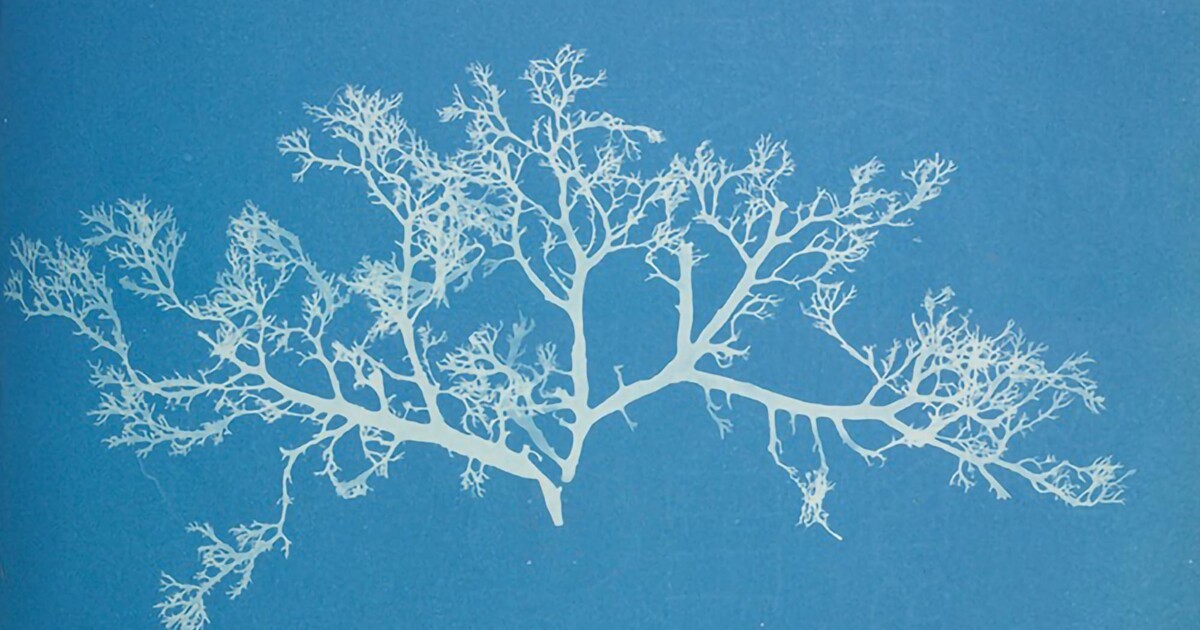

Cyanotype of Sphaerococcus coronopifolius from ‘Photographs of British Algae’ (1843).
Like many people who keep meaning to get round to things, William Henry Fox Talbot was disheartened to discover, early in 1839, that a rival had claimed credit for something he’d been experimenting with for years. On 7 January, it was announced to the Académie des Sciences in Paris that Louis-Jacques-Mandé Daguerre had permanently fixed images created by light. Daguerre was a showman: his painted dioramas had long been popular in Paris. Now he named this branch of a new art after himself. The daguerreotype was the result not only of scientific exploration and personal marketing skills but of canny negotiations with an earlier inventor, Nicéphore Niépce, and his son, Isidore.
Talbot had been exploring the effects of light-sensitive chemicals on paper for five years, but he was prone to distraction: astronomy, microscopy, adventures in integral calculus and the translation of cuneiform inscriptions all fell within his intellectual jurisdiction. If it was the internal structure of crystals one day, it might be the colour of chemical flames the next. He eventually wrote two popular books of essays on classical antiquity, and his investigations into photogenesis coincided not only with his election to the Royal Society but also with a brief stint in Parliament. His notebooks brimmed with ideas: no single lifetime could have allowed him to follow them all through.
His friends and scientific colleagues John Herschel and David Brewster pressed Talbot to focus for long enough to publish his findings. ‘I have often wondered,’ Herschel wrote to him in 1833, ‘that being, as I am aware you are, in possession of a number of curious & interesting things in optical science and taking on every branch of that subject views of no ordinary kind, you should not have embodied them in some more impressive & permanent form than you have hitherto thought it worthwhile to do.’ Daguerre’s announcement caused Talbot’s mother to weigh in too: ‘Dear Henry, I shall be very glad if M. Daguerre’s invention is proved to be very different from yours. But as you have known it five years à quoi bon concealing it till you could by possibility have a competitor? If you would only have made it known one year ago, it could never have been disputed, or doubted’. She added: ‘This is at least the second time the same sort of thing has happened, how I do wish it would operate in future as a spur to make you do yourself justice.’
From Talbot’s point of view, the news from France was grim. ‘I was threatened with the loss of all my labour,’ he told the Literary Gazette, ‘in case M. Daguerre’s process proved to be identical with mine.’ It wasn’t. It was better. An intriguing aspect of the first months of 1839 is that, despite the competitive frenzy, neither Talbot nor any of his close colleagues in England and Scotland had actually seen a daguerreotype. The results had been described (though not the process: Daguerre kept his method a close secret until he could sell it) and letters about primacy had gone back and forth across the Channel, but it was not until Herschel made a trip to Paris in May that they realised they weren’t talking about the same thing at all.
Daguerre’s images were like mirrors: uncanny one-offs recorded on thin, silver-coated copper plates. Talbot’s were, in his own description, ‘lilliputian’ soft-focus relics of what sunlight could imprint on paper over a long period. (He had built tiny box cameras, which his wife called ‘mousetraps’, in an attempt to shorten exposure times.) Daguerre’s images were positives; Talbot’s were negatives. Talbot’s contact prints and landscapes required hours of exposure; human portraits, which Daguerre was intent on capturing, were still impossible by Talbot’s method. In March 1839, much of Daguerre’s work was destroyed in a fire that swept through his theatre, laboratory and home. Yet there was enough left behind for Herschel to send, on 9 May, an ebullient update that Talbot can only have received with dismay:
My dear Sir, Though much pressed for time I cannot resist writing to you first to say that I have this moment left Daguerre’s, who was so obliging as to shew us all his Pictures on Silver saved from the fire which burned his house and also one on glass. – It is hardly saying too much to call them miraculous. Certainly they surpass anything I could have conceived as within the bounds of reasonable expectation … His times are also very short. – In a bright day 3 m suffices for the full effect … In dull or rainy days & in the interior of an apartment (for copying sculptures and pictures) from 5 to 10 m are requisite … In short if you have a few days at your disposition I cannot command you better than to Come & See.
As early as 1831, Talbot had been present – along with Brewster and Charles Babbage – when Herschel showed them, over breakfast at Babbage’s house, the principle behind modern-day platinum prints. Herschel had found an old crucible of platinum salts left behind by his late father, the court astronomer William Herschel, and used them to make simple patterns in test tube solutions by masking areas with opaque paper and exposing them to violet light. He was particularly keen to share the news with Brewster, an optical innovator, who was visiting from Scotland. When Herschel accepted Babbage’s invitation to join them, he added in a postscript that he had himself discovered three days earlier ‘a striking instance of the effect of violet light’. ‘Remind me to tell B. of it,’ he said. The facts, he later explained, were of ‘photological’ importance.
What was required, though, was not just the curiosity to carry out experiments but the incentive to pursue their implications. On honeymoon near Lake Como in 1833, Talbot became frustrated by his failure to master the camera lucida, a portable prism used as a drawing aid, and was compelled as a result to find a way to ‘fix a shadow’ by chemical means rather than by sketching. By then Herschel, a far better draughtsman, had left for the Cape of Good Hope to observe celestial objects that couldn’t be seen from the Northern Hemisphere, taking a camera lucida with him. When he returned in 1838, Talbot had been sending his ‘photogenic drawings’ to friends for four years.
Talbot had reasons other than distraction for not announcing his experiments sooner. Though he understood the principles of light sensitivity, he felt he hadn’t yet perfected the practice. The essential chemical that all the experimenters were using was a compound of silver, whether iodide, chloride or nitrate (Daguerre’s method, as Talbot later discovered, depended on silver iodide developed with mercury fumes). What his predecessors had failed to try, Talbot thought, was a solution of silver with less salt – a ‘subchloride of silver’ as he called it – for exposure, and perhaps a stronger salt wash as a fixative. The problem lay not in making the image appear so much as in getting it to stay; and in terms of fixing, his process was not yet an emphatic advance on what Thomas Wedgwood and Humphry Davy had achieved in 1802. His prints were faint and liable to fade; he could stabilise the image but not fix it permanently. In February 1839, Herschel persuaded Talbot that there was no point in guarding his own secret due to ‘the cat being let out of the Frenchman’s bag’. Talbot was forced to use as evidence of his efforts prints he’d made much earlier, since the paltry light of that English winter prevented him from making any more until spring. ‘I do not profess to have perfected an Art but to have commenced one,’ he explained.
Talbot went to see Herschel at his home in Slough on 1 February, the day after his paper ‘Some Account of the Art of Photogenic Drawing’ was read before the Royal Society (Herschel was ill and couldn’t be there). He took with him small photograms of ferns and fragments of lace, and told Herschel he still had trouble getting the images to last. ‘Let me have this one for a few minutes,’ Herschel said. He returned having worked out something that had defeated his colleagues for decades. ‘I think you’ll find that fixed,’ he said as he handed the picture back to Talbot. Herschel’s solution, hyposulphite of soda, or ‘hypo’, is still used as a photographic fixer today.
It was understandable that the person who pursued the principles of light-fastness with the most urgency was an entrepreneur (Isidore Niépce later wrote of Daguerre’s ‘machiavélisme’ towards his father); the scientists were preoccupied with their ‘natural magic’ and didn’t envisage all of its applications. Daguerre sold his secret to the French state and they released it to the public in August. Talbot refined his method and invented the photographic negative. His images were inverted when they were captured on paper, so he made them translucent with a thin coat of oil and produced a counter-print that was positive. What came to be known as photography – an image that could be reproduced on paper many times – is a direct descendant of Talbot’s line of thought.
Talbot predicted that photography would ‘make every man his own printer and publisher’. But it was a woman who first saw the new art’s potential in that domain. Anna Atkins, the author of the first photographically printed and published book, was a contemporary of Talbot’s and had been known to the members of this scientific circle since childhood. Her contribution would not have been possible without proximity to these men who were exploring optics and light. But if the opportunities afforded her derived from privilege, they were also the result of an unusual degree of affection.
When Talbot disclosed his process to the Royal Society, the person who chaired the meeting was Atkins’s father, John George Children. He and Talbot had known each other for years: it was Children who, as secretary of the Royal Society in 1831, had informed Talbot that he had been elected to a fellowship. Like Talbot, Children was a man of what his daughter called ‘incessant occupations’: he was a chemist, a mineralogist and, somewhat reluctantly, a zoologist. A mineral, Childrenite, was named after him, as were a species of cowrie shell and a python. (John James Audubon, who befriended Children on a trip to London, tried to name an American warbler after him, before finding that it was only the baby of a bird he’d already identified.) In 1838 Talbot sent Children some of his drawings of crystals; he sent him photographic prints in 1839 and 1840.
Anna Atkins married John Pelly Atkins, a fellow science enthusiast, in 1825. They had no children. In 1838 he inherited Halstead Place, a Georgian mansion in Kent, along with its art collection (Caravaggio, Bruegel, Correggio) and extensive gardens. When Anna’s stepmother died the following year, her father retired from his post as a librarian at the British Museum and came to live with them at Halstead, where all three indulged their love of optical toys. ‘When we return to Kent, my daughter and I shall set to work in good earnest till we completely succeed in practising your invaluable process,’ Children wrote to Talbot.
The Children and Herschel families spent a great deal of time in each other’s houses, and Herschel’s children thought of Atkins as an aunt. Herschel, who would become much better known as an astronomer, found that in the years after his chivvying of Talbot he could not let go of experiments with light. (He was the first person to use the term ‘photography’ consistently.) ‘You cannot grasp by what links this department of science holds me captive,’ he wrote to his wife. ‘I see it sliding out of my hands while I have been dallying with the stars.’ In the pursuit of full-colour photography, Herschel tested the juices of flowers and extracts from his pet boa constrictor. In 1842 he lit on an inorganic compound of iron that yielded negatives in Prussian blue and wrote about it almost as a footnote to a much longer paper, ‘On the action of the rays of the solar spectrum on vegetable colours, and on some new photographic processes’, which he sent to Children.
The cyanotype, much less variable than silver-based prints, was the only original process from the first decade of photography to survive into the 20th century – as architectural blueprints. At the time of its invention, Herschel saw no commercial value in it and for the first three decades the only people who used it were members of the Herschel family and Atkins. Herschel himself used the process privately as a kind of carbon paper to copy his own notes. Atkins, however, saw its artistic and botanical potential, and set to work on a project that would take her a decade to complete: creating a cyanotype catalogue of specimens based on William Harvey’s recently published (and unillustrated) Manual of the British Algae.
Atkins had made detailed drawings to accompany her father’s translation of Jean-Baptiste Lamarck’s Genera of Shells in 1823. She and other members of the recently established Botanical Society of London – many of them women – were in the habit of exchanging specimens from their herbaria, including species of British algae, whose details were almost impossible to reproduce by hand. ‘The difficulty of making accurate drawings of objects as minute as many of the Algae and Confervae,’ she wrote in the preface to Photographs of British Algae: Cyanotype Impressions, ‘has induced me to avail myself of Sir John Herschel’s beautiful process of Cyanotype, to obtain impressions of the plants themselves, which I have much pleasure in offering to my botanical friends.’ Atkins was 44 when she undertook her taxonomic endeavour, in the ‘anxious and sorrowful’ second half of 1843 – she had suffered ‘a long, though not dangerous, illness’ and her sister-in-law had died of tuberculosis, leaving an 18-month-old son. She completed the project at the age of 54 in a state of mourning, a year after her father’s death. The book is dedicated to him.

Cyanotype of Rhodomenia.
Idon’t remember when I first learned to make cyanotypes, but I had loved Atkins’s prints for many years when I found myself in the grip of an obsession with her work, and with the possibilities of the process. Many improvements have been made to the chemistry, but I stuck to Herschel’s original method – my aim was not to make perfect prints but to come as close as possible to what Atkins had seen.
As anyone who has tried it will know, the formula for cyanotypes is simple. You make two iron-based solutions – bright red crystals of potassium ferricyanide mixed with water at a ratio of 1:10; and ferric ammonium citrate (a murky olive-coloured powder) mixed with water at 1:4 – then combine them in equal measure. That mixture creates an acid green light-sensitive liquid, which you can use to coat anything that will absorb it – paper, fabric and so on. You apply it in low light, leave it to dry in the dark, then expose it to sunlight in combination with whatever it is you want to print.
If you want to make a cyanotype of a dried plant, for instance, you sandwich it tightly between light-sensitised paper and a sheet of glass (Atkins probably had wooden frames for this), then expose it to daylight. The exposure time will depend on the UV level, the number of chemical coats applied, the type of paper and the density of the object placed on it. When you bring it all inside and remove the plant, the parts the sun has reached will appear grey and the areas blocking the light will remain green. It’s only in washing the chemicals from the paper that the grey turns Prussian blue and the green reverts to the base colour of the paper. In that moment, if you happen to be rinsing large sheets of paper in your bathtub, you’ll find that the print becomes luminous underwater. If rinsed with London tap water, the blue will dry darker and somewhat duller, but there is such magic in that first moment of vivid underwater life that when I first saw it I was compelled to write to a professor of chemistry and ask whether it was possible that my prints were phosphorescent. (As it happens, three years after the invention of the cyanotype, while Atkins was at work on her prints of algae, Herschel looked into the fluorescence of quinine. The chemist I contacted, who was researching Herschel’s work, suggested I try washing my prints in tonic water, and he was right: these remained much brighter.)

Some of Atkins’s seaweed specimens were dense enough to become white silhouettes when printed, showing only their overall form. Others, however, were translucent, revealing details of texture and tone that still look bright and clear more than a century later. In effect, these pieces of dried algae behaved like photographic negatives. Once I noticed this, I tried to work out how I could replicate the process with other objects. If you’re drawing, you look at objects for their line and tone; if you’re sculpting, you see in three dimensions. My preoccupation with Atkins caused me to scan the world for translucency: how will light pass through this?
Atkins sent small groupings of her cyanotypes to her friends as hand-sewn fascicles, usually in sets of twelve. (The prints she sent to Herschel are now in the New York Public Library; Talbot’s are in Bradford.) The recipients bound them in book form themselves, or didn’t – hence the stray prints found in collections today. As she added specimens, Atkins sent instructions to the recipient indicating a new sequence. Sometimes she followed up with a better, replacement print, leading to an amount of confusion and a number of books being bound with the prints in different orders.
When the project was complete, in 1853, it comprised three large volumes containing 425 captioned prints of algae and fourteen pages of text listing the species shown. It’s not known how many sets Atkins printed, but at least fourteen complete versions survive, and enough partial ones and individual prints to indicate that she made more. She sent a volume directly to the Royal Society for its collection, but by the end of the 19th century the book’s authorship had been forgotten. After this project she collaborated with her childhood friend Anne Dixon on cyanotype impressions of ferns, lace and feathers.

Cyanotype of sobolifera.
A lush recent book edited by Peter Walther and produced by Benedikt Taschen offers an overview of Atkins’s work, illustrated not only with facsimiles of every cyanotype but also with photographs of her watercolours, drawings and pages from her herbarium. The hefty volume is largely based on what Atkins sent to Herschel, supplemented by prints from other collections in an attempt to arrive at a complete set of cyanotypes in the order Atkins wished. The scholarship is in the imagery; Walther’s brief context-setting essays are heavily indebted to the work of Larry J. Schaaf, the historian of photography who brought Atkins’s work to light in the 1980s. This book repeats, however, the misattribution to her of several entertainingly florid Victorian novels that were in fact written by Clarinda Atkyns, a friend of Byron and the Shelleys.
When I first touched Atkins’s original prints, leatherbound in the Royal Society library, I felt a rush of elation, not only over the fact that she had made every page but over the specimens that seemed to want to escape from them. Atkins the botanist, Atkins the illustrator, was neat. The dried plants in her herbarium are carefully preserved; her illustrations are detailed and fine. Schaaf notes ‘a considerable lack of tidiness’ in her cyanotypes, but on the whole neatness was also a quality of Atkins the printmaker: each page was evenly coated with light-sensitive chemicals and almost every specimen framed with plenty of margin. We are far, here, from the blur and slosh of her black-fingered successor Julia Margaret Cameron, who, twenty years after Atkins’s project began, took to rushing into the dining room with her dripping glass plates, staining, as she later wrote, ‘an immense quantity of table linen with nitrate of silver’.
In places, though, Atkins’s work developed a life of its own. As you turn the thick pages of watermarked paper, you notice that each of her prints has a slightly different hue. The striated right-hand edge of the handmade volumes is geological: alternately glowing, matte, deep, powdery or pale. These blues could only be controlled to a degree. Very occasionally a piece of seaweed pushes at the edges of its two-dimensional box: the flat wandering strands of Himanthalia lorea barely contained by the page, the folded abstraction of Laminaria bulbosa asserting its scale next to the book’s spine, the X-ray crinkles of Ulva latissima expanding. These had imported their wildness to Atkins’s deliberate endeavour.
An idea came to me: what if they weren’t dried specimens but still living plants, on a much larger scale, hauled from the shallows and exposed then and there on the beach? I checked whether the chemicals were toxic – could the prints be rinsed in the sea? – and lay awake at night planning ways to coat paper and get it to the shore before it fogged. I pictured myself rushing to place fresh sheets of it beneath the seaweed as it unfurled, like a character laying down train tracks in a silent movie. To me this was what Atkins and her subjects were yearning to do – what they would have done had they been free.
Looking back, my notes on cyanotypes fall into three categories. There are detailed technical records about, for instance, the number of coats of chemicals and the circumstances in which they were applied (the floor of a hotel bathroom, a candlelit kitchen table); about measurements of time and corresponding UV indices; about types of paper and their weights in grammes per square metre (hot pressed watercolour, Arches Platine, handmade paper named after John Herschel from a mill in France); about types of water (sea, river, tonic, tap). For each of these, a clearly labelled test strip or print was pinned to the wall of my studio.

Then there were more diaristic drifts: thoughts set down on waking, or a mood coming in aslant. ‘To console myself I think of the cyanotypes I will make,’ my notes begin, out of nowhere. I kept coming back to the idea that in the case of photograms the objects depicted had touched the paper – it was a peculiarly expressive material record, one step closer than the proximity that had struck Elizabeth Barrett Browning when she wrote, after seeing a daguerreotype: ‘It is not merely the likeness which is precious in such cases – but the association, and the sense of nearness involved in the thing.’ So much of early photography seemed like a visitation. What to do with the fact that if the cyanotype image faded, it would return after being kept for a while in the dark?
In the last category of notes there were musings about what struck me when I saw the results. Years on, it seems pointless to dwell on the extreme adventures provoked by my Atkins fever. On cloudy days I sought out sunbeds, and having negotiated an extension of the time allowed beneath the UV rays (‘can I have longer than fifteen minutes if I’m not putting my body in it?’), I arrived with large panes of glass, bulldog clips, pre-sensitised sheets of paper and bin bags full of seaweed.
In summer, I took paper, powdered chemicals, brown glass bottles and stained special brushes to the wild coast of Portugal, where I collected large specimens after a storm. The sea had left silty dark-edged washes on the sand, as if from a receding tide of ink. I made prints on the last day I was there – my eeriest yet – but I was in such a rush to pack that I left them to dry outside and found on my return that the just-fixed images, bleached by the harsh sunlight, had vanished.

In winter, I followed a taxonomic trail to Cornwall, where I discovered that the 18th-century botanist John Stackhouse had built a castle above a cove where he’d found the greatest variety of seaweed in the British Isles. I got lost in the dark and met a woman who claimed to have seen the ghosts of smugglers. I collected seemingly infinite varieties of seaweed and kept them, stinking saltily, in the bath of the B&B. I taught myself to drain and dry the smaller specimens according to the principles of another 18th-century botanist, lining a soup bowl with writing paper, placing seaweed and water in it, then tipping the water out slowly so that the seaweed settled on the paper in the pattern of its native shape.
It was on this last trip that I became frustrated with the images I was able to produce. ‘I can make copies of Atkins’s cyanotypes,’ my notes read, ‘but that’s not the point. The aim was to get away from this – from precision in image-making, from rigid adherence to fact. I wanted my prints to be both monstrous – thrown up by the sea – and spectral, as if Atkins’s ghost had been released onto the page. But I can’t seem to make the prints I have in mind. If you look at the slimy plants floating in my bath, they are wild and old and otherworldly: the giant crocodile-textured kelp, the twisted gorgon furbelows, the wrecked and blistered strips of oarweed, the claw-like holdfasts, the long forking ribbons of thong weed, the arthritic-looking bladderwrack, the sea oak tresses, the translucent ruby fronds of dulse. It would be wrong for the prints to look too neat.’
One morning on waking I saw her: not the frowning woman in the only surviving photograph but a young girl in a laboratory in a high-waisted dress. Atkins’s mother, Hester, had not survived the effects of childbirth, dying ‘twenty weary months later’. John Children had also lost his own mother as a baby, and Atkins was raised by her father and grandfather, an only child to two devoted men. George Children, a ‘benevolent’ figure, was a magistrate and one of the founders of Tonbridge Bank. George and John Children created, as Atkins later recalled, a ‘current of liveliness and fun’ in ‘the little home circle at Ferox Hall’ in Kent. Her father would read Shakespeare aloud after tea, or pull from his pocket some newly published volume. He wrote rhyming couplets to entertain her at almost any opportunity – included in the account of Children that Atkins wrote after his death are verses in the voice of their dog Fidget, an epitaph on a favourite chicken, a petition from a house fly and an ode to a hare. The family would make occasional trips to London to see exhibitions at the Royal Academy. On New Year’s Eve, John Children set off homemade fireworks.
Almost as an extension of the general entertainment, John Children built a laboratory at Ferox Hall. It became, as Atkins recalled, ‘the scene of many pleasant hours spent in investigations either alone or with chemical friends’. One of those friends was Humphry Davy, who, ten years after he introduced Wedgwood’s pre-photographic experiments to the public, injured his cornea there and had to stay on at Ferox Hall to recover (it was this accident that prompted him to hire an assistant, Michael Faraday). In 1815, the year before Mary Shelley wrote her story about the reanimating powers of electricity, Children constructed the most powerful galvanic battery yet invented, for which he received the Royal Institution Medal. The experiments exploring the battery’s powers were conducted at Ferox Hall in the presence of friends including William Hyde Wollaston, the inventor of the camera lucida. The occasion, ‘as may be supposed from the vast amount of talent and learning then assembled at Tunbridge’, Atkins wrote, was ‘most highly interesting in a social as well as scientific view’.
We don’t know much about Atkins’s life beyond what can be read in and between the lines of her memoir about her father. We know the identities of some of her friends, among them the feminist writer Caroline Frances Cornwallis and the ‘rebellious’ Sophia Bliss, and can perhaps deduce from that the strength of her own character. We know that she once lost a bracelet at the opera while listening to Jenny Lind; that, forced to rest her eyes as a result of an inflammation, she missed the coronation of George IV; that in the last year of his life her father made a set of chessmen from ivory and ebony as a gift to her and her husband; that she worked at a table carved from the Waterloo Elm, of which she had made a fine pencil drawing the day before it was chopped down. (Three years after the Battle of Waterloo, the tree where the Duke of Wellington had his main command post was scarred and half-bald from the removal of souvenirs. When she was nineteen, Atkins, on a short tour of Holland and Belgium with her father, sat down to sketch the dying elm. ‘Not a moment too soon!’ their guide exclaimed: it was due to be removed the following day. Children negotiated a price, shipped the tree to England and had several items of furniture made from it.)

Cyanotype of Sargassum bacciferum.
Perhaps most tellingly, we know that when she was about sixteen, her father gave a series of 21 lectures on chemistry, specifically designed for her. He illustrated them, in the laboratory at Ferox Hall, with ‘numerous and beautiful’ experiments. In his own words, they were ‘a pretty extensive survey of the elementary materials which compose the world we inhabit’. He explained their purpose: ‘It was natural that … I should wish to impart to a most dear daughter ideas, which I conceived would at once improve her understanding and enlarge her heart.’
Soon afterwards, a sequence of events would cause their lives to change dramatically: Tonbridge Bank collapsed and George Children was bankrupted; Ferox Hall was sold; John Children took a job at the British Museum and the family moved to London. But it is perhaps with these early expressions of intent that we might best understand the attitude to science that Atkins absorbed: it was social, it was a means to understand the world and it was a way to expand the human heart.
About a year into my dogged pursuit of the perfect cyanotype, I felt my grip on it release. I suspected I would never be able to make the enormous multi-sheet seaweed prints on the beach, and who cared anyway? I kept the chemicals and paper, sometimes pressed and printed the odd flower. A few months later my daughters and I were staying with friends in a whitewashed cottage where the sun shone brightly against one of the external walls. I felt compelled to try something. One of the examples Talbot had given in his original paper on the uses of photography was the making of silhouettes by sunlight. I taped two pieces of sensitised paper to the wall and asked my children to stand in front of them for two minutes. Hold still, I said, as they stood with their midday shadows cast against the side of the house. They complained. Why couldn’t I just draw their silhouettes, cut them out and print them flat?
Once the sheets were washed, I knew the answer. The two blurred white profiles against luminous blue recalled Barrett Browning’s ‘sense of nearness’. I understood that the softness in their shape was a record of my children’s breathing, exactly as they were in the span of those moments, and I felt that all of my explorations, the chemistry and sunlight and the eye on the clock, had been leading up to this sideways. Proof of proximity. An aliveness in time.