On or about December 2015, along with my friends Adam and Gill, I bought a cast-iron table-top printing press from the early 20th century. It was only really large enough to print pamphlets, but it was still the heaviest thing I had ever lifted, in size and shape not unlike the anvils that used to fall on Wile E. Coyote. It was also almost identical to the table-top press that Leonard and Virginia Woolf had purchased and installed in the dining room of Hogarth House, their home in Richmond, almost a century earlier.
Like the Woolfs, we had high hopes of printing short-run editions of works by ourselves and our friends. On our first weekend we took a poem given to us by a university colleague, along with a linocut made by Gill, and attempted to print them as a four-page pamphlet. While we laboured over the type, our children marbled the paper that would be our wrappers, producing a green wash like variegated snot in a vortex. Once all the inks had dried, we folded and stitched everything into an edition of ten, or six if you don’t count the four that were so wretchedly done that we had no option but to throw them away.
What we learned is that the process of making books – composing type, operating a press to get a clean, even impression, stitching bindings – requires meticulousness and a remarkable attention to detail. In the decade since our first experiments, Adam and Gill have improved – a little – as printers. I remain unteachably hopeless: distractable, undextrous, with an underdeveloped drive for perfection. The fact that Virginia Woolf produced books for a considerable portion of her adult life – graduating from her own brief short stories to longer pieces like Katherine Mansfield’s Prelude (which took nine months to print) and E.M. Forster’s Pharos and Pharillon (eighty pages) – demonstrates a capacity for care, patience and precision that should not be taken for granted. Printing, if one is to do it with any competence, has to become part of one’s life.
On the afternoon of 25 January 1915, Virginia and Leonard were at Buszard’s Tea Rooms on Oxford Street. It was Virginia’s birthday. At 33 she was a prolific and accomplished book reviewer, and her first novel, The Voyage Out, was about to appear from the press of her half-brother Gerald Duckworth. Over tea, the Woolfs made decisions: they would take up the lease on Hogarth House; they would get a bulldog and call it John; and they would buy a printing press. ‘I am very much excited at the idea of all three,’ she wrote in her diary, ‘particularly the press.’ As it happened, a combination of illness and lack of funds meant that the printing press would be repeatedly put off. For the next two years it appears flickeringly in Virginia’s letters, along with a sense of how she might use it. To Lady Cecil, for example: ‘We are thinking of starting a printing press, for all our friends stories. Dont you think its a good idea?’
It wasn’t until April 1917 that the press finally arrived at Hogarth House. It had been broken in transit, so the Woolfs had to wait several weeks for it to be fixed. Nevertheless, they were able to get on with the business of making ready, distributing the pieces of type to their correct compartments in the typecase (a finicky job, and Virginia reports having mixed up the hs and the ns). Virginia’s letters from the time are frank about how inexpert she is. ‘Heaven knows how one prints,’ she wrote to Lady Cecil. To Violet Dickinson: ‘We have bought our Press! We don’t know how to work it.’

The earliest production of the Hogarth Press was an advertisement, a slip of paper announcing the forthcoming ‘Publication No. 1’, which was to be a pair of stories, one by Leonard, the other by Virginia. In fact, this announcement is not, strictly speaking, a production of the press, which still hadn’t been repaired when Virginia sent the advert to a friend. The Woolfs must have set up and inked the type before pressing the paper onto it by hand. ‘So its not a fair sample,’ Virginia explained, getting ahead of any criticism. Actually, it’s not the unevenness of the impression that jumps out, but the spacing between the letters. It’s all over the shop: ‘short stories by Leonard Woolf and Virginia Woolf,(price,includ-’; ‘If you desire a copy to be sent to you,please fill up the,’ and so on. This was early May. The idea that they planned, within a couple of months, to issue ‘a pamphlet containing two short stories’ seems wildly optimistic. Virginia hadn’t even started writing hers.
Nonetheless, Two Stories appeared in July, and sold out its run of 134 almost exclusively to friends and acquaintances. When David Garnett wrote to tell Virginia that he had enjoyed her story, her reply gives the sense that it was the press – specifically the slowness and difficulty of composing type – that had pushed her to dabble in short-form fiction: ‘In a way its easier to do a short thing, all in one flight than a novel … Anyhow its very amusing to try with these short things.’ She adds that it is ‘the greatest mercy to be able to do what one likes – no editors, or publishers, and only people to read who more or less like that sort of thing’. The novel she was working on at that point, Night and Day, is her least satisfying and most old-fashioned. It would be the last book she would bring out with a press other than her own. For the rest of her life, Woolf’s experiments in fiction went hand in hand with being her own publisher.
Others were invited to experiment too. ‘Our press you know, is to give birth to every monster in the vicinity,’ she told Clive Bell. If you leave out a private printing of poems by Leonard’s brother, who had been killed in the war, Hogarth’s next three publications would be Mansfield’s Prelude (1918), T.S. Eliot’s Poems (1919) and Hope Mirrlees’s Paris: A Poem (1919-20). A hundred years on, this looks rather like setting the parameters of high modernism. In 1918, they were even offered Ulysses but turned it down with the regretful admission that ‘the length is an insuperable difficulty to us at present.’ (In fact, Leonard had investigated outsourcing the printing to commercial firms, who all assured him that publication would result in prosecution for obscenity.)
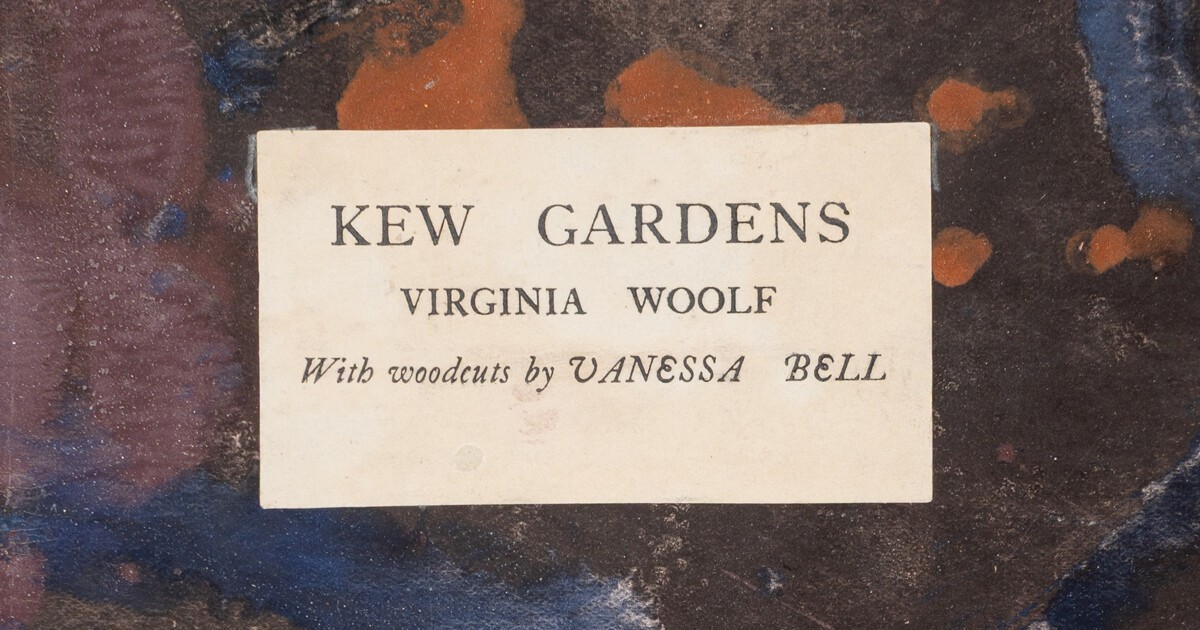
The seventh Hogarth book, Virginia’s short story Kew Gardens, was also published in 1919. Following a glowing review in the TLS, the couple found themselves with more orders than they could fulfil from the initial run of 150 copies. But the type had been broken up, and to print more would mean starting again. Instead, the work of producing a second edition was farmed out to a commercial printer, a practice the Woolfs began to employ routinely, allowing them to publish longer books with larger print runs. It was Kew Gardens, then, that pitched the couple into becoming publishers rather than printers.
A small detail on that book’s final page shows that their intentions for the press were already getting serious. At the end of the text, a note reads ‘L. and V. Woolf’. If you look closely, however, you can see that these words are gummed in on a cancel slip. The original text underneath reads: ‘Printed by Leonard & Virginia at The Hogarth Press, Richmond’. Something is happening: a vacillation about how they want to present themselves, whom they mean to address. Is ‘Leonard & Virginia’ too familiar, too folksy? Is Hogarth to remain a cottage industry or is it to be something more ambitious?
The decision to outsource printing allowed the Hogarth Press to become a major publishing house. By the time of Virginia’s death in 1941, it had brought out more than four hundred titles. During the 1930s the Woolfs published dozens of books a year: a peak of 36 in 1932, a low of 17 in 1938. There were translations, books of prints, a pamphlet series of major essays on communism, imperialism, fascism and feminism. Hogarth also became home to the International Psycho-Analytical Library, making it Freud’s publisher in the UK. Most of these books were printed by commercial printers, but Virginia and Leonard continued to produce a few of their titles by hand.
The current exhibition, Virginia Woolf and the Hogarth Press, at Charleston in Sussex (until 6 September) focuses more on the Woolf-made books than on the others. There is something magnetic about the large case containing all 34 titles that Virginia made, from Two Stories in 1917 to Dorothy Wellesley’s Jupiter and the Nun in 1932. Another case contains six copies of R.C. Trevelyan’s Poems and Fables (1925) from a run of three hundred. With their marbled, paint-spattered covers, each is quite distinct from the others. Displaying them together like this reminds us that, when a book is bound in handmade papers, every copy is unique. It’s an idea that the Woolfs took from Roger Fry’s Omega Workshops, and some of the papers came from Fry himself. And yet the Omega books (which also have a case to themselves here) were different. With their wide margins, thick cream paper and handmade, block-printed wrappers, they were statements of style. For his first publication, Fry had sought out the help of J.H. Mason, then superintendent of printing at the Central School of Arts and Crafts. An advertisement in the Burlington Magazine set out Fry’s intention that the Omega books should ‘give the setting of the page and the illustrations as perfect a harmony with the literary idea as possible’.
By contrast, the early, handmade Hogarth books do not aspire towards perfection. No master printer was sent for when Leonard and Virginia were learning the ropes. A pamphlet, put out on the occasion of Hogarth’s fifth birthday, states their disinclination to ‘sacrifice time or money to embellish our books beyond what is necessary for ease of reading and decency of appearance’. It goes on: ‘Our experience in the past confirms us in our belief that it is essential to keep our prices at the ordinary level, and to aim rather at cheapness and adequacy than at high prices and typographical splendour.’
The book designer Zoe Guttenplan once explained to me how shonky the Woolfs’ early productions were. Take the title label pasted onto the cover of Kew Gardens: ‘The gap between “Kew” and “Gardens” is too large, as are those between the first and last names of Virginia and her sister, and there is too much space beneath the artist credit and not enough above the title.’ To a designer’s eye, after two years of making books, the Woolfs were still unable to balance text and white space. What is it about these books, then, that warrants a display like this? The exhibition, curated by two major collectors, is almost overwhelming in the quantity of early Hogarth books on show. It’s an exhibition for bibliophiles rather than publishing historians: it doesn’t – thankfully – attempt to tell us about Hogarth’s eventual merger with Chatto & Windus, or Chatto’s subsequent acquisition by Random House, or Random House’s final merger with Penguin. Just walls and vitrines full of slim, colourful, delicate volumes from a century ago, attractive but not perfect.
Part of the pleasure of the books is that they present us with a less ethereal version of Woolf than we usually encounter. More granite, less rainbow. In A Boy at the Hogarth Press, Richard Kennedy’s memoir of being a teenage apprentice in the late 1920s, he paints Virginia as a wry presence at the press, hiding from the doorbell, smoking endless roll-ups, handy with a butcher’s knife. He remembers her mucking in, helping to parcel up the books being sent out for review: ‘Mrs W, Ma Cartwright, Miss Belcher and I all lined up at the packing bench and slashed away … Mrs W is a pretty fast worker considering she’s not a professional like Miss Belcher and myself.’
But there is also a charm to these books that more perfectly made ones lack. The publisher John Lehmann, who came in as a partner and general manager of Hogarth in the late 1930s, recalled that ‘both the Woolfs, but in particular Leonard, had an emotional attitude towards the Press; as if it were the child their marriage had never produced.’ The titles that the Woolfs didn’t farm out for printing, the ones they continued to make themselves, were overwhelmingly written by their closest friends. Vanessa and Clive Bell, Vita Sackville-West, Forster and others: the same crowd they wanted to publish before they became professionals. Making these books remained a labour of patience and attention. They were not perfect, but they were good enough: incontrovertibly the product of ‘Leonard & Virginia’.