Iris Hawkins , the resourceful heroine of Francis Spufford’s fourth novel, Nonesuch, wants ‘to be in the room where the decisions are taken’. No small ask in 1930s Britain. She has followed her father into the City, leaving Watford, if not its vowels, behind. She works as a secretary at the brokerage Cornellis & Blome, typing letters, opening the post, operating the teleprinter (she’s the only one who knows how) and delivering printouts of orders to the brokers’ room. At four o’clock each afternoon she sends the list of London closing prices to Barracloughs, a Sheffield exchange, which, though a competitor, is permitted to pay for this information a few hours after Cornellis & Blome has made use of it. Every morning she secretly fulfils her separate arrangement with Barracloughs, sending up-to-the-minute prices for the five most traded London shares. ‘For this they paid her two guineas a week, mounting up nicely now in an obscure bank account.’ She keeps a number of men on the go and is familiar with the ‘wide, firm and comfortable’ beds at the Savoy. When a lover asks what she desires from life she tells him: ‘I want to be rich.’
Two events threaten this ambition. The first is the outbreak of the Second World War, which is imminent when Nonesuch opens in August 1939. The second is Iris’s encounter with a nightmarish being:
She squinted, and down under the last streetlight she saw that a figure was standing. A man in a long coat and a hat, seemingly. Too many clothes to be comfortable on an August night, maybe, but otherwise ordinary enough. Except that this man was slowly bending his head over onto his shoulder. Not just tilting it, or leaning: laying it absolutely flat there, at ninety degrees, in a way that the human neck did not permit. Apart from the hat – why didn’t the hat fall off? – it didn’t look in silhouette like a head at all, but some flaccid appendage, slackly creasable … Then up from the shoulder swung the head, if it was a head, through the vertical and all down onto the other shoulder. A smooth movement, like the swing of a metronome. Or as if he had no bones in him, but were a skin loosely filled with some fluid.
This initial sighting is made from a ramshackle house in Hampstead, where Iris has ended up after seducing a sweet, naive BBC technician called Geoff. She met him at ‘a sort of club’, an avant-garde venue in Fitzrovia. He had been in the clutches of a ‘petite exquisite blonde’ called Lall, who was wearing what Iris thinks is a Schiaparelli evening dress. Iris hears ‘underheated country houses. Dogs. Thorn hedges. Icy ditches’ in Lall’s voice, and calls her a fascist when she praises Hitler for ‘taking care of Bolshevism, for all our sakes’. Lall dismisses Iris as a ‘suburban slut’.
Playing up to the charge, Iris dances with Geoff, goes back to his house and gives him a blowjob. Spufford’s handling of the scene is typical of his novel’s desire to marry intimacy and grand scale:
If this was the key to the city, there was no cold metal to it. It was a living charm. Warmth in the inmost box of the world. Outside, the night, rumours of war, balloons on steel hawsers rising, Poland, Parliament recalled, Mr Chamberlain to speak on the radio, Stalin and Molotov, Hitler and Ribbentrop. In here, a raw and tender and salty warmth.
Iris is returning to bed from the bathroom when she sees the thing lurking outside the house. Not long afterwards it finds her again, this time when she is leaving work. She escapes its attack, just, by jumping onto a passing bus. When she confronts Geoff, tracking him down to the BBC studios at Alexandra Palace, he accuses her of being mad. But his father, Cyprian, knows precisely what she’s talking about. He arranges a meeting at a Lyons tea shop and arrives dressed like a time traveller from the 1880s, in ‘loden cloak and a deerstalker hat, carrying a stick with a silver knob’. Time travel of a more literal kind turns out to lie at the heart of his revelations. He tells Iris he is the librarian and custodian for a secret society, the Order, which has learned how to enslave angels, and that the thing that has been chasing her is a being from the ‘proletariat of the angelic species’. Cyprian presents her with a spell to free this supernatural guard dog and end its pursuit. One result of this is that Iris and Geoff, whose relationship moves from fling to love affair as the phoney war gives way to the Blitz, encounter an angel of a much higher order, the archangel Raphael.
The German filmmaker and writer Alexander Kluge once noted that it would be ‘arbitrary to say that we cannot know anything about angels just because they very rarely come into laboratories’. Spufford’s Raphael is unfamiliar at first, appearing as a ‘creature of light’, a ‘blue abyss’, its speech ‘a blast of harmonious overlapping chords too complex for the human ear, like the result of someone with at least six hands playing a cathedral organ’. To put Iris and Geoff at ease, Raphael transforms into something Kluge, or for that matter Milton or Blake, would easily recognise: a tall, muscular man with a baritone voice, dressed, after an initial nude period, in a pleated tunic, though not before Iris clocks how well-endowed he is. Equally enormous is his capacity for exposition, telling Iris and Geoff about the danger they face and what they must do to overcome it. The members of the Order (Lall turns out to be one), who also belong to the British Union of Fascists, plan to travel back in time and assassinate Churchill before he becomes prime minister. This will result in the appeaser-in-chief, Lord Halifax, taking power when Chamberlain steps down.
Spufford, who had a long career as a non-fiction writer before switching to novels with Golden Hill (2016), set in a version of 18th-century New York, enjoys exploring counterfactuals. His second novel, Light Perpetual (2021), imagines the lives five children might have had if they hadn’t been killed when a V-2 rocket hit the New Cross branch of Woolworths in 1944. The detective novel Cahokia Jazz (2023) takes place in a Native American city near St Louis, the existence of which is predicated on European settlers’ bringing with them a milder strain of smallpox. In Nonesuch it isn’t only the author but his characters who can change history. Iris and Geoff learn of a portal that was discovered by a 17th-century alchemist, Hieronymus Dawe, who called it ‘Nonesuch’ because it exists outside space and time. This is also a Tudor joke of sorts: Henry VIII built a palace called Nonsuch in Sutton, later torn down by a mistress of Charles II, its materials sold off to pay gambling debts.
Dawe constructed the route to Nonesuch by trapping angels in various statues positioned around London. Most were destroyed in the Great Fire but the ‘webwork’ remained, available to be reactivated by anyone with access to Dawe’s spells:
‘You’re telling us,’ said Iris, when the stunning effects of the angel’s prose had had a chance to wear off, ‘that there’s a sort of accidental time machine made of statues on the rooftops of London?’
‘Yes. Old London. Effectively, the City.’
‘And that someone is starting it up?’
‘Yes. Or trying to. Someone has given the first word of command to the ancient engine. They have awoken one captive. The newest, in fact: the statue of Mercury on the roof of Faraday House.’
Iris remembered it – the hundred-foot fortress of cream stone near St Paul’s containing the international telephone exchange. She saw the glint from the tip of Mercury’s silver art deco wings as she did her morning walk up Ludgate Hill.
‘And you want the two of us to do – what?’
‘Find out who it is, and stop them. So that you and your city at least have a chance against the wolves, and do not forfeit life, hope and freedom because someone has snatched out your time from under your feet.’
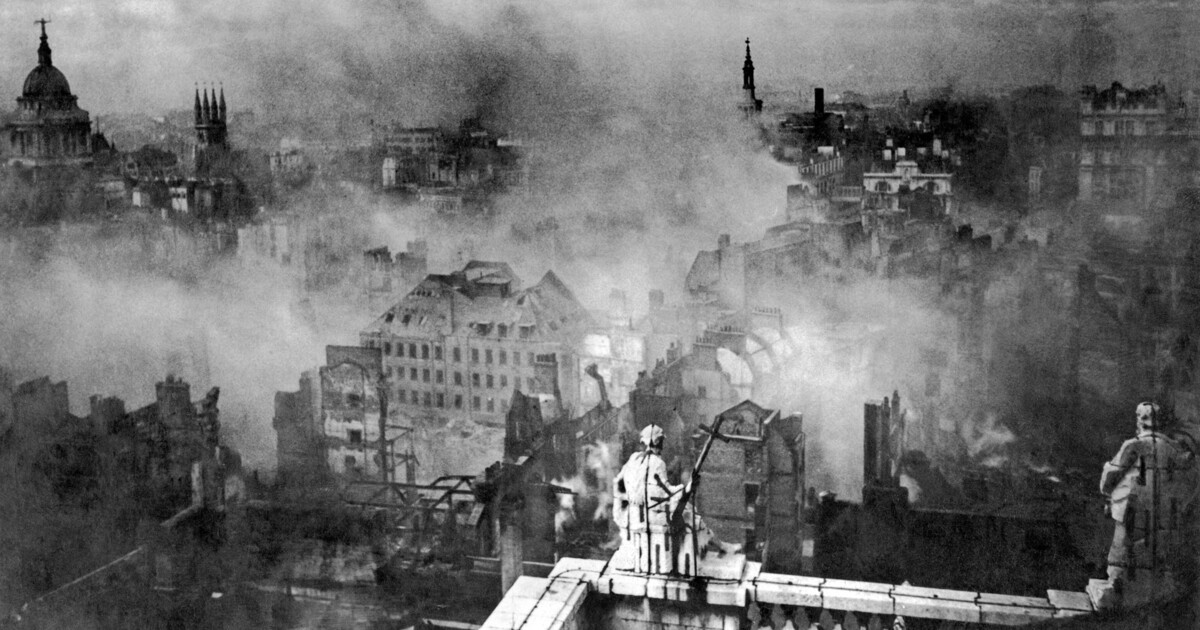
In The Child that Books Built (2002), his memoir of childhood reading, Spufford wrote that the books he loved best were ‘ones that started in this world and took you to another’. Nonesuch muddles the two. The bridges Iris and Lall cross on their race towards Nonesuch – invisible to everyone else – pass through skies filled with Heinkel bombers. It’s exhilarating to read of the ‘unlit reefs of the City’s blocks’ far below, with
floating pink stars falling in the world beyond the bridge, the searchlights pivoting, the blossoms of fire where the HE hit. Only thanks to the warped geometry, the bomb-blossoms appeared above her and directly below, as well as to the sides where the roofline really was; and the pink stars floated along and up as well as down, in an impossible blizzard.
But the gulf between science and magic is neatly reconfigured as a question of terminology when Geoff challenges Raphael’s explanation that time travel ‘requires the building of a bridge through the luminiferous aether’:
‘Oh, come on,’ said Geoff. ‘No one has believed in the luminiferous aether since about, what, 1870! It doesn’t exist!’
‘Ah,’ said the angel. ‘I see that I have used terms you find anachronistic. Would you prefer it if I said that quantum tunnelling was involved? No; that hasn’t been discovered yet, has it. These conversations were much easier when I could simply refer to black magic.’
Nonesuch is an enjoyable adventure story, but for all its peril and conflict, and the trauma in Iris’s past that is withheld until the end of the book, the stakes are never high. Iris is the recipient of extremely good luck throughout. One of the statues that forms the bridge to Nonesuch is attached to her office building, so all she need do is volunteer to be an air-raid warden and she has virtually unlimited access to it. As Iris and Lall’s race to Nonesuch unfolds, Iris learns that one of the statues Lall has used features a wheatsheaf, but she has no idea where it might be. One day after a raid she clambers over a pile of rubble in an alleyway and literally trips over the broken sheaf. Put your characters up a tree and throw rocks at them, the old piece of writing advice goes. Spufford reaches immediately for a ladder.
He also wants everyone to get along, even characters whose enmity is driving the plot. Iris and Lall’s attitude to each other, enjoyably caustic when they first meet, comes close to bonhomie later in the book. After a rooftop fight in which Iris sends Lall over the edge then stops her from falling (she doesn’t want to be a murderer, even with the fate of the world at stake), Iris tracks down the ambulance crew Lall is working with. They trade a few waspish comments but soon they are laughing and confiding in each other, while reiterating that the next time they meet things will be very different. Noticing that Lall is in love with one of the ambulance crew, Iris thinks to herself that Lall would abandon her murderous plot if Harriet would ‘just stick her hand in your knickers’ (unfortunately Harriet doesn’t oblige). Iris has a lot of faith in the distractive powers of orgasm. Terrified after her escape from the malign guardian angel, she wonders how she’ll sleep before reaching under her nightie to ‘give herself the old comfort of her own fingers’. When Geoff becomes an army private she banishes her fears for him with ‘frantic fingerwork in the dark, leaving her sore’.
Despite being a large book, Nonesuch seems overstuffed. Structurally, the requirement that the statues leading to Nonesuch can be activated only during the dark period before a new moon, allied with Iris and Lall’s inability to open the portal successfully, gives the adventure a stop-start rhythm. And there is repetition on the level of the sentence too. Spufford’s first descriptions of the ‘toy-pretty’ streets of Hampstead and the ‘mock-countryside’ of the Heath are nice, but later we get the ‘baby forest of Hampstead’, ‘Hampstead’s toy countryside’ and the Heath’s ‘little patch of imaginary countryside’. When variation is introduced it brings its own problems. At one point the dome of St Paul’s is described as a ‘tethered planet’ rising above the cathedral’s ‘wedding-cake stucco’, only for it to look, a few pages later, ‘like a distant egg in an eggcup’. Might a planet look more like an egg, or a wedding cake an eggcup, from Cannon Street than from Ludgate Hill? Or is Spufford too fond of his similes to jettison one? When Iris investigates the Excelsior Hotel, where the Order used to meet, she finds it
not quite in Russell Square, whatever the address said, but on a side street where London did one of its quick changes, and high-minded Bloomsbury gave way to taxidermists whose windows hadn’t been washed in a decade, obscure organisations behind brass plates worn to unreadability, and surgical-supplies emporia which looked the opposite of hygienic. The feeling here was threadbare rather than austere, crankish rather than intellectual. If the Excelsior had been a person, it would have muttered to itself, and lurched from side to side on the pavement.
Here Spufford shows and then tells, the specificity of the businesses and organisations capably doing the atmospheric heavy lifting and rendering ‘threadbare’ and ‘crankish’ redundant. The personification of the hotel as a disturbed derelict staggering along the pavement (the pavement outside itself?) completes the derailment.
This habit of adding detail beyond what is necessary, or desirable, is a tendency the book itself seems to identify when Iris eventually arrives at Nonesuch, finding herself in a hallway containing a carving so intensively detailed that
your gaze might go tumbling on into it forever … the birds and beasts climbing, carved, up a pillar of dark wood … began to swim, to reveal more and more; the carved fur of the badger revealing closer up, in the expanding whorls of the woodwork, a range of hills with forest on them, and in the forest a tree, and on the tree a branch, and on the branch a cluster of leaves and acorns, and in the shine on the side of one acorn a moiré patterning of light and dark that became a pattern of islands, and on the shore of one island –
Only the interruption of an angel stops the torrent.
Elsewhere the problem is less one of overworking things than of leaving them undercooked. Raphael makes his second surprise appearance when Iris and Geoff are lying in bed and a telltale blue light fills the room. Iris jabs Geoff in the ribs. He wakes, smiling sleepily, then, registering this otherworldly glow containing ‘impossible geometries’, he
rolled away so fast he fell off the far side of the bed with a thud. When he came back up he was draped in the discarded gold coverlet, like a particularly louche Roman emperor. Hail, Dionysus, she might have thought at another time, but here and now she was seeing the ease flee his expression, and tension return. I’d have kept that look off you, she thought.
Taking the time to note what Iris would have been thinking had the situation been completely different is an odd move, increasing the confusion already generated by comparing Geoff to a Roman emperor but having Iris, in this briefly entertained alternate reality, address him by his Greek middle name. And given that surprise and panic caused Geoff’s fall, it’s puzzling to learn of a look of ‘ease’ on his face when he re-emerges, only for it to ‘flee … and tension return’. Somehow a relatively straightforward (though supernatural) moment has become overwhelmed by contradictory, confusing detail.
When Iris walks through Chelsea one morning the neighbourhood is ‘in a prettily grand or grandly pretty mood’. The repetition doesn’t tell us much to begin with, while the choice of conjunction (‘or’ rather than ‘and’) further weakens each part. The sentence is ill-suited to Iris, anyway, who is much too decisive and practical for this sort of empty poetry. Better is the description that follows as she enters ‘Cheyne Walk, Chelsea at its Chelsea-est, where the elegant 18th-century façades, perfect and poised, as carefully stacked as jewel boxes, faced out over the sudden width of the river. She ran her hand covetously along the bonnet of a parked Lagonda and crossed the road to the pavement on the other side.’ The alliteration in the first few clauses suggests a writer amusing himself, but the avaricious, slightly clichéd tone, the jewel box simile, the noting – even stroking – of the luxury car, are all entirely appropriate to this woman who, while fighting time-travelling fanatics, never stops formulating schemes to get rich.
Inspiration on that front comes to Iris when Mr Cornellis despairingly wonders who will care about the stock market if Hitler invades. The trick, she realises, is to turn the thought around:
Yes, if the Nazis came, there was in one sense infinite downside, immeasurable downside, so much downside that losing money would be the last thing you’d worry about. But that meant, in effect, that there was no downside at all, of the conventional kind: no reason for prudence, no reason for caution, if the loss would be absolute … Looked at like that, the entire market was a screaming Buy. The point was not to fix on some individual clever stock choice that would be miraculously exempt from the situation. It was to take advantage of the situation; to make a lopsided bet on the lopsided nature of the times. Any basket of British blue-chip stocks would do, because the market had mispriced them all. It had mispriced them at: shockingly cheap, when their actual value was either zero or (in the long term, with the war won) their usual peacetime price.
The subplot concerning fluctuations of the thirty-share index, and the more dependably upward trend of Iris’s status within Cornellis & Blome (Spufford is alive to the opportunities for women afforded by the war), may be Nonesuch’s most satisfying element. It’s unexpected that the price of Westinghouse, Paramount Pictures and Svenska Handelsbanken stocks should be one of the most interesting parts of a novel that includes angels, invisible bridges and rooftop battles with ‘magical fascist lunatics’, but many of Spufford’s previous books display his ability to act as a thrilling guide to the inner workings of complex systems, from his description of the creation of the Vodafone cellular network in Backroom Boys (2003) to his analysis of the mid-century Soviet economy in Red Plenty (2010). Such control and inspiration come and go over the length of Nonesuch, but its final moments establish an intriguing cliffhanger, finally placing Iris in a situation from which a stroke of luck can’t liberate her. Not, at least, until the arrival of Arcady, the planned sequel.