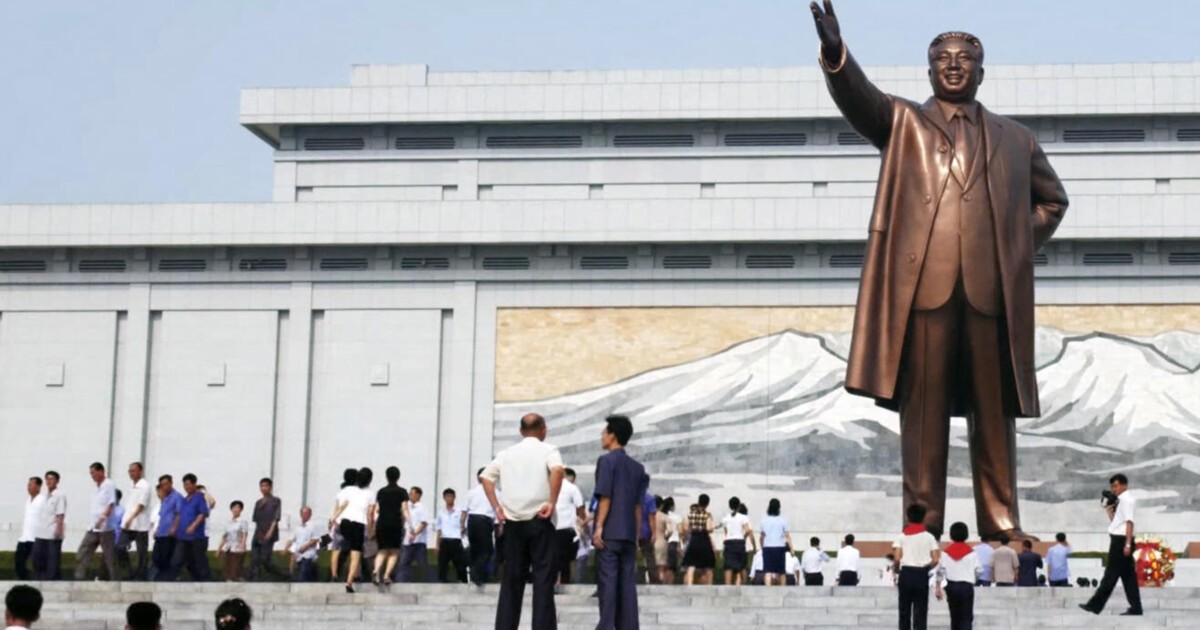
North Korea is an anomaly. Its GDP per capita is at least thirty times smaller than South Korea’s, but it is also an industrialised, predominantly urban society with near total literacy and many more doctors and teachers than the other states below 150th place in global wealth rankings. This seeming contradiction is the product of historical contingencies often at odds with the fantasies projected onto the state from outside. As two new biographies make clear, the man in whose image North Korea was made was formed in very particular circumstances. Over a life corresponding closely to Eric Hobsbawm’s short 20th century, Kim Il-sung faced both the modernity and the chaos of Cold War Asia’s own age of extremes.
He was born Kim Song-ju on 15 April 1912 (the day the Titanic sank), on the outskirts of Pyongyang. Korea had become part of the Empire of Japan two years earlier. Kim’s relatively prosperous Protestant family resisted colonisation: his father’s involvement in the abortive anti-Japanese 1 March Movement in 1919 forced the family to flee north into exile in Manchuria, and until the defeat of Japan in 1945, when he was 33, Kim lived almost entirely outside Korea. The vast expanse on the other side of Mount Paektu was already home to refugees from late 19th-century Korean famines, but after 1919 it became a laboratory of nationalist resistance and ideological experimentation mostly beyond Japanese control.
Kim was propelled by his family’s political and social standing into a fleet-footed, adaptive frontier cosmopolitanism. After dallying with a Korean communist youth club, he joined the Chinese Communist Party in 1931, the year Japan invaded Manchuria; in 1936, he commanded a division of the CCP-backed North-East Anti-Japanese United Army. His guerrilla career was to be luridly exaggerated as part of the mythic prehistory of the DPRK, but he and his men undoubtedly caused significant problems for the Japanese. It was here that he met his first wife, Han Song-hui, and, after her capture, his second, Kim Jong-suk: both were fellow guerrillas.
Despite his possible encounter with a teacher’s copy of Lenin’s Imperialism: The Highest Stage of Capitalism, Kim’s improvised communism was more Mao than Marx. His superficial command of the socialist canon left his nationalism unencumbered. But he relied heavily on Moscow for financial and practical support. In October 1940, a Japanese military surge forced Kim and his comrades to escape Manchuria into the adjacent Soviet Far East (erroneously labelled ‘Siberia’ by Michael Seth in Forever President). Over the next five years, many of the DPRK’s eventual leaders hid out in the Vyatskoye camp on the Amur River. Kim’s eldest son and successor was born there in February 1941, though neither Kim Jong-il’s birthplace nor his Russian childhood name, ‘Yura’ (probably after General Zhukov), would become part of North Korea’s usable past.
Vyatskoye lay beyond the reach of Japanese intelligence, but that didn’t matter much: Kim’s battalion in the Red Army 88th Brigade played no part in the empire’s defeat. As the US bombed Hiroshima and Nagasaki, Soviet liberation forces advanced through Manchuria and into the newly postcolonial Korea. Largely thanks to its proximity, the north of the peninsula, with little arable land but 80 per cent of its mineral wealth, fell into the Soviet ambit. The division of the peninsula into two at the 38th parallel – with Soviet forces controlling the north and the Americans the south – was intended as a purely temporary measure to effect the Japanese surrender. For his part, Kim ended his long exile on a pier at Wonsan on the north-east coast, arriving a month after the Soviets entered Pyongyang.
Despite his status as someone who – in Fyodor Tertitskiy’s no-nonsense phrasing – ‘could not be credited … in any way’ for the liberation of his homeland, Kim found himself one of the few eligible heirs of the Soviet victory in East Asia. Soviet and US fumbling over plans for a unified postwar Korean government at the Moscow Conference in December 1945 led to the creation of a client state in the north with Kim in charge, a counterpart to the new Stalinist ‘people’s democracies’ in Eastern Europe. In a political vacuum and lacking a local communist party for Moscow to act through (Korean leftism was centred in the south, now occupied by the US), Kim’s background seemed to offer the right combination of Koreanness and Sovietness. Personal charisma and sharp political instincts enabled him to form good relations with locally stationed Soviet officials and secure their money. The Workers’ Party of North Korea gave the new polity its leading political organ, but its formation in 1946 had been decreed directly by Stalin, so Kim had to tread carefully. At least until Moscow relaxed its control over Pyongyang in the 1950s and 1960s – after which North Korea became a dumping ground for disgraced officials – senior Soviet military officers and ambassadors had the power to remove him at any time. But he wisely ensured that some of them, including the occupation-era General Terentii Shtykov, became his friends.
According to Tertitskiy, who, along with his mentor, Andrei Lankov, is among the world’s leading authorities on the subject, the DPRK was an unambiguously Soviet product. Instructions to officials, as well as the state’s first constitution, were written in Russian before being translated into Korean, often producing clunky neologisms. The first run of North Korean banknotes was printed in the USSR, and as the prospect of unification faded in the late 1940s, Soviet designers devised a new North Korean flag. The trigrams and yin-yang symbology of the Taegeukgi – the flag of the southern Republic of Korea, briefly used peninsula-wide in the early post-liberation days – were deemed too Chinese: forms embodying Soviet socialist modernity were preferred. Kim was driven in Soviet cars and ate Russian dishes, though he didn’t abandon his taste for gyoza.
To their later regret, the Soviets also initiated Kim’s cult of personality. Korea’s recent past offered serious challenges to any leader’s legitimacy, and Kim’s halting Korean at his first public appearance made his audience wonder whether he was the same Kim Il-sung about whom they had heard wartime legends. Unlike Stalin, whose Russian was always accented, Kim was supposed to represent the ethnonational mainstream, so Soviet scribes set to work replacing his past membership of the CCP with leadership of the invented ‘Korean People’s Revolutionary Army’. Moscow bullied locals in the village of Mangyongdae into claiming that he had been brought up in a cottage there in order to give his peripatetic childhood a sense of rooted authenticity.
Kim’s greatest – and bloodiest – expression of agency was his instigation of the 1950-53 Korean War, which cost three million lives. At various points each side came close to victory – Seoul changed hands four times – but the conflict ended in stalemate, with the armistice brokered by Stalin, Mao and Eisenhower never translating into a formal peace. At desperate moments, Kim had considered resigning from the position of supreme commander; he was rescued by PRC ‘volunteer’ forces who crossed the border into North Korea and stayed until 1958. Reconstruction, too, relied on outside patrons, with a flurry of co-operation across the socialist world; the emerging North Korean elite had embarked on a Eurasian tour asking for aid. Buoyed by this support, Kim emerged from the war with the title ‘leader’, previously reserved for Lenin and Stalin, and a new marshal’s uniform that aped Stalin’s style.
Kim’s apotheosis came just as Moscow was rethinking both cults of personality and geopolitics. In the months after Khrushchev’s secret speech of February 1956 denouncing Stalin, Kim received a dressing-down in Moscow, followed by an extraordinary Sino-Soviet house call from the senior officials Anastas Mikoyan and Peng Dehuai. They forced Kim to walk back his sweeping expulsions of critics from the Workers’ Party central committee and oversaw a vote to reinstate them. But by then it was too late to curb the development of the cult of Kim, and as the Kremlin turned its attention elsewhere, Korea faded from the list of Soviet priorities. Neglect left Kim free to pursue his purification programme; both his own biography and that of the state were purged of the transnationalism to which North Korea owed its existence. Aside from his guerrilla comrades, he had relied since the 1940s on Korean cadres either born or schooled as communists in the USSR or the CCP’s wartime base in Yan’an as well as veterans of the underground struggle against Japan in southern Korea. Kim eliminated each faction in turn; those who survived did so by fleeing overland to China and the Soviet Union.
By the early 1960s, Kim’s coterie of what Seth calls ‘poorly educated, unsophisticated, provincial’ Manchurian partisans reigned supreme. The state adopted a national ethic of guerrilla improvisation as streets, factories, revolutionary songs and mass mobilisation campaigns were named after key episodes and locations from Kim’s biography. He signed friendship treaties with both the USSR and China in July 1961, but let his loyalties oscillate based on circumstance. A tilt towards China as the Sino-Soviet split set in was reversed during the Cultural Revolution, though material imperatives were never far from Kim’s mind, and China was again in favour when assistance was needed to build the Pyongyang metro, completed in 1973. The PRC’s post-Mao reforms motivated a tack back towards Moscow, until Gorbachev, too, attempted to redefine socialism (and stop funding spendthrift clients).
Many significant political roles were given to relatives of Kim, whose paternal lineage was rewritten as a multigenerational saga of independence heroics that was extended into the future when he nominated his son as successor. A parallel familial logic played out across society as Kim tightened his grip on power. Citizens were persecuted for their relatives’ supposed counter-revolutionary deeds, including in a bloody purge, mostly of Chinese and Soviet Koreans, in 1957-59. From 1959, entire families could be condemned to one of many labour camps, euphemistically called kwanliso (‘management facilities’). The revolutionary inmin (‘people’) was fractured into a complex system of hereditary social stratification, from which the Kim family (absent from state records) was naturally exempt. Three categories of citizen – ‘nucleus’, ‘middle’ and (with Soviet inelegance) ‘people of counter-revolutionary components’ – had metastasised into 51 by the 1970s. Kim’s early idea for a party that remained close to the masses was perverted to mean that no one could escape top-down ‘management’: neighbourhood associations kept watch for signs of subversive activity, giving the state’s imprimatur for local tyrants to pursue their personal grievances; from 1967, special permits were required to leave the country. As members of mandatory political organisations (the Children’s Union, the Women’s League, the Union of Agrarian Labourers and, for the privileged, the Workers’ Party itself), all citizens were forced into study sessions based on Kim’s ‘monolithic ideological system’, which asserted that human beings, by which is meant Koreans, were the Promethean ‘masters of all things’.
Kim oversaw a system in which all of history was dragged within the state’s increasingly sealed borders, which were said to encompass the burial site of the mythic Korean ancestor Tangun. Culture and language were to begin and end in North Korea, the origin point of East Asian civilisation. Mass literacy drives included the early removal of the Sino-Korean hanja script in favour of Korean hangul and lingering Sovietisms were replaced by ‘native’ (though still Chinese-derived) vocabulary. Pyongyang’s Mao Zedong Square and Stalin Street were renamed. Every citizen unfortunate enough to be called Kim Il-sung was ordered to adopt a new name. When writing about the sole remaining Kim Il-sung, as North Koreans often had to do, bold type was mandatory. Conversely, some things could not be named: Kim’s third wife, Kim Song-ae, was kept from public view for the first decade of their marriage, while Kim Jong-il’s unveiling to the outside world in 1980 came only after years of oblique hints that identified him not as a person but as an amorphous ‘party centre’.
Despite the feudal strictures imposed on the wider population, Kim travelled extensively. Relentless domestic touring that offered hyŏnji chido or ‘on the spot guidance’ further bound the nation to his person, while his international tours took in the USSR, a kind of substitute West for the party elite, as well as friendly destinations across Eastern Europe, Asia and North Africa. In Indonesia in 1965, President Sukarno gave him some distinctive orchid cuttings which, christened Kimilsungia, are cultivated alongside Kimjongilia (a begonia) in Pyongyang’s botanical gardens to this day. By the 1980s, North Korea had diplomatic relations with around a hundred countries and – despite its faltering economy – distributed aid to a number of sub-Saharan states. Statues and architecture, including the Central African Republic’s parliament building, stand as modernist monuments to North Korean soft power. Che Guevara, Robert Mugabe, Julius Nyerere, the deposed Cambodian monarch King Sihanouk (a personal friend of Kim’s) and a pre-presidential François Mitterrand visited Pyongyang. Leaders in Seoul were engaged in their own global encounters on the other side of the Cold War divide. But since Kim overlapped with the terms of six South Korean presidents before his death in 1994, his range was wider.
Kim avoided flying, and the train carriage in which he travelled remains preserved in his mausoleum below a Korea-centred wall map illustrating his many journeys across Eurasia. Without years of state inculturation, the foreign visitor is poorly prepared for the mausoleum, a thunderous inflation of socialist tomb-building. Unlike the modest sepulchres of Stalin and Mao, Kim’s burial chamber takes up all of the Kumsusan Assembly Hall, his former palace and the model for the parliament building in Bangui. The sense of placelessness I experienced during a 2011 procession through the windowless corridors and cavernous, low-lit halls, accompanied by a drearily slow version of Kim’s signature song, was repeated when I visited again in 2015, by which time Kim Jong-il and his own train carriage had followed their predecessors into the building.
While neither Tertitskiy nor Seth mentions the pharaohs, both reach for comparisons to contextualise Kim and his state, which, with the passing of the Soviet century, became increasingly unintelligible. From purges to great leaps, the elevation of leaderly ‘thought’ and model-emulation campaigns, the DPRK’s Stalinist and Maoist techniques endured. Kim’s was in some ways a modern cult, like those of Hitler, Franco or Hoxha. But Seth also sees strains of heliocentric Japanese emperor-worship. The Chiangs in Taiwan offer a precedent for kinship-based republics beyond socialism, and Mao too might have appointed a descendant-successor had his son Anying not died in the Korean War. North Korea’s hereditary social stratification reminds both authors of Indian caste. But Kim still resists analogy. No comparable classification system has been invented with a full modern surveillance state behind it. Unlike Stalin, Mao or Franco, he created a system that changed little after his death and is upheld by an unprecedented third dynastic generation.
Much was made of Kim’s ‘traditional’ filial piety, but plenty in his biography justifies Tertitskiy’s argument that he was remarkably misogynistic even by the standards of his cultural milieu. He was attended by female recruits known as kippumjo (happy corps), divided into various troupes: manjokjo (satisfaction team), haengbokjo (felicity team) and gamujo (dancing and singing team). In an instance of cultural determinism to which both authors are occasionally prone, Seth attributes these institutionalised harems to Kim’s ‘Chinese belief’ that sex with young women prolongs life.
In his final years, Kim wallowed in primordialism. With the USSR gone, socialist shibboleths like the revolutionary inmin gave way to the Korean minjok (‘nation’). Presiding over a regime with an unambiguously modern capacity for violence, he emphasised the atavism that gave many of the projects of his era their power. From Berlin to Beijing, state socialist high modernism communicated authority through Corinthian columns and mass operas and ballets, but Kim took this cultural classicism further, extending it even into language. His autohagiography, With the Century, is written, as the anthropologist Sonia Ryang notes in her book Language and Truth in North Korea (2021), in a flowery style that is difficult to grasp without understanding literary Korean’s rich Sinitic allusions. In 1992 he composed an ode to his son in classical Chinese: even modern god-kings are shrouded in linguistic veils.
Like the cataclysms which presaged imperial demise in classical China, a severe rainstorm in July 1994 coincided with Kim’s falling ill during a visit to one of his many villas. A rescue helicopter crashed in the storm and no ambulance could reach him along the road, which – like most in the DPRK – was unpaved. The official communiqué announcing his death and a mourning period followed the linguistic pattern set by Stalin’s and Mao’s, expressing collective condolences from the party, the people and the army, as did his son’s seventeen years later. In September last year, Kim Jong-un – travelling as ever by train – visited Beijing for a different kind of memorial. From the rostrum of the Tiananmen Gate, above the portrait of Mao, he observed the massive Victory Day parade marking, among other things, the eightieth anniversary of Korean liberation. Alongside him were Xi and Putin, whom he had lately been helping with the invasion at the other end of Eurasia. The context of the state his grandfather built still stretches far beyond the vistas open to most of its victims.