What does the perfect psychoanalytic consulting room look like? Should it resemble the compact, underground rooms of the London Clinic at the Institute of Psychoanalysis, where the minds of patient and analyst are brought close together and perhaps, at times, exist as one grey matter? Or should more space be added?
A few months ago, I began to think about where I wanted to spend my working days. I needed a room – my own room – in which to grow and settle. I have worked in a windowless NHS storage cupboard, in a portacabin, in the 1960s rectangular consulting rooms of the Tavistock Clinic and in a timber-framed Tudor building where the thin leaded window – the entire fourth wall – absorbed the energy of the busy street below and let it run about the space. Some worked better than others (for me, and therefore the patient) and I wanted something like the room I have been working from for the past few years, which is quiet, close to other practitioners and spacious enough for me to stay there comfortably all day. The room that was eventually suggested to me by a colleague turns out to be in Central London and almost identical to my current one. In fact, it’s in the building next door.
As a psychotherapist, I spend a lot of time sitting across from someone familiar, looking at their face, their movements or, less often, when either of us could do with some space, at a wall behind them and the edge of a plant. Sustained observation can be helpful, but it sometimes gets in the way. There is a couch which allows for the opposite: I can see the top of the patient’s head and part of their horizontal body, but I tend to look at a picture on the wall, my feet or the palms of my hands, on which I occasionally place my head while I listen.
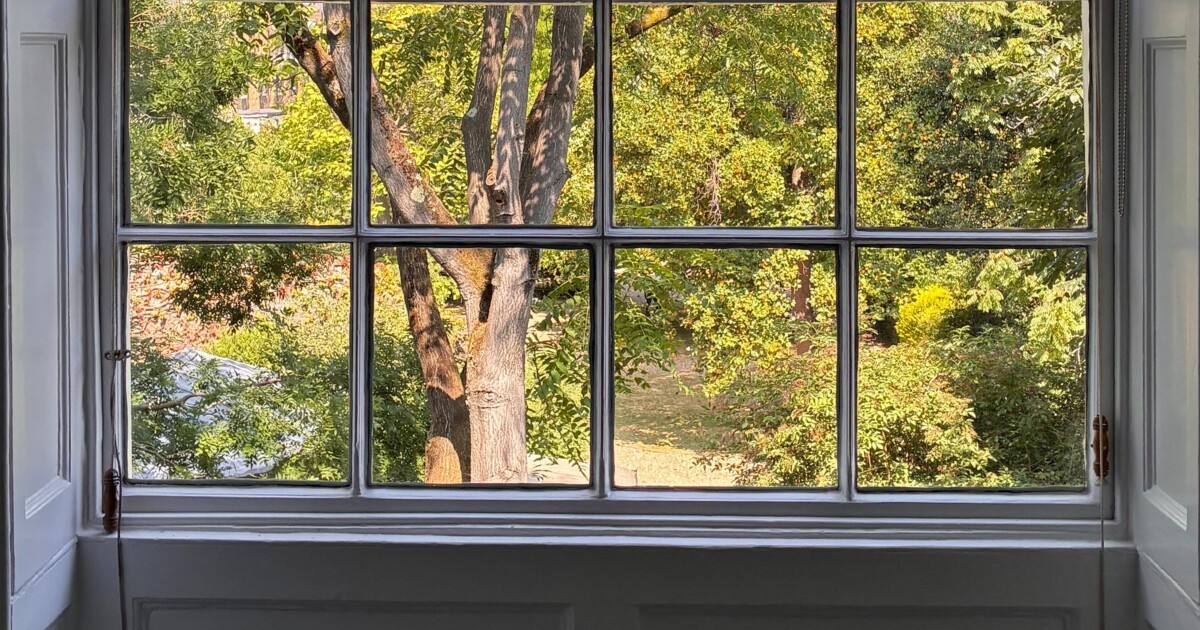
Often I look outside. A window is important because it gives the patient a chance to escape from my close attention, to rest from their thoughts and feelings, or from a mind that has emptied itself. The view outside can encourage new thoughts or emotions, which may help the patient to come back to the room they just needed an exit from. Sometimes people notice changes in the neat shared garden as if it is their own space. They might mention that a new greenhouse has been built and smile at the addition; crows gathering a nest become part of our landscape, as do the growing fox cubs rolling out of the undergrowth.

The window in my new room is large and looks onto the bushy part of a tall tree, with sturdy branches stretching from a smooth trunk. Watching these branches pull in all directions is a bit like looking at a patient. The unconscious roots are there, but what’s exposed above ground, on the outside, by their body, movements, words and the emotion that fills the room – often to the brim – gives an impression of what can’t be seen or put neatly into language. Patients give similar but inevitably imperfect reflections of their complex underground world, which are almost always pertinent and often moving. And I respond with my imperfect reflections and sometimes pertinent comments. And so it rolls on.
If the psychoanalytic encounter is a meeting of two internal worlds, why does the material world matter? Do patients care if a chair is a few inches off? (Some do; others don’t tell me they do but may nevertheless.) Why do I care that there’s a window and enough space to wander in a small circle between sessions if my legs are tired of sitting? Why do I prefer a room that is high above ground and not too messy? The formal psychoanalytic word for a consulting room is a ‘setting’ and it is one part of what is referred to as ‘the frame’: a boundary of time, space and attention that holds the patient’s internal world steady enough to bear examination. Or, to use the psychoanalyst Wilfred Bion’s expression, to provide a form of emotional ‘containment’.
My room allows us both to see the edges of our inner boundaries. They will be different, but sometimes they meet and perhaps align during a session, which may be helpful, or may not, if I start thinking and feeling so much like the patient that there is no separation between us, and no space to think. Transference can be useful, but only when it’s noticed and acknowledged at the right time and in an appropriate way. The setting (the fee, the time, the space, the analyst’s attitude and boundaries) allows us to spot the way in which patients push against these presented borders or, indeed, if they wouldn’t dream of getting anywhere close. I’ve never had a patient who walks around the room, but I wonder whether the main reason most people sit rooted in the chair or lie responsibly on the couch is that they imagine something terrible might happen in their internal world and in mine if they chose to get up and look at what is behind them, or walk towards a picture on the opposite wall that has been puzzling them for months or years.
My professional presence in the room (or the rectangular computer frame of an online session) is there to provide a structure in which to help people examine what they find most disturbing. It is part of my job to notice the less obvious frustration, or fury even, that presents itself within this environment. When I worked for the NHS, some patients were too unwell for psychoanalytic therapy to make an impact; the frame was pushed, pulled and bent so hard that it was often difficult to see the parts that stood steady within the patient and were improving. But in my private practice the more complicated aspects of a person’s unconscious can be observed when someone regularly arrives eight minutes after the session starts, or always calls the session to an end instead of me, or if someone keeps me at arm’s length with unwavering submission or politeness. Any obviously oppositional word, or its equivalent assertive stride across the room, may feel to the patient like the start of war. So instead of getting up to relieve their curiosity (an act which would also allow them to see my response), we sit, both sharing what we know: that we are bound by the setting. Our session is determined by the four walls and the framed view and the noises that enter, by the silent waiting room downstairs and the banging of the front door as it shuts behind the patients and analysts who enter and depart. We are contained and perhaps quite happy to be constrained by it. We are also both aware that we are following a visual structure worked out more than a hundred years ago by Freud, and that he used it because it worked for him.
Freud’s final consulting room was a large but not huge room in a solid Hampstead house. It was a personal space that looked to the past, with ancient and classical statues, and antique rugs on the floor and draped on the furnishings. It was a bohemian style brought from his home in Vienna, the city he had abandoned to escape the Nazis. But it was also very much his style, and his collection of two thousand statues presumably offered comfort and confidence to a mind that must have felt the reasonable confusion that arises when a person lies down and says: ‘Help me change.’
Visitors wander around his room in Hampstead now, as I have once or twice, and experience whatever his choices make them think and feel. I felt rather cut off by it, not relaxed, and a bit sad. But that is not the point. I imagine that what he did with his room was to make an environment that helped him to feel comfortable enough to be accessible to others. I also imagine that his decorations made his analysands, in turn, feel comfortable (or at least impressed), since Freud’s choice of therapy room remains the archetype from which therapists veer away or which they decide to keep. Though most have fewer statues.
Freud made no secret of the fact that his couch was introduced because he couldn’t ‘put up with being stared at by other people for eight hours a day (or more)’. In ‘On Beginning the Treatment’ (1913), he wrote: ‘I hold to the plan of getting the patient to lie on a sofa while I sit behind him out of his sight. This arrangement has a historical basis; it is the remnant of the hypnotic method out of which psychoanalysis was evolved.’ And so, 113 years later, patients and analysts continue this now antique method. Perhaps it gives them a sensation similar to the one Freud felt when he looked at his crowds of classical statues, or his patients: something solid and there, but mysterious and meaningful.
While Freud would ‘insist on’ patients lying down because he felt his expressions distracted them and the couch would give further clarity and strength to the transference, many modern analysts are not so prescriptive. I allow patients to choose. Some are keen, and some feel as though they should be keen, while for others it’s an easy ‘no’. When they are sitting in the chair, the vacant couch is present, taking up a lot of space. One person may say it looks too uncomfortable; another might imagine a sexual encounter and explain it’s important to keep their eyes on me, and someone else might be clear they don’t want to look at me but the couch is ‘a cliché’ or ‘in the wrong place’, so they will continue doing what they don’t want to do. These responses, when talked about, can be as important as whether someone sits or lies down. But when patients decide to lie, they can find it adds something quite dramatic to the experience of therapy, taking them back to more infantile feelings of being less able than someone else (sometimes ‘incapacitated’ describes it better). The place we usually occupy on the spectrum between vulnerability and security is removed. People rarely feel somewhere in the middle any more. They usually find themselves either free or in chains. And some people decide they want to sit down again, having felt overwhelmed by my out-of-sight presence, or overly floaty and relaxed, or missing what has been lost when two people’s eyes meet.
Marion Milner said that the frame creates a ‘special kind of reality’, and from my position opposite or behind a patient I’m aware that what happens between the first and fiftieth minute of a session is entirely different from the fifty minutes with any other patient I’ve seen that day and is nothing like my world outside the room. It’s a reality entirely of our own making, and the separateness from outside is partly what draws both patient and practitioner into the room and why it is guarded so closely.
When I tried to build a mental picture of my new therapy room, old spaces sprang to mind: rooms I have felt comfortable in, rooms I have admired or whose owner I admired, and rooms in which I have received my own therapy. I suppose I wanted to feel all these things in this new space. Not a professional thought, since it involves too much of me, but, I suppose, a human one, and a surprising one, because as a patient I thought that the therapy room barely mattered. The NHS storage cupboard/room that I used when I saw my first patient fifteen years ago would have been only a slight distraction for me had I entered it as a patient. The piles of plastic chairs, an old computer and a few odd storage units would have presented themselves to me, then retreated. The person in the room mattered, and if that person moved to a more homely, spacious room – which both my therapists did at some point during the time I was with them – then I was slightly pleased to be more comfortable, but still aware that the room I was most interested in was the other person’s mind.