| |

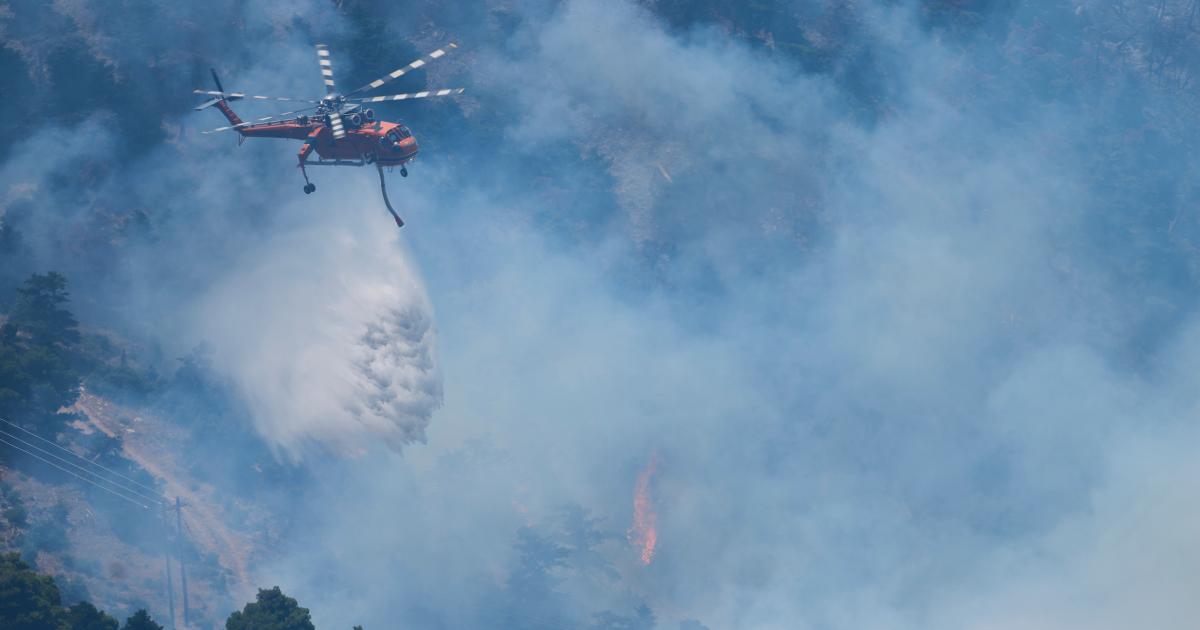
A firefighting helicopter drops water over a wildfire on Mount Kithairon near Porto Germeno, northwest of Athens, Greece during August 2026. Image: Petros Giannakouris / AP Photo / PA Wire.
'Blaring...from every direction'. Europe’s extreme fires will only worsen unless we act with force.
This summer has made it clear - we are reaping what we have sown.
Apocalyptic scenes have once again hit the news - this time from France and Spain.
Fires which started in July reached unfathomable heights this summer, in what Emmanuel Macron, the president of France, is calling the “most severe situation” for the country since World War II.
We are in the midst of a war, not against our suffering planet, but with ourselves.
Breach
Our addiction to burning fossil fuels and exploiting the Earth for every last resource has driven the death of countless people and the destruction of countless animals and precious ecosystems.
The Earth’s climate is more out of balance than it has ever been, as 2015-2025 were the hottest 11 years on record, according to the World Meteorological Organization’s State of the Global Climate 2025 report.
Our ongoing carbon emissions are the indisputable root cause. The UN Environment Programme’s Emissions Gap Report 2025 found that nations are woefully off course to limit global heating to the Paris Agreement target of 1.5°C.
Nationally Determined Contributions are on track for 2.2°C–2.5°C, but current policies are projected for 2.8°C. The recent withdrawal of the United States, the world’s second-largest emitter, puts us even further behind.
We are already perilously close to exceeding the 1.5°C limit. 2024 was the hottest year on record, reaching 1.55°C, the first calendar year to breach this target. While monthly or annual averages over this limit do not mean we have failed, we are rapidly approaching it.
Devastating
More than 91 per cent of the excess heat from our emissions has been absorbed by the ocean, undermining its climate regulation capacity and pushing critical tipping points to the brink.
Glaciers and the Antarctic ice sheets and Arctic sea ice are melting quickly, reaching extreme lows in recent years.
Several globally significant impacts are resulting, such as the Super El Niño, which is causing wildly damaging events in multiple locations across our planet.
At the same time, it is now clear that Atlantic Meridional Overturning Circulation (AMOC), which does much to govern oceanic heat circulation, has been slowing.
This summer has made it clear - we are reaping what we have sown.
Were it to shut off altogether, it would have devastating consequences for our global climate, a scenario some experts are saying is becoming increasingly possible.
Fire-clouds
This summer has made it clear - we are reaping what we have sown.
Heatwaves across the globe have been rapidly escalating, with June being Western Europe’s hottest on record, driven by the highest sea surface temperatures on record for the month.
A total of 10,000 excess heat-related deaths were recorded in Europe during the June heatwave, of whom over 9,000 were aged 65 and over.
The resulting dryness and exacerbation of drought conditions laid the fuel for the fires in Spain and France.
Across the region, these dangerous and unpredictable fires have been ravaging the land, spreading rapidly and generating unprecedented conditions, including pyrocumulonimbus clouds, or “fire clouds,” which create their own wind and lightning.
Force
The human toll is severe. As many as 375,000 people across Spain and France were forced to evacuate their homes. There are predictions that these fires will burn until early November.
The impacts - destroyed homes, scorched land, ruined local economies, devastated agricultural production and skies filled with hazardous smoke - will continue long after the last flame is put out.
Nowhere is our tomorrow written more clearly than in the climate politics of today. Words from world leaders are not an action plan. This is what force actually looks like:
- End fossil fuel subsidies on a near-term fixed timetable. Governments must publish binding phase-out schedules for fossil fuel subsidies, starting with the most carbon-intensive first, and close the loophole that allows “transition” gas projects to qualify as green investment.
- Stop permitting new fossil fuel infrastructure. No new licences for oil, gas, or coal exploration - full stop. Every new field approved today is a promise broken tomorrow.
- Massively upscale renewable energy production. Upgrade local, national and international energy transmission systems while also facilitating renewable micro-production for individual households to gain far greater energy independence.
- Fund adaptation and resilience at the scale of the risk, not the politics. This means dedicated, ring-fenced climate finance for disaster risk reduction, early warning systems, and support for the elderly and vulnerable during heatwaves - not discretionary spending that gets cut in the first austerity round.
- Protect and restore ecosystems as frontline infrastructure. Wetlands, forests, and healthy soils reduce fire and flood risk simultaneously. Nature restoration should be funded and legislated as critical infrastructure, not treated as “nice-to-have” alongside roads and grids. And above all, protect and restore our ocean - the blue beating heart of our planet.
- Remove polluting industries from climate negotiating rooms. Fossil fuel lobbyists should not be shaping the policies meant to phase them out. Conflict-of-interest rules for climate negotiations are long overdue.
Industry cannot wait for governments to force its hand. They must:
- Publish credible, science-based transition plans with interim targets - not just 2050 net-zero pledges, but verifiable and independently audited 2027 and 2030 milestones and work hard, not for net-zero, but real-zero.
- Cut emissions across the full supply chain, not just direct operations. For sectors like fashion, food, and shipping, that means tackling Scope 3, or indirect emissions where the bulk of the footprint actually sits.
- Stop financing fossil fuel expansion. Banks and insurers must end underwriting for new oil and gas projects and redirect capital to renewables, grid upgrades, and nature-based solutions. The returns are already competitive: 91% of renewable energy is cheaper than fossil fuel energy.
- Build climate risk into core business planning, from supply chain resilience to workforce safety during extreme heat, rather than treating it as a sustainability-team side project.
- Back - not block - ambitious regulation. Businesses serious about the transition should be lobbying for stronger climate policy, not quietly funding trade associations that fight it.
- Invest now for the future: invest in renewable energy, its production, distribution, efficiency and storage.
Scale
The pathway we find ourselves on is an unmitigated disaster: it will lead to violence, starvation, overwhelming forced migration, war and death. Current action is too slow and entirely unfit for the urgency of the moment.
But a better future is within reach - it is not too late - and the economics increasingly make the case for us: Chinese CO2 emissions have been flatlining or falling for almost two years, driven by growing investment in renewables.
This is not a story about sacrifice. Protecting our ecosystems and phasing out fossil fuels is how we protect livelihoods and build strong, resilient economies, not how we trade them away. Effective action on climate is not a “cost” it would be the greatest cost saving in human history.
The global heating driving the devastating fires and drought across Europe will get far, far worse unless we act with the necessary force.
“The climate alarm is blaring, from every direction,” said the UN climate chief, Simon Stiell. We must now demand our leaders - and the businesses that fund and lobby them - act with the force, speed and scale needed.
This Author
Steve Trent is the chief executive and founder of the Environmental Justice Foundation.


