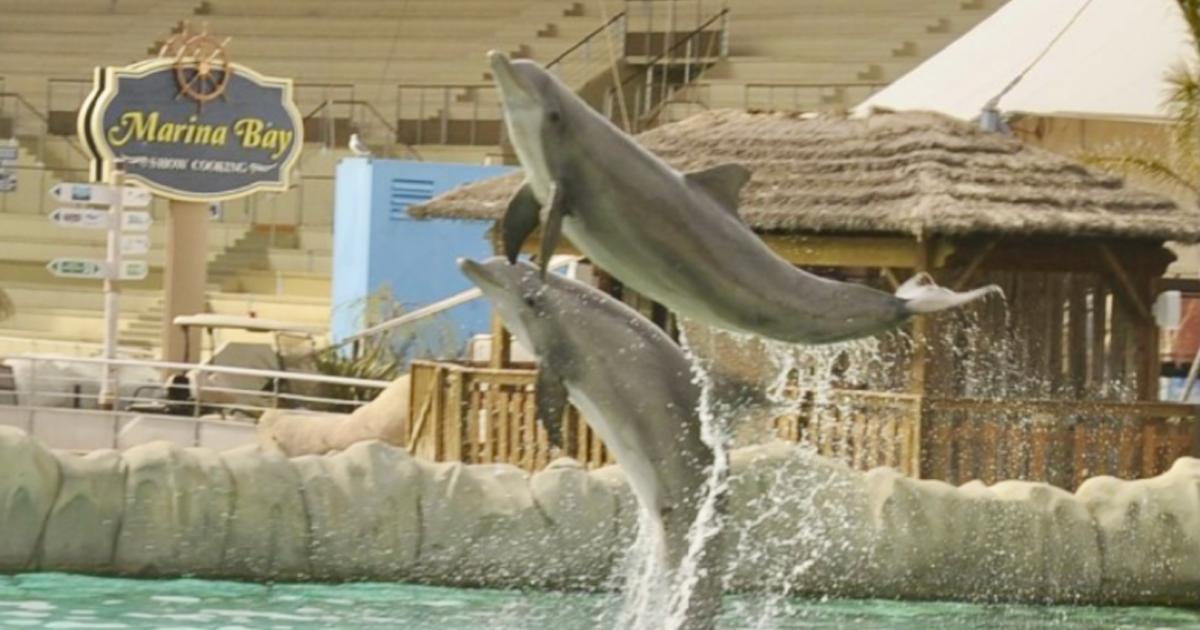
Eight dolphins have finally left Marineland Antibes, the marine park in southern France that closed in January 2025.
Four dolphins remain, along with Wikie and Keijo, the last captive-born orcas in France. Their prolonged limbo has become a case study in the consequences of ending captivity without funding an exit for the animals inside the system.
In the early hours of 23 July, the bottlenose dolphins Dam, Rocky, Lua, Neo, Tux, Kai, Anya and Joe were removed from Marineland Antibes.
Rejected
They travelled by road to Nice airport and then by cargo plane to Málaga, where they were placed in pools at Selwo Marina in Spain.
After eighteen months inside a closed park with deteriorating infrastructure, their departure is progress. However, Selwo Marina is still another operating dolphinarium, owned by Parques Reunidos, the company that also owns Marineland.
The move is intended to be temporary, with the goal to move the dolphins to a new facility being developed at ZooParc de Beauval, though no firm date has been announced.
Back at Antibes, the remaining four dolphins await a proposed transfer to Oceanogràfic in Valencia. France has also approved the proposal to send Wikie and Keijo to Loro Parque in Tenerife, but the transfer still requires the consent of the Spanish government.
The French legislation ending cetacean shows was passed in 2021. Marineland closed on 5 January 2025. In the years between, relocation proposals were discussed, rejected, revived and rejected again.
Sanctuary
The delay was not caused by government inaction alone. Animal-protection organisations also opposed proposed transfers to other captive facilities.
In January 2024, One Voice obtained a temporary court order preventing the removal of the Marineland orcas while an independent expert assessment of their health and living conditions was conducted.
Other organisations subsequently resisted transfers to operating dolphinariums and continued to press for sanctuary alternatives.
Those interventions arose from a legitimate concern: that animals removed from an industry France had chosen to end would simply be returned to commercial display elsewhere.
But while governments, owners and campaign groups disputed the ethically preferable destination, no operational sanctuary was available to receive the animals. The longer the dispute continued, the longer they remained inside a deteriorating facility.
Abolition
In October 2023, Wikie’s twelve-year-old son, Moana, died at Marineland Antibes from bacterial septicaemia. Five months later, her brother Inouk died after ingesting a piece of metal.
Contaminants inside cetaceans’ tanks can easily become fatal, yet construction has continued around Wikie and Keijo in those same tanks already marked by their family’s illness and death.
In May 2026 Mathieu Lefèvre, France’s minister delegate responsible for ecological transition, said that an expert report had found Marineland’s pools to be unstable and that no proposed sanctuary could receive the animals within the necessary timeframe.
In the event of a basin rupture, he warned, euthanasia might be the only remaining response.
Marketa Schusterova of the cetacean advocacy organisation TideBreakers argues that immediate welfare and the long-term abolition of captivity must be treated as separate obligations.
Deterioration
“The priority now is the immediate welfare of these animals and the risk to their lives,” she said.
“We want captivity and breeding to end. But the animals already alive should have the chance to survive long enough to reach a sanctuary when one becomes available.”
Wikie and Keijo were both born at Marineland and have spent their lives dependent upon human care. They would require continuing feeding, veterinary treatment and protection in any future environment, including a sanctuary. Unsupported release into the ocean is not a viable option.
Loro Parque says that it is able to care for Wikie and Keijo. Given the deterioration reported at Antibes, transfer to the park may now be the least harmful available action and the quickest route away from immediate danger. That does not amount to an endorsement of the receiving institution.
Breeding
Loro Parque is not a sanctuary, but a tourist attraction where orcas are on public display. It also continues to breed them. Morgan, an adult female orca held there, has in recent years given birth to two calves. Her first, Ula, died in 2021 at the age of two. Her second, Teno, was born in March 2025.
Wikie and Keijo would therefore be moved from one entertainment facility that has closed in the shadow of the French ban to another operating beyond its reach.
Thus, any transfer agreement should include binding protections: Wikie and Keijo should remain together; neither should be bred; they should not be sold or transferred onwards without independent scrutiny; their welfare should be monitored transparently; and the possibility of eventual retirement to a credible sanctuary should remain.
Further breeding of captive orcas and dolphins must end. But ending breeding does not discharge the responsibility owed to the animals already alive.
Captivity
Any government closing a captive-animal industry must know, before the gates shut, what will happen to every animal inside it and primary financial responsibility should remain with the companies that bred, displayed and profited from them.
Operators should be required to establish ring-fenced lifetime-care funds before closure, protected against insolvency or changes of ownership and subject to independent welfare oversight.
Public funding may still be necessary in an emergency, but the cost should not simply pass to governments and charities once commercial revenue disappears. There must also be investment in credible sanctuary capacity, transitional facilities, transport and veterinary care.
A law that brings down the curtain on captivity cannot leave the animals behind it waiting for a future that has not yet been built.
This Author
Dr Rebecca Gaston is a UK-based writer and animal-welfare advocate working with international NGOs on marine-freedom campaigns.