A pebble road leads to the garden, which also has a large house on the mountainside in the forest. The house, surrounded by the forest from all three sides, is made primarily of red brick and timber.
Meshe eco-village, or to put it precisely, eco-community, was set up by Murad in Dashtatuk village, Lankaran.
Things started when Murad Ibrahimov, 38, who was running the popular ETUD Cafe&Bar music venue in Baku, decided to relocate to a village that is part of the city of Lankaran, where he is also originally from. He is Talish, a member of one of the ethnic minority groups in Azerbaijan.
Self-sustainable
His relocation happened because of his desire to connect with nature, create healthy living habits and establish an eco-community in 2019. Previously, he lived in various countries and cities, but a lack of connection with soil and nature remained a problem.
He sought a place where he wouldn't have to start from scratch with difficulty, but one that offered connection, acquaintances, and familiarity.
While more people in the country are moving to the capital city, given socio-economic factors, Murad’s story is the reverse of this common tendency.
Also, globally, rapid urbanisation is growing. Still, given climate and environmental concerns, it creates a drive for young people to seek ways to reconnect with the land in a nature-friendly way.
What makes Meshe eco-village unique is its adherence to sustainability values and the intention to build a community that fosters these values. The purpose is to create a community or small village of five to ten families that will work and live together to make the area economically self-sustainable.
Together
There is no sustainability term in the livelihoods of local villagers. This way of living is naturally given to them based on centuries-old traditions.
However, the application of innovative energy and water-saving technologies, along with building awareness around environmental sustainability, is underway to make life in the eco-village more nature-friendly.
Meshe, which means forest in the Azerbaijani language, would not be possible without the support of friends, members, volunteers, and local villagers. Currently, Meshe is sustained through the hard work of several permanent or long-term-staying community members and seasonal volunteers.
These community members are individuals who plan to settle in the area in the future.
"We sleep under one roof, with two people in each room. And at the same time, we work together. No one acts individually. We give people a lot of experience, which they cannot gain anywhere else.
Permaculture
"In return, we also gain experience from them, which we can examine and learn about if we come together as a community."
Volunteers have a range of backgrounds, including biologists, creative groups, and many others. “Over the past 4 years, we have accepted over 200 volunteers and gained more than 10 community members who have joined us for six months, one year, or more.”
Humay Sadiqova is a biologist by background but had never practiced biology as a professional pursuit. She began her involvement with Meshe as a volunteer in 2021. After several years of on-and-off volunteering, she recently joined the Meshe community as a field biologist.
Humay told The Ecologist: “We cope with farming setbacks, such as fungi and pests. As the country's only eco-village, we face pressure, which has led us to adopt natural cultivation and holistic living.
"For instance, we use Urtica, chili pepper, garlic and other means to treat plant diseases and control pests. Permaculture stands at the heart of our farming.”
Organic
To understand scale and impact, she also studies locally existing chemical-intensive and degradative farming practices.
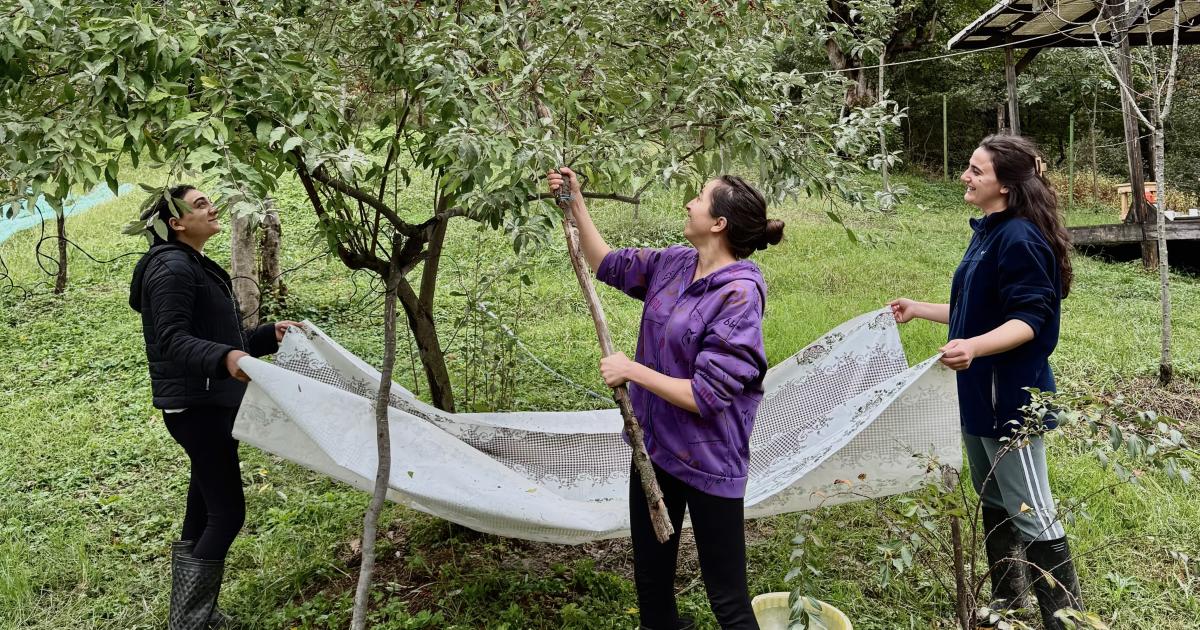
The work in Meshe involves building and renovating a house (houses going forward), an animal barn, working on the land – planting and harvesting, and cooking. Meanwhile, Meshe also offers a space for artists and creative minds for reflection and creation.
The Meshe's vegetables are cultivated for both self-consumption and retail. They apply organic farming techniques in the whole production chain. Exploring local seeds, applying water-saving technologies, creating their natural pest control, and composting organic waste are a few examples.
Meanwhile, Murad notes that finding an expert in organic farming practices within the country is challenging; therefore, “eco-villages outside the country prove valuable sources in this context.”
There is no work without a set of challenges. Physical accessibility to Meshe was the main challenge when they started five years ago. Therefore, after having some foundation in the eco-village, they built the main road from pebbles in 2024.
Opportunities
This eased accessibility during rainy periods, as previously, they could only get there in dry seasons, mostly by hiking about 2 km. Now, via off-highway vehicles, a new road is accessible in all seasons to the community and villagers to get to Meshe and nearby forests.
Murad said: "We want to remain inclusive, so that people with physical limitations, children, and the elderly can come."
Another challenge that needs to be overcome in the village is access to electricity. Power-cuts are a common occurrence that often disrupts the work in the area.
While solar panels are desired, high installation costs make them almost impossible to obtain. As a temporary solution to power-cuts, they would like to get an electric generator, but limited financial gains hinder them from obtaining it for now.
There are government support programmes that offer subsidies; however, the chances of qualifying are pretty limited for them. With all the challenges and opportunities, Meshe eco-village strives to set a precedent for sustainable living and achieve economic self-sufficiency.
This Author
Incha Aliyeva leads the Beeco initiative, which focuses on climate change and environmental awareness. She holds degrees in Azerbaijani Language and Literature from Baku State University, including a master’s in the Theory and History of Literary Criticism. She further expanded her education by studying an MA in International Relations from the University of Wroclaw and the University of Leipzig. She possesses extensive experience in sustainability, development and education.