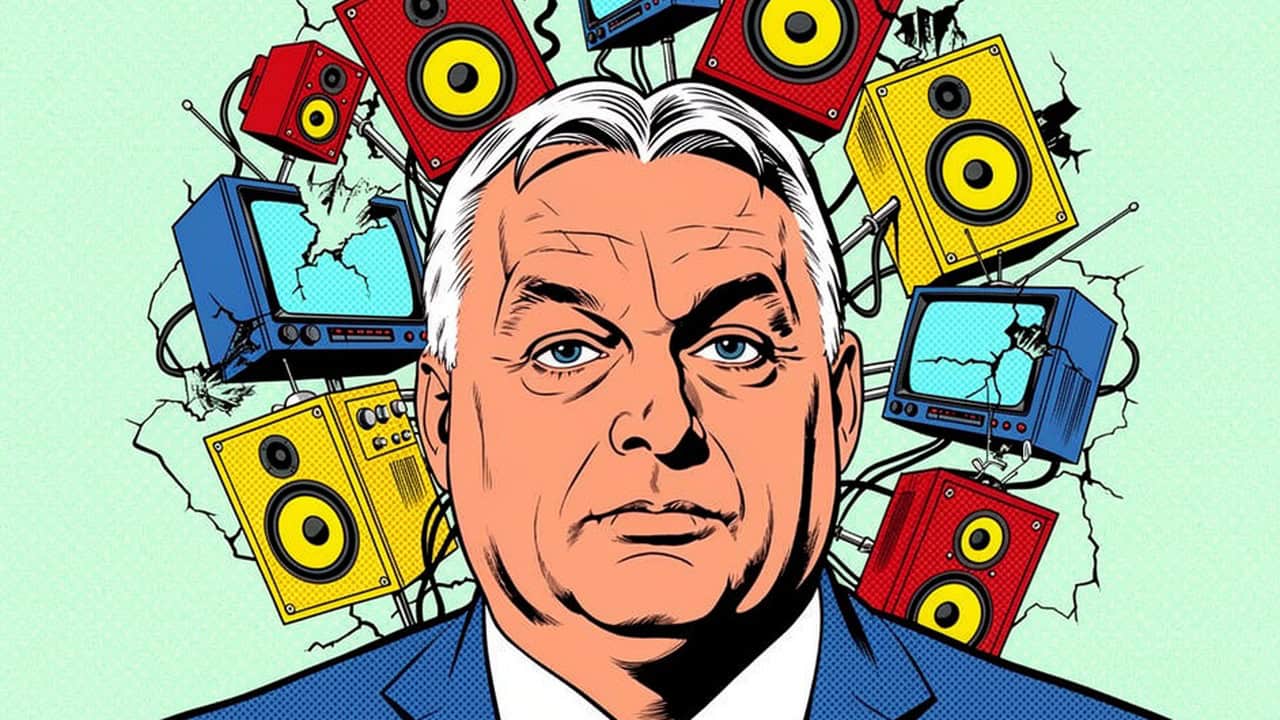
- Informational autocracy failed from within: Fidesz’s tightly controlled media system left its own leadership unable to recognise TISZA’s appeal or to adjust course.
- Fear lost its grip: The share of Hungarians perceiving a threat of war fell from 46 per cent in 2025 to 29 per cent in 2026, and 62 per cent rejected the claim that Ukraine and the West were dragging Hungary into conflict.
- Pre-bunking blunted the smears: Magyar warned supporters that attacks were coming, so voters read them as expected claims rather than revelations.
- Everyday experience beat geopolitics: TISZA centred its campaign on prices, public services, and corruption, where the government’s framing could not override what voters lived.
- Lessons for Italy and the United States: Challengers should break the information monopoly, meet voters on their own experience, and exploit the gap between the regime’s narrative and reality.
For 16 years, Viktor Orbán was a dominant force in Hungarian politics. His Fidesz party won four consecutive parliamentary elections, reshaping Hungary’s political institutions and building a media system that gave the government an enormous advantage over its opponents. By 2026, this system extended across Hungary’s media landscape, encompassing a disciplined messaging operation and the resources of prolonged incumbency.
And yet, in this year’s election, Peter Magyar and his TISZA party emerged as the victors, winning a two-thirds majority and a mandate to dismantle much of the political architecture Orbán had built.
The result was striking. For years, Fidesz’s political machinery had appeared capable of neutralising every serious challenge to its rule. Yet in 2026, it lost while still operating at full capacity. This paradox matters beyond Hungary.
Orbán had constructed what can be called an informational autocracy: a system in which political power is sustained not through repression, but by shaping how citizens receive and interpret information. Fidesz achieved this by concentrating Hungary’s media landscape in the hands of government-aligned owners and allies. It became the default interpreter of events, persuading voters that the government was competent, protective, and, above all, irreplaceable.
For almost two decades, the system worked. Economic stagnation, corruption, and declining public services may have contributed to Fidesz’s defeat, but these problems were nothing new. In 2014, 2018, and 2022, the government proved adept at shifting responsibility onto Brussels, George Soros, migrants, and the Ukrainian president, Volodymyr Zelensky.
What changed was the context in which those explanations were received. Political inevitability, one of Orbán’s greatest assets, came under challenge when Magyar, a former Fidesz insider who broke with the government in 2024, managed to appeal both to disillusioned Fidesz voters and to long-standing opponents of Orbán.
By June 2025, a Medián survey found that Hungarians regarded Magyar as a more competent potential prime minister than Orbán. More respondents also expected TISZA to win. The government’s messages no longer functioned as uncontested descriptions of reality.
When repetition stops persuading
Fidesz responded with a strategy that had served it well before, framing the election as a choice between "war" and "peace". It portrayed Orbán as the guarantor of Hungary’s security and Magyar as a puppet of Brussels and Ukraine who would drag the country into war.
But repetition no longer produced persuasion. The share of Hungarians who perceived a threat of war fell from 46 per cent in 2025 to 29 per cent in 2026. Political Capital’s own polling found that 62 per cent rejected the claim that Ukraine and Western actors were trying to draw Hungary into war. The message still mobilised loyal Fidesz voters, but it increasingly failed to persuade anyone else.
TISZA, meanwhile, campaigned on living standards, corruption, public services, and "regime change", anchoring the election in voters’ everyday experience rather than in Orbán’s preferred geopolitical framing.
Progressive Thinking on the Big Issues of Our Time
Read by policymakers, academics and journalists in 100+ countries.
TISZA also challenged Fidesz’s messaging before it appeared. Magyar repeatedly warned supporters that smear campaigns were coming, sometimes drawing on insider information and leaks. This was "pre-bunking": alerting audiences to a misleading narrative or manipulation tactic before it surfaces. When the attacks came, voters interpreted them not as revelations but as claims they had already been expecting.
Investigative journalists and experts likewise warned of Russian influence operations targeting TISZA. Fidesz’s long-standing pro-Russian and anti-Ukrainian messaging became a liability. Revelations about contacts and leaked conversations involving Hungarian and Russian officials allowed TISZA to recast Fidesz’s "pro-peace" position as evidence of dependence.
In doing so, Magyar turned one of Orbán’s central political claims, sovereignty, against him. The question increasingly became whether Orbán himself had endangered it.
Perhaps the most revealing failure, however, occurred inside Fidesz’s own information system. Since 2010, Fidesz had told Hungarians that Orbán was uniquely competent, the opposition inherently weak, and an incumbent victory inevitable. By 2026, much of the governing camp had internalised those assumptions. Its dominance reinforced the belief that another victory was assured.
The propaganda machine had blurred the very information needed to understand the public. Fidesz remained effective at reinforcing its core vote, but the same system made it harder for the leadership to recognise TISZA’s appeal and adjust its strategy.
Lessons for democratic challengers
That offers lessons for democratic challengers elsewhere, including in Italy and the United States, where populist incumbents sympathetic to Orbán are seeking to reshape institutions and concentrate executive power.
First, breaking an information monopoly may be more important than defeating individual propaganda narratives. TISZA did not need to rebut every Fidesz claim; it needed to establish a credible alternative account of Hungary and, crucially, to demonstrate that another government was possible.
Second, challengers need to meet voters where their experience is strongest. Fidesz could dominate the geopolitical conversation, but it could not easily override voters’ experience of prices, public services, and corruption. TISZA made those experiences the centre of its campaign.
Finally, information asymmetry can backfire. Governments that spend years constructing tightly controlled information environments may become dependent on the information those environments produce. Democratic challengers can exploit the gap between the regime’s narrative and voters’ reality.
Propaganda does not have to stop reaching people to lose its power. It becomes vulnerable when citizens have a credible alternative through which to interpret their experiences, when official narratives diverge from everyday life, and when those producing political messages can no longer distinguish between persuading the public and understanding it. Fidesz lost all three advantages in 2026. Its most consequential failure may have been the last: it had become better at telling Hungarians what to believe than at finding out what they actually believed.
This article is based on a paper published by the Political Capital Institute in the framework of the Hungarian Digital Media Observatory project. Other contributors included Csaba Molnár, Bulcsú Hunyadi, and Adél Tilistyák.