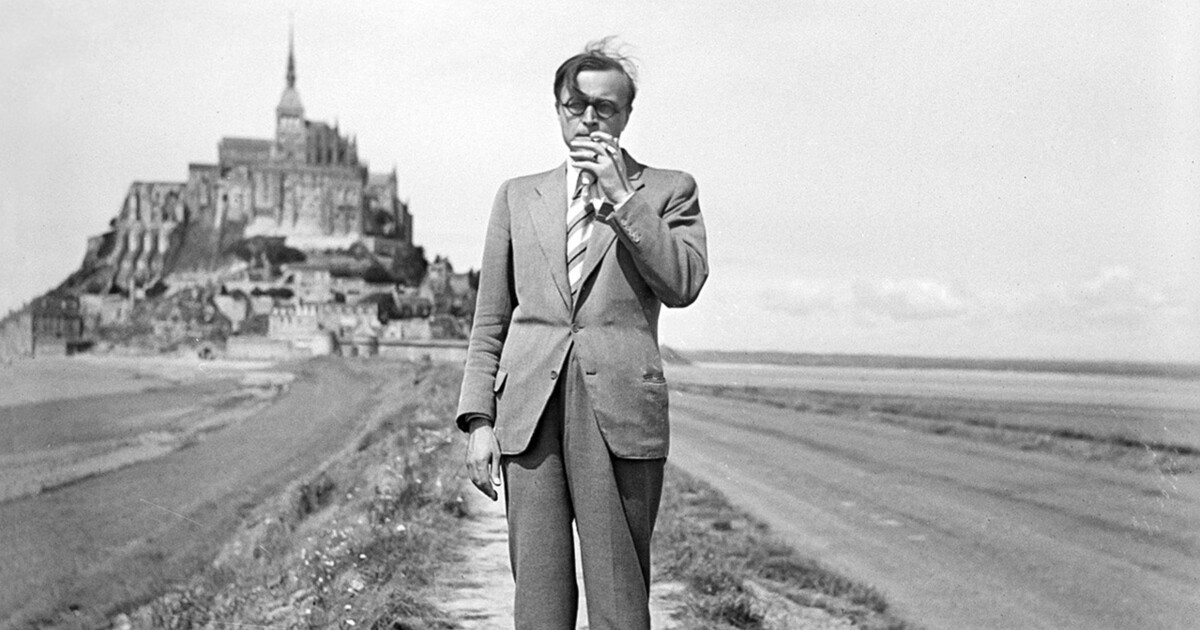
The obituary in Le Monde was unequivocal: the death of Alexandre Kojève on 4 June 1968 had deprived France of one of its greatest civil servants. Kojève had worked at the Ministry of Economy and Finance for more than twenty years, overseeing Marshall Aid, nurturing the European Economic Community and brokering the Kennedy round of tariff agreements, and he died in harness, at the age of 66, after addressing a committee of the Economic Community in Brussels. But he was not a typical French mandarin. He was Russian by birth and went on to study philosophy and religion in Germany in the 1920s, without bothering to take a degree. He then moved to Paris, but never attended a French university, let alone one of the grandes écoles, and he was already in his forties when he entered government service.
It happened almost by accident, in the wake of the war, when the French state was busy reinventing itself. Kojève was short of money, and a friend wangled him a temporary job as an interpreter at the Directorate of Foreign Economic Relations. He soon made himself indispensable not only for his linguistic skills, which were prodigious, but also for his far-sighted advice – astute, if unsolicited – on the conduct of negotiations. He did not conceal his political opinions: he was, he said, a ‘classical Stalinist’ and a ‘right-wing Marxist’ and he believed that the epoch of autonomous nation-states was coming to an end; but as a civil servant he was willing to promote the long-term interests of France, as he saw them. Within a year he was given a permanent post, with a secretary and an office of his own, and was left to operate as he chose. His preferred method was to sit in on meetings, listen unobtrusively, then write an analysis of what was at stake and assemble a few sharp words to dispatch – as his obituarist put it – the ‘absurdities of his opponents’. He conducted himself, in short, like an old-world ‘privy counsellor’ rather than a modern ‘expert, laden with files’ and his position was ‘completely unique’.
The journalist Gilles Lapouge, interviewing Kojève early in 1968, was impressed by his ‘elegance’ and ‘ease’. Kojève told him he ‘adored’ international negotiations, but did not take them too seriously: for him they were essentially a ‘superior game’, which he played ‘like the devil in holy water’. In the opinion of the diplomat Olivier Wormser, he was one of the visionary architects of European unity and his briefing notes on the General Agreement on Tariffs and Trade were ‘brilliant’ and ‘profound’. Raymond Barre, a future prime minister, remembered him as ‘ironic’ and ‘sarcastic’, and skilled in ‘presenting arguments that pitched everyone else into chaos’, especially the British. The Canadian negotiator Rodney Grey recalled chairing a meeting in Geneva when Kojève slipped in at the back. At a pause in proceedings, Kojève showed him the latest edition of the Herald Tribune, which reported that France was about to propose a new mechanism for levelling tariffs. ‘I asked Kojève if this was France’s policy,’ Grey recalled. ‘“No,” he replied, “but it will be soon.”’ By the time the meeting resumed, the delegates had read the article and the new measures were adopted without a hitch. Raymond Van Phan Phi, who was part of the French team, realised he had been outplayed: Kojève was, as usual, flouting the ‘arguments and instructions’ of the ministry, but he had ‘arguments and instructions of his own’, which ‘were of course approved by his superiors, but only afterwards’.
Kojève’s colleagues were aware that he had another life outside the ministry: on Sundays he became a ‘Hegelian philosopher’, devouring the Gesammelte Werke – so it was said – with the same appetite that others brought to the latest adventures of Tintin. They sometimes referred to him as ‘le professeur Alexandre’ and he had indeed taught philosophy in Paris before the war. In the 1920s, the École Pratique des Hautes Études had sponsored regular public lectures on ‘Religious Ideas in Europe’ covering, among other things, various early works by Hegel. In 1933, an unknown Russian called A. Kozhevnikov was recommended to take them over.
Kozhevnikov got off to a shaky start. He had decided to concentrate on Hegel’s unwieldy and enigmatic Phenomenology of Spirit, which was barely known at the time (he himself was not very familiar with it) and not available in French. To make matters worse, he was only 31 (younger than most of his audience) and had never taught before. He was to be employed as a suppléant (supply teacher or deputy) rather than a professor, but his application for an honorary licence, or teaching permit, was rejected – perhaps because he did not have a degree, or because he was still a Russian national. (He waited four more years for a French passport, in the name of Kojève.) The authorities refused to pay him, but he went ahead anyway, supporting himself by selling Leica cameras imported from Germany. His early lectures were, it seems, rather sketchy, but after six months he started receiving a salary and got into the habit of immersing himself in Hegel’s tricky German prose and guiding his audience through it paragraph by paragraph, week after week, translating as he went along and commenting in vivid demotic French. It would take him six years to reach the end.
The lectures took place on Monday afternoons and the official record shows that they attracted an audience of around twelve or fifteen, including several ‘registered students’ (élèves titulaires) and ‘regulars’ (auditeurs assidus), together with a handful of miscellaneous spectators, often including a Jesuit priest, a retired military gentleman and his wife, and the wily Surrealist André Breton. Some of them took Kojève out for dinner afterwards, so he must have been well liked. But he wanted to reach a larger public, and early in 1939 he published a sample in the prestigious literary review Mesures.
The article was presented as an essay by Hegel called ‘Autonomy and Dependence of Self-Consciousness: Lordship and Servitude’ (in fact a section of the Phenomenology) with an inconspicuous note at the end: ‘traduit et commenté par A. Kojève’. But Kojève’s self-effacement was deceptive. His translation (set in roman type) was all but overwhelmed by a long introduction and a barrage of interjected remarks (all in italics), preceded by an epigraph from Karl Marx: ‘Hegel … sees Labour as the Essence – the self-validating essence – of humanity.’ The quotation comes from the so-called ‘Economic and Philosophical Manuscripts of 1844’, written when Marx was in his twenties, but not published until 1932. By using it (without revealing the source, which was still almost unknown), Kojève gave notice that he intended to tantalise his readers and flout all sorts of pieties, beginning with the notion that Marx and Hegel were, philosophically speaking, implacably opposed. For Kojève, they were fundamentally at one, as atheists (many Hegelians would disagree) who believed that creation is the prerogative of humanity rather than God, and that human beings need to demonstrate their humanity by distancing themselves from the natural world and shaping their destiny through their own efforts, or in other words through ‘labour’.
The doctrine of human self-fashioning clearly appealed to Kojève and he devoted his introduction to explaining it. Humanity ‘differs essentially from animality’, he said, in that ‘human desire’ is directed outwards, to ‘society’, whereas ‘animal desire’ aims at self-contained, physical satisfaction. More specifically, human desire is a yearning, on the part of every human being, for ‘recognition’ (reconnaissance) by another human being, who will of course have the same desire. (‘Desire’ sounds less fruity in French than English.) But that implies, according to Kojève, that human beings cannot achieve their humanity without passing through a ‘struggle for recognition’ or indeed a ‘life-and-death struggle for pure prestige’. He then sketches a primal scene in which two antagonists beat the crap out of each other until one of them prevails and condemns the other to a life of laborious servitude. At that point, however, a dramatic reversal takes place: the victor languishes in luxury like a pampered animal, while the loser fights back, eventually achieving a robust ‘consciousness of self’ (conscience de soi) and attaining full humanity.
Kojève adds a pinch of Nietzsche by calling his antagonists ‘Master’ and ‘Slave’, and follows it with a dash of Freud, saying that the slave responds to humiliation by constructing an ‘ego’ or ‘self’ (Moi) with the confidence to call itself ‘I’ (Je). He then loops back to the Marxist doctrine that ‘all history is the history of class struggles,’ and concludes by anticipating a future in which history (or ‘history in the strong sense’, meaning history as conflict) will come to an end, inaugurating an epoch without masters or slaves – an age of perpetual peace and post-historical bliss.
These lengthy introductory remarks, in which Kojève set out his philosophical stall and paid tribute to Nietzsche, Freud and Marx without ever mentioning Hegel, prepared the ground for his translation of a few paragraphs from the Phenomenology. He approached them rather like a Christian theologian interpreting verses from the Hebrew Bible, conjuring meanings not so much from the text itself as from subsequent events and revelations. Hegel’s ‘doubling’ of self-consciousness thus becomes ‘two human beings confronting each other’, while ‘life’ and ‘objects’ are downgraded to ‘animal life’ and ‘object-things’, and ‘lordship’ and ‘servitude’ are transformed into ‘two human-individuals’ called ‘Master’ and ‘Slave’.
Kojève must have known that his approach was high-handed. He must have known that the Phenomenology was designed as an account of the evolution of consciousness in general, rather than the genesis of ‘society’, ‘humanity’ or ‘self’. He must also have known that Hegel’s ‘Lordship and Servitude’ is about two facets of consciousness, rather than two lads spoiling for a fight and oblivious to the rest of the world, just as he must have known that it leads into discussions of ‘stoicism’, ‘scepticism’ and ‘unhappy consciousness’ rather than – as he might have preferred – class struggle and the end of history. On top of that he must have known that Marx’s theory of class struggle had nothing to do with it, that when Marx wrote about the Phenomenology, he didn’t dwell on ‘Lordship and Servitude’ – in fact, he never mentioned it at all.
But Kojève did notice one important feature of the Phenomenology: that, unlike Hegel’s later works, it is structured as a narrative – a kind of Bildungsroman, describing the exploits of a guileless protagonist, an Everyman called ‘Spirit’ (Geist), who keeps venturing into new forms of experience, only to be beaten back and humiliated over and over again. Spirit starts its restless quest by exploring ‘sensation’ in all its forms, then traverses the varieties of ‘self-consciousness’ (including ‘lordship’ and ‘servitude’) and ‘reason’, before finally coming to rest, older but wiser, in ‘absolute knowledge’. Kojève also noticed that in telling his tale, Hegel borrowed the novelist’s technique of alternating between two voices, one expressing the way things look from the point of view of the hero, baffled in the mazes of experience, and the other offering the perspective of a narrator who looks down from on high, taking in the entire scene and knowing what will have to happen next. Kojève admired the technique and made it his own, casting himself as a super-narrator looking down on Hegel looking down on the tribulations of Spirit. He believed he was speaking for Hegel’s better self when he declared that, ‘despite what Hegel thought’, the Phenomenology is essentially ‘an ontology of Humanity’ and that ‘while Hegel did not say it in so many words’, its true achievement was to locate the ‘birth of the human from the animal’ in ‘the dialectic of Master and Slave’.
Kojève wrapped up his lectures in the summer of 1939, but any plans he may have had were dashed by the outbreak of war. He was called up in December and undertook military training until his unit was dissolved the following May. After the fall of France, he spent a year in occupied Paris, working on a philosophical testament in Russian intended for Stalin (he sent it off but never got a response). He also hid packages in his flat for a Resistance cell and in 1941 crossed the Demarcation Line into southern France, where he stayed for three years and worked on a manuscript about the ‘Hegelian world-spirit’ and its inexorable progress towards global government. The document, which wasn’t intended for publication, provided a rationale for Kojève’s highly malleable approach to political commitment: not so much ‘there is no alternative’ as ‘the alternatives produce identical results.’ Having failed to engage with Stalin, he offered advice on national renewal to the Vichy government. He also tried to persuade some German soldiers to defect, for which – according to one account – he was arrested and sentenced to death, only to be released after an interview with a German officer with whom he shared memories of art galleries in Munich.
After returning to Paris in 1944, Kojève received a message from an editor at Gallimard inviting him to turn his lectures into a book. At first he demurred, saying that his notes were ‘by no means ready for publication’, but relented when the editor – who had himself attended the lectures – offered to knock them into shape. ‘To refuse,’ Kojève said, would ‘amount to taking oneself seriously’. His Introduction à la lecture de Hegel appeared in 1947, with very little exertion on his part. By this time, the Phenomenology was available in French translation, together with two volumes of commentary, and Kojève’s Introduction, comprising six hundred pages of old lecture transcripts, could easily be dismissed as superfluous, repetitive and outdated. Nonetheless it had a certain appeal. The Phenomenology can be seen as an abstract history of philosophy, omitting names, dates, anecdotes and personalities; and Kojève’s gimmick was to put them back in. Apart from identifying references to individuals such as Kant, Fichte, Schelling, Jacobi and Novalis, he also dramatised different phases of Hegel’s argument by associating them with a series of archetypal characters: not only Master and Slave but also the Monk, the Priest and the Layperson (personifications of unhappy consciousness), followed by the Sensualist, the Scientist, the Intellectual and the Pseudo-Philosopher (representatives of reason), then the Philosopher and finally the Sage, who embodies absolute knowledge.
But the Sage should also be identified, according to Kojève, with the author of the Phenomenology. By completing his book when he did, in 1806, Hegel had, it seems, achieved not only perfect wisdom but also the ‘end of history’. ‘History is dead,’ as Kojève put it, ‘and Hegel has dug its grave.’ He then suggested that Hegel was not acting alone: there had been a second gravedigger – a famous contemporary who, without knowing it, pushed Hegel into finishing the Phenomenology after dithering over it for five years. Hegel was in his thirties at the time, holding down a junior post at the University of Jena and hoping that a hefty publication would give him a chance at a decent career. In January 1806, he contacted a publisher in nearby Bamberg and sent off the opening sections of his manuscript as a pledge, promising that the rest would follow soon. He was still procrastinating nine months later when Napoleon’s Grande Armée showed up at the city gates. He admired Napoleon and supported his imperial ambitions but, fearing civil unrest, packed up his remaining drafts and sent them to his publisher for safety. A few days later Napoleon’s troops entered Jena without difficulty. ‘All of us wish the French army good luck,’ Hegel said; and when he caught a glimpse of Napoleon himself – ‘this world-soul’ (diese Weltseele) as he called him – riding through the familiar streets, he tipped over into euphoria. ‘It is indeed a wonderful feeling,’ he said, ‘to see such an individual who, concentrated here at a single point, astride a horse, reaches out to the whole world and holds it in his power.’ The following day, 14 October 1806, parts of the city were ransacked in what came to be called the Battle of Jena. Soldiers entered Hegel’s rooms and, as he put it, ‘mixed up my papers like lottery tickets’. But the manuscripts of the Phenomenology were safe in Bamberg, and when he was reunited with them ten days later, he had little choice but to see them through to press.
Kojève drew the conclusion that Napoleon deserved a share of the credit for the completion of the Phenomenology and the end of history. There were no explicit references in the text, but Kojève sensed his presence everywhere. Hegel’s system ‘came into existence at the heart of the Napoleonic empire’, he said, and marked the conclusion of the ‘final period of history’, heralding a ‘post-revolutionary (Napoleonic) society, in which there are no more Masters and no more Slaves’. Hegel’s absolute knowledge would never have come into existence, in short, without Napoleon’s world-historical victory at Jena, in which ‘the real process of historical evolution … reached its terminus’ and ‘history came to an end.’
Kojève described his book as ‘very bad’, and he had a point. His take on the Phenomenology is not only misleading but slapdash, dogmatic, frivolous and flamboyant. The characters he filled it with, from the Master and Slave to the Sensualist and the Sage, sound rather like Mr Worldly Wiseman, Madam Bubble and Mr Sagacity in Pilgrim’s Progress, and his overall approach recalls the moment in Howards End where Helen Schlegel populates Beethoven’s Fifth Symphony with heroes, goblins, dancing elephants, and ‘gods and demigods contending with vast swords’. Moreover, the idea that the completion of the Phenomenology in Jena in 1806 marked the ‘end of history’ is so wild that you have to wonder if it was meant as a joke.
This is not the kind of thing that was expected of a French intellectual – least of all at the École Pratique des Hautes Études, which was created specifically to promote iron-clad German-style research in France. But Kojève was not very interested in the Western academic world: he always remained, as Boris Groys puts it in Alexandre Kojève: An Intellectual Biography, ‘a culturally isolated (Russian) immigrant living in a culturally foreign (Western) milieu’. Groys does not substantiate the point (his book isn’t so much a biography as a partisan exposition of Kojève’s writings), but the idea of Kojève as an ‘immigrant’ finds ample support in Marco Filoni’s Life and Thought of Alexandre Kojève, which is well-documented, though heavily reliant on Kojève’s colourful recollections; and, as Kojève would have wished, it tells a captivating story.
Kojève was born into a wealthy Russian family in 1902 and started at an exclusive secondary school in Moscow at the age of seven, while receiving extra tuition in Latin, German, French and English. He soon fell under the spell of ‘Romantic philosophy’, which according to Filoni involved rejecting ‘modern civilisation’ in favour of ‘culture’ and ‘religiosity’. But he seems to have been equally enchanted with the Hegelian idea that the only point of a work of philosophy is to give expression to a ‘system’, and that if you want to make your mark as a philosopher you had better come up with a ‘system’ of your own.
Kojève was never reticent about calling himself ‘a genius’ – ‘I say it because it’s true’ – and he took pride in a youthful ‘philosophical diary’ in which, it seems, he wrote about leaving moribund Western traditions behind and constructing a new system based not on the ‘real’ or the ‘ideal’ but on the ‘inexistent’. This would enable him, he thought, to propagate an enlightened atheism, with affinities to Buddhism, together with a world-weary pessimism, for which individual morality is incompatible with the ‘common good’, love is not beautiful until it is over and the purpose of life is to ‘try to be the man whom one will never succeed in becoming.’
The upheavals of 1917 were a challenge for his super-rich family and the 15-year-old Kojève got involved in the black market in soap, leading to his arrest and imprisonment – an experience which, he said, convinced him of the justice of the Russian Revolution. He was soon released, thanks to an uncle who served as Lenin’s physician, and was able to finish school in 1919 and enrol at Moscow University. The university was in turmoil, however, and he decided to escape to Germany in the hope of finishing work on his ‘system of the philosophy of the inexistent’ and developing the ideal of a ‘Sage’ who shuns society and knows that ‘there is no such thing as life and no such thing as death.’ After a hard journey, including a spell in a Polish prison, Kojève reached Berlin in July 1920 and a few months later came into possession of a large stash of diamonds, sent illicitly from Russia by his mother. He was just eighteen and found himself, as he recalled, ‘at the mercy of money and the pleasures of life’. His extravagances and indiscretions may have been extreme, but they did not stop him taking courses in Sanskrit, Tibetan and Chinese, and devouring, as he put it, ‘everything worth reading in philosophy’. He also registered at Heidelberg to pursue research on Vladimir Soloviev, whom he regarded as ‘the first Russian thinker to devise a universal philosophical system’. He commended Soloviev’s vision of an ‘end of history’ in which humanity would rally to the feminine figure of Sophia, or absolute wisdom, but criticised the irrational attachment to Christianity which, he said, prevented Soloviev from winning through to ‘a new stage in the evolution of thought’.
Kojève finished his dissertation in 1924 but didn’t stay in Heidelberg long enough to qualify for a degree. Berlin was far more exciting and before long he was involved with a glamorous Russian woman, Cécile Shoutak. She was already married, and her aggrieved husband persuaded his older brother, Aleksander Koyra, to remonstrate with Kojève. The scheme misfired, however: Koyra came away convinced that his sister-in-law was ‘absolutely right’ and that Kojève was ‘much, much better than my brother’. He then returned to his home in Paris and persuaded the scandalous couple to join him there in 1926. They married and lived in conspicuous luxury in the Latin Quarter, while Kojève took up an inquiry into determinism and modern physics. But the Crash of 1929 wiped out his investments, which put an end to his high living, his marriage and his work in natural science, though not to his friendship with Koyra.
Koyra was one of the most celebrated intellectuals of the Russian diaspora. He had studied philosophy in Germany and France before joining the Foreign Legion, fighting on the Eastern Front and taking French citizenship under the name Alexandre Koyré. He completed a state doctorate in 1922, at the age of thirty, and was appointed to the École Pratique des Hautes Études, where he started trying to rehabilitate Hegel in France. The ‘traditional interpretation’, he said, was completely wrong: Hegel was not the ‘absurd dialectician and outrageous reactionary’ portrayed in patriotic French textbooks but a ‘singularly attractive’ thinker, more interested in ‘experience’ than ‘method’. Early in 1933, Koyré gave lectures on ‘Hegel in Jena’ in which he evoked ‘a human Hegel, vibrant and vulnerable’. He admitted that Hegel’s notion of an ‘end of history’ looked preposterous, even self-contradictory: how could abstract philosophical reasoning adjudicate on questions of historical fact and how could there be a ‘future’ in which there is ‘no longer any future’? But the difficulties disappear, according to Koyré, once you realise that Hegel was talking not about history as such, but about the way philosophy reflects on it. ‘Philosophy always arrives too late,’ as Hegel once put it. ‘When philosophy paints its grey on grey, a form of life has grown old,’ or in other words, the ‘owl of Minerva’ – symbol of philosophical insight – ‘takes flight only at dusk’. The notion of an end of history is therefore hypothetical rather than categorical: it means that philosophy will not be complete until history is finished, or conversely, that if philosophy is complete, then history must be over. Koyré seems to have thought that no one in their right mind could imagine that these conditions would ever be fulfilled; but he conceded rather sorrowfully that, in Jena in 1806, ‘Hegel himself may well have believed it.’
Without Koyré, Kojève might never have become a Hegelian: the lectures and articles on a ‘human Hegel’ were a ‘revelation’, Kojève said, and the idea of an ‘end of history’, which had previously struck him as ‘hot air’, started to make sense. He would never have become a teacher either: Koyré did him an extraordinary good turn when, before leaving to start teaching in Cairo in 1933, he nominated Kojève to take over his courses at the École Pratique. Once word had spread about Kojève’s lectures on the Phenomenology, however, his debts to Koyré were largely forgotten. Jean-Paul Sartre – one of the first to draw inspiration from what he called ‘the famous “Master-Slave” relationship, which was to have such a profound influence on Marx’ – seems to have thought that no one in France took Hegel seriously before Kojève. The same is true of Georges Bataille, who, unlike Sartre, attended the lectures, finding them so brilliant that he was ‘torn apart’. He went on to describe Kojève as ‘the greatest philosopher we have’, but also sought to outdo him by repudiating the Hegelian touchstones of ‘knowledge’ and ‘recognition’ and replacing them with something less dowdy: ‘ecstasy’, ‘the unknown’, ‘sacrifice’, ‘virility’ and ‘violence’. Kojève wasn’t impressed – he described Bataille as a trickster beguiled by his own tricks – but he treated another of his ‘regulars’, Jacques Lacan, with enduring respect. Lacan had contributed to the lectures in 1935 with a comparison between Hegel and Freud, and would go on to describe Kojève as ‘my master (my only master)’. His discussions of psychoanalysis proliferated over the decades but never lost touch with their source in Kojève’s remarks about desire and the struggle for recognition.
Lacan and Bataille may not have had much in common, but they seem to have learned the same lesson from their master. In his lectures, Kojève contrived to present his favourite ideas – about the difference between humans and other animals, for example, or about history coming to an end in 1806 – as if they were obvious facts or self-evident truths rather than arbitrary dogmas. Lacan and Bataille would in turn become exponents of the art of issuing improbable philosophical pronouncements without exploring alternatives, engaging with possible objections or permitting expressions of doubt. Dozens of admirers were soon unveiling new ends of history – the end of humanity and humanism, or the end of modernity and modernism, or the end of art or literature or philosophy, or indeed the end of the world – in the same menacing style, as if daring anyone to express an honest doubt. Francis Fukuyama had his moment, just before the fall of the Berlin Wall in 1989, when he tried to outdo Kojève by asserting that the real end of history – the end to end all ends – would be the collapse of communism. Boris Groys is now attempting to resuscitate the idea for the 21st century, on the basis of a couple of ‘famous footnotes’ to the Introduction à la lecture de Hegel. In the first, dating from 1946, Kojève said he now believed that the ‘end of history’ was still to come; and in the second, written twenty years later, he said that ‘the preceding note is ambiguous, not to say contradictory,’ and appeared to revert to his former opinion that history had come to an end with the Battle of Jena. But then he confessed to another change of mind. On a recent visit to Japan he had, he said, noticed that snobisme was becoming ubiquitous. The Japanese – the poor as much as the rich – were so snobbish that they made the English upper crust look like ‘a bunch of drunken sailors’. Thus they were replacing old-style class struggles, which were in any case petering out, with the quarrels of snobbery, which are interminable; and in doing so they were giving history an infinite new lease of life.
Groys takes Kojève’s vacillations as an invitation to chip in with some proposals of his own. He begins by stating that ‘human history seems to have come to an end,’ then goes on to recall that in the 1930s Kojève volunteered as a publicist for his uncle Wassily Kandinsky, whose paintings he saw, according to Groys, as ‘images of the post-historical, sophic world’. Groys draws further encouragement from Kojève’s interest in photography, which is, he claims, emblematic of ‘post-histoire and post-modernity’. He may be right about the history-ending significance of Kandinsky and photography, or he may be wrong; either way I was reminded of Raymond Barre’s remark about Kojève’s taste for arguments that ‘pitched everyone else into chaos’. Jacques Derrida was probably onto something when he said that it might be time to put an end to talk about ‘the end’. An ‘apocalyptic tone’ had entered philosophy in the 1950s, he said, and forty years later it had turned into a ‘tiresome anachronism’, constantly recycling old declarations about ‘the end of History, end of Man, end of Philosophy, Hegel, Marx, Nietzsche, Heidegger, with their Kojèvian codicil and the codicils of Kojève himself’.
It is hard to believe that Kojève meant his codicils very seriously. When he looked back on his lectures, he took some pride in having defied taboo by encouraging smoking and using colloquial French. Beyond that, he regarded them as nothing but ‘propaganda, designed to shake people up’; and when he was accused of using Hegel’s name as a ‘pseudonym’ for his own opinions, he agreed enthusiastically: ‘Bien vu!’
Some philosophical readers have yet to catch up with what Kojève’s colleagues at the ministry always knew: that he was a bit of a jester. After becoming a civil servant, he published very little except reviews of light fiction. In 1956, for example, he wrote in praise of the astonishingly precocious Françoise Sagan (‘une très très jeune jeune fille française’), saying that she had created, in Bonjour Tristesse and Un Certain Sourire, a brave new world where wise and fearless girls look on old-fashioned ‘men’ with derision and disbelief. He was even more enthusiastic about the comic novelist Raymond Queneau, especially as it was Queneau who had carried out the thankless task of editing and publishing his lectures for Gallimard. (‘That publication was the work of a comedian,’ Kojève recalled, ‘and this is very important to me.’) In 1951, Queneau wrote about philosophers for Les Temps modernes, saying that they need to be a combination of voyou (rascal), fainéant (layabout) and vagabond (tramp), and Kojève responded with an article praising Queneau’s slang-infused stories, whose open-hearted, simple-minded heroes have a better claim to wisdom than the greybeards doted on by professors of philosophy. He also suggested that Queneau’s stories ought to be translated into every language in the world – except ‘literary French’, which would be the death of them. Bataille was not amused by his master’s turn to comedy, but Kojève repeated it when Queneau published Zazie dans le métro in 1959. Its tale of a ten-year-old girl with a strong will and a foul mouth who spends a wild weekend in Paris should be taken, according to Kojève, as a ‘summary of the Phenomenology of Spirit’. Zazie, he explains, wanted nothing so much as a ride on the metro, but by the time she finds a seat she is so exhausted that ‘she falls fast asleep and sees nothing’ – which shows that she has, in her ingenious innocence, travelled the long Hegelian road to wisdom. Wisdom, as he said in his last interview, ‘was once the preserve of the gods, who could afford to be fainéants’; but times have changed, and we can all be fainéants now. ‘I myself am a fainéant,’ he added, ‘the kind of fainéant who enjoys playing games – as I am doing now.’