In the autumn of 1777, as the American War ground on, Charles James Fox paid his first visit to the Duke and Duchess of Devonshire at Chatsworth. The young duchess was captivated by her new house guest. His conversation, Georgiana told her mother, ‘is like a brilliant player at billiards, the strokes follow one another piff paff’. For his part, Fox was enamoured of his hostess and the splendour of her house in equal measure, but the conversational billiard game underway in her drawing room gave him little confidence that his Whig interlocutors would ever be capable of unseating the detested Tory government of Lord North. In a letter to his friend Edmund Burke he complained that his aristocratic fellow guests were ‘as unfit to storm a citadel as they would be proper for the defence of it’.
Burke’s response, dated 8 October 1777, has been much anthologised. It is a personal letter that nevertheless ranges freely over the follies of the American War and dwells on the supine condition of the British people, seemingly blind to the faults of their political masters. ‘As to that popular humour which is the medium we float in … it is far worse than I have ever known or could imagine it.’ In the face of public passivity, Burke concluded, even the most coherent opposition stood little chance of storming the citadel: ‘The greatest number have a sort of heavy lumpish acquiescence in government, without much respect or esteem for those that compose it.’
Although Burke sympathised with Fox’s frustration with aristocratic Whigs, he would not allow him to turn his back on politics or renege on the duties incumbent on a party of opposition. By 1777, Burke had become a leading light of the parliamentary faction known as the Rockingham Whigs, which defined itself primarily through its objection to untrammelled royal power. He firmly believed that Fox would be an asset to the party: ‘You are better able to serve them than any man I know.’ Moreover, he continued,
you will certainly want some better support than merely that of the Crown. For I much doubt, whether, with all your parts, you are the man formed for acquiring real interior favour in this Court, or in any; I therefore wish you a firm ground in the country; and I do not know so firm and so sound a bottom to build on as our party.
This exchange stands as the epistolary equivalent of a portrait miniature, representing the friendship of Burke and Fox in microcosm. The story of their friendship contains within it a much larger history and, as James Grant shows, both story and history were shaped by the seismic events that refashioned Britain’s place in the world during the second half of the 18th century. The title of Grant’s joint biography, Friends until the End, offers its own kind of miniature, both in the ways in which it is accurate and the ways in which it is not. Burke and Fox’s relationship could not withstand the ideological chasm that emerged between them after the French Revolution. But they believed passionately in the importance of friendship. In a clubbable century, both men had ample opportunity to learn its value and to be hurt by moments that revealed its fragility. Underpinning their friendship was a shared belief in the threat of royal overreach that Burke articulates in his 1777 letter; ultimately, differences about the dangers inherent in storming a citadel would force them apart.
It was an unlikely pairing. They were twenty years apart in age and came from different worlds. Burke was born in Dublin in 1729, the second son of Richard, a Protestant lawyer of ‘fretful temper’, and Mary, daughter of a Catholic family from County Cork. Richard Burke was a harsh and unforgiving father, and rumours about cradle Catholicism dogged Edmund throughout his life. His was a complicated inheritance. He spoke with an Irish brogue and as a child attended a ‘hedge school’ run by a Mr O’Halloran, who taught his classes outside in deference to laws prohibiting Catholic education. Yet in 1761, as a junior employee of Lord Halifax, the new viceroy of Ireland, Burke found himself, in Grant’s words, ‘a cog … in the British machinery of Catholic suppression’.
In his 1777 letter to Fox, Burke represented Ireland as a cautionary tale for a government bent on the destruction of the American colonists. ‘The state of Ireland ought forever to teach parties moderation in their victories,’ he insisted. ‘People crushed by law have no hopes but from power. If laws are their enemies, they will be enemies to laws; and those who have much to hope and nothing to lose will always be dangerous, more or less.’ For the young Burke, it was a relief to escape poverty and oppression for the more congenial pleasures of London. He trained for the Bar, but despite this outward show of obedience had little interest in following his father, preferring to devote himself to writing. In 1757 he published A Philosophical Inquiry into the Origin of our Ideas of the Sublime and the Beautiful and married Jane Nugent, his doctor’s daughter. By the time he entered Parliament in 1766, he had left the disapproving orbit of his father, exchanging the chilly atmosphere of his childhood home for a loving household encompassing wife, brothers, friends and children, among whom he found great domestic happiness. The brothels and gambling dens of 18th-century London were not for him: his places were the House of Commons, where he rapidly made a name for himself as an orator of note, and his new estate at Beaconsfield.
Charles Fox’s journey to adulthood and Parliament presented a stark contrast. He was born in 1749, the second son of Henry Fox, the first Lord Holland, and Caroline Lennox, who was descended (through the illegitimate line of the Dukes of Richmond) from Charles II. Fox grew up in great luxury at Holland House, his every whim indulged. His biographer Leslie Mitchell relates a representative anecdote: having promised that young Charles could be present when a wall was demolished, on discovering that the wall had come down in his son’s absence, Henry Fox had it rebuilt so the boy might enjoy its fall. At seven Fox was given the power to ordain his own schooling; he developed into a young man whose tastes and appetites knew no restraint. Although in later life caricaturists delighted in depicting him as fat and slovenly, in his youth Fox peacocked among the London ‘Macaronis’: dandies who vied with one another over the sharpness of their shirt points and the ornateness of their cravats. At Eton, then at Oxford and during his Grand Tour, Fox collected friends and women and gambling debts on a heroic scale. He was elected to Parliament in 1768, aged only nineteen, courtesy of a rotten borough purchased for him by his father.
Fox would come to be defined by his association with Whig opposition, but in his early years in the House of Commons he hewed to a different line. His father viewed the Rockinghamites as his enemies and Fox, a devoted if expensive son, was fierce in his filial loyalty. An early test of parliamentary allegiance arose in 1769 after the outlawed John Wilkes returned to London to contest the seat of the City of London and his supporters were fired on by soldiers. Fox, still on good terms with North and his ministers, spoke against Wilkes in the Commons, where his chief antagonist was Burke. Burke told the Commons that he had little interest in excusing the behaviour of the Wilkesite mob, but he nevertheless insisted that Parliament should investigate the use of military force to quell civil protest. ‘If you take away the Civil Execution of justice,’ he warned, ‘you maim and mangle the whole constitutional Polity of England.’ British troops firing on citizens in a British city was not something Burke could countenance.
Three years later, the behaviour of the king brought Burke and Fox into alliance. They might disagree about the treatment of a troublesome crowd, but on the subject of a troublesome monarch they were united. In 1772, George III, angry that his brothers had married beneath their station, introduced a piece of legislation, the Royal Marriages Act. North was simply told to get the bill through. For Fox, the matter was personal. Had such a bill been in force when his own parents met, his mother, as a descendent of royalty, would have been forbidden permission to marry. Burke saw the question in terms of moral absolutes, as a power grab by a man determined to rule like a despot rather than the constitutional monarch described by the settlement of 1688. Between 1772 and 1774, Fox served as a Treasury minister in the government but North’s failure to appreciate the familial concerns of the Hollands about the Royal Marriages Act drove him out of government. He was 25 when he resigned his post. Both the prime minister and the king thought such an action by a young man already mired in debt and vice demonstrated an insufferable degree of presumption.
Throughout the first half of the 1770s, strained relations between the king, his government and the American colonists brought questions about royal power and the executive’s responsibility towards its citizens into sharp relief. Burke watched with dismay as the North administration hardened its position in relation to the rebellious citizens of Massachusetts, pushing the Rockinghamites to defend American liberty. In 1774, he became the MP for Bristol, a city whose wealth depended on trade with the colonists and on slavery, an institution Burke loathed. In a series of parliamentary speeches, notably his ‘Speech on Conciliation with America’ in 1775, Burke set out a theory of government shaped by the prospect of conflict. He argued that an empire prospered through trade and mutual aid: therefore no good could come of one part of that empire taxing another for rapacious gain. War was inhuman; royal overreach disastrous. Burke ensured that his speeches on these themes were printed and circulated widely outside Parliament, making himself the voice of opposition not just in politics but in the country at large.
Fox was astonished by the power of Burke’s oratory. In the mid-1770s, he was in political limbo, no longer part of North’s government but not allied to the Rockinghamites. But in the summer of 1776, Burke and Fox began to meet and talk with increasing regularity. Fox’s cousin Sarah Lennox remarked with some surprise that the princeling of Holland House had ‘left off all his fine acquaintances … and lived quite with Mr Burke’. By the time of Fox’s visit to Chatsworth in 1777, the friendship had been sealed and Burke’s suggestion that Fox should formally ally himself with the Rockingham cause was in reality a proposal for the formalisation of an allegiance already solidified through conversation and shared ideals.
The events of 1780 marked a turning point. During the anti-Catholic Gordon Riots that June, George III ordered that troops should fire on the London rioters. In Parliament, as the dust settled, Burke thundered that the king and his ministers had established a ‘military on the ruins of a civil government’; Fox added that he would ‘much rather be governed by a mob than a standing army’. Lord North, in contrast, believed that the populace would flock to the cause of a government and a monarch who had valiantly saved them from the mob, and called an election accordingly. Fox won the seat of Westminster and became leader of the opposition in the Commons in all but name. Burke, who held robust views about an MP’s right to represent his constituents as he, rather than they, saw fit, faced defeat in Bristol and withdrew from the contest. His opposition to the slave trade was well known by 1780; so too was his support for free trade with Ireland and for mercy for debtors and Catholics. On almost every issue of note he held an opposing view to those of the Bristol merchants who were his electorate. He subsequently returned to Parliament representing a rotten borough, but, in the words of one of his more recent biographers, Jesse Norman, his story after 1780 became ‘more one of intellect and imagination than of political achievement’. In the 1780s Burke appeared in Parliament and in the press as a kind of political soothsayer, a Cassandra warning against the dangers of royal despotism while the country stumbled into silence and submission.
In October 1781, the British army was defeated at Yorktown. The following March the North ministry resigned, having lost a vote of confidence. Rockingham became prime minister and began peace negotiations, with Fox as his foreign secretary. Four months later Rockingham died and in the fraught parliamentary manoeuvring that followed, Fox and Burke united around one idea: that in the affairs of Parliament and government, there should be ‘no king’. Neither man was a republican but both believed that George III was undermining the constitutional settlement by refusing to accept the will of his ministers or the people. After the Rockingham ministry foundered under the weak leadership of Lord Shelburne, Fox attempted to form a coalition with North. George III was horrified by the prospect and campaigned actively against it. He asked the 23-year-old William Pitt to lead a government instead: anyone, other than Fox. When Pitt declined, the king threatened to abdicate, before withdrawing the threat and accepting – most unhappily – a government led by the inoffensive Duke of Portland, in which Fox and North would act as the acknowledged powers behind the throne. But in an attempt to shorten the life of this detestable ministry, George refused to let his new ministers dispense sinecures and peerages – gifts termed by Grant as ‘those bonding agents of 18th-century party loyalty’. Fox and his friends took to calling the king ‘Satan’.
The Fox-North coalition fell in December 1783; in choosing its successor, George III meddled once more. Fox had a majority in the Commons but the king nevertheless asked Pitt to form a government. Burke accused Pitt of having seized power ‘by means the most disgraceful and unconstitutional’ and of answering only to a royal constituency of one. Pitt, however, was a formidable opponent. With the king at his side he was immovable. At the end of the hotly contested election of 1784, in which the ‘Foxite Martyrs’ were heavily defeated, Burke concluded that the House of Commons was ‘something worse than extinguished’. With great effort it had been proved to be independent of the Crown but ‘we found that its independence led to its destruction. The people did not like our work; and they joined the Court to pull it down.’ Faced with an electorate which appeared to prefer absolutism to democratic civil rule, Burke and Fox were once again relegated to opposition, forced to watch as the king accrued power to himself in the manner of an absolutist European monarch. The Regency crisis of 1788 appeared briefly to offer the prospect of change, but to Fox’s evident disappointment the king recovered his sanity. Such was the public animus between the two men that gossip circulated in the London broadsheets that the king’s ailment had been caused by Fox poisoning him.
Burke and Fox did not concern themselves solely with royal and parliamentary intrigue. At home there were families to be supported and women to be won. In his leisure hours Burke read Frances Burney’s Cecilia and forged a firm friendship with the novelist after he wrote her a fan letter: ‘In an age distinguished by producing extraordinary Women, I hardly dare to tell you where my opinion would place you among them.’ Burney was less circumspect: such was Burke’s appeal, she told her friend Hester Thrale, she was in danger of falling ‘quite desperately and outrageously in love’. Extraordinary women featured in Fox’s story too: first the actress and poet Mary Robinson, or ‘Perdita’, who had previously been the mistress of the Prince of Wales; then Georgiana, Duchess of Devonshire, with whom it is likely he had an affair; and finally Elizabeth Armistead, another former mistress of the prince (Fox eventually married Armistead in secret).
Personal happiness offered one compensation for royal opprobrium. Global affairs were another kind of distraction. The fortunes of the Burke family were enmeshed in the business of the East India Company; the Fox-North coalition collapsed in December 1783 because of the failure of Fox’s India Bill. The management of India (and, by proxy, of Britain’s expanding empire) became a touchstone in the friendship between Burke and Fox in the 1780s, in large part because of the behaviour of Warren Hastings, India’s governor-general. Burke had begun his career as a staunch defender of the East India Company but by the early 1780s had shifted his position. In 1784 he alleged that Hastings was ‘ravaging countries, depopulating kingdoms, reducing the gardens of the universe to a desert, plundering opulent towns’. When the king and Pitt contrived to scupper Fox’s India Bill, which would have offered a measure of relief to starving Indian subjects, Burke saw it as an attack on the very premise of empire. He had argued before the American War that empire should rest on mutual trade and aid, rather than rapacious extraction. Yet although Fox and Burke agreed on this principle they approached the question of India and Hastings from different angles. Fox, Grant writes, viewed these as ‘political questions’, Burke as ‘moral certainties’.
In 1787, Hastings was impeached in Westminster Hall, charged, among other crimes, with embezzlement, extortion, coercion and judicial killing. Burke played a crucial role in the political campaign that led to Hastings’s impeachment, to the great disappointment of Burney, who attended on the first day of the trial and found her sympathy ranged firmly against her old friend. ‘How did I grieve to behold him now, the cruel Prosecutor – such to me he appeared – of an injured and innocent man!’ Fox was also present on the first day of the trial and for a time Burke and Fox worked together on the impeachment, but as the trial dragged on Fox lost interest. By the time Hastings was acquitted in 1795, the attention of politicians and the public had long since moved on. Burke’s indefatigable prosecution of Hastings stemmed from the same principles that saw him object to a parliament levelling extortionate taxes on its own people. Power exercised without thought for the wellbeing of the people was an affront to Burke, and in Hastings he saw all the old corruptions of power personified.
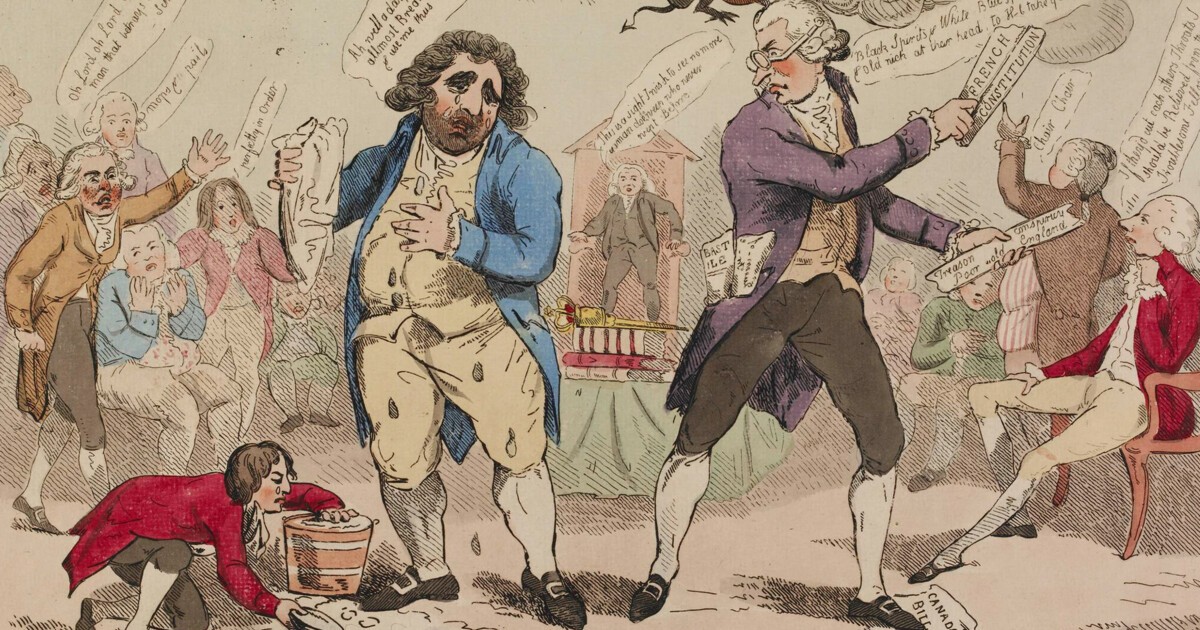
Those who know Burke only through his most famous work, Reflections on the Revolution in France (1790), might find this surprising. His pen portrait of the terrified French queen, scantily clad at the feet of her husband as the mob stormed Versailles, became one of the totemic images of the French Revolution and brought a good deal of censure on him within his lifetime. Burke viewed the early violence of the revolution as a betrayal of the ideals enshrined in Britain’s bloodless overthrow of James II in 1688; in his eyes, unbridled power in the hands of the crowd was even worse than unbridled power in the hands of a king. Fox, in contrast, laid the blame for the Terror at the feet of despotic monarchs (Louis XVI chief among them) who had failed to reform themselves. In a Commons debate on 6 May 1791, Burke attempted to speak on the ‘horrible and nefarious consequences flowing from the French Idea of the Rights of Man’ but was shouted down. Fox seconded the motion that called his old mentor out of order. In his own speech, Fox insisted that the new French constitution was founded on the same ideals as the Glorious Revolution. In reply, Burke spoke directly to Fox. He knew, the parliamentary report recalled, that it was ‘indiscreet at his time of life to provoke enemies, or give his friends occasion to desert him’ but there could be no friendship where there was such fundamental disagreement. Grant gives the moment its due: ‘Mr Fox whispered that there was no loss of friendship, the Parliamentary History records. Mr Burke replied that yes, there was … he had done his duty at the price of his friend – their friendship was at an end.’
Burke was true to his word. In 1797, when Fox heard his old mentor was dying, he wrote asking to be allowed to say goodbye in person. In return he received a letter from Burke’s wife declining the meeting on her husband’s instruction. ‘It has cost Mr Burke the most heartfelt pain to obey the stern voice of duty in rendering asunder a long friendship but … he deemed this sacrifice necessary; that his principles remained the same; and that in whatever life yet remained to him, he conceives that he must live for others and not for himself.’ By the time of his death, Burke was regarded as a prophet of Conservatism, who had foreseen the bloodbath of the Terror at a moment when Fox was still extolling the virtues of revolution. Fox was punished for his optimism and by the mid-1790s was reduced to leading a small band of loyalists who withstood the suppressions of Pitt’s own ‘Terror’. He died in 1806, with his liver in such a state that it shocked even the hard-drinking doctors responsible for his autopsy.
Because Fox became a hero of Whig Liberalism and Burke the founding father of British Conservatism, many commentators have assumed that in politics they were always on opposing sides. Grant’s valuable book explores the way in which, on some of the most pressing questions of their day, they were united. Faced with militarised streets they spoke out. And as the behaviour of a monarch whom Shelley would ultimately describe as ‘old, mad, blind, despised and dying’ became more despotic and less respecting of the principles of England’s unwritten constitution, they stood against him too, at significant personal cost. The things they held in common are no less important in their story than the global, political and parliamentary forces that would eventually drive them apart. Not for them that ‘heavy lumpish acquiescence’ of passivity, or indeed a tempering of opinions in the service of friendship, even if, as had been suggested by a young Fox, friendship offered ‘the only real happiness in the world’. Happiness mattered to Fox and Burke, and friendship did too, a great deal – but, for Burke at least, ideals mattered more.