The story of archaeology in Egypt usually begins with the Napoleonic expedition of 1798-1801 and Jean-François Champollion’s decipherment of hieroglyphs in 1822. That’s the European side of the story: Arab scholars had already been recording and debating pharaonic monuments and scripts for centuries. In the 19th century, the Ottoman khedive (or viceroy) Muhammad Ali and his successors founded scholarly institutes and museums and introduced laws to restrict the export of antiquities. Thousands of men and boys were pressed into excavating ancient temples and removing villages and their inhabitants to allow for an unpeopled view of ancient Egypt. Mohamed Sa’id, the fourth khedive, employed a Frenchman, Auguste Mariette, to oversee the growing national collection and gave him the title conservator of Egyptian monuments. The khedives offered antiquities as diplomatic gifts, and Mariette would secure thousands of artefacts for the Louvre. After the British invasion in 1882, foreign excavators officially received a share of the objects they discovered. The British Museum now holds more than a hundred thousand Egyptian antiquities. There are around 80,000 in the Ägyptisches Museum in Berlin and the Louvre, and 57,000 in Turin.
The Egyptian Museum opened in downtown Cairo in 1902. It was built by a French architect, Marcel Dourgnon, who rejected allusions to ancient Egypt in favour of neoclassical arcades, pilasters and domes; Latin inscriptions commemorate ancient kings and the foreign founders of Egyptology. Until their demolition in 1947, the British army barracks of Qasr el-Nil cast a late afternoon shadow across the museum. Between 1858 and 1941, the directors of the museum were all French or British. The revolution of 1952 did not erase all European and American influence from Egypt’s public curation of its past. Museum displays hardly changed and major projects still depended on funding from foreign collaborators. Excavations continued, for the most part, to be organised by foreign institutions, particularly the Cairo-based scholarly institutes set up by the French, German and American governments. President Nasser’s triumphant delivery of the Aswan High Dam prompted not only an international flurry of salvage excavation and documentation, but the presentation of entire temples to the cities of New York, Madrid, Turin and Leiden.
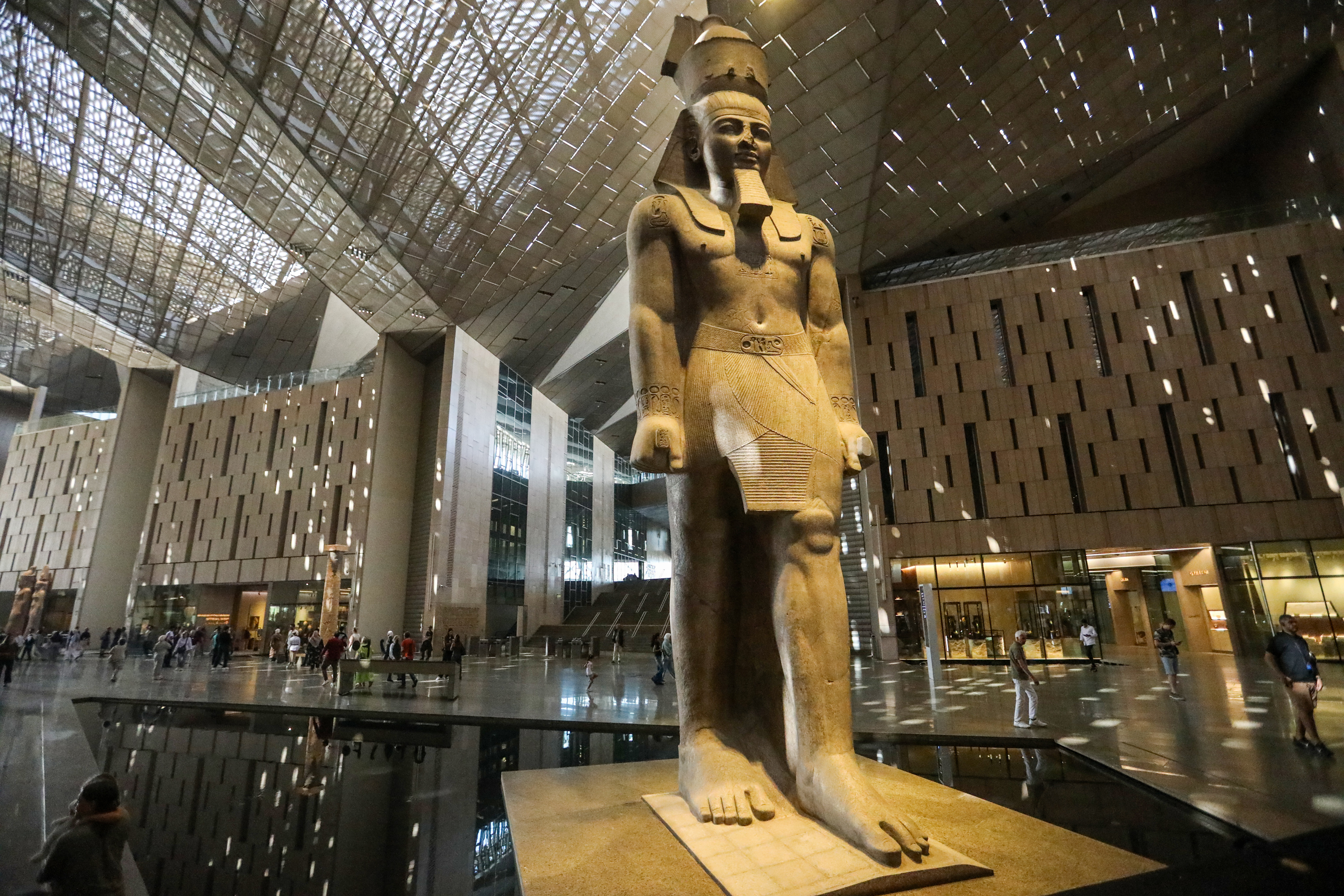
Statue of Ramses II.
Over the past few decades, however, Egyptian museums have pivoted away from Europe and America. The National Museum of Egyptian Civilisation, which opened in 2021, rejected the traditional division of artefacts into pharaonic, Coptic, Greco-Roman and Islamic eras (a framework associated with European academic disciplines). The Grand Egyptian Museum, announced at the height of Hosni Mubarak’s rule and styled ‘the largest museum in the world dedicated to the people, history and culture of Ancient Egypt’, opened in November last year with a lavish ceremony broadcast round the world. It is estimated to have cost more than $1 billion ($300 million of which was a loan from Japan) and sprawls over an area the size of seventy football pitches. The financial crash of 2008, the Arab Spring and Covid meant that its construction took almost twenty years. Much has changed in that time. The last decade of construction took place under the military regime of Abdel Fattah el-Sisi, who installed one of his generals as its head – the first non-Egyptologist to direct a major Egyptian museum.
To get to the Grand Egyptian Museum, you must arrive by car or bus via the new roads that connect the edge of the Giza plateau to the gated communities and shopping centres that have sprung up in the desert. The physical separation of the museum from Cairo is a little like that of the Getty Museum from Los Angeles, but here it is not merely a matter of space or vistas. The regime is keen to keep international visitors away from sites of popular resistance and the struggle of daily life; a nearby military airfield has been turned into a tourist entry point and renamed Sphinx International Airport. The museum building, designed by the Irish-Japanese firm Heneghan Peng, is understated, slung low in the landscape next to the pyramids. Its steel-framed sloping façades are made up of triangular panels of translucent alabaster and expanses of glass. There is none of the inflated, ill-proportioned pharaonism that can be seen in buildings recently commissioned in Cairo, such as the shiny Bashtil train station. The most impressive areas, the conservation centre and science laboratories, are hidden underground. A consortium led by Hassan Allam Holding, one of the favoured corporate partners of the Egyptian military state, manages the whole facility.
Visitors enter into a vast atrium. A statue of Ramses II, eleven metres tall and 75 tonnes, is dwarfed by the massive space and its many attractions, which include a number of chain restaurants (Starbucks as well as Zooba, which sells gentrified Egyptian street food). The statue was moved here from the plaza outside the old downtown train station, where it had been erected in 1955 as a symbol of Nasser’s Egypt. Through the ticket barriers, a staircase leads up to a large window framing the Great Pyramid. The sculptures that adorn the staircase – statues, obelisks, shrines, sarcophagi and gateways – are not arranged in chronological order, as originally envisaged, but in four thematic clusters: royal images, divine houses, gods and kings, and the journey to eternity.
The historical sweep of the museum is vast – more than thirty centuries – and many of the artefacts are huge. I was drawn to the smaller things: colourful materials and unusual textures that offered a respite from all the stone. One of the first rooms, on the earliest era of Egyptian history, includes a group of objects ritually buried at Tell Farkha in the Nile Delta around 3200 bce and only discovered in 2006. Alongside dozens of animal figurines fashioned from hippopotamus ivory are two standing wooden figures with lapis lazuli eyes, coated in hammered gold. They are among the earliest Egyptian renditions of the full human figure. Paintings from tombs at Dahshur near Cairo, applied directly to mud plaster around 2200 bce, show boats ferrying possessions down the Nile; in another scene, a hand is poised to pick some cooked duck from an offering table. The Tod temple treasure, discovered in 1936, comprises dozens of silver vessels, chains and ingots alongside jewellery and precious stones. The treasure was packed into four copper boxes and buried under a temple floor around 1900 bce. These objects position Egypt within a trade network that included Anatolian silver mines, Minoan artefacts and lapis lazuli from Afghanistan. At present, however, the gallery texts offer little guidance about the makers, their working methods or where the materials came from.
Archaeology and philology dominate Egyptology, both in Egypt and beyond, and art historical readings of ancient Egypt are still rare. More frustrating is the narrowness of the story offered by the museum, which focuses on Egypt’s singularity. There are many characters – gods in anthropomorphic or hybrid form, kings and their courtiers – yet the narrative is strangely devoid of human thought or experience. The grand eras that structure the layout (Old, Middle and New Kingdoms) were defined by European scholars of the 19th century and don’t reflect the way ancient Egyptians documented their own history or the way modern archaeologists approach it. ‘Intermediate’ periods of foreign incursion or internal atomisation are glossed over, perhaps because the distinctive regional styles that emerged are antithetical to the government’s message of national unity. A low-ceilinged coda of three galleries brings together the final fifteen hundred years. Libyan, Nubian, Persian, Greek and Roman rulers occupied Egypt for much of that time, but this goes largely unmentioned in favour of anodyne statements about a ‘multicultural Egypt’ of different languages and clothing.
There is nothing new, of course, in using museums to shape national identity. The Louvre epitomises the transfer of culture from royalty to the Republic; the British Museum collections reflect the reach and exploitation of the British Empire; large museum projects have been recently commissioned by Saudi Arabia, the UAE and Qatar as part of a drive among the Gulf states to diversify their economies and improve their image abroad. But the Acropolis Museum in Athens may be the most useful comparison here. Like the Grand Egyptian Museum, it is designed to overlook an important archaeological site and to focus minds on Greece’s struggle to reclaim its antiquities. Ottoman rule in Athens and beyond isn’t mentioned.
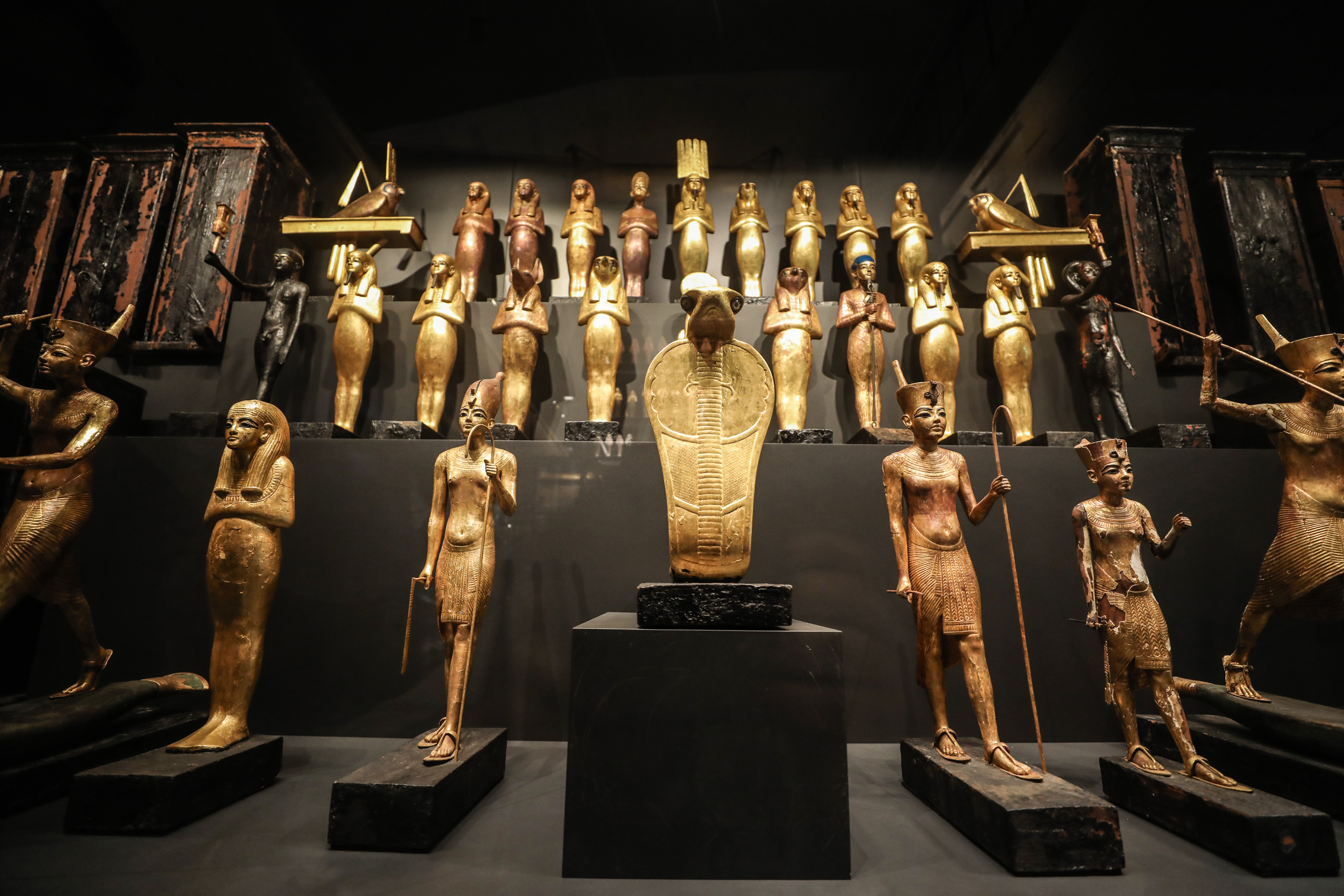
Artefacts from the museum collection.
The pyramids provide the Egyptian state with a monumental symbol of national power (in contrast to the Beaux-Arts neighbourhood surrounding the old museum) yet the displays have little to say about Giza. Most of the star objects found at the site, such as the schist triads of Menkaure or the statue of an enthroned Khafre protected by the Horus falcon, remain in central Cairo. The funerary furnishings of Queen Hetepheres, mother of Khufu, the king buried in the Great Pyramid, are the only part of the display focused on Giza itself. In the Egyptian Museum they were shown in a low, cramped space; Hetepheres’ ceremonial canopy, gilded bed and throne make much more of an impression here.
The museum also has little to say about the people who discovered these objects and other 20th-century finds, even though new discoveries are celebrated in press releases as the work of Egyptian teams. One senior Egyptian archaeologist complained to me that ‘we are being colonised by our own government,’ as the regime moved an obelisk and sphinxes hundreds of kilometres to Tahrir Square, precluding any commemoration of its role in the Arab Spring. The rush to display recently discovered and rapidly excavated coffins in media tents at desert-edge cemeteries often sideline the Egyptian archaeologists working on the excavations.
It’s understandable that displays at the Grand Egyptian Museum do not celebrate Mariette, W.M. Flinders Petrie or George Reisner, all of whom directed excavations that yielded thousands of objects that fill museums in Cairo and across the world, but in avoiding this history the museum also misses an opportunity to emphasise the role played by Egyptians. The expertise hidden behind the phrase ‘excavation labour’ is an important focus of research in Egypt at present. Specialists from the southern town of Quft are now recognised for the drawings, notebooks and maps produced across 130 years of excavation, though their contributions are omitted from almost all European and American scholarship. They, along with thousands of locally hired labourers, unearthed the objects that make this museum possible. The absence of critical or fresh perspectives on Egyptology and its history, or any of the decolonial approaches that are debated by archaeologists and Egyptologists today, in turn subverts claims for restitution. The Grand Egyptian Museum already has its perfect account: what would other objects add to the narrative?
Ancient Egyptian objects have long provided inspiration for a modern Egyptian cultural identity, a ‘pharaonism’ distinct from the ‘Egyptomania’ celebrated in Britain and France. In the 1920s, architects and sculptors turned to materials such as the pink granite of Aswan to create works that evoked a modernity rooted in a distinctively Egyptian past. Mahmoud Mokhtar’s granite sculpture Nahdat Misr (‘Egypt Awakens’) from 1928 pairs a monumental sphinx with a peasant woman lifting her veil to look to the future. After decades of presenting Egypt’s past for the international tourist market (‘Welcome to our seventh millennium,’ was an enduring Tourism Authority strapline), el-Sisi has reimagined pharaonic culture to convey Egyptian prowess to domestic audiences too. Since it opened, up to eighteen thousand visitors a day have thronged the museum. Most of these are Egyptians, but at 200 Egyptian pounds (around £3), the ticket price is prohibitive for much of the country’s population.