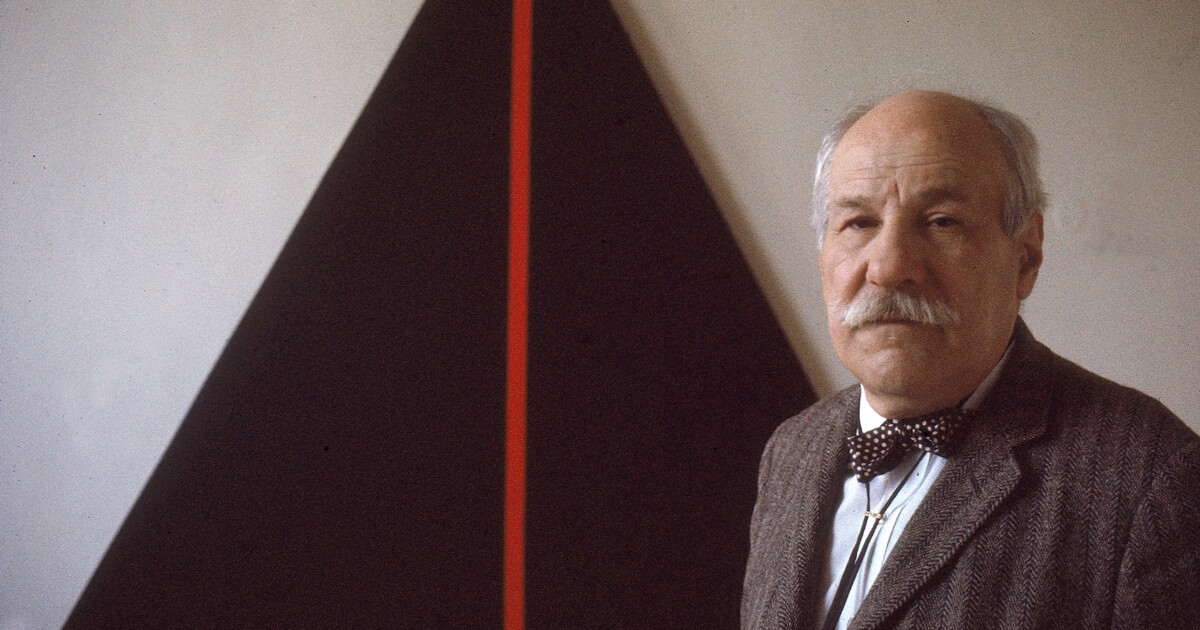
Barnett Newman with ‘Jericho’, late 1960s.
Barnett Newman was an ‘eminence’ in the postwar art world, Amy Newman (no relation) writes in her exhaustive biography; at the time of his death in 1970 no one in his cohort was more revered. Yet today he is largely forgotten, which is one indication of how much the terms of art have changed. Was he eclipsed by the many artists he influenced, and are they now eclipsed in turn?
Born in 1905 in a tenement on the Lower East Side, Barney (as friends called him) was the oldest child of Abraham and Anna Naiman, Jews from Poland who had arrived in New York five years before. Abraham was a broker of menswear, and the family of six rode the ups and downs of his business. While Abraham was committed to Zionism, Anna was invested in culture, and Barney aspired to be an artist. In 1927 he graduated from City College, that great bastion of immigrant education, but the Depression compelled him to go to work for his father. A union supporter, Abraham had some socialist sympathies; Barney inherited his antipathy for communism but added an attachment to anarchism.
A string of failures marked his twenties and thirties. His application to be an inspector of clothing factories was turned down more than once. In 1936 he started a publication called the Answer, ‘a civil service magazine’, but it quickly folded. Even more quixotic was his 1933 run for New York mayor as an anarchist. Announced with the broadside ‘On the Need for Political Action by Men of Culture’, the campaign seems like a lark, but Newman was deadly serious about his ‘ticket for intellectuals’ (as the press called it). Over the years his many letters to newspaper editors, government officials, school leaders and museum directors attest to his dogged belief in the artist as citizen.
Newman liked to skip class to visit the Metropolitan Museum. He met Adolph Gottlieb, a fellow future Abstract Expressionist, in the early 1920s, and attended the Art Students League from 1922. He also worked as a substitute art teacher in secondary schools, though here too he struggled (a permanent post eluded him eight times). His one success came in the form of a fellow teacher, Annalee Greenhouse, whom he married in 1936. Annalee sacrificed her intellectual ambitions to his artistic ones, supporting and managing their lives thereafter. ‘I want my contribution to be the giving of a great mind to the world,’ she wrote to him in 1937. They decided not to have children, but still Newman failed to launch as an artist. Though he had begun to write by the late 1930s, he didn’t start to paint in earnest for another decade, and he switched his tax designation from ‘writer/artist’ to ‘artist/writer’ only in 1948. This delay had consequences, not the least of which was his obsession with priority. Newman always insisted that his innovations came first, and frequently they did.
Interest in modernist art boomed in New York in the 1930s and 1940s. The Museum of Modern Art opened in 1929, followed by the Museum of Non-Objective Painting a decade later (renamed the Guggenheim in 1952), and new galleries appeared too, the most important among them Betty Parsons and Sidney Janis, opening in 1946 and 1948 respectively. MoMA staged two landmark exhibitions in 1936, Cubism and Abstract Art and Fantastic Art, Dada, Surrealism, both curated by its director, Alfred Barr, and two years later hosted the first historical survey of the Bauhaus, arranged by its former head Walter Gropius. Already known as a polemicist, Newman took issue with all three shows. He dismissed geometric abstraction as arid diagramming (he reiterated his aversion in a review of a memorial exhibition of Mondrian in 1945, also at MoMA), and he dispatched the Bauhaus as a bevy of ‘screwdriver designers’. Not wrongly, Newman pegged MoMA as a ‘Cézanne museum’ which privileged the lineage from Post-Impressionism to Picasso and Cubism and on to Mondrian over ‘the Impressionist idea of even surface [with] no edges’: Newman took the saturated colours and immersive canvases of late Monet as his model from the start. As for Surrealism, Newman couldn’t abide its ‘Marxist-Freudian content’, but at least it pointed to a different kind of abstraction. It also helped to displace figurative art of the Depression era, which he deemed both ‘isolationist’ and ‘philistine’.
By the early 1940s Newman found aesthetic solidarity in the fledgling Federation of Modern Painters and Sculptors, which included old friends like Gottlieb and new ones like Marcus Rothkowitz (soon to become Mark Rothko). He came to know William Baziotes and later, through Rothko, Clyfford Still, and then Jackson Pollock, Robert Motherwell and Ad Reinhardt. According to Motherwell, the group opposed art dedicated either to ‘social values’ or to formalist aesthetics, and they agreed that ‘the function of the artist is to make actual the spiritual.’ Clearly, this position was prompted by the dramatic spread of mass culture. As Amy Newman points out, in 1939 the World’s Fair in New York had celebrated such novelties as television and colour photography, and that same year Clement Greenberg presented abstract painting as the heroic defender of high culture against such ‘kitsch’. The imperative of autonomous art also appealed to the anarchist in Newman: ‘I felt destroyed by established institutions’ in the 1940s, he later recalled. It promised an agency that he lacked in real life. One sign of this lack was his relentless litigiousness: Newman sued, or threatened to sue, anyone he felt had crossed him – landlords, insurance agents, businessmen, publishers, curators and artists alike. He petitioned the government to recognise him as a conscientious objector during the Second World War with an argument that was especially tortured. ‘Joining the army would deprive me of my right to kill,’ he claimed, because he might be commanded to do so.
Throughout this period Newman was known as a critic, not a painter, and he produced a flurry of texts: his milieu put a premium on a ‘stance’, and each show, indeed every painting, was supposed to be a ‘statement’. In the early 1940s he toiled on an unpublished essay, ‘The Plasmic Image’, which supported the work of Gottlieb and Rothko and anticipated his own (he began to draw botanical and ornithological motifs in the mid-1940s). Once more Newman ran down the geometric abstraction of Mondrian as well as the formalist criticism of Roger Fry; he saw a ‘disdain for the self’ in both. ‘The new painter,’ Newman insisted, ‘is concerned with his subject matter, with his thought.’ The term ‘plasmic image’ didn’t catch on, but he had more luck with ‘ideographic picture’, the title of an essay published in 1947, where he again argued that ‘the basis of an aesthetic act is the pure idea’ and defined the ideographic image as ‘a vehicle for an abstract thought-complex’. This ‘pure idea’ was not about pure painting; it signalled that pictorial form must arise out of the ‘void’ as though in a re-enactment of creation as such. As early as 1945-46, his drawings and paintings feature ideographic shapes and come with titles like Gea and Genesis – The Break.
In this respect the ‘new painter’ was, for Newman, like the ‘primitive’ artist who is ‘always face to face with the mystery of life’. If the Cubists had turned to African art for inspiration, and the Surrealists to Oceanic art, the Abstract Expressionists-to-be looked to the Indigenous Americas – Pollock to Indian sand painting and Newman to a range of archaic and tribal art, from pre-Columbian societies to the tribes of the Pacific Northwest. This interest in primitivism was whetted by several shows in the 1930s and 1940s, some of which Newman reviewed. He sought in such work both an alternative to ingrained conventions of European picturing and a model for painting that confronted ‘the mystery of space’ or, more darkly, ‘the terror of that blank area’. A double move essential to Abstract Expressionist ideology can already be glimpsed here: an Existentialist idea of terror is rendered ontological, and actual historical terror – the Second World War, the Holocaust, the atomic bomb – is sublimated in the abstract form of a new sublime.
In ‘The First Man Was an Artist’ (1947), Newman returned to the ‘tragic state’ of ‘helplessness before the void’, and declared human ‘dignity’ in this condition ‘the ultimate subject matter of art’. (It was the ultimate goal of his life too: Newman suffered from a sort of indignation disorder.) New in this text is the priority given to man as artist; Adam may have fallen, but actually he ‘sought the creative life’. For Newman ‘the aesthetic act always precedes the social one’; ‘man’s first expression’ was ‘a poetic outcry rather than a demand for communication’. Once more an American version of the sublime is vaunted, one with an Emersonian inflection. As Newman later remarked to Greenberg, in a burst of chauvinism, ‘the European is concerned with the transcendence of objects, while the American is concerned with the reality of the transcendental experience.’
In an attempt finally to put this rhetoric into practice, Newman produced Onement I. Supposedly painted on his 43rd birthday, 29 January 1948 (though it is not documented until 1952), this thin canvas, a little over two feet tall, is a single field of dark cadmium red divided by a vertical stripe of one-inch tape painted over with orange cadmium red – the first full appearance of his famous ‘zip’ (though the term wasn’t used until the mid-1960s). Apparently, Newman wasn’t clear about what he had done; he intended to remove the tape as he had previously, but instead left it. He sat with the painting for eight months before declaring it a breakthrough – and then gave it to Annalee to memorialise the event. Every one of his paintings thereafter was structured by this band, which ‘activates and gives life’ to the rest of the space. For Newman the ‘fully held image’ first achieved in Onement I was the ambition of all the important artists of his cohort because it ‘deeply involves the whole being’. ‘Onement I does not “mean”, it confronts,’ the critic Harold Rosenberg intoned, once he had been won over to Newman; it is ‘an act of revelation’.
His confidence deepened, Newman produced his next text, ‘The Sublime Is Now’, in late 1948. Standard modern art offered some escape from the twin constraints of the Western tradition, ‘the Greek ideal of beauty’ and ‘the reality of sensation’, but mostly via the ‘distortion’ of German Expressionism or the ‘empty world of geometric formalisms’. What was required was a new kind of painting produced ‘as if painting never existed before’, a painting that would convey the exaltation of its making in the moment of its viewing, a painting that would proclaim (as Newman later put it to the critic Thomas Hess) that ‘Man is Present’: ‘Here I am, here.’ That kind of heightened presence remained his aspiration for the rest of his life.
‘The pictures were painted by a painter conceived’ by a writer, the MoMA curator William Rubin once remarked of Newman, and, as Amy Newman notes, his cohort was ‘drenched in discourse’. Maybe it had to be: the New York School (as it came to be known) was never coherent as a stylistic movement, and in the early years success remained elusive. A Pollock show at Parsons in January 1948 garnered little attention, and nothing sold from a de Kooning exhibition at Charles Egan Gallery in April. ‘Isolation,’ Greenberg wrote that year, was ‘the natural condition of high art in America’, and soon the Existentialist talk of alienation was matched by the political reality, as the House Un-American Activities Committee targeted abstract art as ‘communistic’. (Of course, Abstract Expressionism was also used as an emblem of liberal-democratic freedom in several CIA-sponsored exhibitions in the 1950s.) Despite this climate Newman produced twenty paintings between August 1948 and December 1949, some great ones among them, such as the all-black Abraham (his beloved father died in June 1947). They were bigger and flatter, with less atmospheric space and less inflected colour. But when he showed a selection of paintings at Parsons in January 1950, he got mixed reviews and only one work sold (to a friend of Annalee’s – Newman cleared $84.14).
Nevertheless, Newman was on the rise, eventually to be placed on a par with Rothko, Pollock and de Kooning. Certainly he was positioned dead centre in the ‘Irascibles’ photograph of the group published in Life magazine on 15 January 1951. An artefact of another age, it presents one woman (Hedda Sterne) and fourteen men, with all the men in coats and ties. Newman insisted that they appear with the ‘same dignity as bankers’; the edgy downtown look of the 1960s, which was foreign to him anyway, was still far away. ‘It was the first time that there was a breakthrough to the public,’ Reinhardt commented. Maybe, but at this moment Newman was hardly a shoo-in even with local curators, excluded as he was from a group show at MoMA that opened only a week after the Life article, and from its Fifteen Americans survey in 1952.
Even so, this was a period of truly radical work, such as The Wild (1950), which lives up to its name. Nearly eight feet tall and only an inch and a half wide, it is almost all zip, a rough red stripe edged by dark blue. Not a painting (at least as conventionally understood), it is also not a sculpture, though it was probably influenced by the elongated figures that Giacometti exhibited in 1948. Newman said these bronzes looked ‘as if they were made of spit – new thing, no form, no texture, but somehow filled’. He meant it as a compliment, and the remark has a bearing on The Wild as well as on the sculptures Newman would go on to make. The first one, Here I (also 1950), was made up of two thin white verticals in wood, eight feet tall, one finished in rough plaster, the other in smooth paint, set on plaster mounds on top of a wooden milk crate.
Where The Wild stretched painting to its vertical limit, Vir Heroicus Sublimis (1951) did the same with its horizontal extent; eighteen feet across, it was the biggest painting on the scene, bigger than the sixteen-foot Number 1 that Pollock had produced a year earlier. The ‘crisis of the easel picture’ – the title of an essay by Greenberg from 1948 – had fully arrived. Newman wanted to make paintings, not images. Hence the size of his canvases; hence too his instructions for a show at Parsons in 1951 which included Vir Heroicus Sublimis: ‘The large pictures in this exhibition are intended to be seen from a short distance.’ He specified this distance as the length of an arm and a brush, that is, the distance of the painter from his canvas, with whom the viewer was thus invited to identify: ‘Here I am, here.’ Although Newman was mostly mum about Matisse (perhaps so that his connection to late Monet might appear more direct), the Matisse retrospective at MoMA in 1952, which contained large canvases such as The Dance I, would have supported this direction as well.
Critics didn’t like the second Parsons show any more than the first: ‘They find me too abstract for the Abstract Expressionists,’ Newman complained, ‘and too expressionist for the abstract purists.’ Fair-weather friends like Still and Rothko backed away from him, but Pollock and Reinhardt stood fast, along with the sculptor Tony Smith (Pollock and Smith had helped Newman install the second show), and he had the powerful support of Greenberg. But not Rosenberg, at least not yet. In December 1952 Rosenberg published his most impactful essay, ‘The American Action Painters’, which framed Abstract Expressionist painting as an Existentialist event. In this account Rosenberg favoured de Kooning over Pollock, whose drip paintings he slighted as ‘apocalyptic wallpaper’, but he mocked Newman even more: ‘In a single stroke the painter exists as a Somebody.’ With Newman, as with Still and Rothko, Rosenberg scoffed, ‘the cosmic “I” … turns up to paint pictures,’ in a display of ‘megalomania’ that issues only in ‘standard brands’. Ouch.
Newman mustered only two paintings in 1953. The following year was difficult too (he was left out of the 25th anniversary show at MoMA as well as a group exhibition at the Whitney’s new building), and by 1955 he hadn’t exhibited in four years. Some relief came by way of Greenberg, who in ‘American-Type Painting’ elevated Newman above his peers. De Kooning was still a ‘late Cubist’, Greenberg argued, while Pollock had ‘pulled back’ with his recent semi-figurative work, and Still had become ‘buckeye’ (as in stale or prosaic – Still suspected that Newman had supplied the derogatory term). Newman showed the way forward: he had ‘studied late Impressionism for himself … Colour is to function as hue and nothing else … The easel picture will hardly survive such an approach.’ Suddenly, by the end of the year, Amy Newman writes, ‘Barney had become an unavoidable eminence after barely having had a career.’
He had attracted other advocates too, such as the art historian Meyer Schapiro and the Vogue editor Alexander Liberman, and Hess and Rosenberg were soon to convert, to be followed by young critic-curators like Sam Hunter and Lawrence Alloway. Just as important, Newman finally had patrons such as Ben Heller. ‘Ultimately,’ Amy Newman writes, ‘he entered and navigated [the art world] with more success and finesse than any of his former cohort.’ Yet he still felt embattled. A bundle of contradictions, Newman could be witty and winning one moment, suspicious and scornful the next. The situation shifted in August 1956 when Pollock died while driving drunk, and in late 1957 when Newman suffered a massive heart attack (a second one would kill him on 4 July 1970). But his tendency to indignation persisted.
In May 1958 Greenberg curated a survey of Newman’s work at Bennington College. ‘They say that I have advanced abstract painting to its extreme,’ Newman remarked with typical false modesty, ‘when it is obvious to me that I have made only a new beginning.’ Financial success finally arrived in 1959 with a similar show of 29 paintings at the swanky gallery French & Company (where Greenberg was a consultant). Yet by the end of the year a new threat appeared in the form of the next generation: Sixteen Americans at MoMA advanced ‘Neo-Dada’ artists like Robert Rauschenberg and Jasper Johns as well as the 23-year-old Frank Stella, the enfant terrible of geometric abstraction. Colour-field painters like Morris Louis, Kenneth Noland and Jules Olitski, whose work Newman had influenced but didn’t encourage, were also on the rise, and Greenberg had swung much of his support to them. Newman was now recognised as the co-leader, with de Kooning, of the New York School – they represented the two poles of Abstract Expressionism – but in the quickened pace of the art world they also seemed prematurely historical: ‘It’s like we were all dead,’ Newman later said.
When MoMA presented a Monet show in 1960, Newman was struck by his use of series as in Haystacks and Rouen Cathedral. He began to conceive a project of his own in this format, the Stations of the Cross, which would figure prominently in his retrospective at the Guggenheim in 1966. Eventually Stations consisted of fourteen large paintings, each black and white on unprimed canvas, all of which focus on one moment in the story, Christ’s utterance ‘Why did you forsake me?’ ‘This is the Passion,’ Newman explained. ‘This outcry of Jesus. Not the terrible walk up the Via Dolorosa, but the question that has no answer.’ Perhaps he saw it as an ultimate instance of the tragic sublime. It was a controversial subject for a Jew to take on, and it was bold to sign the canvases at bottom right. Apparently Newman, always the wounded one, identified with this state of forsakenness. Otherwise his biblical references were to the Old Testament, as in the triangular painting Jericho (1968-69), whose title alludes to the moment when Joshua is told by God: ‘The place on which you stand is holy.’ Appropriately, as the epigraph to her biography, Amy Newman cites Isaiah 6:8. ‘Then I heard the voice of my Lord saying, “Whom shall I send? Who will go for us?” And I said, “Here am I; send me.”’ Newman always felt he had a vocation; in the end he had recognition as well. His Guggenheim retrospective impressed young artists across the board – colour-field painters, Minimalists and some Pop practitioners too. In 1969, when the Met staged its survey New York Painting and Sculpture 1940-70, Newman was given a huge gallery for thirteen works from 1946 to 1969, more than anyone else in his generation.
Amy Newman’s biography, many years in the making, teaches us a great deal about the art world of the time. Along with a discursive intensity that one can’t help but envy today, there was a lot of bad behaviour. This group of men was often rancorous, vain and tiresome, given to self-aggrandisement and backstabbing. Newman was adept at conflict (he went so far as to sue his great friend Reinhardt over one of his satirical comics), but Still wins top prize. Here is Newman on Rothko in 1955: ‘Why should I look at his death image?’ And here is Still on Newman in 1951: ‘He is a childless father whose need is so great that he has almost become his own child. To compensate he would be all things.’ Many disputes in this milieu stemmed from claims of priority. Although Newman was driven to make up for his late start, his foundational idea about art – that ‘artists are the first men,’ that each painting re-enacts the creation of the world – is an absolute claim on firstness. It is also as American as apple pie or Emerson; as Hess caustically remarked in 1951, ‘the American myth of sacrosanct originality … has made the possibility of derivation more unmentionable than that of venereal disease.’ When Newman fell out with Still, Rothko, Reinhardt and Motherwell, it was usually over questions of precedence: who did the first monochrome? The first black painting? Whose pictorial ground was the first to be ‘incident-free’? Who invented ‘the open space concept’? Newman claimed them all.
To be fair, priority is also important to anarchism, to its faith in first principles, and for Newman this had egalitarian implications as well: anarchism meant that ‘anybody is able to make anything, particularly a work of art, spontaneously or directly – a primo.’ There seems to be a historical rapport between anarchism and abstraction; Seurat and Pissarro, arguably the most abstract painters of their time, were anarchists, and so was Mondrian, the most committed abstractionist of all, except perhaps for Newman. Anarchism supports the aesthetic autonomy that all these artists swore by as well as the non-hierarchical mode of composition that each devised. Mondrian strove to give equal weight to each element in his paintings while maintaining a unified whole, and so, in his way, did Newman; perhaps he insisted on their differences because they were close in this and other respects. In a sense theirs are ‘leaderless’ (an-arkhos) canvases that appear to be self-organised. A destructive impulse is also at work in anarchism, as it is in their abstraction; both Mondrian and Newman aimed to undo basic oppositions like figure and ground or colour and line. As Hess saw it, Newman sought an ‘extreme of painting which sacrifices painting’. Newman extended this claim in grandly anarchistic terms: properly understood, his paintings ‘would destroy state capitalism and state socialism’.
Of course, one can argue that his politics were more liberal (or libertarian) than anarchist and note that he sought validation from the very institutions, such as MoMA and the Met, that he attacked. A similar ambivalence (we could also call it hypocrisy) informed his relation to art criticism and art history. Newman railed against the machinations of art critics despite being expert at them. There is ‘no such thing as art “history”’, he claimed, even as he wanted nothing more than to be inscribed in it. Although his most famous bon mot is ‘aesthetics is for the artist as ornithology is for the birds,’ this amateur ornithologist was an aesthetician first to last. Again, a bundle of contradictions.
Then there is his rhetoric of the sublime. It proved seductive to artists as an exalted alternative to the Existentialist commonplace of alienation. It influenced art historians as well: in ‘The Abstract Sublime’ (1961), Robert Rosenblum traced a non-French lineage of modern art from Turner and Friedrich to Still, Rothko, Pollock and Newman. Yet the sublime comes with problems of its own. In Kant it is essentially a two-step event: we might be overwhelmed by a great thunderstorm, but then we regroup and absorb the awe; initially shattered, the ego is ultimately affirmed (in the end the sublime is sublimated). Did Newman devise his immersive colour fields to operate in a similar way? My favourite of his paintings, a dark blue expanse zipped with a white stripe from 1951, is titled Cathedra, which refers to the seat in a church reserved for a bishop; its original title was simply Throne. And once you get over your initial wonder at this vast canvas, you do feel empowered by it. In an essay from 1994 titled ‘In Defence of Abstract Expressionism’, a defence that is also a critique, T.J. Clark acknowledges the allure of this subjecthood but notes that it is petit bourgeois in aspiration, that Abstract Expressionism offers us an image of liberal individualism that advanced capitalism has already undone, ‘a last gasp of oxygen as the plane goes down’.
The rhetoric of the sublime didn’t age well. In 1972 Leo Steinberg argued that the sleek design of colour-field paintings was not unlike that of new cars from Detroit, and in 1978 Robert Hughes dispatched the Rothko retrospective with this nasty line: ‘Sublime, sublime, sublime: the reflexes go clickety-clack, all the way down the Guggenheim ramp.’ How could this talk of the sublime survive the irony encouraged by Pop, let alone the deconstruction taught by poststructuralist theory and postmodernist art? (Newman was a full-on logocentrist: painting was ‘a living voice’ for him.) ‘The absolute images of Rothko, Newman, Gottlieb, Still, Reinhardt can co-exist in a picture collection but not in the minds of their originators,’ Rosenberg once remarked. ‘Each is the proprietor of a sacred enigma, whose authority must exceed that of all others.’ Armed with Benjamin, Derrida and Luce Irigaray, feminist artists and theorists of my generation mocked this mystified talk of male genius, originality and singularity. I wonder, though, whether this critique isn’t now the official view (in the art world if not the culture at large) and whether we might look at Newman with fresh eyes. If so, this biography will be a great help.
This is not to say that he had no legacy; on the contrary. In 1958 Allan Kaprow, who gave us ‘happenings’, published an essay titled ‘The Legacy of Jackson Pollock’, which Kaprow located in performance as much as in painting, anticipating the impact of the drip canvases on body and process art of the 1960s. Newman had much to offer too, both within painting and without. ‘The paintings are a saddle-point between art predicated on expression and art as an object,’ Alloway wrote in 1966, and Newman was indeed the favourite artist of his generation among Minimalists like Frank Stella, Donald Judd, Dan Flavin and Richard Serra. Yet the connections are ambiguous, and Newman seemed ambivalent about his influence. ‘My search is for a picture that is simple and self-evident,’ he remarked of his first show in 1950. ‘What is there is there.’ Far from transcendental, this approach is almost positivist, close to Stella’s dictum from 1964: ‘What you see is what you see.’ Stella was referring to his ‘literalist’ paintings of the late 1950s and early 1960s, as though they were to be taken, first and last, as matter-of-fact things. But Newman also attested to an opposite aim in 1963: ‘I want my painting to separate itself from all and every object that exists in the world.’ Perhaps influenced by Stella in turn, Newman experimented with triangular paintings in the late 1960s, but was worried that a shaped canvas might be dismissed as ‘a graphic design or an ornamental image’.
Newman did pass one protocol on to Minimalists like Judd and Serra: a suspicion of the a priori, a caution not to overthink the work with prior drawings. (This is another charge Newman made against Mondrian, whose compositions are actually more intuitive than Newman allowed. It is also a bright line between Minimalism and Conceptualism, which is very precalculated – as Sol LeWitt put it, ‘the idea becomes the machine that makes the work.’) Yet the continuities with the next generation also came with important shifts in emphasis, especially regarding notions of presence and space. Between 1950 and 1966 Newman made multiple versions of three sculptures titled Here I, II and III, each of which consists of three zips in steel set on a trapezoidal base. They insist on absolute presence, but that presence is bedevilled by repetition (the same can be said of his four Broken Obelisks). Like the Pollock drip, the Newman zip was a statement of ‘hereness’ which, repeated many times, undercut its own declaration; these autographic signs became trademarks, which both artists hated. Conversely, the Minimalists, like the Pop artists, made repetition work for them, as Carl Andre did emphatically with his rows of bricks and grids of metal plates. For Newman presence was metaphysical, transcendental, while for Andre (for whom the term was just as important) it was physical, immanent: one is made aware of the material conditions and spatial parameters of the artwork rather than transported above them. To put it grandly, the Minimalists did to Newman what Marx did to Hegel; they turned his idealism upside down, made it materialist.
This shift had implications for the space of art as well. ‘Instead of making shapes or setting off spaces, my drawing declares the space,’ Newman said in 1962, when Minimalism was coming into its own. ‘Instead of working with the remnants of space, I work with the whole space.’ Judd, Flavin and Serra all took up this mantra – ‘I declare space’ – but, though they began as painters, they made that declaration outside the frame of painting, in actual objects set in our space. Newman did not; even his sculptures aim to elevate us above the everyday surround. Of course, Newman was followed by other great abstract painters such as Robert Ryman, yet Ryman’s achievement was precisely to reconcile abstract painting à la Newman with Minimalist imperatives of materiality and space. Newman took abstract painting as far as it could go in his terms.
Obviously, abstract art is still being made; it is one option among many others. But that is precisely the difference: for Newman and frenemies it was everything – the origin and end, the alpha and omega, of art. Today not only is Abstract Expressionism ‘a thing of the past’, but abstraction appears as a historical interlude more than a world-historical necessity. That said, Newman, brilliant talker and writer that he was, should have the last word: ‘The freedom of space, the emotion of human scale, the sanctity of place, are what is moving – not size (I wish to overcome size), not colours (I wish to create colour), not area (I wish to declare space), not absolutes (I wish to feel and to know at all risk).’