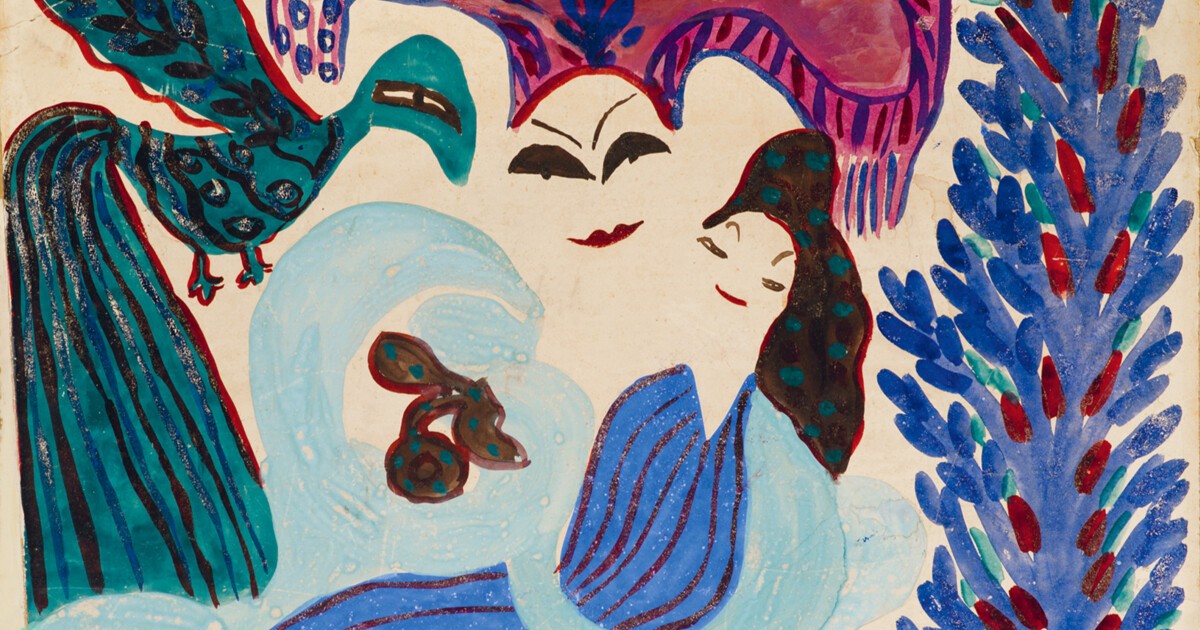
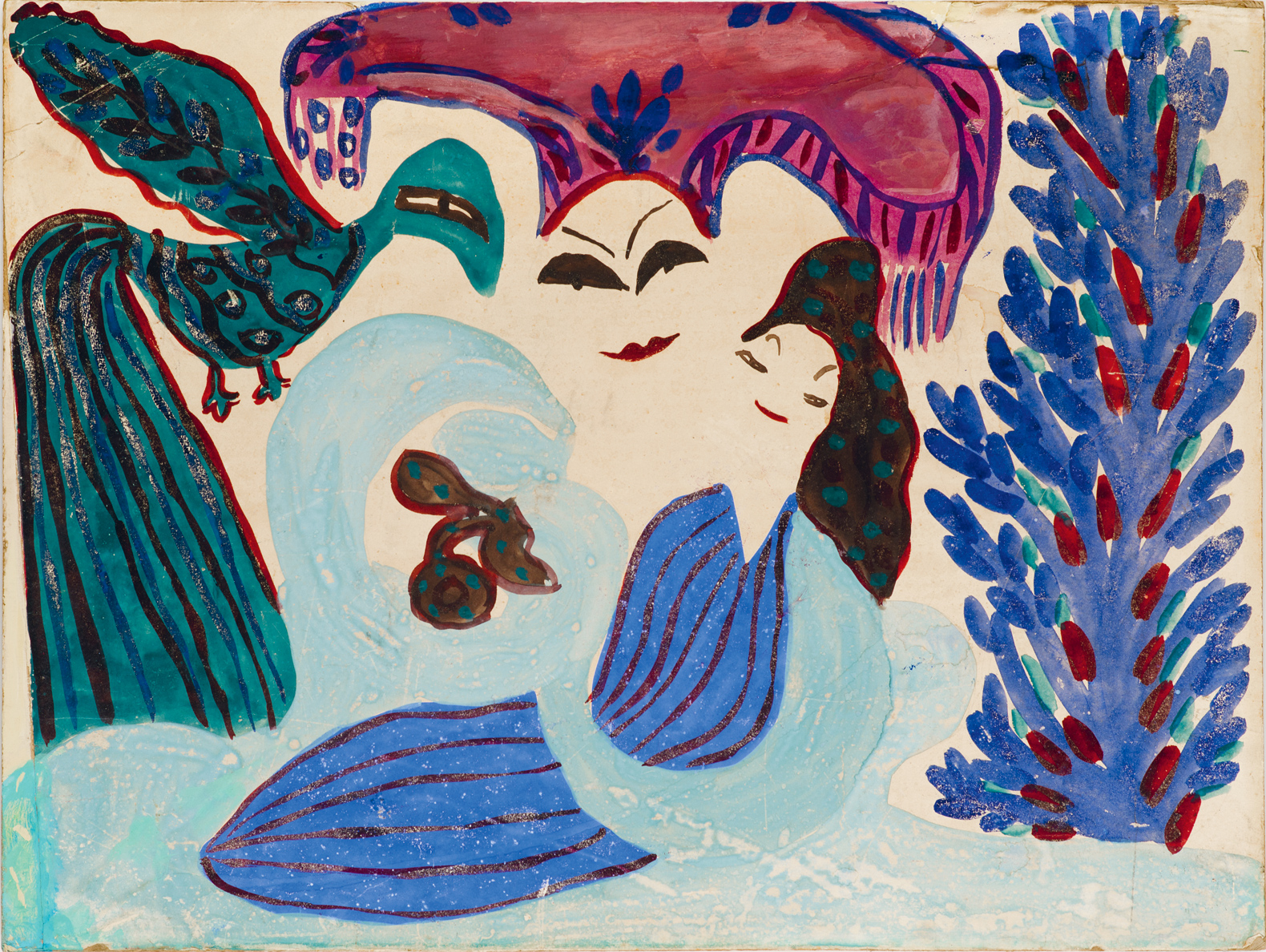
‘Woman and Vegetation’ (1945)
André Breton gave one of the best descriptions: ‘the rocket I’ll call Baya’. He also gave some of the worst: ‘a being as frail as she is talented’, ‘the child that is Baya’. Excitement vibrates around the subject of Alice Kaplan’s biography Seeing Baya (Chicago, £21). The artistic gift of Fatima Haddad – who chose to be known as Baya – was quickly celebrated. But celebration was entwined with and shadowed by bewildered awe. The painter was a girl. She was young. She was brown. She was Muslim. She was from Kabylia in Northern Algeria. Her work came to prominence in France soon after violence in Sétif and Guelma, as Algeria was stirring to independence.
From a European perspective, this is a story of explosive celebrity and subsequent disappearance. Baya’s gouaches and sculptures were exhibited in Paris when she was sixteen. She modelled in clay alongside Picasso at the Vallauris pottery studios: they ate couscous together; he called her ‘la Berbère’. In North Africa she has been a constant presence. In 1969, her work appeared on Algerian postage stamps. At the Vieille Charité, the former alms-house in Marseille where her work was exhibited in 2023 with a sumptuous catalogue, the Algerian attendant took her importance for granted: he had grown up with her paintings. That exhibition was also seen in Paris. Yet there has never been a major UK exhibition dedicated to her work. We have been missing a glory.
She was born in 1931. Orphaned at the age of nine, she was gathered up by her grandmother, who took her to work on a flower farm. It is as well that Kaplan has a firm hand with sentimental interpretation. The harshness of the early life – ‘cold, hunger, lice’ and beatings – and the fragrance of the farm, which specialised in bird of paradise flowers, are susceptible to fairy-tale treatment, as is the sudden intervention from a powerful well-wisher. Marguerite Caminat, the sister of the farm’s owner and a friend to artists, asked if she could employ Baya as a maid in Algiers: ‘She was given to me,’ she said. When not mopping the floor, Baya was leaving clay figurines to harden overnight in the fireplace. Caminat took the figurines to the local baker’s oven and brought home paints for her protégé. The girl started to produce astounding pictures in which turquoise, purple, ochre and emerald become new absolutes. Women – and hardly any men – appear to glide, bodies flattened, arms bent as if studying to be pottery limbs. Eyes are the shape of dolphins or seed pods; a baby is curled like a scorpion; a mother and daughter, caught in each other’s stare, are separated by a boulder. Baya did not give her pictures titles, but they have been labelled: Caged Bird Surrounded by Two Women, Woman with Palm Tree, Woman Standing and Woman Lying Down.
She was scooped up again when the gallerist Aimé Maeght was tipped off about her work and, almost immediately, arranged for her terracotta figurines and paintings to be shipped to Paris and shown. Baya went too, got up in newly made ‘authentic’ garments: velvet karakou top, gold and red striped sarouel. She talked and sang on the radio, was flash-bulbed and praised by Camus for producing ‘a kind of miracle’, became a repository of hope for those wishing Algerian-French relations could be soothed, was pronounced ‘the granddaughter of a witch’ and a girl who ‘has never learned anything’. A year later, Edmonde Charles-Roux profiled her in Vogue.
At 21, Baya was removed from Caminat’s household. She came under the tutelage of a traditional professor of Arabic who had it in mind to arrange her marriage to one of the sons of Mahfoud Mahieddine, a distinguished musician. When Mahieddine saw Baya, he fell for her himself. They married in 1953. He was 52, with eight children and a resident first wife. Baya and he went on to have six children together. For eight years – from 1954 to 1962 – she didn’t paint. She might have been thought to have enough on her plate. Kaplan leaves the question open, quoting a gnomic remark of Baya’s that there was not enough green paint. These were the years of the revolution; green was the colour of the Algerian flag. In a remark not quoted here, Baya says she consulted her husband before she went back to her easel and that he agreed. She continued painting until her death in 1998. To the birds and fish and flowers and fruit a range of stringed musical instruments was added; black lines loop across the space like calligraphy. The pictures were not much exhibited outside Algeria; the first large show in the US was in 2018.
This is the first biography. It is vital to have the pictures and a pity only that some are split across a spread: it looks more like accident than wit that a photograph intended to show a united family divides the members in two, giving new meaning to the chapter’s title, ‘Separation’. Vital, too, in the absence of much recorded speech from the subject herself, to have a scrupulous sifting of superfluous description. Kaplan has fought her way through thickets of woebegone sentimentality (Baya has been wrongly described as illiterate), pallid and slanted eulogy (‘colourful’, ‘engaging’, ‘intriguing’) and academic explanation: ‘a mash-up of Kabyle, Arab, Islamic and French cultural heritage’, ‘emblematic of urgent global conversations about identities in transformation’.
Kaplan’s own touch is more intimate and surprising. She is illuminating about the traces in Baya’s paintings of the rich palette, circles, stripes and checks found in the traditional pitchers and dresses of Kabylia. And she is brilliant on the importance of the skirt. Baya said she started to paint by tracing and colouring in the pictures of dresses in Modes et travaux and Marie-Claire. Kaplan points to the way in which wide skirts, teeming with fish and flowers, so often ‘anchor’ the paintings. Such skirts, painted at the time when Dior was launching his 1947 collection, when Baya was in Paris, are not reflections of the clothes she herself wore: they imagine another way of moving through the world. Another of Baya’s gifts: a new look at the New Look.