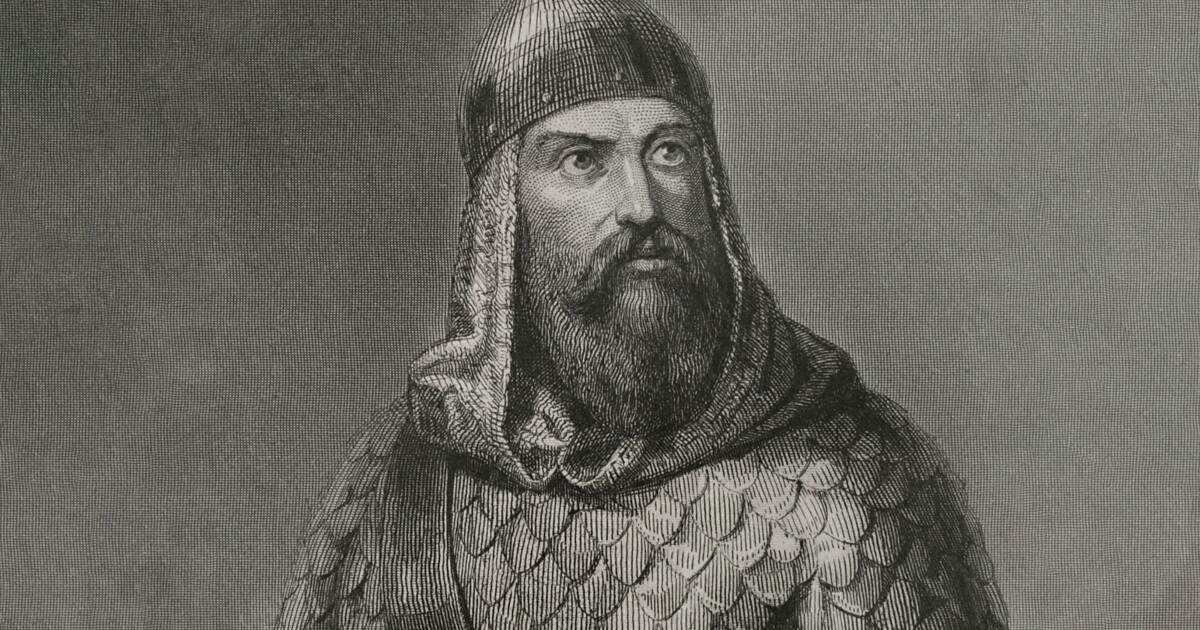
In 711 ce, the last king of the Visigoths, Roderic or Rodrigo, was defeated by Umayyad conquerors, an event that marked the loss of Andalusia to Muslim rule. According to legend, Rodrigo had defiled the daughter of a certain Count Julian, who in revenge invited the Umayyads to invade Spain. Four hundred years later, the Andalusi Muslim historian Ibn Bassām recorded a prophecy that had been circulating widely:
A man once told me he heard it said … that once upon a time this Peninsula was conquered and taken away from a ruler named Rodrigo, and that another Rodrigo was one day destined to take it back – a prophecy that has filled all hearts with terror, and made men feel that what they feared and dreaded most would soon come to pass!
This second Rodrigo was Rodrigo Díaz de Vivar, better known as El Cid.
‘A myth is in a sense invulnerable,’ Ernst Cassirer wrote, and in the contest with history the myth of El Cid has always come out on top. If you picture him now, you might be visualising Charlton Heston in Anthony Mann’s epic of 1961, filmed in Franco’s Spain. For the climactic final scene, Mann restaged the most memorable story of the Castilian warlord, who conquered the Muslim city-state of Valencia and ruled over it for five years until his death in 1099. Just as El Cid lay dying, the Almoravids were amassing outside the gates to liberate the city. If the enemy knew he was dead, Valencia would fall. At dawn, Rodrigo’s corpse was propped upright in his saddle. His horse, Babieca, took his place at the army’s helm. El Cid rode out into battle, eyes blank, as the Almoravids fled in fright into the sea. In an interview, Mann recalled that God himself provided the lighting for the cameras, the sun beaming down onto Heston’s armour at precisely the right moment. ‘We let him ride out, and by God that was how he shone and there was no spotlight or anything,’ Mann said. ‘It was so white it was electrifying.’ The Cid was death itself, waging war.
The story, first written down in the 13th century, appears to have originated at the monastery of San Pedro de Cardeña, which received Rodrigo’s cadaver. In the days leading up to his death, the monks related, El Cid tried to embalm himself by drinking only balsam and myrrh. After his posthumous victory, Babieca carried his body on the long journey to Cardeña. With his sword Tizón in his left hand, the well-preserved Cid was placed on an ivory stool by the altar, where, for a decade, his relics greeted Christian pilgrims and converted Muslims and Jews. In the late 12th century, the knight’s exploits were enshrined in the anonymously authored Poema de mio Cid, transforming him into a protagonist of Spanish literature akin to Beowulf or Roland. From there, Rodrigo enters myriad ballads and romances, chronicles and plays, and the miracles from Cardeña were incorporated into the Estoria de España, the 13th-century chronicle of Spain produced at the court of Alfonso X. (An official attempt to canonise Rodrigo, initiated by Philip II in 1554, failed.) In the street theatre of the 17th century, El Cid appeared as Christ, with his widow, Jimena, as his patient bride, representing all who await his second coming.
By the time Spain could be spoken of as a modern nation, Rodrigo Díaz had become its national hero, and a symbol of the ‘Reconquista’ of the Iberian peninsula from Muslim into Christian hands. El Cid was ‘the archetype of our race and the sun of our glory’, declared Emilio Castelar, president of the short-lived First Spanish Republic in 1873. After his rise to power in 1936, Franco fashioned himself as the ‘new Cid’ and established his first capital at Rodrigo’s birthplace of Burgos. ‘In him is all the mystery of the great epics,’ the general proclaimed in 1955, inaugurating the monuments of Burgos’s Vía Sacra Cidiana, including Juan Cristóbal González’s huge bronze of the knight on his horse, pointing his sword towards Valencia. In the 21st century, El Cid’s image has been taken up by Spain’s far-right party Vox, which has rallied beneath his statues. He has become the medieval precursor of supremacist ideologies: a warrior against Muslims, immigrants and secessionist movements.
His deification is paradoxical, Nora Berend argues, for what we know of the historical Rodrigo Díaz suggests the opposite: he was scarcely motivated by religion at all, or by patriotism. Exiled by King Alfonso VI of León and Castile in 1081, Rodrigo turned up at the Muslim court of Zaragoza and offered his services to the ruler al-Muqtadir as a mercenary commander, selling the arts of war in exchange for pay, in a chapter of the Cid’s life excluded from the Poema. It is likely that the knight, in his lifetime, killed many more Christians than Muslims. The Historia Roderici, a 12th-century chronicle based on earlier eyewitness accounts, describes Rodrigo treacherously attacking the king’s lands in Rioja: ‘Most savagely and mercilessly through all those regions did he lay waste with relentless, destructive, irreligious fire.’ Rodrigo cultivated his own personal army, made up of both Christians and Muslims, rewarding their loyalty with the spoils of plunder. How did a warlord who pillaged with ‘impious devastation’, Berend asks, become a Catholic saint? ‘He took huge booty, yet it was saddening even to tears,’ the Historia relates.
In El Cid: The Life and Afterlife of a Medieval Mercenary, Berend traces his apotheosis after death, and slightly before it, transformed from a soldier of fortune into ‘the perfect Christian knight’, Spain’s nationalist idol and even, for some, the inventor of the bullfight. She tracks El Cid’s metamorphoses into the present day, lending his shape to chocolate bars, slashing his way through video games and death-metal lyrics, encountering a time-travelling Donald Duck. Even stranger, as a figure embraced by both the far right and the left, El Cid has also come to stand as an emblem of democracy and pluralism. Berend is writing with deicidal intent: once the myth has been fully exposed to the light of fact, she insists, everyone should stop worshipping El Cid. ‘His heroisation,’ she writes, ‘must be abandoned.’ It is as if she wishes to lure in the Cid with stories of his own adventures, and then, bang! Slam the book shut. The victim is squashed for ever.
Her project is as quixotic as that of Cervantes’s knight errant, who also read every book on El Cid. (In the prefatory verses of Don Quixote, Babieca scolds his descendant, Quixote’s skeletal horse Rocinante, for complaining that his master eats all the oats and hay.) Berend shows us the way narrative, politics and bodily remains were knitted together into a myth. Yet she misses what has made the Cid so compelling. When I started to read about him, I couldn’t stop – I accumulated so many books that I felt myself beginning to turn into a knight of Manhattan. There was no priest to exorcise my library with holy water and hyssop, no barber to hurl the books out of the window into a pile to be burned. My four-year-old son asked to dress up as El Cid.
As he set off into exile, El Cid studied the paths of birds in the sky. A verse from the Poema relates:
Crows flew across to their right
as they were leaving Bivar,
and as they drove down to Burgos,
crows crossed to their left.
El Cid was fixated on bird omens. ‘Your gods are … ravens, crows, hawks, eagles,’ his nemesis, Count Berenguer of Barcelona, wrote in a letter included in the Historia Roderici, in which he accused El Cid of desecrating churches. ‘You trust more in their auguries than in God.’ Cid scholars cannot leave them alone either: according to the conservative philologist Ramón Menéndez Pidal, the left crow (corneja siniestra) was a bad omen, the right crow (corneja diestra) was good. Others have argued the opposite: in a Roman tradition that persisted in medieval Europe, the left was considered auspicious – ‘sinister’ could mean ‘propitious’, as in Cicero’s writings on divination. In the Poema, the hero interprets his own fate as mixed: ‘My Cid shrugged and shook his head.’
The exact date and place are unknown, but Rodrigo Díaz was probably born in the mid-to-late 1040s, to an aristocratic Castilian family in the village of Vivar, near Burgos. There are no representations from the time of what he looked like. In the sources he goes by multiple names – Rodiric, Rodericus, Ruy, in Arabic Rudhrīq or Ludhrīq, sometimes qualified as ‘accursed’, ‘the oppressor’, or ‘enemy dog’. Accounts vary as to how he gained the nickname El Cid, from sidi, the Arabic honorific ‘my lord’. It is often traced to his conquered Muslim subjects in Valencia, who, the story goes, welcomed him. Yet at the time others too were called ‘mio Cid’, as the Arabic loan word served as a fairly common epithet for Castilian nobles. Another, now forgotten Cid, Berend notes, was the warlord Muño Muñoz around 1100, ‘who operated in the frontier regions of Zaragoza in much the same way as Rodrigo had’. The name of El Cid’s horse, Babieca, or Bauieca, which first appears in the Poema, seems to have been borrowed from William of Orange’s horse, Bauçan.
At the time of Rodrigo’s birth, political unity had disintegrated across Andalusia with the fall of the Umayyad caliphate of Córdoba in 1031. Its collapse left a patchwork of principalities called taifas, or ‘factions’, that were rich in culture – philosophical treatises and love poetry, architectural wonders and advances in agriculture and astronomy – but constantly at war with one another, and held together by little more than panegyric. The Christian kingdoms of the north were equally fragmented and subsisted on raiding the south. In an organised system of extortion, Muslim rulers struck deals with Christian kings and warlords, paying tributes known as parias in exchange for protection. Christian and Muslim rulers were continually forming new alliances based on fleeting shared interests, and fighting against enemies from their own faiths.
Rodrigo rose to prominence as an uncommonly skilled warrior in the court of Sancho II of Castile, where he was head of the king’s personal retinue. After Sancho’s sudden death, he entered the service of the late king’s brother Alfonso VI, ruler of the now enlarged kingdom of León-Castile. In 1079, sent on a mission to collect tributes from Sevilla, Rodrigo became involved in a skirmish, fighting on the Sevillian side against Alfonso’s own loyal vassals. He captured Count García Ordóñez and other Christian courtiers and humiliated them by looting all their possessions, an action that made him some distinguished enemies. By 1081, Rodrigo had become a liability: when he led an unauthorised ambush against a Muslim ruler under Alfonso’s protection, the king exiled him from Castile, separating him from Jimena and his children. After five years serving at the Muslim court of Zaragoza, Rodrigo reconciled with Alfonso and was reunited with his family, but was soon cast out again. By some accounts he had stood up the king, either by intention or accident, when he was supposed to be assisting him in battle. According to the Historia Roderici, his court rivals declared him a traitor; his lands and possessions were confiscated and his wife and children imprisoned.
Many of the nearest contemporary accounts we have of El Cid are in Arabic, and the knight would have learned some of the language during his stint in Zaragoza’s magnificent palaces. Ibn Bassām, writing soon after the events, related that Rodrigo was fascinated by hagiographies of Muslim warriors: ‘It is said that books were studied in his presence: the warlike deeds of the old heroes of Arabia were read to him,’ and he was ‘seized with delight’. The Dutch Orientalist Reinhardt Dozy, who in the 1840s was the first European scholar to read the Arabic sources, described Rodrigo as ‘only concerned by the pay he would get and the pillaging … he violated and destroyed many churches,’ and concluded that ‘this man without faith or law’ was ‘more Muslim than Catholic’. (Edward Said would note Dozy’s ‘impressive antipathy’.) In the Poema, the hero’s closest friends are Muslim. Yet when asked why he is close to the Cid, the Muslim governor Avengalvón replies: ‘Even if we wished him harm, we wouldn’t be able to do him any.’
Ibn ‘Alqāmā, a native of Valencia born in 1036, composed a history of the walled city and of Rodrigo’s invasion, The Clear Exposition of the Disastrous Tragedy, which survives in part in a later manuscript. For an entire year, beginning in the winter of 1093, Rodrigo laid siege to Valencia, until the population began to die of famine. ‘Whoever reads it, weeps,’ one Muslim author wrote of Ibn ‘Alqāmā’s account, ‘and the judicious man is stunned.’ (In Mann’s film, a benevolent Cid catapults loaves of bread over the city walls.) When Valencia’s ruler, the city’s judge Ibn Jahhāf, finally negotiated its surrender, the gates were opened and Rodrigo’s army stormed in as the starving residents rushed out, seeking food. He took captives, demanding steep ransoms for their release, and shocked the city by burning the judge alive.
During his rule of Valencia, Rodrigo had little by way of government or policy beyond violence and extortion. When the Almoravids arrived to the city’s aid, Rodrigo crushed them in an astonishing victory. (The birds, Ibn ‘Alqāmā related, had foretold it.) As the first Christian triumph over the previously invincible Muslim-Berber force, it was ripe for prophecy, creating an arc of reconquest and redemption from the first Rodrigo to the second. The only surviving physical trace of El Cid that seems to be incontrovertibly authentic, a donation charter written in Latin in the Visigothic script and signed in the knight’s own rough hand, records his endowment of Valencia’s cathedral. ‘The most merciful Father’, it proclaims, raised up Rodrigo ‘to be the avenger of the shame of His servants and the enlarger of the Christian faith’.
To answer her own question, of how a warlord became a Catholic saint, Berend explains that the monks at Valencia who scripted the document had ‘a vested interest in portraying Rodrigo in a good light’. Rich plunder from an opportunist who killed indiscriminately ‘would not look nearly so good as the pious donation of a God-appointed hero’. The monastery of Cardeña too, she notes, as it inherited his potentially lucrative relics, sought to frame its patron not as a mercenary but as a saviour, divinely sent. But one wonders whether Berend isn’t projecting her own moral judgments onto these monks. (These judgments pepper the book; the press coverage of Franco’s speech in Burgos, for instance, is ‘nauseating’.) That a candidate may have committed bloodshed or pillage has never posed much of a problem in the annals of canonisation. Berend doesn’t demonstrate that it was an issue for medieval ecclesiasts to receive huge booty from someone who killed large numbers of people, or was too close with Muslims. At the time, monasteries functioned like banks, secure places to lay up treasures, much like the heaven depicted in Matthew 6:20. They depended on the tributes Muslims paid to Christian rulers in a flow of gold, mined in West Africa and traded through oasis towns along the Saharan caravan route, which built and furnished Christian Spain. From their stores of bullion, the Spanish monasteries ‘were well placed to make loans’, the late historian Richard Fletcher noted – they were sites of intercession in both finance and prayer.
Berend shows that the violence on the ground cut across doctrinal divides, with Christian raiders pillaging Christian abbeys. During El Cid’s lifetime there wasn’t yet a fully fledged ideology of a war of faiths – the knight would become, she writes, the ‘accidental beneficiary’ of the crusader rhetoric that grew more pronounced in the decades after his death. In the mid-12th century, the Almoravids were overthrown by the messianic Almohads, founded by the Berber sheikh Ibn Tumart, who declared himself the Mahdi. By 1173, this formidable dynasty had conquered all of al-Andalus, and prompted a rising need for Christian unity. The myth of El Cid was magnified alongside that of another unlikely figure: the Apostle James, a Galilean fisherman who became known as Matamoros, or the Moor-Slayer. Martyred in 44 ce, James was put in chain mail in the mid-12th century, recast as a martial horseman trampling Muslims underfoot. (He would later travel to the New World, becoming first a conquistador and then a killer of Spaniards, leading anticolonial movements, as in his guise as Santiago Mataespañois in Peru.) El Cid calls out the Moor-Slayer’s name in the Poema, in Paul Blackburn’s excellent translation:
It was morning, almost, and they are arming;
each man knows exactly what he has to do. At dawn the attack began.
‘For God and Santiago, knights,
hit them hardily and with love.’
Berend writes of ‘whitewashing’, but El Cid’s sainthood seems to have more to do with poetry, and its immortal ability to keep speaking to changing contexts. The Poema was meant to be sung aloud by the juglares, roving ministrels who entertained medieval crowds in ways that were irresistibly political. The epic is structured around a series of falls: with each misfortune, El Cid’s glory increases. He possesses an inviolability that becomes the mark of his divinity; seemingly debilitating throws of fate bounce off his shield and amplify his greatness. First exile, then restoration, then a more humiliating blow: in a strange episode in the third cantar, his daughters set off on a journey with their husbands, a pair of cowardly noblemen, and are savagely beaten by them in the wood of Corpes. El Cid appeals to the court of Toledo, the husbands are defeated in a duel, and the daughters are remarried, though he never properly gets justice for them, only money for himself. El Cid is not innately honourable; he tricks two Jewish moneylenders into believing a chest is heavy with gold – ‘that big box of sand’ in Pound’s Cantos. Honour emerges, as Joachim Küpper has written, as just ‘a name for the public acknowledgment of the legitimacy of material wealth’.
El Cid obeys a law of tyrants: as his character gets sillier, he grows unassailable. By the early 15th century, his legend was turning to farce. Another set of tale-telling monks, in the bishopric of Palencia, composed Las Mocedades de Rodrigo, an irreverent epic which imagines the hero in his youth, a hot-headed, impulsive Cid who is determined not to sleep with Jimena until he has won five battles. During Spain’s literary Siglo de Oro, or Golden Age, El Cid goes burlesque – part saint, part clown – in plays performed to large audiences of all social classes; at least 22 survive from the period. Berend might have delved more deeply into the quality of buffoonery that becomes intrinsic to the myth of El Cid, and why it later lends itself so well to fascism. A 17th-century mojiganga, a type of absurdist short play, opens with the Cid’s father, Diego, lamenting flea bites; in Jerónimo de Cáncer y Velasco’s parody of Las Mocedades, once performed for the king and queen, an inept Cid cannot locate Valencia, and Jimena is surprised to discover she is a virgin. Taking on the aspect of Cervantes’s mocked knight, the Cid swells in power: having already been laid low, he has no further to fall.
In the autumn of 1936, the monastery of San Pedro de Cardeña became a concentration camp. During the Spanish Civil War, the abandoned abbey housed more than four thousand imprisoned members of the International Brigades, as well as Spanish Republicans and civilians. Thousands more passed through it as a transit hub on their way to labour camps. The bodies of Rodrigo and Jimena were already in Burgos; in 1921 they had been ceremonially reinterred in the cathedral to celebrate its seven hundredth anniversary. Both skulls had gone missing over the centuries: the loss may have occurred during the French occupation of Spain in 1808, when the Cid’s sarcophagus was sacked. The French general Paul Thiébault took credit for saving the bones ‘with great pomp’, as he wrote in his memoir: ‘I put them for safekeeping under my bed.’ Yet on the occasion of the Cid’s reburial, under an inscription celebrating Napoleon’s brother Joseph Bonaparte, Thiébault recalled with dismay that an erudite Spaniard had told him El Cid never existed at all.
Once the site of deification, the San Pedro monastery became home to a new chronicle, the Jaily News, written in secret by the English-speaking inmates. In Francoist publications and speeches meanwhile, each advance in the war found a parallel with a battle won by El Cid, and the Generalísimo drew on a particular version of this history, Ramón Menéndez Pidal’s La España del Cid, first published in 1929 and running to more than a thousand pages. (Menéndez Pidal would later serve as adviser on Mann’s film.) For him, the knight was a symbol of Castilian resurrection amid the death of an empire: following the Treaty of Paris in 1898, Spain had ceded or sold nearly all its once vast colonies, and nationalism was in decline as separatist movements gained ground. On his honeymoon in 1900, Menéndez Pidal and his wife were guided by the Poema as they traced on horseback the Cid’s path into exile. Overhearing a washerwoman singing a ballad, Menéndez Pidal became convinced she was transmitting historical fact. His lifelong work on El Cid would be shaped by the conviction that epic poetry and myth represent history. Under the Franco regime, his book entered the syllabus for Spanish military cadets. El Cid stood, above all, for the will to permanence.
What Berend frames as the contradictions of El Cid – that a warlord who allied himself with Muslims and killed Christians should become a Catholic Nationalist hero – were also Franco’s own. To seize and maintain power, the general recruited around eighty thousand Muslim troops from North Africa, including the Guardia Mora, Franco’s personal cavalry, who wore white hooded capes, turbans and blood-red tunics. Many of the soldiers were from the Berber region of the Rif, where Franco had launched his career in the 1920s during Spain’s brutal war against Moroccan anticolonial resistance. Franco, like El Cid, was banished by higher authorities: in 1936, amid fears of a military coup, the elected Popular Front government reassigned him to the Canary Islands. In an escape organised by Major Hugh Pollard, an English Catholic with MI6 connections, a British aircraft sent from London with two women aboard posing as tourists picked up Franco and secretly transported him to Tetuán, where he took control of the Moroccan army. With Hitler’s assistance the soldiers were airlifted to Spain. The archbishops of Compostela and Zaragoza announced that the Nationalist campaign was a religious crusade. Drawing on tropes of a shared, mythic Andalusi past, and a present, common enemy of godless communism, the Moroccan caliph Mulay al-Hasan designated Franco’s war a jihad. So it was that jihad and crusade were waged on the same side, with the Catholic Nationalists providing halal food and a Muslim cemetery.
In 1937, Franco sponsored a hajj to Mecca. To transport pilgrims, his government took the Spanish steamship Dómine (‘O Lord’), outfitted it with a mosque, and renamed it al-Maghrib al-Aqsa, the Arabic for Morocco. On board, the Spanish government organised Sufi liturgies and ritual sessions of dhikr, the invocation of God’s name. Styled as the ‘protector of Islam’, Franco met with the pilgrims in Seville, in the Royal Alcázar’s Islamicate throne room, where he delivered a speech framing Spain as a new Mecca. In the Arabic translation, Franco speaks in Quranic idioms; the general, al-khaniral, himself becomes Muslim. ‘It is difficult to overstate the sheer political strangeness of this moment,’ Eric Calderwood has written. For the Francoists, the appeal to ‘Hispano-Arab’ unity was a way to frame Spanish colonialism as superior to its counterpart in France, a foreign invader that used tactics of divide and rule against Arabs and Berbers to destroy Moroccan unity. (The Spanish colonial regime’s support of the Moroccan nationalist movement – legalising political parties and even financing several of them – paved the way for Moroccan independence in 1956.)
The task Berend sets herself is to interpret, like the crows, the right and left Cids. While the far-right Cid of Franco, and now Vox, has its paradoxes, the liberal Cid seems to make even less sense. The warlord’s embrace by leftist intellectuals and politicians from the 19th century to the present often hinges on a single story. According to the Estoria de España, Rodrigo forced Alfonso VI to swear, in front of his entire court at the church of Santa Gadea in Burgos, that he had played no role in the suspicious death of his brother. (A 12th-century account relates that, not long before the murder, Alfonso was so full of bad intentions that his hair stood straight on end for an hour.) The episode, however apocryphal, was thick with significance, for it demonstrated that a vassal can hold an unjust king accountable. Alfonso’s oath, Berend writes, became ‘invested with significance as a forerunner of parliamentary democracy, the emblem of resistance to tyranny and the symbol of legal controls over monarchical power’. Exiled in Guernsey after Napoleon III’s coup, Victor Hugo wrote Le Romancero du Cid (1859), which includes a dialogue between the Cid and the sovereign on the subject of perjury. ‘King, you swear on the gospel/with a hand full of night,’ the Cid declares. Painting the scene in 1889, the Cuban artist Armando Menocal captured the guilt in the king’s eyes, in a work made a few years before Menocal went off to fight for Cuba’s liberation.
Berend describes leftist attempts to seize back El Cid as a symbol of political freedom, such as the poet Antonio Machado’s speech at the 1937 International Congress of Writers for the Defence of Culture. Machado conjured El Cid’s ghost riding alongside victorious anti-fascists: ‘The best will triumph again. Or it will be necessary to disrespect the divinity itself.’ In exile in Buenos Aires, the activist María Teresa León Goyri wrote feminist texts on the Cid and Jimena, who ruled Valencia for three years after her husband’s death. All these efforts, Berend reminds us, entail forgetting that the Cid’s merits ‘consisted mainly of killing many people’. Even worse, she writes, is the way the Cid’s dealings with Muslims, his celebrated tolerance and immersion in Muslim courtly life, have been ‘distorted as multiculturalism’. He has come to embody the liberal ideal of convivencia, a word coined by Menéndez Pidal to describe the ‘living together’ of Christians and Muslims in medieval al-Andalus. It is often pitted as the opposite of reconquista, another modern term, which has grown to have white supremacist connotations. (‘We like reconquests,’ Vox’s president Santiago Abascal said in 2019.)
Berend concludes with the plea that we should find our heroic role models not in history but in fiction. ‘We are better off creating fantasy figures,’ she writes, for when it comes to real-life men enshrined in epic, ‘the problem is that audiences do start to mix up the literary image with truth,’ even academics like Menéndez Pidal. ‘Purely fictional heroes serve us better.’ (She doesn’t offer any suggestions which.) It is an odd claim for a historian to make – not least because the concept of fiction itself was developing over the same centuries as the myth of El Cid. Berend has just shown us, over eleven chapters, that nearly every fragment of data we have on El Cid is a construct of the imagination. She appears to agree that there needs to be something fantastical in our political heroes in order that they be useful to us. Yet the fantastical requires that split second of hesitation between reality and unreality – nothing ‘pure’ will do. Berend is preoccupied with fidelity to the past, to history as a bedrock of factual truth. She demystifies the Cid, then instructs us to find enchantment elsewhere. But the writing of history – conjuring forth what is dead, letting it converse with the present – is always already enchanted. The past has no meaning unless we give it one.
The Cid appears in an unholy trinity in the Spanish novelist Juan Goytisolo’s Count Julian (1970), alongside a gored bullfighter and the arid Castilian plains. ‘The Cid, Manolete, the Meseta! Mysticism, tauromachy, stoicism!’ Goytisolo, whose father was imprisoned during the Civil War and whose mother was killed in a Francoist air raid, wrote from an itinerant exile in France, the US and Morocco. His protagonist imagines himself as Count Julian, the ultimate traitor to Spain. ‘I offer you my country, invade it, sack it, plunder it,’ the voice urges. The novel presents the argument that all anti-fascist politics must begin with treason. To bring about an alternative future requires betrayal, of the nation and its worn symbols. The left fails when it imagines itself as pure; perhaps myths are a dirty means of achieving political ends, when nothing else seems to work. For Goytisolo, it is a treason waged through language itself and the literary form; he wrote in Spanish, ‘your beautiful native tongue’, to destroy its totems and exile its saints. ‘Gallop, gallop, toward the fog-shrouded myth you emerged from at the wrong moment,’ his narrator commands Santiago, evicting him from Compostela. ‘Gallop, gallop away, and leave us in peace.’
But El Cid remains: there was always treason within him, in his friendships, his crows, his crossings with the king. He poses the question of what makes power legitimate, and that question will not go away. Goytisolo has an incantation: ‘Solemn treason, joyous treason: premeditated treason, spontaneous treason: overt treason, covert treason: he-man treason, pansy treason’. Stir in the balsam and myrrh: treason against mortality, the unbreakable rule that governs us all. In the myth of El Cid, still being written, who is betraying whom?