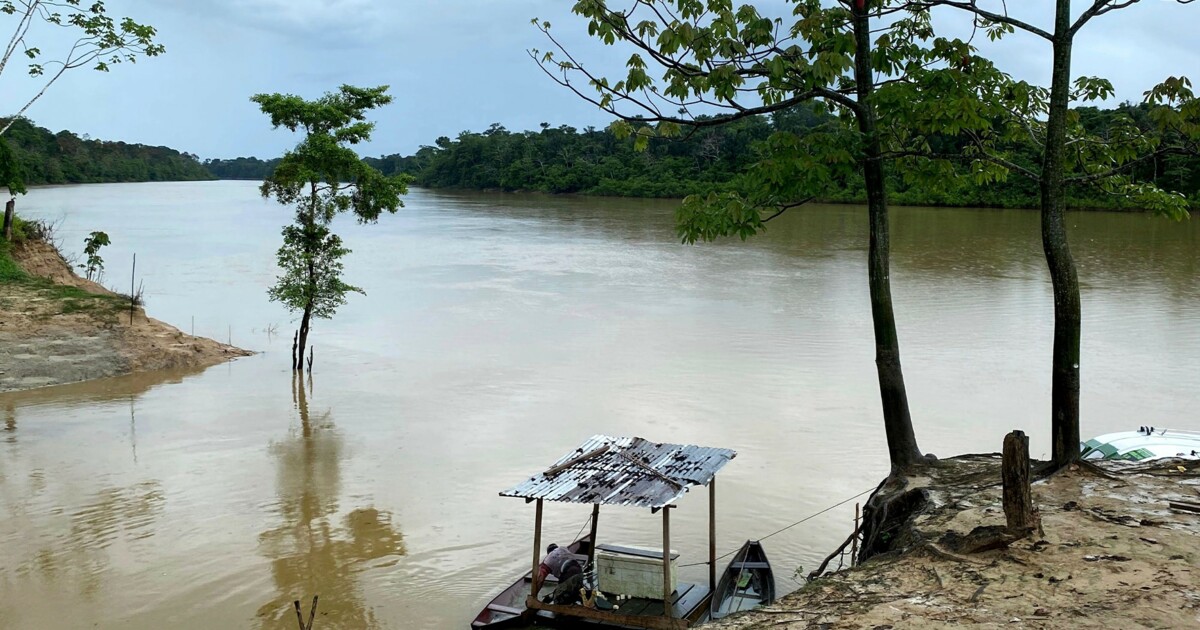
Two thousand miles north-west of Rio de Janeiro, the Javari Valley is a swathe of the Brazilian Amazon larger than Scotland and accessible only by boat or helicopter. Its ecological riches and isolated tribes – sixteen known groups, the largest concentration of uncontacted peoples on earth, with drones intermittently detecting the vestiges of other tribes – have tempted outsiders for decades. Residents from the rest of the country have been barred from entering the Javari since 1996 on account of the danger they pose to native populations. But they come all the same, catching motorbike-sized arapaima, hauling away hardwood trees and killing Indigenous people through disease – nearly a tenth of the reserve’s six thousand inhabitants died between 2000 and 2010 – or violence: when a group of isolated Korubo was contacted in 1996, one in three had gunshot fragments in their bodies. For the cartels, the Javari is an operations hub. It borders Peru, where coca is harvested, and Colombia, where narco-profits are often laundered, and provides a tangle of waterways leading deeper into Brazil, the world’s second largest cocaine market. For missionaries, meanwhile, the Javari is the final frontier – ‘the darkest, densest, hardest to reach place in all South America’, in the words of a helicopter pilot working for the New Tribes Mission.
For the journalist Dom Phillips, the Javari Valley represented a test for the Amazon and its future. ‘More threatened than it had been in decades’, the region was contending with ‘contamination from heavy pollutants, illegal gold mining barges entering its rivers to the east, armed commercial fishing gangs prowling and ranchers pressuring its southern edges’. If the most remote part of the jungle couldn’t fend off such intrusions, the future of the rest of the Amazon seemed hopeless. During his first trip to the region, reporting for the Guardian in 2018, Phillips shadowed an expedition that travelled six hundred miles across the reserve by foot and boat. An Indigenous group – the Marúbo, first encountered a century earlier by Peruvian rubber tappers – had begun receiving visits from unclothed nomads with long hair who stole knives and bananas, occasionally leaving behind offerings of freshly killed rodents. Who were these people, and what did they want? Over the course of seventeen days, the team’s leader, Bruno Pereira, an official at Brazil’s Indigenous affairs agency, Funai, related forest wisdom between mouthfuls of boiled monkey brain; a pair of Korubo provided security, carrying tribal bludgeons on their shoulders and tracking wild boars and sloths. By the end of the expedition no signs of the uncontacted tribe had been found other than a series of plant stalks bent at 45-degree angles. ‘More pieces to the jigsaw puzzle helping create an understanding of this isolated group,’ Phillips wrote.
By the time he returned to the Javari in 2022, Jair Bolsonaro had come to power and started making good on his promise to turn the Amazon’s ‘rich lands’ full of ‘poor Indians’ over to development and extraction. He gutted environmental agencies, forced Indigenous experts like Pereira out of their jobs and put an evangelical pastor in charge of Funai’s Uncontacted Tribes Unit. Phillips was on a research trip for a book he was writing about the Amazon and how it might be spared irreversible destruction. On the morning of 5 June, he and Pereira were preparing to leave São Rafael, a village on the northern edge of the reserve. In the wake of Bolsonaro’s election in 2018, it had increasingly fallen to Indigenous scouts to patrol the Javari’s thousands of miles of waterways, looking for illegal fishermen and torching the barges of bandit gold miners. Phillips had come to tell their story. The two men’s destination was Atalaia do Norte, a community a dozen miles up the Itaquaí river. A photograph taken that morning shows Phillips sitting in a canoe, speaking to a local man in a black cap and camouflage cargo trousers who is holding a child in a green shirt. Phillips is recording the conversation on his phone. Minutes later some of the villagers watched as he and Pereira cast off in a narrow aluminium boat with a 40-horsepower engine. Pereira had a chrome .380 Taurus pistol; Amarildo da Costa de Oliveira, a poacher known as ‘Pelado’ who lived a few bends up the river, had recently fired a round in his direction, and the previous afternoon had passed São Rafael in his speedboat with a bandolier of shotgun cartridges round his waist.
Phillips had texted his wife a few days earlier: ‘I probably won’t have signal again until Sunday. I love and miss you.’ At midday on Sunday she still hadn’t heard from him. That afternoon, Indigenous scouts began searching for Phillips and Pereira. Two days later they were joined by police and military units. On the fifth day an Indigenous searcher spotted slash marks on a tree trunk beside the river, suggesting that a boat with a propeller had slammed into the bank. A day later, investigators searching in a remote swamp found a spoon, a knife and cargo trousers like those worn by Phillips. At last, ten days after Phillips and Pereira went missing, Pelado started talking. He led officials into the woods behind his house where the bodies of both men were found buried beneath several feet of mud. They had been burned and dismembered.
In 1968, the British writer Norman Lewis arrived in the Amazon to find that Brazil’s military dictatorship was on the verge of finishing – by chainsaw, shotgun and Bible – what the conquistadors had begun more than four hundred years before. In the thirty years that had passed since Claude Lévi-Strauss catalogued their myths and customs, the number of Bororo had dropped from thousands to hundreds. In the 1930s, there were ten thousand members of the Cinta Larga; by the 1960s five hundred remained. In 1963 a rubber firm called Arruda, Junqueira & Co had hired a pilot to drop dynamite on the tribe’s largest village before sending in gunmen to finish off the survivors – a massacre that, had a participant not confessed his role to a priest, would probably never have become public knowledge. Many such incidents went unreported in the postwar campaign to clear the Amazon of its last tribal populations; the new state slogan, ‘a land without men for men without land’, was true enough for the hundreds of thousands of Brazilian families lured from the shanties of Rocinha and the plains of Goiás to a jungle threaded with new highways and divided into plots of forest that were given away to anyone who pledged to remove half of the trees. In 1541, European explorers sailing down the Amazon had passed as many as twenty villages a day, according to the chronicler Gaspar de Carvajal – many scholars believe that the basin’s population exceeded eight million. By 1970, fewer than a hundred thousand of their descendants were still living in the forest.
By the time Phillips came to Brazil, these Indigenous populations were at once more protected and more vulnerable than they had been during the decades of military rule. Following pressure from Survival International (founded in response to Lewis’s reporting from the Amazon for the Sunday Times) and Funai, Brazil’s 1988 constitution recognised the right of Indigenous peoples to their ancestral lands and obliged the state to protect them against incursion. Indigenous territories were demarcated, illegal airstrips were destroyed and settlers were expelled in cargo planes. By 1992 more than two hundred reserves had been established across the country. But cordoning off remote areas of forest, most of them too large for the state to defend and all rumoured to contain precious resources, often made tribal lands more attractive to intruders, and sometimes to neighbouring Indigenous populations. The Javari Valley was a case in point. In 1996 it was sealed off from the rest of Brazil, at least in theory; but illegal gold miners continued to trespass, and as late as 2017 gold prospectors could still go into a bar and boast of having just murdered ten tribespeople. Another consequence of the bureaucratic protection of native lands was that, from the 1990s, many of their most prominent defenders were no longer Indigenous, but environmentalists, lawyers, activists, scouts and journalists who came from other parts of the country.
Phillips wasn’t an obvious heir to this tradition. When he arrived in Brazil at the age of 43, he didn’t write about politics or the environment. He’d cut his teeth as a reporter two decades earlier on London’s rave scene. His pieces for the dance music magazine Mixmag ranged from gonzo dives into drugs to profiles of DJs. In 1992 he coined the term ‘progressive house’; he became Mixmag’s editor the following year. In 2007 he decided to move to Brazil to finish Superstar DJs Here We Go!, a book about rave culture and its commercialisation. He met his second wife there and began learning Portuguese. He covered the 2014 World Cup for the Washington Post and, two years later, reported on the Rio Olympics for the Guardian.
In How to Save the Amazon (Bonnier, May 2025), the half-finished manuscript Phillips left behind which was completed by his friends and colleagues, the Guardian journalist Jonathan Watts suggests that two reporting trips in 2015 were responsible for Phillips’s awakening. For the Washington Post, he helped profile an Indigenous group called the Guajajara who, fed up with illegal loggers ransacking their reserve, decided to form their own militia, tying up intruders and burning their trucks; in response, the loggers began introducing alcohol to the Guajajara, 42 of whom were murdered between 2000 and 2018. Then, in a dispatch for the Guardian, Phillips tracked the fallout of the collapse of a tailings dam near the south-eastern city of Mariana, which sent sixty million cubic metres of toxic sludge down four hundred miles of riverways, killing nineteen people and smothering thousands of acres of wetlands.
As Phillips came to see it, the deforestation of the Amazon was the work of a stupendously profitable interlocking network of corporate and political actors. ‘You don’t have to look far in the Brazilian Amazon to find people breaking the law,’ he writes in How to Save the Amazon: ‘the articulated truck, loaded with enormous logs’; ‘the nurse at an isolated health post on an Indigenous reserve, obliged to tend bullet wounds and snake bites in miners who shouldn’t even be there’; ‘the sprawling cattle ranch whose skinny animals range among charred tree trunks’; ‘the wrecked flatbed trucks, lacking doors and bonnets and licence plates, like props from the Mad Max films’. In the Brazilian interior, legality ‘exists in a separate dimension, where people only need to pay it passing attention from time to time’.
But Phillips also came to see that there was a parallel story which hadn’t been properly told: the emergence of a resistance network of experts. Many were from Indigenous groups like the Guajajara. Some worked for NGOs; others were botanists or agronomists or açaí harvesters. Scattered across the Amazon, largely unaware of one another’s existence, they were attempting to fish, grow food and cut down trees in a way that ensured the generations that followed them could do the same. Many faced threats and had been killed. For Phillips, their collective knowledge was akin to the jungle’s Indigenous languages and plant remedies, wisdom to be documented before it disappeared.
Bruno Pereira was part of this network. The son of a sales executive, he grew up in the coastal city of Recife. In 2010 he was hired by Funai and sent to the Javari. The local Marúbo were convinced that a mistake had been made: the new gringo was too ungainly to help patrol their land. But Pereira won them over after lugging a heavy antique radio battery hundreds of miles from one end of the valley to the other. Over the next decade he absorbed all the Indigenous knowledge he could, learning five native languages, memorising tribal chants, taking ayahuasca with the elders and, in 2014, acting as a peace broker in a bloody dispute between a group of isolated Korubo and a Matsés village. He observed Indigenous society – its deference to a forest with which it aspired to exist in equilibrium – and concluded that there was no other way to live. By 2019, however, the greatest threat to Pereira and the Indigenous of the Amazon was the state that employed him. When Bolsonaro slashed funding for Funai and fired its leadership, Pereira took a leave of absence and thought about his next move. He decided to stay in the Javari and shore up its defences, helping to lead a new patrolling outfit of mostly Indigenous scouts and securing drones, GPS trackers, security fencing and camera traps.
According to his confession to the police, Pelado was sitting on his porch a few miles up the Itaquaí from São Rafael when he saw Phillips and Pereira’s boat. He grabbed his 16-gauge shotgun, some modified lead ammunition used for hunting, and fetched a neighbour. ‘Let’s go kill him,’ he said, referring to Pereira. Phillips and Pereira probably didn’t hear the 60-horsepower black speedboat behind them. Phillips took a shot to the ribs; Pereira managed to fire several shots despite his back being peppered with bullets. Over the next few hours Pelado called in other local fishermen to help him conceal the crime. They sank Pereira’s boat with six sacks of clay and moved the bodies three kilometres away.
Pelado’s confession may have settled the immediate question of who killed Phillips and Pereira. The bigger question – one that Phillips himself repeatedly asked during his reporting on the murder of activists and environmentalists across the Amazon – is why, despite having made many documented threats against Pereira, Pelado was convinced he could get away with murder. He is currently in a high-security prison awaiting trial, having retracted much of his original confession. He now claims that he never intended to murder either man. He only acted in self-defence – Pereira fired at him first.
Pelado’s family had moved to Brazil’s north-west corner during the dictatorship, and he grew up in the Javari Valley. He was four when a pair of Petrobrás oil surveyors were clubbed to death by Korubo warriors; in retaliation, settlers burned several of the tribe’s longhouses and distributed poison-laced flour to its members. Seven years later, one of Pelado’s relatives led a band of fifteen settlers into the woods, where they murdered three Korubo and tossed their corpses in a river. ‘We are civilised,’ his aunt later insisted. ‘We are not Indians.’
In 1996 more than thirty thousand square miles of territory was cordoned off to form the Javari Valley Indigenous Territory. Officials swept through the valley, building watchtowers, establishing river checkpoints and evicting all non-Indigenous residents. But the settlers didn’t go far. Calling themselves ‘os sem rio’ (the riverless), many of them moved into wooden structures on stilts that they built along the northern edge of the reserve. The election of Bolsonaro promised a return to the frontier years of military rule. He openly lamented that a North American-style genocide of native populations had never taken place in Brazil. After thirty years spent struggling to keep fishermen like Pelado out of the Javari, Funai agents were being laid off. For the riverless, a return to their parents’ land and its unexhausted reserves of arapaima and gold seemed possible again. The only thing standing in the way was Bruno Pereira and his Indigenous scouts. ‘If we kill Bruno,’ Pelado told a relative in a bar in a conversation later related to a journalist, ‘we’ll be the bosses of everything here.’
In the Guardian’s podcast series Missing in the Amazon, the paper’s Latin America correspondent, Tom Phillips, says that one could view the murder of Dom Phillips and Pereira as the result of a clash between two incompatible conceptions of the Amazon. Pereira came to the Javari Valley and saw it as something to be protected at all costs; Pelado grew up in it and saw it as something to be exploited. But, as Tom Phillips points out, this interpretation assumes that Pelado was acting of his own accord. Brazilian investigators have since pieced together a more complicated story, one in which Pelado was a cog in a system he himself may not have fully understood. It’s not improbable that Pelado – who had an expensive speedboat and an arsenal of weapons, who could call on accomplices from across the valley to help cover up his crimes and who seemed peculiarly confident that he could murder a celebrated indigenista and a foreign journalist without repercussions – was getting money from, and was answerable to, something more powerful than a local poaching network.
Last February I travelled to Leticia, the second most violent town in Colombia, thirty miles from where Pelado shot Phillips and Pereira. It hugs an 18-mile strip of asphalt; everything must be brought in by barge or plane. Yet Leticia owes its existence to what the rest of the world could extract from its environs. In the early 20th century, speculators descended on a belt of rubber trees running through the heart of the Amazon. Then as now, Brazil, Peru and Colombia were unable to assert much control over the territory or to agree on who owned the river islands that appeared then vanished with the rain. ‘There is no law there,’ a Peruvian colonel complained. ‘The strongest, the one with the most rifles, owns the justice.’ From that vacuum emerged a company state, run by the London-registered Peruvian Amazon Company, whose atrocities – at least forty thousand Indigenous people were enslaved and worked to death – were exposed by Roger Casement in 1911. Over the next decades the rubber boom ended, but Leticia kept growing. It became a magnet for uprooted tribespeople, Mennonites, sex traffickers, spies for the guerrilla group FARC, currency exchangers and murderers. In 2019, Pereira’s right-hand man was shot twice in the head in front of his family while riding his motorbike through the town’s Brazilian quarter.
Today, Leticia has a fish market that specialises in decapitated arapaima with fatty meat that is dislodged using ice-cream scoops; it’s likely that many have been trafficked out of the Javari. Contraband continues to move across the Amazonian tri-border, where police are rotated out every six months to prevent their loyalty being bought by gangsters and, as in the adjacent Javari Valley, ventures such as the illegal fishing of arapaima are presided over by transnational groups whose main business is cocaine.
One morning a Tikuna man called Anderson agreed to show me his plantation. We set out down the Amazon, past naval gunboats, fleets of canoes bearing schoolchildren and floating casinos. After three hours Anderson steered us down a thin dark river that coiled towards the Javari Valley. We passed a wooden tower marking the border with Peru; a few soldiers nodded at Anderson, seemingly unfazed by the possibility that we might have been transporting chemicals for cocaine production – on many days, that is what he’s doing. An hour later, we began to be able to make out a jumble of neon blue vats in a swamp. A pitched black tent sheltered the ‘laboratory’: a rusting iron scale, some tarps for drying leaves and several tubs of cement mix and bootleg petrol used to manufacture paste. Up a muddy incline, an expanse of jungle had been cut down and replanted with acres of coca. A single towering tree remained, offering shade to a dozen pickers; the foreman signalled a water break by getting his parrot to squawk repeatedly. I asked Anderson who his boss was. ‘Many bosses,’ he answered uncertainly. ‘They live in Bellavista.’
This is a grungy town an hour away, on the Peruvian side of the river, where the cacique, a local Tikuna chief missing all but his two front teeth, told me that outsiders now arrived every few months by plane, landing at an airstrip cut out of the jungle. They started coming fifteen years ago and had since set up around 150 labs up and down the river. Sometimes the police attempted to stop production and flew helicopters over Bellavista, but this was mostly to keep up appearances; Peruvian officials pocketed their cut (estimated by the cacique at $1000 per lab each month) and turned a blind eye. Cocaine brought money to Bellavista, some of which was used to buy exercise books for schoolchildren and build infrastructure in the town, but the influx of cash had another effect: almost all the teenagers and adults had stopped fishing and farming and now picked coca leaves for a living.
In October 2022, four months after Phillips and Pereira were killed, Indigenous activists returned with metal detectors to the stretch of swamp where Phillips’s cargo trousers had been discovered. They were looking for Pelado’s shotgun but instead found, deep in the mud, Phillips’s notebooks and Pereira’s phone. The last photograph of Phillips – the one showing him sitting in a boat in São Rafael – was salvaged from the phone’s memory chip. When he was first questioned by the police, the fisherman in the photograph denied any involvement in the killings. But a later search of his phone records revealed that, in the six days between Phillips and Pereira’s arrival in the Javari and the day following their murder, the fisherman had 419 calls with a figure the Brazilian authorities have come to refer to as ‘Colombia’.
This man, whom Brazilian police have named as Rubens Villar, is emblematic of the fluidity of the jungle’s triple border. Possibly born in a fishing village up the Amazon from Leticia, he has Peruvian, Brazilian and Colombian identity cards, each with a different name and date of birth. Hardly anything is known about his true identity or who he was working for. When asked about him, locals tend to pretend they didn’t hear the question. What is clear is that, by 2022, he was based on a peninsula on the Peruvian bank of the Javari, where, police believe, he acted as an intermediary between wildlife poachers and cocaine traffickers, handling the export of arapaima out of the Amazon and arranging the import of weaponry and cash into it. It was ‘Colombia’ who, according to the Brazilian authorities, provided the motorboats and ammunition Pelado used to kill Phillips and Pereira. His communications with the São Rafael fisherman raise the possibility that the murder was not a spontaneous act but an organised hit. For four days, the movements of the two men along the Itaquaí were in all likelihood being monitored, discussed in the fishing villages of the Javari, then relayed up the criminal ladder of the Amazon.
In the final episode of Missing in the Amazon, Beto Marubo – one of Pereira’s closest friends and a representative of the Indigenous Peoples of the Javari Valley – is asked about the Amazon’s future. He outlines a grim scenario, in which an ecosystem chronically vulnerable to exploitation may soon become the world’s biggest and most uncontrollable gangland. For all the worries about deforestation reaching a point at which the Amazon begins emitting more carbon than it absorbs, there’s another future, probably a closer one, in which criminal organisations – better funded and organised than the states claiming to combat them – decide who comes and goes on what they see as their turf and enrich themselves by destroying patches of wilderness as they see fit.
The trial of the men charged with murdering Phillips and Pereira – ‘Colombia’, Pelado and Jefferson da Silva Lima, who accompanied Pelado in the motorboat – is expected to begin this spring in Tabatinga, which abuts Leticia on the Brazilian side of the border, before a jury that is likely to include fishermen and smugglers. In late 2024, charges against a fourth suspect were dropped on grounds of insufficient evidence. Meanwhile, despite Lula’s election, it seems increasingly unlikely that the efforts to bring the killers of Phillips and Pereira to justice will develop into a broader campaign against the destruction of the jungle and the impunity of poachers and loggers – to say nothing of the corporate and financial interests profiting from its devastation. Federal police, sent back to the Javari Valley in the wake of Lula’s victory, have since been withdrawn again. Along the Itaquaí, arapaima fishermen and gold miners are back in business. An Indigenous campaigner against illegal fishing was recently approached by two men who invoked the killings of Phillips and Pereira: ‘Wise up or the same thing will happen to you.’