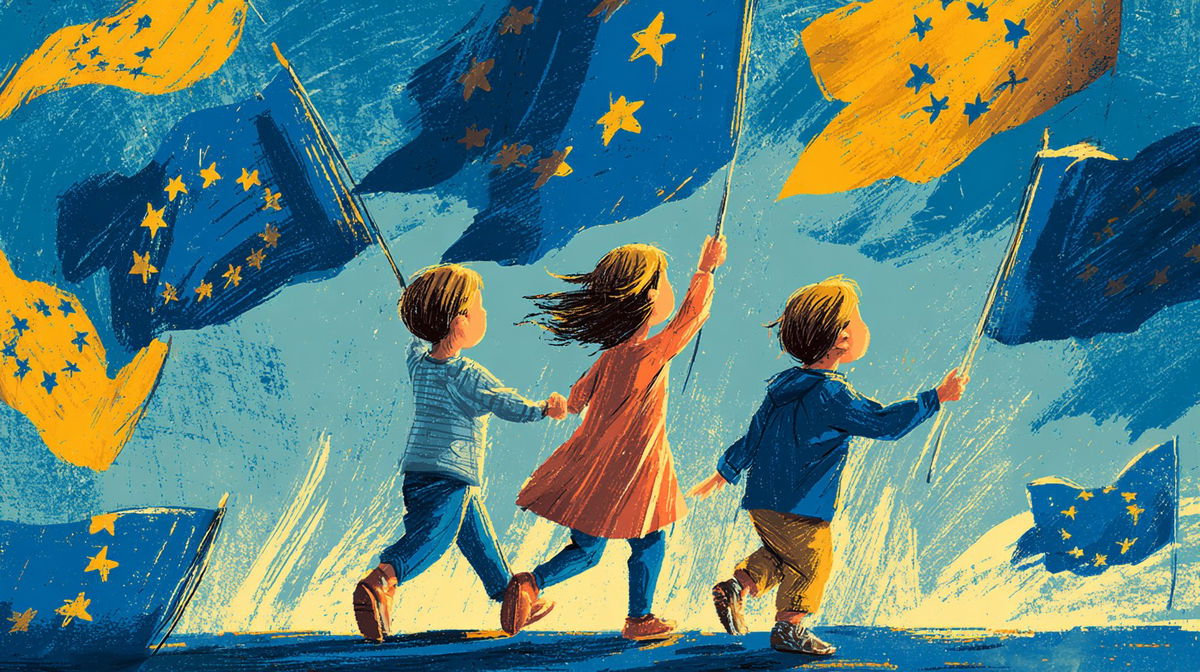
As global powers carve out their spheres of influence, Europe is reaching for a new sense of self. The good news is that Europe has its fate in its own hands. To future-proof their societies, European states urgently need to invest in the generations to come. In a new policy paper, we discuss the importance of policy learning for improving opportunities early in life and make concrete proposals, building on expertise from across the continent.
Much of Europe’s potential lies in its children. Yet nearly a quarter of minors in the EU are at risk of poverty, and hardship is passed from generation to generation. Child poverty is particularly widespread among families where parents’ educational attainment is low. To strengthen children’s opportunities, the EU passed the Child Guarantee in 2021. As a recommendation, it creates a space for policy learning, where member states are encouraged to take inspiration from promising practices across the Union. Such competition and exchange of innovative policy ideas is arguably one of the EU’s biggest strengths—if it is done correctly.
For policies to be successfully transferred, research suggests they need to fulfil at least three criteria: they must have a reputation as innovative solutions to domestic problems, be coherently adaptable to the domestic institutional context, and align normatively with the agendas of relevant stakeholders. Beyond good ideas, however, this also requires a mindset of learning. Some states have long realised this and actively use the Child Guarantee to develop meaningful reforms. Others could still benefit from a more proactive exchange of ideas.
Germany’s policy patchwork is costing its children
Faced with persistent child poverty despite immense national wealth, Germany is a prime example of this reluctance. In just half a decade, Europe’s largest economy dropped from the strongest to the weakest third of EU states regarding severe material and social deprivation among young children. Yet, Germany’s national action plan on the Child Guarantee primarily repackages pre-existing projects and policies while lacking genuinely groundbreaking reforms.
Smart, Progressive Thinking on the Big Issues of Our Time
Join 20,000+ informed readers worldwide who trust Social Europe for smart, progressive analysis of politics, economy, and society — free.
For policy learning to be effective, a state’s specific challenges must be identified. Germany, for instance, faces a political patchwork in which competences and responsibilities are divided horizontally and vertically between numerous actors. Additionally, compartmentalised and complex services constitute a social-policy maze for recipients. Regional inequalities are also starkly evident in outcomes: all East German municipalities surpass the EU’s 2030 target of 45 per cent of under-three-year-olds being enrolled in formal education or care, while 97.6 per cent of municipalities in West Germany fall short.
Exploring potential remedies, we combined comparative research, expert conversations, and guest contributions to derive seven policies that lend themselves well to transfer under the Child Guarantee.
A few “low-hanging fruits” fit well both institutionally and normatively, making them comparatively easy to transfer. Inspired by Ireland and Portugal, Germany could establish a Child Wellbeing Office linked to the federal Chancellery while encouraging local and regional action plans. Following the “House of the Child” model from Flanders, the federal government could further encourage wider coverage of and consistent quality standards for “family centres” through a framework regulation. On top of that, when implementing planned reforms of education and participation benefits, Germany could engage in exchanges with states like Sweden to learn from their experiences in providing dedicated cards for such benefits and services.
Institutionally fitting but politically more challenging, we also identified three “contested matches” that are well-transferable, assuming political controversies are resolved. Germany could take inspiration from its Nordic neighbours and expand permanent funding in the area of child policy, update parental leave benefits, introduce a dedicated paternity leave scheme, and constitutionalise children’s rights.
Finally, we argue that Germany can look to Estonia for ideas around proactive family policy. Benefits and services could be offered automatically and digitally to reduce non-take-up and bureaucracy while easing administrative pressure on young families. This, however, could well be considered a paradigm shift for Germany, entailing non-trivial institutional and political requirements. Crucially, these are resolvable—if the federal government prioritises the issue.
Europe must go back to school
Germany is not an isolated case. Similar patterns and challenges can be found in other member states. These policies are just a few examples of what is necessary more broadly if Europe wants to make its welfare states, its economies, and its societies resilient and fit for the future: resources for and a mindset of proactive policy learning.
As the Child Guarantee approaches maturity, states like Germany that were long sure of themselves and avoided necessary social-policy reforms would be especially well-advised to look to their neighbours for innovative concepts. In 2026, the European Commission can nudge member states in the right direction, be it through the country-specific recommendations in the European Semester or in reaction to upcoming biennial reports on the Child Guarantee. Ultimately, however, national governments are the ones that must invest in their children to weather the political turbulence ahead.
Help Keep Social Europe Free for Everyone
We believe quality ideas should be accessible to all — no paywalls, no barriers. Your support keeps Social Europe free and independent, funding the thought leadership, opinion, and analysis that sparks real change.
Social Europe Supporter
— €4.75/month
Help sustain free, independent publishing for our global community.
Social Europe Advocate
— €9.50/month
Go further: fuel more ideas and more reach.
Social Europe Champion
— €19/month
Make the biggest impact — help us grow, innovate, and amplify change.