Maybe it’s just me , but the publication of John Updike’s selected letters, masterfully assembled and presented by James Schiff, doesn’t appear to have been the parade event that might have been expected. The reviews have been largely laudatory, marbled with tribute to Updike’s impeccable filigree, effortless versatility, unfaltering application and sleek plumage, but I don’t get the sense that the accolades have resonated beyond the baby boomer contingent of Updikeans who matured with the Rabbit Angstrom novels and counted on the continuing nourishment of his presence in the New Yorker. Perhaps Updike’s gifts and graces were too easy to take for granted, bannered for so long while he was alive. Whatever the explanation, betwixt and between is a strange place for any major writer to be more than a decade and a half after their death, and Updike’s standing in the literary hereafter remains profoundly iffy. It’s one thing to fall out of fashion, another to fall out of favour, and Updike seems to have fallen out of both while still being suspended mid-air, cushioned by the thermals while posterity figures out what to do with him.
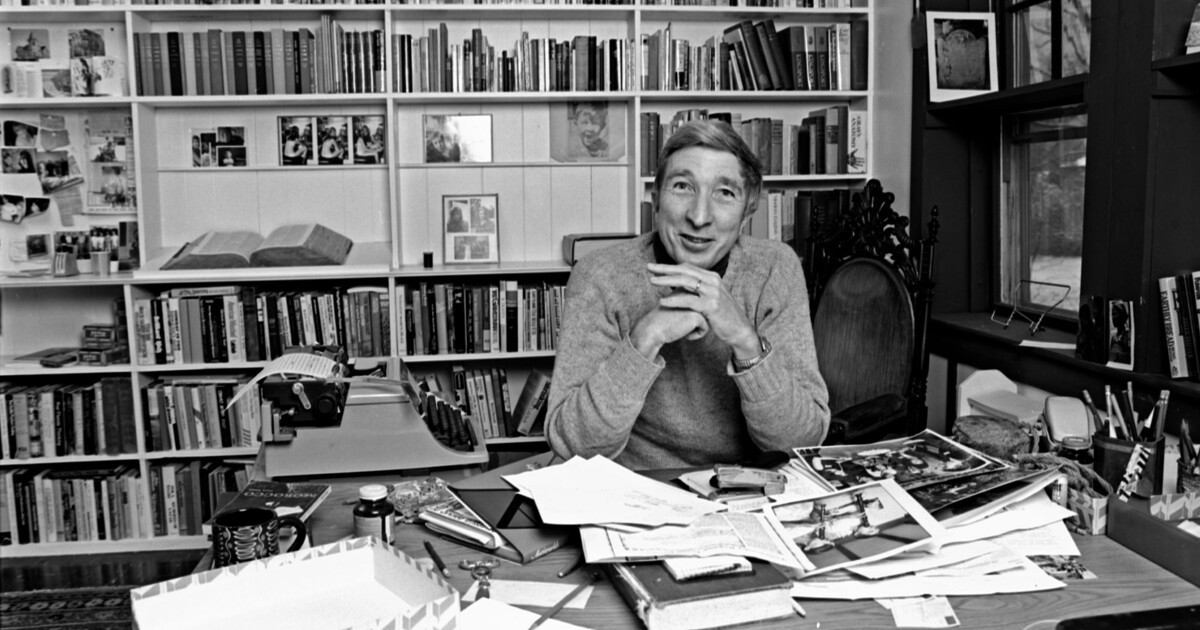
Born in 1932 and raised in Pennsylvania, a child of the Depression, Updike reached prominence during the Kennedy era as American literature’s princely elf, his Jiminy Cricket nose peering down with amusement, his tall, gangly frame having the lanky assurance of someone preparing to sink a basket from the free throw line. (The scrape of sneakers on the basketball court was one of the authentic touches in Rabbit, Run.) He became imprinted on the public mind while skirting celebrity, his features a cartoonist’s dream. To his admiring public, which grew over the years like the epic tree rising through the stage floor of Balanchine’s Nutcracker, Updike never seemed to suffer from writer’s block, dark 3 a.m.s of the soul, loss of confidence in the cockpit. Apart from a slight stutter and acute psoriasis, which he wrote about with bemused, clinical aplomb in his memoir Self-Consciousness (1989), he seemed to defy age and attrition, remaining nimble and smooth on the page, his brain a well-oiled Leica. With the exception of the still generative Joyce Carol Oates, a frequent pen-pal in the letters (and presiding grande dame of X, garrotting Elon Musk with brisk dispatch), Updike’s productivity was unmatched among his peers. Even on his deathbed (he died in 2009 of lung cancer), he had multiple projects mapped out. Quantity didn’t corrode quality for most of his marathon trot. There were books that didn’t click with readers and critics, books that he knew would be orphaned on release, but he never turned in a bum performance, a money grab. His hall of fame stats are beyond dispute: numerous bestsellers, countless awards, multiple volumes in the Library of America, and, perhaps the ultimate honour, a cameo on The Simpsons.
Despite his astonishing range (poems, prefaces, novels, collections of short stories, essays and reviews, the play Buchanan Dying, a gathering of golfing meditations, art criticism for museum-goers – museums for him doubling as erotic temples), Updike foresaw that he might become a victim of typecasting, tagged as an exhibit. In a letter to Ian McEwan in 2005, he mused: ‘It occurs to me that since you interviewed me that first time in a BBC studio you have risen to be generally called the best novelist of your generation whereas I have fallen to the status of an elderly duffer whose tales of suburban American sex are hopelessly yawnworthy period pieces.’
Yawnworthy is in the mind of the yawner and the period Updike planted his flag in remains vivid. His parcel of suburban America was one of shiny appliances, finned automobiles with hood ornaments fit for Vikings, black and white television sets piping perky laugh-track entertainment into the living room as the kids did their homework lying on the rug, backyard barbecues, pool parties, and drunken passes and spats at cocktail parties that entered local lore. Updike’s early stories emanated a Kodachrome glow, pictures pasted in a scrapbook preserving youth, hope and trim figures, with intimations of distress ahead. Progressive pundits didn’t need to make the case for abundance in the Ike-JFK-LBJ era because abundance was everywhere apparent, at least in Leave It to Beaver land. ‘America is a vast conspiracy to make you happy,’ Updike later wrote.
Not any more, Bucky. America, ripping off its Reagan mask, has become a vast conspiracy to keep Americans on edge, in debt and at one another’s throats. The supermarket and pharmacy product aisles that Updike lovingly inventoried down to the last nozzle would come to be depicted by Don DeLillo and others as transmission belts of paranoia and confusion. Unlike J.D. Vance and conservative podcasters such as Ben Shapiro and the late Charlie Kirk, Updike was never in thrall to American exceptionalism. He never longed to return to an imaginary yesteryear when everyone knew their place and personal pronouns were as distinct as a pen and pencil set. He was a lifelong Democrat who didn’t lurch right as he got older; he defended FDR and the New Deal against right-wing revisionists, flew to Florida to help with the vote count in 2000 and adored Barack Obama. His fiction bore witness to the country’s slow corrosion. Updike’s first Harry ‘Rabbit’ Angstrom novel, Rabbit, Run (1960), is a study of youthful promise and energy ineluctably going to seed. It engendered a tetralogy, the Raj Quartet of American torpor. The second stop on the cabbage trail, Rabbit Redux (1971), is a vivid and harrowing depiction of social crack-up counterpointed with the moon landing, and captures the ominous smoke in the air. Updike would eventually forgo his anthropological studies of suburban tribes and their sullen offspring because he couldn’t bear further examination of unpaid mortgages and obesity. Luckily for him, he had little idea of how much blubber lay ahead.
Suburbia was central to Updike’s battle map as a novelist because it’s where the eros could be waged in close quarters with access to actual trees and picnic grounds for gulps of fresh air, whereas free love in Greenwich Village or some San Francisco beatnik pad was sordid and itchy. Post-Pill (oral contraceptives became available in 1960), marriage was no longer a sealed coffin, a death-do-us-part pact; there were escape hatches, diversionary manoeuvres. Of course, there always were, but by the 1960s the prying eyes and doomed longings in a Douglas Sirk melodrama had given way to Twist parties and other pagan revels. The throbbing heart and loins of the Updike letters is the telenovela of passion, angst, guilt and other spicy fixings that was his break-up with his first wife, Mary Pennington, and the lateral move to his second, Martha Ruggles Bernhard. Mary, Martha – very biblical, a detail not lost on Updike, on whom nothing was lost, as Henry James had enjoined. Complicating matters for Updike was the fact that Mary was also taking lovers while he, when not cleaving unto Martha like a shipwreck survivor, carried out his own extracurricular sorties, including with a pair of Australian roommates. ‘Flirt, fuck, is there so vast a difference?’ he asks, to which the answer is, I guess it’s all a matter of what you can get away with.
Updike and Mary (who had four children), Martha and her husband, Alexander Bernhard (with whom she had three sons), were members of the Ipswich Group, a conga-line of swingers and swappers in Ipswich, Massachusetts, who were making the most of the sexual revolution while they were still limber and could afford babysitters. They regarded the commandment ‘Thou shalt not covet thy neighbour’s wife’ as a caution light rather than a stop sign, coveting one another’s spouses like crazy. Updike would describe himself as a mini-Mailer, a stag among the herd of housewife does. For a time, the shifting combinations of partners produced quite a kaleidoscope. You couldn’t tell the players apart without a scorecard in this melange of matinée bed-hopping, impromptu interludes in parked cars and furtive rendezvous when the significant other was out of town visiting mother. Eventually the tangled yarn untangled as the participants paired off in new household formations. In Adam Begley’s biography of Updike, published in 2014, we learn that ‘John separated from Mary in 1974, and they were divorced two years later. John and Martha married soon afterwards. And then, as if to demonstrate what a snarled web it was, Alex Bernhard, Martha’s ex-husband, married Joyce Harrington, John’s ex-mistress.’ ‘Oh l’amour, l’amour,’ as Mary Boland coos in The Women.
Until matrimony reinstated its grip, Updike gathered rosebuds wherever he lay. In letters to girlfriends, he rues that he may have fallen short (‘Will I ever be able to suck hard enough to please you?’), giving fine expression to Benjamin Franklin’s American credo of continual self-improvement, but post-coital tristesse and agenbites of inwit are rare. ‘And how nicely you blow; my recalcitrant member just twitched at the memory,’ he writes. Updike wasn’t one of those lazy recliners who failed to reciprocate. A giver as well as a receiver, he was an avid snorkellist. ‘The faint taste of your cunt in my mouth has become the most precious thing in the universe.’ Pages later, ‘I thirst for your cunt.’ To Martha: ‘Your fantasy of having some of my sperm to lace your tea makes me wish I was all cock … instead of being only a tiny fraction cock.’ But Martha, my dear, ‘You, in truth, are all cunt – your mouth is a cunt and your eyes invite me in and your whole being is as rosy if not as wrinkled as your very wonderful cunt.’ ‘You must help me look for your clitoris sometime,’ he urges. The letter continues as Updike makes fifteen additional numbered notes, running through the pad of Hotel Australia stationery helpfully provided by management. Number 15: ‘My cock is yours – up or limp, your toy and acolyte and (sometimes timid) explorer.’ The next letter, composed on the same stationery on the same day, is addressed to his estranged wife, Mary: ‘In the plane from Honolulu I had to watch The Way We Were again and found myself crying over the way we were (and are).’ What an operator.
When Updike bids au revoir to a girlfriend or mistress, he memorialises their involvement in a fond display of gratitude that seems all the more fluffed up for being genuine. To Joan Cudhea, one of the more cherished Ipswich irregulars, Updike pays tribute:
Thank you for so enjoying our day, or afternoon. I loved it. I loved being able to drive your Mazda and able – please don’t find the parallel insulting – to elicit pleasure from your body and mine and pleased that, 42ish as we are, you still kindle a remarkably high temperature of lust and happiness from me. Even the thought, what must have crossed both our minds, that this might be our last fuck, did not cloud the sun of our peculiar good humour, and the rather great degree of affectionate understanding that you and I have always given each other.
Then the tender sign-off, ‘I think you are a neat cunt.’ It’s the gallantry of a man used to getting what he wants and who, having got it, extends a final flourish, wishing to leave no ill-will in case future opportunities – another spin in the Mazda – present themselves.
It can’t be denied that Updike put all that fornication and eloquent embroidery to industrious use. His two favourite pastimes, reading Protestant theologians and periscoping other men’s wives, huddled under one roof in his breakthrough novel, Couples (1968), the book that boosted Updike into the major leagues of bestsellerdom and landed him on the cover of Time, his wheaty, squinty, Andrew Wyeth-esque head bearing solemn witness to ‘The Adulterous Society’. Prefaced with a quotation from Paul Tillich and with a high-gloss finish (‘his phallus sheer silver’ etc), Couples lent itself usefully to brow-furrowed editorial ponderings on the sexual revolution and its social tremors, unlike the exploding confetti and frantic wrist action of Philip Roth’s Portnoy’s Complaint and Gore Vidal’s Myra Breckinridge (all three published in one wigging-out year).
Couples was sexually explicit but morally serious, psychologically astute and starkly pore-examining, a John Cassavetes ensemble transplanted to a troubled patch of paradise semi-vacated by God. Intimations of profundity were flattened in the slideshow of Updike’s male gaze. The mysteries in Couples ‘all too often centre on how breasts will hang or spread, on whether a woman will be dry or wet, will “fellate” or not fellate’, complained the critic Anatole Broyard, quite the satyr himself. Another Ipswichian study of philandry and its fallout, Marry Me was a lumpy account of Updike’s affair with Joyce Harrington, which nearly wrecked his first marriage; the manuscript was kept in a safe deposit box for a decade. The abiding gem of the divorce books is Too Far to Go: The Maples Stories, most of which originally appeared in the New Yorker. It depicts the dissolution of Updike’s first marriage with graceful restraint, and the descriptive touches never flitter off into Fine Writing. In 1979, Too Far to Go was adapted into a television film starring Michael Moriarty and the divine Blythe Danner that still holds up today, if you can find it.
The longest, purest romance of Updike’s life was with the New Yorker, which began as an ‘adolescent crush’ – pre-adolescent, really: ‘I fell in love with the NYer when I was about eleven, and never fell out’ – and ripened into one of the most inspiring matings of man and magazine in the annals of troubadour song. As a young stripe, Updike sent off poems that were politely rejected, everything at that magazine being done with tact and courtesy, even when they were pushing some longtime contributor out to sea in a rowboat. Young John was undeterred by their polite nos. ‘The ice with the old New Yorker has been broken: they snappily returned my first story of the summer with a strangely reassuring rejection slip. I always feel happier when I’ve received one, for some damn perverse reason. A rejection slip represents a response, an acknowledgment, and a sort of accomplishment in itself. I love them.’
When his first poem was accepted, he sent his family a telegram to bugle the news: ‘New Yorker Buying Rolls Royce poem future things must go to Mrs White Whopee – LOVE John’. It is his LINDBERGH HAS LANDED moment. Not that he lets himself get big-headed. ‘Let’s face it: I am talented and intelligent, but not so much so that I can conquer the New Yorker simply by willing it.’ It would require sitting at the loom and learning to spin gold, which he proceeded to do. After he and Mary moved to New York in 1955 (for what would prove a limited period), Updike established himself as one of the sterling assets of the ‘Talk of the Town’ department, composing reportorial vignettes and musings that helped make his mark even though ‘Talk’ stories were then unsigned. Individual voices such as Updike’s – and, later, Jamaica Kincaid’s and George W.S. Trow’s – managed to peep up despite the magazine’s horse collar of wry urbanity. A volume of Updike’s Talk from the Fifties sits on my shelf, a memento of a metropolitan flâneur with notepad at the ready, sniffing in the sights.
Updike went on to become one of the magazine’s most prolific contributors, his sentences nimble, airy and balletically turned out, his observational acuity on a whole other optical level, as if Eustace Tilley’s trademark monocle had conferred X-ray vision. Where so many New Yorker contributors in the old regime seemed to have been born middle-aged, prone to neurotic fits, rampant hypochondria and hearing phantom footsteps down the hall, Updike radiated a youthful poise and confidence that stuck in the craw of some of his elders, most prominently the misanthropic humorist S.J. Perelman, a New Yorker fixture since the 1920s. ‘Nauseating’ was the way he described Updike’s calisthenics on the page. It was a futile snort.
A paragon of a good son, Updike had continued to post progress reports to his family in Plowville, Pennsylvania as he levitated to Harvard and the Harvard Lampoon and from there to the Ruskin School of Art in Oxford. With acceptance at the New Yorker, he was adopted into an extended family that interlocked with his own. His mother, Linda Grace Hoyer Updike, later published stories in the magazine and his son David would also find a path into the fiction section. Having secured a berth in the upper echelon of eminence, Updike never forgot to acknowledge the ancestral tribe of authors, editors and cartoonists who came before – Peter Arno, Charles Addams, John O’Hara, John Cheever, James Thurber, Dorothy Parker, J.D. Salinger, E.B. White, Katharine White (the Mrs White of his telegram) and the sainted William Maxwell – nor did he pull up the ladder against younger novices coming aboard. So entwined was his identity with the New Yorker and its denominational place in American fiction that for a time there was talk of the three Johns: O’Hara, Cheever and Updike, passing along the communion host. In a meditation on the three, published in the New York Review of Books, Alfred Kazin declared that ‘if to be “cool” is not just a social grace but awareness unlimited, Updike is the best of this cool world.’
This was in 1973. But as Anthony Giardina wrote in a recent issue of Commonweal, it’s Cheever who now seems our true contemporary, the holy ghost of the trinity. His stories can be stereotyped – as postwar pre-Mad Men cocktail hour, commuter-line period pieces – but their encroaching darkness and ineffable sense of their protagonists’ fallenness preserve them. Updike found a metaphysical soul brother in Nathaniel Hawthorne, modernising The Scarlet Letter in the trilogy of A Month of Sundays, Roger’s Version and S., and publishing the limited-edition monograph Hawthorne’s Creed, but it’s Cheever who evokes the haunted backdrop of Hawthornian romance, the Puritan pall.
At one point in his career, Cheever found himself shunted aside at the New Yorker as postmodernists, minimalists and collagists (specifically Donald Barthelme) became the vogue. Updike was spared the indignity of finding himself on the outs, though the perpetual honeymoon had its bumpy patches. Tina Brown’s Batmobile arrival from Vanity Fair to assume the editorship in 1992 initially proved trying. When her appointment was announced to much fanfare and baying at the moon, Updike didn’t huff off like Garrison Keillor, who packed up his desk and a lifetime supply of dudgeon and headed for the elevator. So long, suckers! Spared whatever psychodrama was roiling the New Yorker’s cubicles, Updike adopted a prudent wait-and-see attitude from his observation post in Massachusetts. Unlike her predecessor, Robert Gottlieb, spatula’d out of the editor’s chair after five years, Brown wooed Updike, treating him to lunch at the Four Seasons, packed with men in power suits. The most Gottlieb ever offered was a sandwich in his office.
Updike’s faith would be sorely tested, however. Like any number of aghast subscribers clutching the railings when the latest issue arrived in the mail, Updike considered some of Brown’s editorial decisions impulsive, disruptive and desecrating. ‘What she has done to the magazine in her first two issues shouldn’t happen to a dog,’ he fumed. He detested a cover illustration that reduced the magazine’s mascot to a ‘pimply street goon’. Four-letter words, quarantined for most of the publication’s history, ricocheted everywhere, and longer pieces became aggressively performative, grunting exercises: ‘This week, reading Joyce Carol Oates’s gruesome story after Harold Brodkey’s maundering about Brando was like a chocolate sundae on top of a banana split.’
Along with the big-name, high-price blowhards were some specimens of nouveau riff-raff that Brown had hauled over from Vanity Fair. To Michael Arlen, the New Yorker’s former television essayist, Updike bemoaned that ‘I never plough through one of Wolcott’s orotund, bad-breathed screeds on the latest in moronic television comedy without remembering your charmingly light-handed reviews, back in the Age of Light.’ Nothing quite like receiving a judo chop from the great beyond, an accusation of halitosis from one of America’s spearmintiest idols. (And ‘orotund’, I might add, is code for ‘fat’.) A pettier person might point out that the ‘moronic’ shows covered during this stint in purgatory included Seinfeld, Buffy the Vampire Slayer and The X-Files, which have shown more cultural staying power than the fiction of the period, including Updike’s own, but let’s not brood. By the end of Brown’s tenure, Updike, like many other haggard stalwarts, conceded that if she had sometimes vulgarised the magazine, she had also energised it, unloading the deadwood, loosening the corsets, broadening the range of subjects and driving away the ghosts. Equilibrium and a more restful decorum were restored under the editorship of David Remnick, whose courtesies and assurances made Updike feel as if he was still part of the venerable enterprise, even if some of his later stories were rejected. They wrote handsomely to each other until the end.
The intramural New Yorker communiqués are cordial and inspiring (especially those with William Maxwell, the mentor’s mentor), but it’s the literary shop talk, spiced with a dash of entre nous bitchiness, that offers dishier reading here. The shoptalk is sometimes indiscernible from guy talk. Updike congratulates Bernard Malamud on The Tenants, in particular ‘that black girl … with her miniskirt and tight cunt’. To Norman Mailer, in appreciation of Tough Guys Don’t Dance: ‘Thank you indeed for the copy of your new novel, and for including me and the pussy passage in it.’ (Mailer’s protagonist discloses that ‘I had never looked at a pussy properly until I read Updike.’) In response to Roth’s kind words about Memories of the Ford Administration (1992), Updike writes: ‘So glad you noticed the changing shape of pussies as the single most quietly pivotal event of our times. What do women think about, while they studiously bend over their crotches, razor in hand, consulting the template of the newest high-thigh swimsuit cut?’ If these two geniuses couldn’t figure it out, what hope for the rest of us?
Updike and Roth shared a brotherly bond as scrupulously hardworking literary craftsmen with libidinous propellers, who burst into the spotlight with taboo-breaking bestselling sex bangers and found themselves fending off the flurried attentions of impertinent interviewers, critical inquisitors in intellectual journals, English professors with theses to grind, gossip columnists, literary groupies and cocktail party sirens with plunging cleavages and sullen, inattentive husbands. Being a literary sex symbol can really take it out of you, making it tougher to maintain your lofty dignity as a quoter of Kafka and a conscientious purveyor of Quality Lit, as Terry Southern called it. That neither Updike nor Roth appeared envious of the other was unusual in this era of literary jousting. Of course, it couldn’t last.
Authors, being incorrigible, can’t resist getting into mischief, and Updike sank the Bismarck when he panned Roth’s Operation Shylock (1993) from his pulpit at the New Yorker. Given that Updike had told Roth that he liked the title and was looking forward to the novel (‘Keen to read fresh Roth, red in tooth and claw’), Roth was blindsided when Updike meted out a headmaster’s caning. ‘Roth … has become an exhausting author to be with. His characters seem to be on speed, up at all hours and talking until their mouths bleed.’ Roth was more than miffed; he was undone and unstrung. Updike’s imperious dismissal, sprinkled with a few of the usual grace notes kept in the petty cash drawer, helped send Roth into a tailspin that landed him in Silver Hill Psychiatric Hospital and fissured his marriage to the much put-upon Claire Bloom. Updike’s hit job wasn’t the sole cause of Roth’s breakdown. Chronic back pain, a knee operation and insomnia landed him in the clutches of the sedative Halcion. When Bloom later published her memoir Leaving a Doll’s House (1996), chronicling the dissolution of the marriage with the wounded stoicism of Lady Marchmain, Updike noted with a shrug: ‘And to think that my friendly little review broke it up. Well, you never …’
With the villainous Gore Vidal (said with utmost respect), there was never a falling out because there was never a falling in. He and Updike were never destined to compare notes on lady gardens, and the catechisms of the New Yorker held no sway over Vidal on his clifftop at Ravello. He considered the magazine and its vestal virgin readership parochial, coddled and swaddled, the real literary achievement and advancement happening elsewhere, in the greater world beyond the comma diddlers. After maintaining a wary distance from each other in print for decades, Vidal had grown fed up with Updike’s sly digs at him for being a political heathen (‘Apparently, I do not sufficiently love the good, the nice America, is the burden of his épingles’). He waited for a choice opportunity, unfurled his cape and struck. Take that, beanpole! In the TLS no less, an unfamiliar staging ground for rogue operations. Vidal’s mugging of In the Beauty of the Lilies (1996) is one of his most Basil Rathbone performances, executed with theatrical zeal and wicked asides, and wearily dismissed by Updike as an extension of Vidal’s ‘ineradicable rictus of a sneer’. Leaving aside the merits and demerits of Vidal’s arguments and his rhetorical overkill, it can easily be argued that he was a keener prophet of America than Updike, whose deference to authority and to the platitudes he once held dear dimmed his perceptions, leaving him unable even to take a clear stand against the invasion of Iraq. But then that was a war the New Yorker supported, and he wasn’t one to buck consensus.
Vidal had squirrelled away his animus for one coup de grâce. Not so Updike’s persistent nemesis, James Wood, a familiar name in these pages, who took to running a lawnmower over Updike every time he had the audacity to bring out a new body of intricately beaded words. Take his New Republic review of Terrorist (2006): ‘What is most striking about this novel is that, despite Updike’s massive familiarity with the technical challenges of fiction-writing – this is his twenty-second novel, for goodness sake – he proves himself relatively inept at the essential task of free indirect style, of trying to find an authorial voice for his Muslim schoolboy.’ The putdown of Terrorist is relentless and thorough, like a back-room beatdown in a James Ellroy novel, and Wood also gave a thorough kicking to Licks of Love in the LRB (19 April 2001). If Updike despaired of working on a novel only to have a ‘self-aggrandiser like Vidal’ defecate all over it, he must have considered Wood a serial defacer, albeit brilliant, deeply read, well-shod and all that.
So picture Updike’s dumbfoundment when some oblivious apparatchik invited him to take part in an onstage literary dialogue with Wood. In a letter to Cynthia Ozick, he wrote: ‘The elongating relation between me and Wood took a curious turn last month, when I discovered that he was scheduled to interview me on stage (that increasingly popular and loathsome attempt to make authors more interesting than their written words) at – get this – Unitarian church at Harvard Square.’ Updike refused to take part, instead doing a solo reading before ‘a congregation of perspiring culturati’, of which Cambridge has plenty. Years later, he altered his tune and tone about his phantom menace, expressing gratitude to a New Yorker editor for being part of a glorious procession. ‘I have been honoured to be one of the NYer’s book reviewers from Fadiman to Wilson and up to Gopnik and Acocella and Menand and the formidable James Wood.’ Elevated to chief book critic, Wood had received vestment, induction into the fold and with it an upgrade to the honour society. It may seem that these are trifling matters, but trust me they are of the utmost significance, or used to be.
It’s easy to peck and paw at the letters, that’s what these cockspurs are for, but there’s no belying the tremendous heft of this selection, amounting to an authoritative autobiography supplemented with photographs, chronology and an index that doesn’t skimp. It’s all here, Updike in full, and almost none of it has gone stale. An unbroken arc from boyhood to infirmity, the gravity’s rainbow of a life, career and mind. In some of the earliest letters, Updike is posting fan mail to comic-strip artists such as Milt Caniff (Steve Canyon) and Harold Gray (Little Orphan Annie); six hundred pages later he’s decrying the Boston Globe’s decision to stop running Spider-Man in the daily paper, a decision the Globe reversed, earning Updike a note of thanks from the man himself, Marvel’s Stan Lee: ‘To me you’re a fellow superhero! If you ever need me, just wiggle a web!’ Updike was as loyal to the lower-case geniuses of the funny pages as to the Hollywood blondes who lit up his balcony like incandescent bulbs, Lana Turner and Doris Day. He was all of a piece, engulfed in paperwork up to the end. Weeks before his death, Updike was making changes to a new edition of The Maples Stories, refusing to settle for good enough if a tweak could take a sentence up a notch. This editorial vigilance was instilled at the New Yorker, but few practised it as religiously and absorbedly as Updike, down to the last dot. When I reached Schiff’s final editorial note (‘John Updike died in hospice on 27 January, in Danvers, Massachusetts’), I got a thump in my chest, an echo of the one I felt when the news of his death first hit the wires. But then I had grown up reading the guy.
If Updike has fallen out of fashion, it’s partly because the vision of America he’s associated with has been rubbished and blasphemed beyond recognition. This isn’t Updike’s fault and it isn’t fatal, since he wrote a bushel of novels and poetry collections that are independent of facile bracketing. They include the Henry Bech story cycle, a bouncy picaresque of the literary world in which Updike impersonated a Jewish American novelist with nary a misstep or misplaced Yiddishism; Gertrude and Claudius (2000), a sympathetic prequel; The Witches of Eastwick (1984), that hot tub potboiler; and the valedictory Endpoint and Other Poems (2009). Perhaps the best way to appreciate Updike and discover what all the fuss was about is to start with the early stories and novels and carve out your own canon at a stately pace, as his lordship would desire. Even novels regarded as misfires or miscalculations contain phosphorescent passages of which no other writer, save Nabokov in his magic shop, seemed capable.
That won’t be enough for some, the fervent unpersuadable. The reason Updike has fallen out of favour is more resistant to remedy. His stature as a literary artist precariously balances on a Woman Problem that was zeroed in on by Patricia Lockwood in the LRB (10 October 2019), piloting the Millennium Falcon through the corpus. Literary legacy in our scrappy century is harder to maintain if you lose female readers, and the letters aren’t likely to stem the migration or win over novices. They may worsen the exodus. With female correspondents he considered literary or intellectual worthies and equals (Oates, Ozick, Muriel Spark, Diana Athill, Erica Jong), he was on best behaviour, courtly and solicitous, but fiction with too much feminine essence could bring out his alluvial worst. In an otherwise businesslike missive to his British publisher André Deutsch, he calls Edna O’Brien’s novel Night (1972) ‘a beautiful brilliant book, although a bit like being inside a cow’s vagina during a warm May rain. Awfully liquid, somehow, her vision. Miss O’Brien’s.’ Updike’s misogyny wasn’t as muscular as Mailer’s, or maniacal, as in the case of Roth’s anti-heroes swinging from vine to vine, but when it seeps out it leaves a stain tough to remove because it’s phrased with such lapidary care. Awfully liquid, her vision.
Then there is the issue of the cunt fixation, the word itself and its referent. Updike’s persistent use often reveals a colonial aspect, of territorial possession or advantageous incursion. As Vivian Gornick pointed out in her review of these letters for the Nation, ‘after Updike divorces Mary and marries Martha, there is not another word, at least in the letters in this volume, about either sex or Martha herself. Once she stops being all cunt, Martha becomes invisible.’
Instead, the luxuriantly rendered episodes of oral sex and the gynaecological probe reports were siphoned off to non-New Yorker fiction and became more acrid and irascible as the years wore on. (Seek My Face, his 2002 novel about a Lee Krasner-like painter, offers a slight reprieve.) The narrator of Toward the End of Time (1997) laments: ‘My sexual memories had become epics of a lost heroic age, when I was not impotent and could shoot semen into a woman’s wincing face like bullets of milk.’ (Until preparing this review, I had never read Toward the End of Time and now want my innocence back.) Comparing one woman’s cunt to another’s, the protagonist of Villages (2004) remarks, as if doing a sample tasting, ‘Smoother, somehow simpler, its wetness less thick, less of a sauce, more of a glaze.’ Updike’s reduction of women to receptacles, landing strips and entrapment devices is a compulsive tic as identifying as Vidal’s rictus sneer, and with it goes a resentment against women who give head with insufficient gusto. There’s just no satisfying some people. And by people, I mean men.