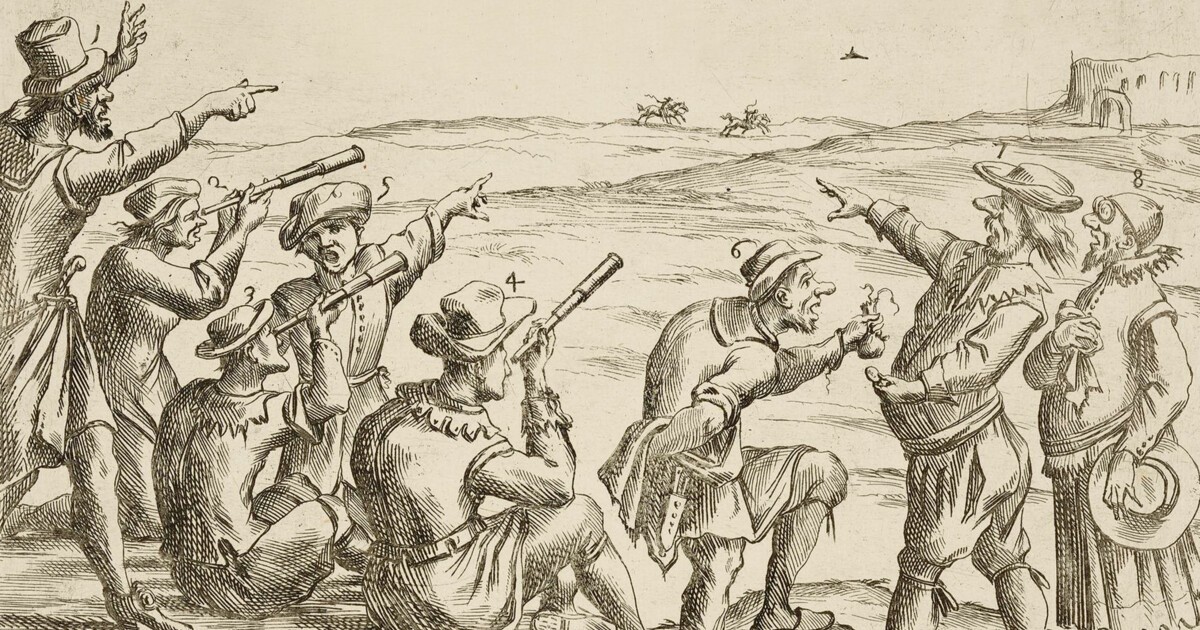
In a print made by the Italian engraver Giuseppe Maria Mitelli at the end of the 17th century, a group of excited men spies two figures on horseback in the distance. The men point; they shout; they chatter among themselves. ‘There he is, there he is, soon we’ll know everything!’ The print is called ‘Il corriere in lontananza aspettato dagli appassionati di guerra’, or, ‘The courier in the distance, awaited by the enthusiasts of war’. The enthusiasts can’t agree whether the figures are French or German or Spanish. Some peer through spyglasses, as though seeing them more closely will reveal the new information the courier’s mailbag holds. What might be a walled town is visible to one side, conjuring the world of battles and sieges that the courier (and his fellow rider) will bring to life. He will have travelled quickly in relay across the countryside, braving attack and disease to deliver the mail; everyone knows his news will be fresh. It may make fortunes or portend disaster. Money is already changing hands: people love to bet on the news.
In early modern Europe, couriers represented the increased connectivity of the Continent. They travelled faster and faster on roads that were constantly improving; they became more reliable, with mailbags handed off regularly to a fresh rider for the next stage of a journey. Timetables meant that you could plot a letter’s transit across Europe and beyond, from inn to inn, city to city, post office to post office. The volume of mail shot up during the 16th and 17th centuries, as state services opened up to private customers. Medieval methods of mail delivery, which relied on closed systems operated by and for merchants or the Church (or involved simply handing your letter to a trusted messenger going in the right direction), were left in the dust.
The early modern postal system had its origins in medieval northern Italy, on the plains south of the Alps where couriers beetled between Milan and Venice, Verona and Mantua, and where guides could be hired to accompany the intrepid traveller or jaded merchant through Alpine passes. Political intrigue and commercial exigency fed the need for a reliable service. A letter might be marked with the words cito cito cito – ‘quickly quickly quickly’ – to spur on its carrier or adorned with a sketched hangman’s noose as a warning to anyone who threatened to delay or disrupt its progress. The speed with which mail came to traverse the region, and beyond, was due in large part to the work of the Tassis family, which began operating a company of couriers in the Italian city states around 1290. Later, as success brought ennoblement and they sought to distance themselves from their humble beginnings, the Tassis would be known as the House of Thurn und Taxis (which operated the Thurn-and-Taxis Post), but their roots were in the Valle Brembana, below the Alps and not far from the roads that linked Milan to Venice.
The Tassis began to develop an international postal system in the late 15th century. They parlayed their success in northern Italy into a role as the preferred postmasters and couriers of the Habsburg Empire. An early 16th-century tapestry shows Francesco Tassis kneeling to receive letters from the Holy Roman Emperor Maximilian I. Francesco promised Philip I of Castile, Maximilian’s son, that a letter could make it from Brussels to Granada in fifteen days (with three days’ leeway in winter). That Francesco and his successor postal officials could also provide the latest intelligence along with a bulging mailbag sweetened the deal. With Habsburg backing, Rachel Midura writes in Postal Intelligence, the Tassis ‘translated a northern Italian technology of running mail in relay into a powerful international network’. The ‘Italian Road’ that crossed the Padan Plain and the ‘German Road’ that passed through Trento towards northern cities such as Antwerp, Augsburg and Cologne became routes in the emerging Tassis postal empire. Even as rivalry between siblings and cousins threatened to tear the family firm apart, the Tassis ran post offices and directed postal services in Lyon, Madrid, Augsburg, Prague, Vienna and Rome. By 1506, they employed forty postal couriers in Brussels; when the Council of Trent assembled to debate the direction of the Catholic Church in a century of religious upheaval, the Tassis handled its postal communications.
Tassis pre-eminence was never unquestioned, but the cousinly rivalries that risked breaking up the firm were made more serious by the fragmentation of Habsburg power that followed the abdication of the exhausted and unwell Emperor Charles V in 1556. Changing political winds in Spain prompted a thorough audit of the Milan post office, then overseen by Lucina Cattanea Tassis and her postmaster lieutenant, Ottavio Codogno; they were accused of fraud and negligence that had cost the Habsburgs the eye-watering sum of 118,000 lire. Yet this kind of administrative peril was still preferable to the fate of their postmaster in Rome, Giovan Antonio Tassis, who in 1556 was arrested, tortured and imprisoned for more than a year and a half as part of a battle over control of the posts in the Papal States.
Giovan Antonio was a victim of the ‘postal wars’ that played out across the same terrain as the military battles fought between European powers in the later 15th and 16th centuries for control of Italy. Midura explores the postal wars as a struggle between ‘information sovereignty’ (that is, ‘the right to establish a secure channel of information in external territory’) and ‘communications monopoly’. States, of which there were many in early modern Italy, disagreed about whether each prince should have total control over the communications services in his territory. The alternative was that couriers of other powers should be allowed to operate within the state’s frontiers. In places such as Ancona and Rimini, handover points for mail travelling back and forth between Venice and the Papal States, it wasn’t unknown for fistfights to break out between postal workers serving the rival powers. Giovan Antonio’s time behind bars, grim though it must have been, helped to establish the principle that couriers and postmasters should be protected from harassment or violence; foreign posts ‘were now treated as parallel embassies’.
States struggled to work out their role in these rapidly changing systems. Private mail presented different problems: should couriers working for state-funded postal services be allowed to carry post on behalf of paying customers? For the states that underwrote postal systems, this was risky – it increased the risk of robbery since private mail often included money and valuables – yet attractive: an efficient postal service subsidised by private clients would be less of a drain on state resources. Controlling the carriers of private mail also made surveillance simpler. As time went on, the price of sending a private letter fell, so that more ordinary people were involved in the flow of mail and news: ‘What had started as a state privilege had become a preferred public service.’ Crucially, by the second half of the 17th century, the postal stagecoach had become the essential vehicle of European travel, carrying passengers at the same speed as it delivered the mail. The machinery of the post – its itineraries and printed guides, inns as relay stations, couriers with local knowledge – adapted seamlessly to facilitate a new era of tourism and would form the backbone of the Grand Tour. The infrastructure of posts and couriers that served states and merchants laid the foundations for a revolution in communications.
Information flowed, with increasing rapidity, across Europe and beyond. In 1608, Ottavio Codogno published Nuovo itinerario delle poste per tutto il mondo, or New Itinerary of the Posts of the World. Codogno celebrated the unsung role of the postmaster and listed journey times, detailed routes and delivery timetables that linked towns and cities in Europe and as far afield as India and Guatemala. The network laid out in Codogno’s book – one of many postal guides used by correspondents and travellers throughout the 17th century – was a far cry from its medieval predecessor. There were moments when the flow was stopped or diverted – the Thirty Years’ War (1618-48), for instance, devastated Central Europe, but also led to the collapse of an information infrastructure. The powers that agreed the Peace of Westphalia in 1648 had the task of building a new one. By the 18th century, Codogno’s successors could recognise that the routes established by Europe’s postmasters and postmistresses were the sinews of the Enlightenment state.
Information in the early modern world could move no faster than the bodies that carried it. A horse transporting mail between Tassis relay stations in 1425 travelled at just under 15 kilometres per hour. At that speed, between a trot and a gallop, a horse could keep going for about an hour and a half before the risk of overheating and damaging its spleen became critical. Carrier pigeons clocked in at about 25 km per hour. Despite these limitations, information flows were accelerating. For those who lived in London around the middle of the 17th century, it would take six days for news to arrive from Edinburgh, eleven from Paris, 28 from Venice and 44 from Lisbon. Things were speeding up because the systems were smoother – better roads, more direct connections, relay systems timed to cut out lag and better protection for the couriers. The dispatch notes signed when a delivery left a relay station and the rider receipts filled out when a courier arrived allowed postmasters to identify delay and disruption, and to pinpoint the blame. The influence of the Tassis and other powerful families resulted in a more efficient network; the Fuggers – bankers from Augsburg – poured their own money into improving connecting roads.
Restrictions when plague hit could limit couriers’ movements, or slow them down as they went through disinfection procedures, such as having their letters (or their persons) doused in vinegar. During the savage plague years of the 1570s, northern Italian rulers chafed against the restrictions imposed on couriers, casting them as essential workers who must be allowed to move even as cities and towns were locked down. Highway robbery – svaligiamento – was a constant threat on the roads of northern Italy, where bandits in false moustaches or beards and leather masks targeted the routes known to be taken by couriers transporting valuables. When a courier from Mantua was robbed in 1587, he was carrying ‘a golden parrot with many jewels and pearls, a golden girdle, a great quantity of silver spoons and forks, many diamonds and fine rubies in a small box, a silver plate of about thirteen pounds, a few gold necklaces, two silver ewers and a good deal of Mantuan coins’.
Information moved fast, but not with total freedom. In a Europe divided by religion and scarred by war, surveillance of the posts was inevitable, and one way that postal officials secured their supremacy was by making a devil’s bargain with the rulers who contracted them: let us build you an efficient postal service and run it on your behalf, and we’ll help you monitor the information that travels through it. This was the era of black chambers – shadow post offices in cities such as Brussels, Vienna and Paris in which letters were secretly opened and read. The wax seal, which should have guaranteed that a letter remained unopened, could be moulded using mercury, melted with steam and then remade after the letter had been read. Some letter-writers fought back: the technique known as letterlocking allowed paper to be folded in ways that made it impossible to open without leaving evidence of tampering. In fact, letter-writers expected to have their correspondence read. One 17th-century French correspondent directly addressed the person she imagined secretly reading her letters, with a sardonic request that they at least put them back in their envelopes before sending them on their way. Others reminded their correspondents to keep schtum on topics that might draw the eye of a Tassis interceptor. Midura concludes that ‘systematic signals intelligence was well underway long before the 18th century,’ when it becomes more apparent in surviving archives: from the early years of the new system, private mail was rarely private in practice.
Couriers bore news not only in the sealed packets they carried but by word of mouth. They communicated gossip, rumour and political intelligence between cities and states, labourers in a vast information infrastructure that worked across languages and borders. The Milanese author Pietro Verri wrote in 1764 that items of news ‘make us almost fellow citizens of all Europe’, but this was a news culture that encompassed an even wider world. Messages from Persia might come through Paris; Antwerp was a source of updates from India and Indonesia; in Lisbon and Seville news trickled in from the Americas. An Italian merchant in Alexandria provided fresh news from Jeddah and Cairo and cited information gathered from his friends in the Maghreb. Updates from Russia were slow and stuttering but increasingly made their way via Narva and Stockholm to Hamburg and from there into the news circuits of the rest of Europe.
While Midura’s account of early modern European postal systems exalts the role of the postmasters and postmistresses, Joad Raymond Wren’s The Great Exchange presents European news culture as an unplanned miracle – ‘a vast, invisible system not conceived or constructed by any individual or entity’. News took many forms. It could be words exchanged by the people who haunted Venice’s Rialto. You might hear news in a barbershop, a pharmacy or a London coffee house; out in the street, you could listen to the headlines being relayed by ballad-singers, whose public performances turned news into catchy tunes. In early 17th-century Madrid, the blind ballad-singers – ciegos – had their own guild and a near monopoly on commercial news. In the countryside, an inn where post was collected and travellers stopped for a meal or a night’s sleep would be the site of the freshest news; in a city, merchants could usually be relied on to have the latest information, and bourses and exchanges like those in Amsterdam, Antwerp and Seville were alive with news of prices and politics. In London, a stroll through the nave of old St Paul’s Cathedral would let you eavesdrop on news and gossip: in 1628, one observer described the noise of the place as being ‘like that of Bees, a strange humming or buzze, mixt of walking, tongues and feet: It is a kind of still roare or loud whisper. It is the great Exchange of all discourse.’
Those who could read and afford it could pay for a manuscript newsletter. A growing number of professional newswriters – menanti, reportisti, novellari, Zeitungschreiberen, newsmongers, gazetteers – offered a subscription service that packaged together all the items of news they had been able to glean, sent regularly to news-hungry subscribers among whom were private individuals, government figures, elite families such as the Medici and the Fuggers, and corporations. The Dutch East India Company spent 25 guilders on newsletters in 1606 alone. The manuscript newsletter, originally an avviso with its roots in the Italian cities of the later medieval period, was a tenacious genre that survived long beyond the beginnings of print and the emergence of the printed newspaper. The avviso was an unadorned weekly hit of news. One written by Giovanni Sabadino degli Arienti in 1478 began: ‘I have news from Pistoia from 15 December until 9 January 1478,’ before listing items from Genoa and Lyon. A standard avviso contained headline news presented telegrammatically, usually on the themes of politics, war, trade and diplomacy. A manuscript newsletter could be personalised (subscribers to Joseph Mede’s service in 1620s England got their own covering message to accompany their package of news) or they could contain privileged information, like the handwritten updates on parliamentary proceedings paid for by English subscribers throughout the 17th century.
The paragraph was the core unit of news. There was little change in the format of an 18th-century printed newspaper from that of a 14th-century manuscript newsletter. They were both, as Wren points out, an assemblage of discrete units, with each item of news tagged with ‘metadata’ indicating its date and place of origin. ‘Data were effectively tagged with their history of transmission,’ he writes. ‘This is the genius of the paragraph.’ Such information was used to assess trustworthiness. How recent was it? How far had it travelled, and did it come from a reliable source? Paragraphs made the news network visible: the same words moved between manuscript and print and back again, while the information they encoded survived translation and communication over long distances and across political and physical barriers.
Wren understands that the story of news is not the story of the newspaper. Print was a medium for news long before the newspaper, as pamphlets announced strange and wondrous happenings from natural disasters to sea monster sightings. In London in the 1580s, John Wolfe, a printer trained in Florence, pumped out slim translations of Continental news. Newspapers weren’t needed for news from the Battle of Lepanto to cascade across Europe in 1571, with three hundred pamphlets and broadsides printed from Naples to Leipzig telling the story of the Christian triumph over the Ottomans at sea. Newspapers developed and grew in popularity throughout the 17th century, but did not simply displace manuscripts or word of mouth: they were slow to take hold in Italian cities where thriving news cultures already existed; England’s bustling Restoration market for printed news still left room for the handwritten newsletter.
The first printed serial newspaper appeared in Strasbourg in 1605, though the first surviving copy was published four years later. Strasbourg had a post office, which was essential to the running of a successful newspaper. In 1619, the Frankfurter Postzeitung became the first postal newspaper, capitalising on the central place of the Frankfurt post office in the European system and its excellent access to up-to-date information. It was run by the postmaster Johann von den Birghden, who served the Tassis but faced efforts to freeze him out: he was an outsider rather than a family member and a Lutheran who did not share the family’s political sympathies. More newspapers sprang up around the same time, especially in the northern Netherlands, where by 1620 Amsterdam had newspapers in Dutch, French and English. The first newspaper in Yiddish, the Kurant, started in the city in 1686. During the 17th century, about two hundred newspapers were founded in eighty different places in the German-speaking lands. The Netherlands, with its high literacy rates and booming print trade, became, according to Wren, ‘the newsiest place in Europe’. Even those who couldn’t read were part of the culture of printed news, as papers were read aloud at home, at the inn, at the market and in the workplace. Yet people continued to get their news from a variety of different sources, both printed and not.
Publications of various kinds were, as Wren points out, ‘made to be read in apposition with others’. We see this in the vast collections of news material made by individuals such as the 16th-century Swiss clergyman Johann Jakob Wick, who compiled 24 volumes of letters and illustrations to ballads and manuscript newsletters. A slim surviving slice of the correspondence received by Andrew Ellis, deputy postmaster at the Letter Office in London, shows that across four months in 1668, he received 98 news publications, including materials from Paris, Amsterdam, Brussels and Frankfurt. What might seem a bewildering variety in fact suggests ‘a purposeful kind of multiplicity’. We know from contemporary complaints about the sheer quantity of news that some people were disoriented by the changes: living in such a connected time may have quickened a sense of European identity, of sharing the same current affairs, but it also meant a bombardment of information.
In the face of this multiplicity, political and religious authorities considered the best ways to keep news culture under control. Unrestricted access to news – of religious upheaval, political activity, even supernatural occurrences – could stir up the populace and neither priests nor princes saw the general freedom to report and consume news as beneficial. Those in authority were attentive to information flows, monitoring where news and rumour came from and the people who spread it. When it was in their interests to disrupt or redirect information flows, they experimented with ways of doing so. The city of Ragusa – modern-day Dubrovnik – was a key staging post for news making its way from the Ottoman Empire into Western Europe. In 1567, under pressure as they sought to renegotiate their privileges with the Ottomans, members of the Ragusan senate imposed severe penalties on anyone found to be spreading news westwards from the city, conscious of their imperial neighbour’s misgivings about the city’s leakiness. The 16th-century Venetian authorities tried to introduce pre-publication censorship for handwritten avvisi, while the Catholic Church’s Index of Prohibited Books expanded constantly during the early modern period. In the 1590s, the Ming politician Yu Shenxing complained about those who ran news bureaus, or baofang, seeing them as money-grubbing spreaders of misinformation who were heedless of the needs of the state. Iberia was slow to adopt a printed periodical news culture, but just a year after the first Portuguese gazette appeared, a royal decree banned ‘the printing of public Gazettes, with news from the Kingdom or abroad, due to the little truth of many, and the style of all of them’. English newswriters of the later 17th century could expect to get roughed up or have their windows smashed if they offended the secretary of state.
But authorities could also turn the production of news to their advantage, with papers of record such as the national gazettes circulating state-approved news. In 1703, Peter the Great established Vedomosti, the first printed newspaper in Russian, though six decades later Russian officials grumbled that the propaganda power of a state media organ was not being realised, since copies of the paper ‘are not received in all towns of the Russian Empire, and so not everywhere has received news of [our] military successes’.
Cynics thought that news could be, or already was being, easily manipulated. One jaded observer in 18th-century Paris described the way in which the system could be abused:
Some cowardly courtier puts some infamies into verse, and through a ministry of henchmen passes them to the market halls with herbsellers. From the markets they are conveyed to the artisan, who in his turn brings them back to the great folk who forged them, who immediately start to whisper in one another’s ears, in a tone of the most consummate hypocrisy: ‘Have you read about that? I’ll tell you. All the people of Paris are talking about it.’
It was said that the diplomat Henry Wotton played with this kind of early modern ‘astroturfing’ in London, sending a team out into the city’s gossipiest spaces to spread confected rumours and then monitoring their spread. One eyewitness to Wotton’s scheme – it’s unclear whether it was a prank or an experiment – reflected that ‘I then sawe How fewe men could regulate & Create fame, & the dangerous influence of Fame, if not regulated to honest designes.’
Wotton’s disinformation campaign seems modern: he and his helpers were spreading news he knew to be untrue. And he wasn’t alone. The Russian state used its diplomats abroad to spread the false news of the crushing of Stenka Razin’s rebellion in 1671. The London Gazette printed the news, citing ‘an Envoye from the Czar of Muscovy’ to The Hague, though it noted that the news had yet to be confirmed. Berlin’s Mittwochischer Mercurius was more openly sceptical, writing that ‘nobody knows what is the truth in this question. How could we ever, in such circumstances, have any trustworthy information from Moscow, situated some four hundred miles away?’ Other state actors lied by omission, with the careful editorial control exercised over national gazettes significantly limiting what was deemed fit to print. Much of what was reported in print and manuscript was outlandish or partisan, and sometimes it was both: the reports of the Lisbon earthquake of 1755 that spread rapidly across Europe reflected the ideologies popular in their place of publication, with Catholics and Protestants interpreting the news according to their confessional stances (Catholic publications reported the Virgin Mary’s life-saving intercessions, while some Protestant counterparts noted that the death toll among members of their own religion seemed curiously low) and one Scottish newspaper insisting that the whole story had been cooked up by the French.
Wonders, signs and natural disasters were commonly reported in newsprint, and authors were happy to put a providential spin on news that seemed to show the hand of God working in the world. Some news cultures turned vicious: English newspapers, forged in the turbulent decades of the civil wars and the Interregnum, were venues for side-taking and partisan invective that often became personal. Théophraste Renaudot, editor of the Gazette de France, wrote in 1632 that ‘history is the narrative of things that have happened; the Gazette only the noise that circulates. The first is required always to tell the truth. The second does enough if it prevents lies, and does not lie even if it publishes false news that has been given to it as true.’
Wren argues, however, that early modern news culture isn’t a mirror of today’s fake news, which is crafted specifically to confirm the prejudices of the reader. He doesn’t want to suggest that all early modern news was true, or that Europe gloried in ‘a pre-post-truth golden age’. But early modern enthusiasts of news were dab hands at weighing conflicting reports, considering the variables that might influence an item’s trustworthiness and seeking confirmation from other sources. News reports commonly looked back to earlier reports, which they confirmed or confuted, or forward to future reports that might settle the question and establish the truth. The titles of some news publications contained such fence-sitting phrases as ‘The great probability of the truth of the last Newes’. For all that satirists mocked the unreliability of news reports, there was ‘fact-checking embedded in a flow of news’, as the news culture itself equipped its readers and hearers to practise scepticism.
New communications infrastructure created new kinds of community, though not simply national, or not yet: in the Tassis heartland of northern Italy, regional and urban identities were felt more strongly than any sense of italianità. For Wren, the news network was less international than ‘trans-local’ and ‘inter-vernacular’. News was able to circulate once it had the infrastructure to do so with relatively little regard for political borders or linguistic difference. It was a means by which people across the Continent came to think of themselves as European, and even began to consider ‘the idea of an international community’. It was possible to feel this sense of a Continental community without needing to pass through national identity first. Wren writes that postal systems ‘can pull against nations, creating associations and communities which, like merchant companies, are fundamentally international. In this way, cities resist states.’ For Midura, the infrastructure put in place by postmasters and postmistresses during the 16th and 17th centuries transformed communications, although postal officials eventually found themselves elbowed out of the narrative as their rulers took credit for each service, which was ever more identified with the state. The utopian idea of a pan-European community of news and information, if it ever existed above the conflict and cultural difference of the period, could never survive contact with the nations and nationalism of a later era.
Midura and Wren rely on meticulous archival work to reconstruct transnational networks. Drawing on an array of newly available digital archival materials, they present a Europe growing ever more connected. They are alert to the different emotions prompted by the arrival of news. Giuseppe Maria Mitelli also made an engraving showing a pedlar overloaded with news. He cries his wares to the street: news of all kinds at a good price. A basket hanging from one arm overflows with broadsides; there are news-sheets pinned to his boots and his hat. News from London and Buda, maps of battlefronts and images of wonders and marvels fill the frame. But this time the pedlar’s audience flies from him in disgust. One man turns away, covering his eyes. Information overload – the comparing of sources, the weighing of hearsay and gossip, the endless expectation of newer news that might tell a very different story – must have been exhausting when it wasn’t exhilarating. It’s easy to empathise. One member of the pedlar’s audience is already leaving; we can see only his retreating feet. Another puts his fingers in his ears: ‘Non voglio udir più nove, nò, nò, nò,’ he complains. ‘I don’t want to hear more news, no, no, no.’