Preaching before Edward VI and his council in June 1548, Stephen Gardiner, bishop of Winchester, reflected that ‘in my time hath come many alterations.’ Gardiner was referring to the break with Rome, the dissolution of the monasteries and the iconoclastic fervour of Edward’s reign, each of which represented a ‘great alteration’ of policy and sentiment. Further twists were to follow: Gardiner’s sermon led to his imprisonment in the Tower, from which he was only released on the accession of Mary I, who completed Gardiner’s own series of ‘great alterations’ by appointing him lord chancellor. For those close to power in Tudor England, the ground underfoot was never secure.
Much of the fascination of this tumultuous period consists in what we don’t, rather than what we do, know. There are large gaps in the documentary record, and what survives is often administrative, recording the bald facts of payments and legal disputes without the stories behind them. Contemporary documents are sometimes augmented by anecdotal evidence, which can be hard to trace to a reliable source. Did Nicholas West, Putney boy turned diplomat turned bishop of Ely, really set light to the lodgings of the provost of King’s College while an undergraduate and steal the spoons, as a later 16th-century writer claimed? Did Hans Holbein the Younger really push an earl down the stairs of his workshop in fury at being interrupted in his work?
The visual world of the Tudor period is also largely vanished, swept away in those ‘great alterations’, or for more mundane reasons: eaten by mice; burned in accidental fires; discarded due to wear or changes in fashion. The same peaks and troughs of fortune that affected people changed objects. Eustace Chapuys, the Imperial ambassador to England, recorded in 1529 that he had spoken to an embroiderer who was busy removing Thomas Wolsey’s arms from a set of magnificent vestments. Had these been sent by one of the institutions founded by the cardinal, perhaps wishing to maintain the longevity of a valuable item by removing a tainted association? Or had the vestments been seized, and were they now intended for the royal chapels? No corresponding vestments are known to survive, but even if they did, the removal of the escutcheons would make their original patron impossible to identify.
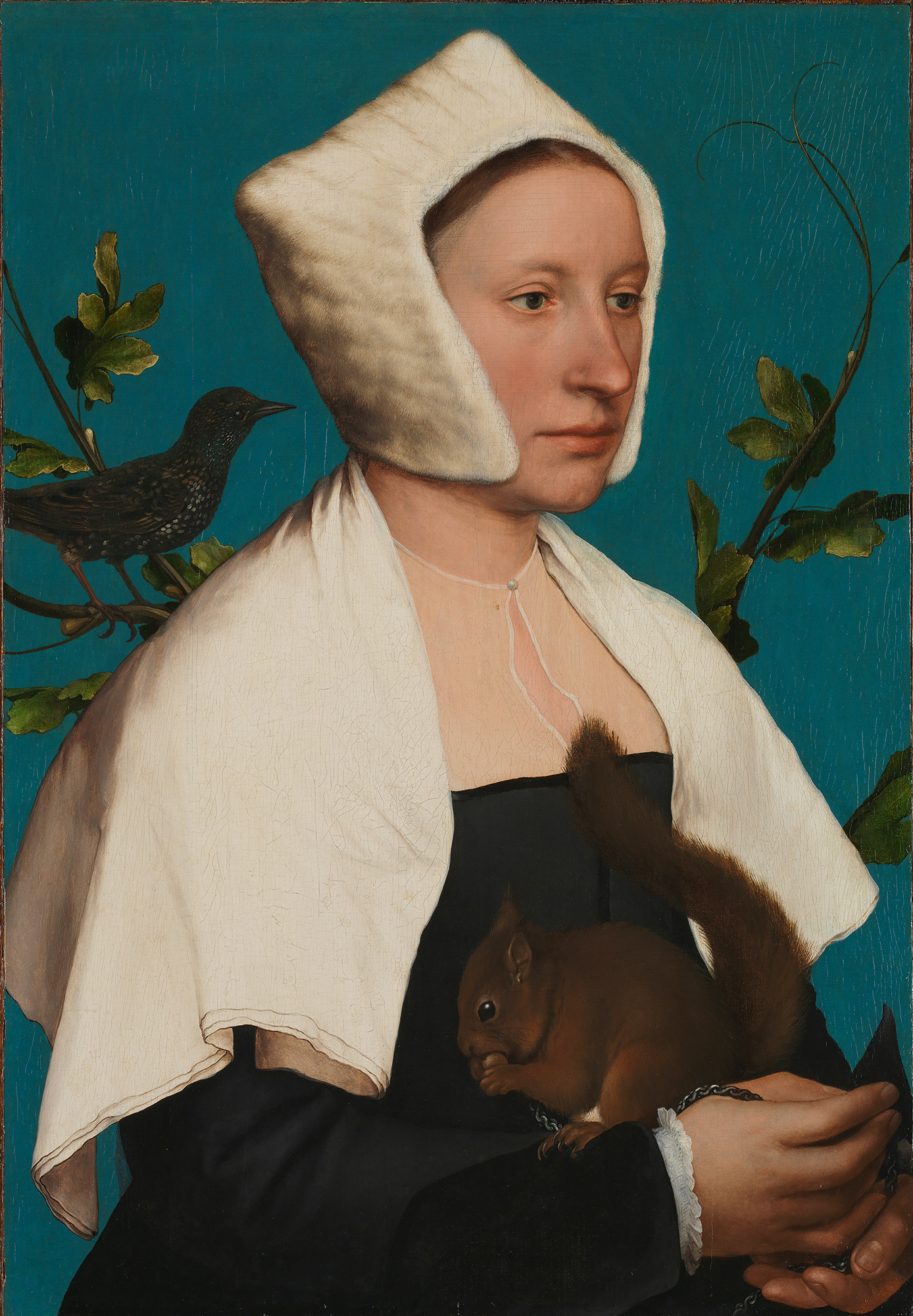
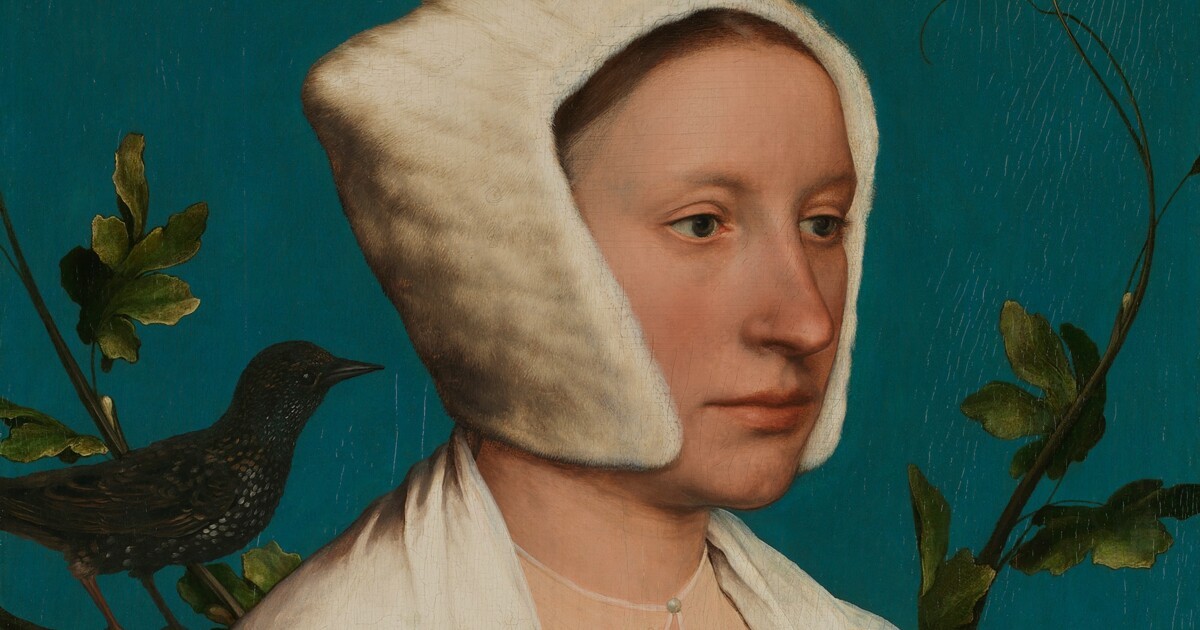
Holbein’s ‘A Lady with a Squirrel and a Starling’ (c.1527-28).
What remains is often without context. Portrait sitters have lost their names and many of the religious works that survived the Reformation are untethered from their origins, having been repurposed or concealed at great risk. Individual pieces are made to stand in for an entire culture. How representative is Lady Anne Drury’s inventive closet, painted with sprightly emblems and botanical motifs in the early 17th century? The decorated panelling was moved between different residences and then, on the destruction of Hardwick House in the 1920s, to an Ipswich museum. It is a rare and exciting survival, but was it unusual in its time? Or were such interiors more common than the evidence would suggest? Incomplete knowledge has often been supplanted by wishful thinking. Works of art are attributed to the few craftsmen whose names we know. The unknown subjects of portraits become the long-lost faces of favoured figures. Crowd-pleasing narratives (some excellent, some less so) fill in the gaps.
Two new books offer a welcome contribution to our understanding of this fractured legacy. Christina Faraday’s lively history of the Tudor visual world examines not just the ‘fine arts’ of painting and sculpture, but the wider decorative arts, bringing in works as diverse as manuscripts, samplers, armour and candle-snuffers to tell the story of art between the accession of Henry VII in 1485 and the death of Elizabeth I in 1603. Elizabeth Goldring has produced a superb biography of Hans Holbein the Younger. While many important studies have focused on Holbein’s work in either Basel or England, Goldring looks at his life as a whole and draws new information from scant archival sources. The Holbein who emerges from her book is a well-rounded figure: an ambitious, business-savvy workaholic, ‘not averse to a brawl’ (perhaps, Goldring suggests, he did push that earl down the stairs) yet able to produce work of such sensitivity that he won commissions from some of the greatest patrons in Europe.
Art in Tudor England was more than just decoration. In his 1548 sermon, Gardiner was careful not to mention that the Tudor dynasty was itself a series of ‘great alterations’. Occupants of a precarious throne, passed down through a series of unexpected heirs (the second son, a minor, two daughters), English monarchs of the 16th century had continuous need of burnishing. They commissioned artists to produce pieces that projected a glorious heritage and irrefutable authority. Nowhere is this more apparent than in Holbein’s mural of Henry VIII, Henry VII, Elizabeth of York and Jane Seymour, lost to fire in 1698 but known to us through preparatory studies, eyewitness descriptions and a later copy. Holbein arranged the four figures around a central plinth inscribed with verses celebrating the might of the Tudor dynasty. Goldring shows that the work’s influence extended beyond the small closet at Whitehall Palace where it was painted: individual portraits of Henry and Jane based on the mural had a wide circulation. The Whitehall Mural defined Henry’s image and royal portraiture for centuries to come, but it also sat within a longer tradition, discussed by Faraday, of royal genealogies, which traced English kings far back to Noah and Brutus of Troy.
It wasn’t only the Tudors whose family history needed bolstering. Faraday devotes a whole chapter to the men and women who lacked aristocratic status but had acquired the means to commission art. They provided a new market for architecture, furnishings and portraiture, commissioning the accoutrements that their noble contemporaries had inherited. Holbein’s sitters included the grasping Norfolk administrator Sir Richard Southwell and Hanseatic merchants based in the London compound known as the Steelyard. The most arresting painting of an English sitter by the Netherlandish painter Antonis Mor is not his depiction of a wary Mary I, but his portrait of the merchant Sir Thomas Gresham, who now regards us shrewdly from the walls of the Rijksmuseum, where he hangs alongside Mor’s portrait of his wife, Anne.
Mor, like Holbein and many of the artists who found success in Tudor England, was an immigrant, trying his luck at a court that embraced foreign talent to demonstrate its international standing. By employing craftsmen and buying luxuries from across Europe, the Tudors were showing they could command the same resources as other European monarchies. They wore armour made in Germany and Italy, ate and drank from French tableware and pored over manuscripts painted by Flemish illuminators in rooms adorned with Flemish window glass and tapestries. This enthusiasm for foreign wares sometimes provoked unrest. On Evil May Day in 1517, London apprentices and journeymen, wound to fury by a campaign of xenophobic rhetoric, rioted in protest against a perceived influx of foreign craftsmen. Thomas Elyot complained in his Boke Named the Governour that the English did not encourage their children to pursue the arts, forcing patrons, ‘if we wyll haue any thinge well paynted, kerued, or embrawdred, to abandone our owne countraymen and resorte unto straungers’. Like many of their contemporaries, Elyot and his wife, Margaret, were happy to follow the trend, commissioning their portraits from Holbein.
Portraits signalled status, but they also cemented social ties. Goldring considers the many portrait copies that Holbein (and presumably his workshop assistants, about whom we know nothing) produced, intended as gifts to the sitter’s friends. One such multiple commission gave Holbein his first experience of international diplomacy: in 1523, Erasmus paid him to paint a number of portraits for his correspondents and sent him to France with one of the panels, thereby giving him a taste of the sophisticated French court. Goldring’s attentive readings of the archival evidence show that copies of other portraits made their way into the collections of friends and acquaintances of prominent sitters such as Thomas Cromwell. Might such a gift be the source of the incongruous ‘litle table with the picture of the wiff of the Lord of Fiennes’, which was recorded among Henry VIII’s pictures at Whitehall in 1542? There is no evidence that this portrait was by Holbein, but it sat alongside his works, including the magnificent full-length of Christina of Denmark, painted in Brussels as part of Henry’s search for yet another queen in 1538.
Holbein was on the move, Goldring reveals, much more often than was previously thought, regularly crossing the Channel on his own or royal business, negotiating his continuing affairs in Basel and nurturing the careers of his sons (both became goldsmiths). It was thanks to him that the daughters of the Duke of Cleves were allowed to be painted for royal consideration, after traditional diplomacy had failed. English patrons journeyed to the Continent too, as scholars, ambassadors and exiles. Some of those travellers commissioned or purchased works of art: Lord Morley obtained a portrait from Albrecht Dürer, Cardinal Wolsey amassed Flemish tapestries and George Brooke, Lord Cobham, bought some much admired Flemish candlesticks.
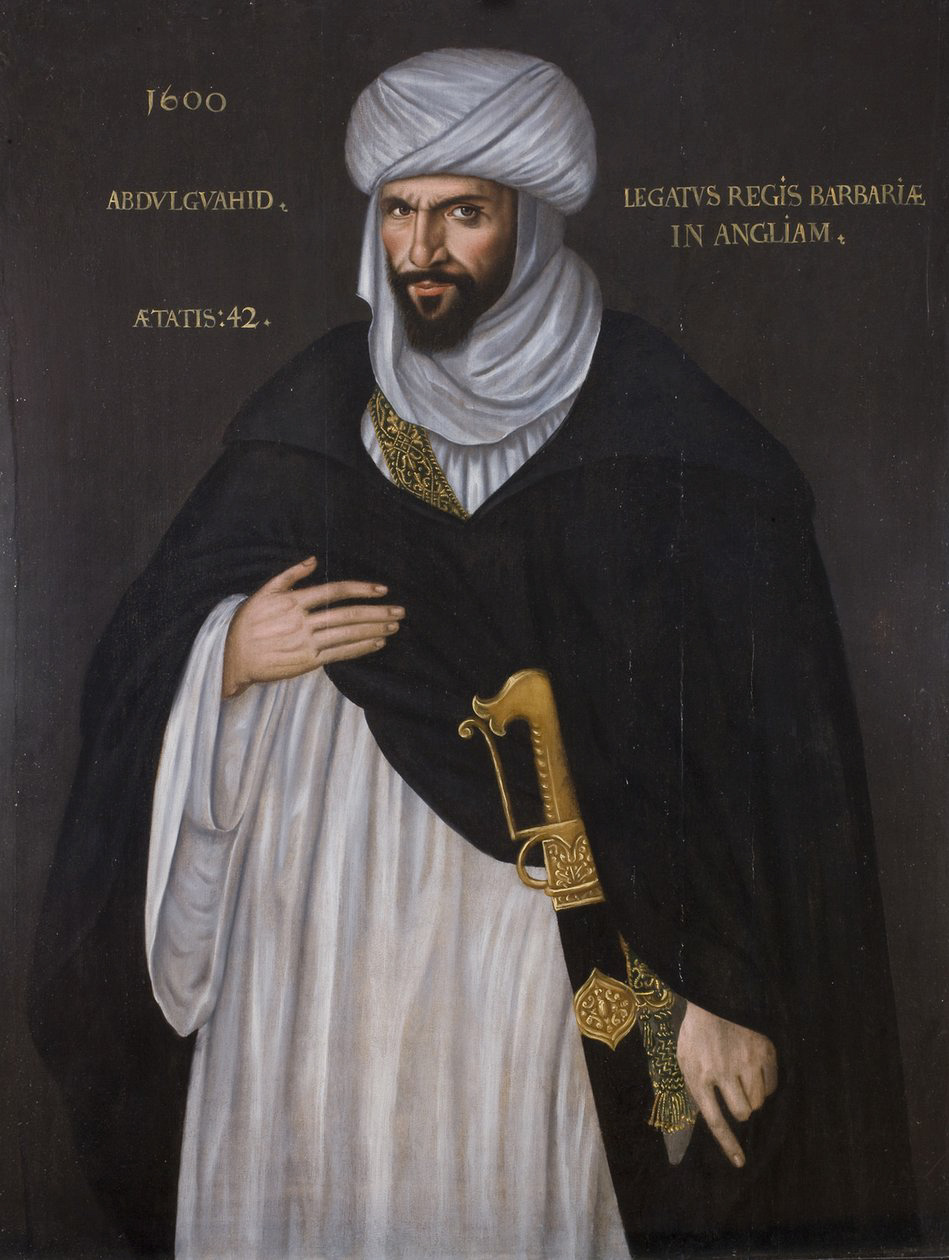
Portrait of Abd el-Ouahed ben Messaoud (c.1600).
Faraday emphasises the international nature of Tudor culture, showing the impact of imported works on art produced in England. Among the most fascinating of the pieces she discusses is a portrait, now in the collection of the University of Birmingham, of Abd el-Ouahed ben Messaoud, ambassador from the sultan of Morocco, who, on visiting London with a diplomatic mission in 1600, commissioned a portrait from a painter whose name is now lost. As an ambassador, Abd el-Ouahed would have been shown the full splendour of Tudor culture. His portrait sits in the same tradition as Holbein’s paintings of Jean de Dinteville and Georges de Selve (The Ambassadors), and of Charles de Solier, Sieur de Morette, both commissioned while the sitters were visiting London. Might Abd el-Ouahed’s portrait give us a sense of those displayed in the Duke of Norfolk’s gallery at the now destroyed Kenninghall, described in a contemporary inventory as ‘other small tables, demonstrating the vyzanamies [portraits] of sundry estates being in dyuers countries’?
In a crowded field, Holbein was the most spectacular artistic import of the century, but as Goldring shows, he was known in England before his arrival through printed frontispieces and the portraits of Erasmus (who knew how to keep himself uppermost in the minds of his correspondents). Holbein remained in England, on and off, until his sudden death in 1543, but Goldring’s careful reading of the annotations on his English drawings suggests that he never fully mastered the language: these remain almost entirely in German, with the spelling of the occasional English word implying that he retained a strong accent (‘felbet’ rather than ‘velvet’ and so on). In a city as cosmopolitan as London, Holbein would have found ways of making himself understood: among his associates were Nicholas Kratzer, the Munich-born astronomer who lived in England from 1517, and the German master armourers who worked in the royal workshop at Greenwich. He didn’t seek denization, which provided a number of rights, until 1541. Goldring proposes that he encountered no difficulty as a foreigner until the 1540 Act Concerning Strangers, which restricted the work of immigrants. Holbein emerges from her reading as a shrewd businessman (the result, Goldring suggests, of watching his artist father’s struggles with money), who conducted his dealings with prudence.
Neither Faraday nor Goldring presumes to offer the last word on their subject. Their work, as Goldring herself puts it, is intended to ‘provide new routes’ for future scholarship. Are the handful of non-autograph drawings that accompany those by Holbein in the Royal Collection evidence of lost work by the master or independent drawings by later artists who continued to practise in his idiom? Do they fill gaps in our understanding of what came after Holbein’s death or point to holes in our knowledge of his work? Can we extend Faraday’s examination of the motivations and interests of English patrons to better calibrate our understanding of the aesthetic norms of the time? We are sometimes too quick to assume ‘a poverty of artistic impulse’ (to quote A.F. Kendrick’s assessment of the work of late medieval English embroiderers) among native craftsmen when set alongside the sophisticated works of immigrants. Great English patrons such as the cardinals John Morton and Thomas Wolsey, who travelled widely and had the contacts and the funds to commission whomever they liked, employed ‘expertest artificers that ware both farre and nere’ (as Wolsey’s gentleman usher George Cavendish put it). And, as Goldring discusses, Holbein’s first royal commission in England was as part of a team made up of both native and foreign painters. If we have fallen for Thomas Elyot’s self-professed ‘cholericke humour’, and been misled by his complaints about native art in our understanding of what was thought to be good, then Holbein and The Story of Tudor Art encourage us to look again at the riches of the Tudor visual world.