In the Brazilian countryside, a man is driving in the wrong direction. It’s 1977, and he’s been on the road for three days. As his yellow Volkswagen Beetle pulls into a remote petrol station, we see what he is about to encounter: a dead body on the ground, crudely covered with cardboard.
Wagner Moura, playing the driver, clocks the body and attempts to reverse before the station attendant intercepts him. An attempted robbery, he explains; the body’s been there for days. The driver glances at the indicator on his empty tank: nothing for it, he’ll have to stay. He gets out of the car and takes in the stench. The attendant rears into the foreground, his vast bare stomach exaggerated by the camera’s wide lens, his bottle-bottom glasses veering crookedly off his nose. Before long, the two are joined by wild dogs, a carload of carnival-goers and then the police. We scan the scene through the driver’s alert, sceptical eyes and understand that in the monstrously ordinary territory we are about to enter, the long-abandoned corpse, the corrupt police, the dogs and the party crowd are par for the course. He negotiates a bribe and gets back on the road.
This is the opening sequence of The Secret Agent, Kleber Mendonça Filho’s fourth feature film, which has picked up an unbroken sequence of awards since it premiered at Cannes last summer. In January Moura became the first Brazilian to win a Golden Globe for Best Actor, and the film is currently nominated for four Oscars, including Best Actor and Best Picture. If it wins, Mendonça’s wife and regular producer, Emilie Lesclaux, will collect the award. Like Walter Salles’s I’m Still Here, which had a similarly successful run last year, The Secret Agent is set during the military dictatorship in Brazil. Unlike Salles’s film, however, Mendonça’s occasionally breaks out of its apparent genre – the political thriller – to pause for a cinematic joke. This isn’t the first time Mendonça has begun a movie with a corpse. In Bacurau (2019) a lorry carrying coffins has crashed and spilled its load across the highway. Locals inspect the goods while a body, perhaps the driver’s, lies at the side of the road. It’s an image worthy of Buñuel.
Moura and Mendonça were initially brought together by the Bolsonaro regime’s opposition to their work. Mendonça, a former film critic, spent seven years working on Pictures of Ghosts (2023), a documentary set in his home town, Recife, which included family footage and clips from his own films. As he unearthed archival material and remembered his youth spent in cinemas, the shape of The Secret Agent began to emerge. A projectionist interviewed in the documentary became the inspiration for a projectionist in the drama. He wrote the protagonist with Moura in mind.
Our hero’s name is Armando, and he’s a university professor in hiding. He’s heading towards Recife, where he will live under the assumed name of Marcelo. It’s the wrong direction for his safety but the right one for what we might imagine to be his soul. After his wife’s death, from causes we assume to be less natural than those he describes to his son, he is hoping to reunite with the boy, who is living with his maternal grandparents in the north-eastern coastal town.
He takes shelter in a shared house for refugees of various political and personal stripes, presided over by Dona Sebastiana, a tiny, chain-smoking landlady who can’t remember whether she became a communist or an anarchist first. Dona Sebastiana is played by Tânia Maria, a seamstress in her seventies who was first cast by Mendonça as an extra in Bacurau. Here, her disconcerting comedic panache almost steals the show.
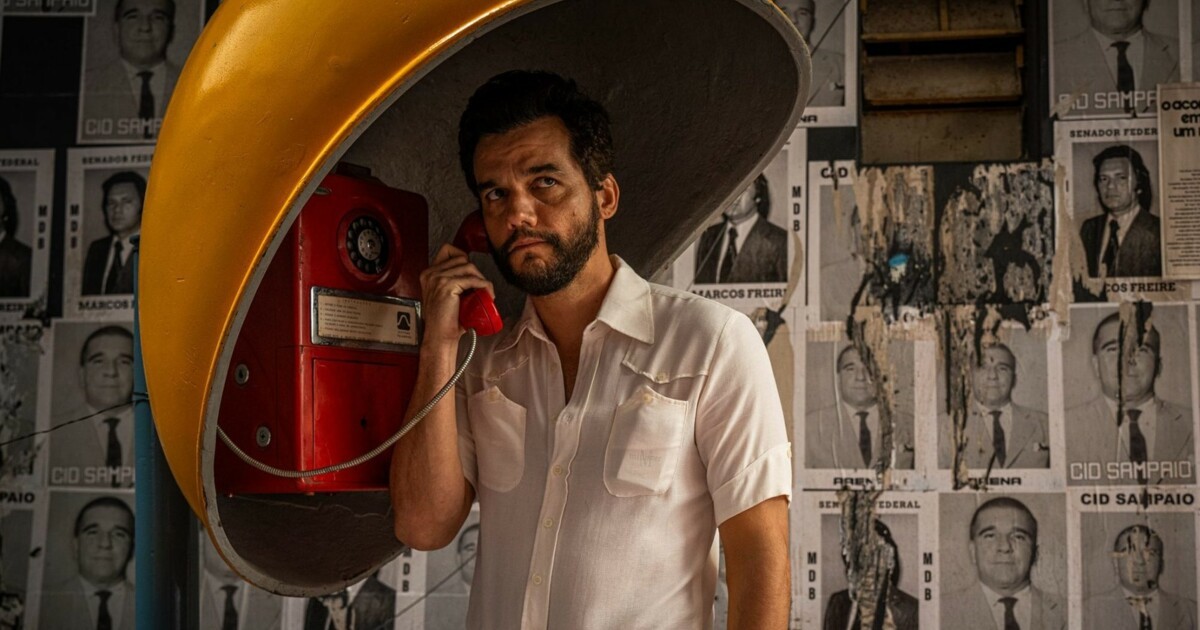
In Recife, Armando makes contact with an underground network. There are cryptic exchanges, envelopes of cash, 5 a.m. appointments, calls made from phone booths, the promise of fake passports. If it takes you a while to piece it all together, join the club. ‘What’s going on? I don’t get it,’ Armando tells Elza (Maria Fernanda Cândido), the lynchpin of the network. ‘Why do I need a fake passport? I haven’t done anything wrong. And what’s in it for you? Who are you?’
Armando is on the run the way Cary Grant is on the run in North by Northwest: he is the wrong man. Only in a corrupt system would his actions be considered crimes. That his weary despair should concern anyone higher up is not just confusing to him. At one point an informant calling from a payphone gives him an update on ‘the case’ (which case, we don’t know). Armando’s name is on a list. ‘It’s very bizarre,’ the caller says. ‘I’m trying to understand it. It’s foul play at the highest level.’
Elza tells Armando that there’s a contract out on him – a fact we already know since, in parallel, we’ve been following the sleek moustachioed hitman and his dimwitted sidekick. We do form a fuller picture, eventually: the controlling hand of industry shutting down academic research, arguments over patents, the big city demolishing the provinces, murderous misogyny, a personal vendetta, a country run by crooks. But much remains in the shadows. Will Armando make it into exile in time?
A large part of what’s great about The Secret Agent is Moura, who inhabits his role with the naturalism of a documentary subject and the charisma of a star. He plays two roles, the second of which I won’t reveal. Suffice to say that they are strikingly different and uncannily related. The detail in his attention to human mannerisms and emotion is extraordinary. Moura’s Brazilian career spans soap operas, blockbuster crime dramas and a high-profile production of Hamlet documented on film by his wife, Sandra Delgado. In the Anglophone world he’s best known for playing Pablo Escobar in the Netflix series Narcos, for which he learned Spanish with a perfectly pitched Colombian accent, and gained enough weight over the course of two seasons to become the pot-bellied drug trafficker of lore. Two years ago he played an American war correspondent of unspecified descent in Alex Garland’s prescient Civil War. He’s also a director: his film Marighella (2019) was set during the dictatorship too, and starred the Brazilian singer Seu Jorge as the Marxist politician and guerrilla fighter Carlos Marighella.
‘The Secret Agent’ may refer to the fact that in 1970s Brazil ordinary citizens were forced to live undercover – that it was all too easy to become a secret agent in your own life. The phrase also has a cameo as the title of a film within the film. We see it come up in caps on a movie screen at the São Luiz cinema: ‘O AGENTE SECRETO’. This fleeting reference seems so tangential to the plot that it produces a ripple of bathos: is that the meaning we were waiting for? Except it’s not tangential: the São Luiz is at the heart of everything: assignations, secret phone calls, lethal information slipped through the ticket booth – and the film’s love of film itself. ‘This is like those American witness protection programmes,’ Armando says as Elza puts a tape recorder in front of him. She laughs. It’s almost as if they were in a movie.
Mendonça withholds certain genre satisfactions – the sombre mood of a film about dictatorship, the closure of a character’s demise – and adds others that would crumble in less confident hands: a comedy hitman duo, a cat with two faces, body snatcher-style horror scenes. He’s up to something more than his political plot presents. He has said that rather than recreating a replica of the past he wanted to evoke the period’s ‘fumes’. That goes some way towards explaining what it feels like to watch the result: you’re inhaling an atmosphere, smelling a memory. A newspaper reports that the carnival’s death toll is 91. A woman is possessed by a spirit in the foyer of the cinema. A section of the film is titled ‘The Boy’s Nightmare’. There’s a mildly hallucinogenic quality to events that allows for a dismembered leg, first seen in the mouth of a shark, to attack lovers in the park at night. We don’t just see the hairy leg in action; we also see Dona Sebastiana’s band of refugees laughing over the story in the newspaper afterwards. It could be a riff on a dream or a political satire: somehow everyone in the movie understands its code.
The film’s visual allure lies in its period colours, cars and clothes. It’s beautifully shot by Evgenia Alexandrova with vintage anamorphic lenses that nod to CinemaScope. But Mendonça won’t stay there. He pulls us into the present, where two young researchers are transcribing cassettes recorded during some of the scenes we have witnessed. These modern-day passages protect us from the dangers of nostalgia, and tell us that the story is not just about the past.
There is a recurring argument in The Secret Agent over whether Armando’s son, Fernando, should watch Jaws. The little boy, missing his mother and worried he might forget her, is obsessed with sharks. He draws them constantly and has nightmares about them from looking at the film poster. His grandfather – the projectionist – thinks he may as well see the movie. Armando vetoes it. It’s a banal, ongoing conversation about what’s good for a child, regardless of whether their family is living with death threats. In the end Fernando watches Jaws and as soon as he does his nightmares evaporate. There’s something in this miniature fable, the film seems to suggest, on which contemporary Brazil is built. It’s not that there aren’t real things to worry about. It’s that what you don’t know or can’t remember or will not face haunts you more.