In photography the line between grace and shame is often blurred. We are apt to ask a simplifying question: are we looking at bodies exalted or abused? Things are rarely so straightforward. The Ukrainian artist Boris Mikhailov published his photographic series Case History as a book in 1999, and the following year the Photographers’ Gallery in London mounted its first retrospective of his work. Mikhailov’s scalding images of the bomzhi, or homeless people, in his native city of Kharkiv flummoxed critics; a Guardian article concluded: ‘There is no one in these pictures to identify with.’ Their subjects appeared to arrive from an abject elsewhere: they were naked, hungry, maimed or drunk, and it was unclear why they had exposed themselves in this way. It emerged that Mikhailov had paid his sitters – the equivalent of a month’s pension, it was said – to pose, undress and reveal their scars, their sadness or their diseases. There was no consoling sense that photography was simply doing justice to such lives. As Jeremy Millar, curator of the 2000 exhibition, put it at the time, ‘what is striking here is that you feel worse.’
Part of Millar’s response might have been a matter of scale: I have usually seen the Case History pictures in relatively large formats, all their subjects’ frailties staring you in the face. In the current Mikhailov exhibition at the Photographers’ Gallery (until 22 February), the series is mostly represented by four-by-six-inch prints mounted in a grid, face up in a vitrine. Reduced and crowded together like this, the images look like residue from a questionable exchange between Mikhailov and the destitute of post-Soviet Kharkiv, whom the photographer had been surprised to encounter when he returned from a year in Germany. The photographs are less monumental, and one goes hunting across the glass case for some familiar individuals and attitudes. Here is a shirtless young man in the snow, supported by a man and a woman in a Pietà pose, his glazed eyes directed towards the camera. Two guys in woollen hats on an icy street drag around the spine and ribs of what I hope is a cow. Elsewhere, several men and (mostly) women have begun to strip for their supper.
When Mikhailov’s work first became known in the West, it was often understood primarily as documentary revelation, somewhat complicated by the ethics of his transactions with the bomzhi. Here was news from the pitiless aftermath of Soviet life, from one who had seen the depredations of communism and capitalism. And his work as a photographer had been seditious from the outset. In 1965 he was working as an engineer in a Kharkiv factory when he was given a camera and tasked with documenting the facility. The KGB soon found out that he was using the factory’s darkroom to print nude photographs of his wife; Mikhailov lost his job and narrowly escaped prison. But he carried on taking pictures as a mordant and playful artist of the clandestine Ukrainian avant-garde. He recorded hardships, absurdities and mundane ecstasies in the period following Khrushchev’s Thaw. But subjects and context don’t exactly explain the visual and conceptual qualities of Mikhailov’s art from the mid-1960s to the dissolution of the Soviet Union and beyond. The current exhibition is a fine overview of the very different series he made in that time.
In 1968, Mikhailov began making Red, a series which a gallery label tells us ‘reveals the extent to which communist ideology saturated daily life’. It certainly does that, with blazing red insignia and backdrops everywhere, made all the more vivid by the tonalities of colour slide film. Parade banners and sashes, a patriotic tractor and racing car, posters, flags and billboard-sized portraits of Lenin all saturate the public spaces in which they appear, acting as indelible reminders of state presence and power. Red, however, is also the colour of irony and evasion here. It’s the colour of cardigans, headscarves and bikini bottoms. The palette in a mural that depicts an onward-marching Lenin rhymes with a bus or tram in the foreground, and a man’s fancy red jumper and floral shopping bag in the middle distance. Collective performances of allegiance or solidarity are undercut by the sheer ubiquity of red, its kitsch or mundane qualities: fake ceremonial flowers, armbands and military badges are mimicked and mocked by traffic bollards, lipstick and even an acne-ridden face.
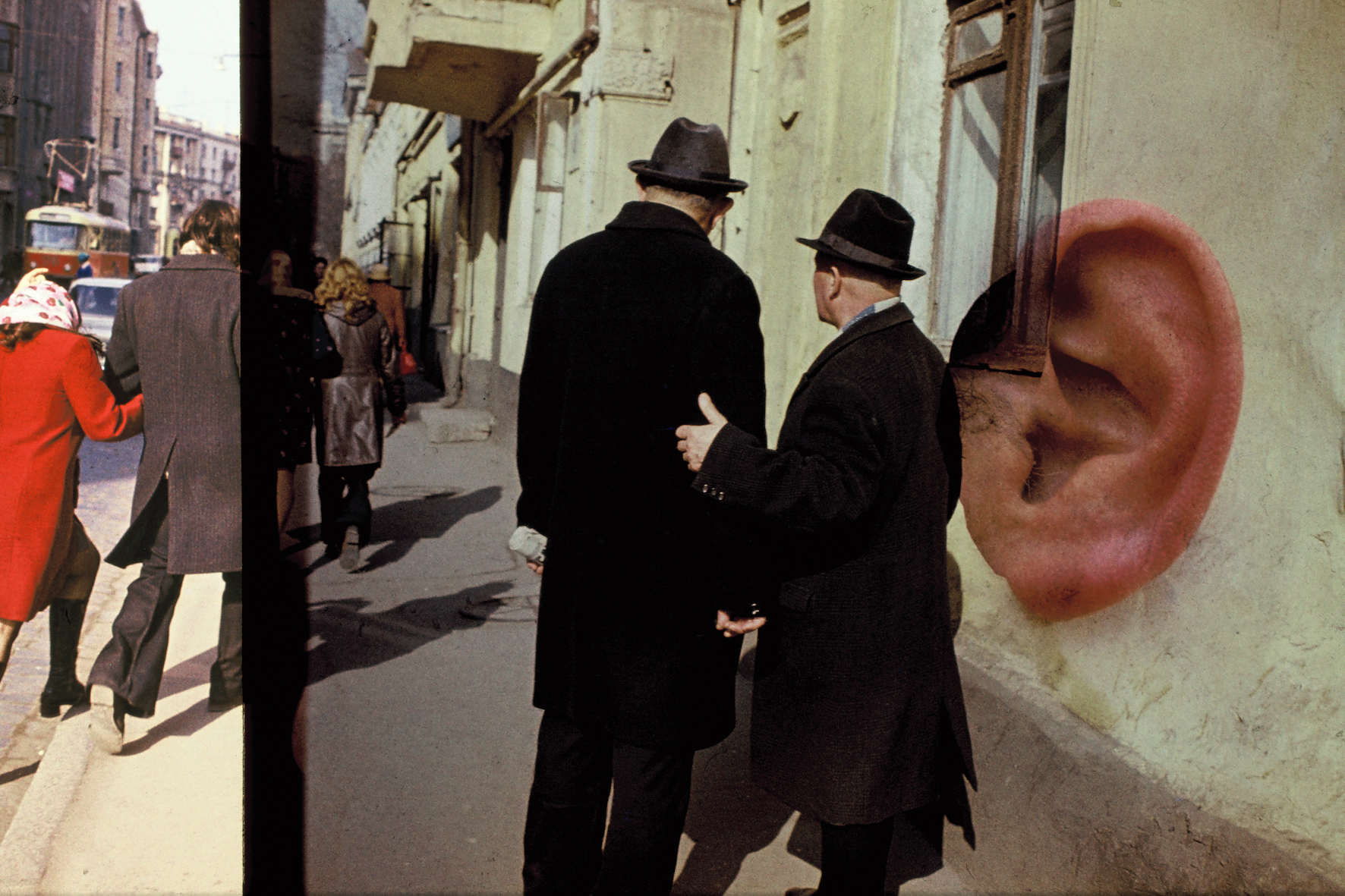
From ‘Yesterday’s Sandwich’ (1960s-70s)
Mikhailov has described the late 1960s and 1970s as ‘a period of hidden meanings and coded messages in all genres … Everyone was on the lookout for the smallest piece of new information, hoping to uncover a secret or read something between the lines.’ In the paranoid, divinatory spirit of the times, he embarked on a project he titled Yesterday’s Sandwich. One day he threw a handful of 35 mm slides onto his bed and two of them stuck together to make a new, overlapping composition. In the ensuing series he tried to retain the element of chance. At times the juxtapositions have the comic-erotic quality of Dadaist or Surrealist photomontage. A rash of foliage sprouts on the body of a woman suspended in a hammock; a giant golden crane fly sits on the lap of a naked woman; a pair of fried eggs looms over twin figures of Christ. Some pictures have the dreamy aspect of stills from Tarkovsky: the statue of a melancholy angel surrounded by stalks of dry grain or grass; a woman lying down in a field of fire. But elsewhere Mikhailov (or his chance operation) is more politically provocative. A huge ear seems to be listening to a busy street; a purple flower poisons the sky above a group of women in uniforms and gas masks.
In part, Mikhailov’s work in these years was a scurrilous comment on the place of photography in late Soviet society, nowhere more so than in two series he produced that rely on the antique but then still prevalent technique of adding colour to black and white prints. Mikhailov has spoken of this method as a particularly Soviet hangover, at a time when colour film was hard to come by. (In fact the practice produced vivid anachronisms in other countries for decades, among them the gorgeous postwar studio photography of the Armenian-Egyptian master Van Leo, and bizarre studio portraits that members of the Taliban made of themselves.) In the early 1970s Mikhailov began hand-colouring anonymous found photographs with aniline dyes. There are studio portraits of men in military uniform, given scarlet or pink backdrops. (Two of these are already peculiar images: a soldier holding a child’s doll; two young sailors with a teddy bear.) A man with a moustache and big hair is montaged into a double portrait with Stalin against an acid green background. In these works, and a concurrent series in which the artist colourised his own documentary-style photographs, Mikhailov pushed his critique of official styles further into parody.
This is not to say that the documentary impetus in a work like Case History wasn’t also present earlier. Among Mikhailov’s most conventional or nostalgic-seeming pictures are his panoramic street studies of the 1990s in cyanotype blue or sepia brown. The aesthetic looks mild, but the desolation of post-Soviet life that Case History made so lurid is already there among lone or harried figures in the cityscape: the poor, homeless, exhausted or maimed, photographed from an ankle-level vantage, as if everything has begun to sink. It was the viewpoint, Mikhailov said, of a ‘bastard dog’.