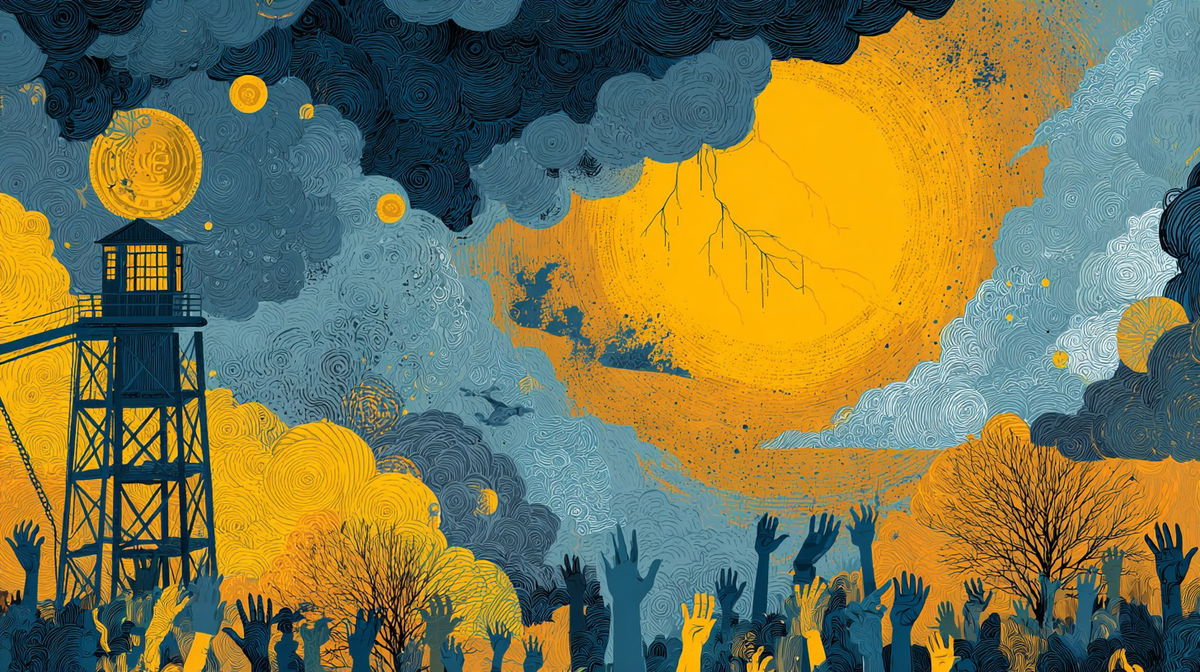
My fourteen-year-old daughter and I are devoted fans of dystopias. At times, given the world we are living in, I wonder whether encouraging this shared passion is such a good idea. I take comfort in the thought that, in most of these stories, the good eventually prevail: justice, solidarity, and the values that left-wing thought and movements have long defended.
The darker side of that consolation is well known. Victory rarely comes in time for many, and it is usually preceded by prolonged suffering, inequality, and injustice.
If we look to history, the last victory in which we still recognise ourselves came after the horror of Nazism, the Second World War, and its inhuman epilogue in the form of a nuclear mushroom cloud. That extreme experience, combined with fear of the Soviet alternative, helps explain why political and economic elites accepted a shift in the model of capitalism that had already begun to take shape with Roosevelt’s New Deal in the 1930s.
It also mattered that there were political parties willing to reform the system to improve people’s lives: some renouncing revolution, others resisting the recurring temptation to reopen the door to the far right under the illusion that it could be tamed. Above all, it was made possible by an exhausted yet hopeful population—the generation that gave rise to the baby boom.
Smart, Progressive Thinking on the Big Issues of Our Time
Join 20,000+ informed readers worldwide who trust Social Europe for smart, progressive analysis of politics, economy, and society — free.
That “Spirit of ’45” not only brought about welfare states in Western democracies; it also underpinned an international order based on multilateralism—albeit within the bipolar framework of the Cold War—and on respect for human rights, which in turn fuelled broad processes of decolonisation. Neither the social nor the geopolitical contracts of that era were flawless. The postwar social pact did not alter the sexual contract embedded within it. Nor was the so-called Liberal International Order as liberal or as universal as it claimed to be.
The United States, its main guarantor, combined an idealistic rhetoric of democracy and human rights with wars, coups, and the overthrow of democratic regimes to secure its economic interests and spheres of influence.
Despite its many shadows, that model delivered unprecedented levels of welfare, dignity, and legitimacy. Yet economic elites never ceased to devise ways of reversing that balance so that wealth and power would once again tilt in their favour, nor did fascism disappear. The abandonment of the dollar’s convertibility in 1971 and the wave of deregulation launched in the 1980s marked the beginning of the neoliberal, financialised phase of capitalism—economically, politically, and culturally. With it came the weakening of state power, the erosion of the transformative capacity of left-wing parties, and the hollowing out of the democratic promise of equality and freedom.
Fascism, meanwhile, lingered at the margins, waiting for its moment. That moment arrived with the discontent generated by neoliberal globalisation and accelerated with the privatisation of the internet and the rise of social media governed by algorithms that reward polarisation, hatred, and symbolic violence.
The figures Giuliano da Empoli has dubbed the “engineers of chaos” have learned to exploit these tools to discredit politics—especially left-wing politics—portraying it as fragmented, demoralised, and ultimately useless. Dividing us and wearing us down has not been difficult. We will always have Monty Python.
When democracy cannot defend itself
To hollow out democracy and the moral legitimacy of progressive forces, consolidating populist leaderships has been as important as destroying the adversary. Democratic institutions are not equipped to defend themselves against fascism unless political parties and citizens do so first.
Predatory economic elites have grown intoxicated with money and power and have corrupted democracies they no longer need for legitimation, as figures like Peter Thiel openly proclaim. The new international fascism, while rhetorically opposed to neoliberal globalisation, is in fact its most accomplished disciple. Today, even the very idea of equality is being challenged—the principle enshrined in the Universal Declaration of Human Rights that all human beings are born equal in dignity and rights.
And yet, they continue to fear the power of democracy and of left-wing ideas. They know that the steadily rising levels of inequality since the 1980s are incompatible with democratic stability. Hence their fear of a “limitarian” alternative that would curb endless accumulation.
That fear explains the construction of private “free cities”, attempts to purchase islands—including Greenland—as modern-day arks, and above all the massive investment aimed at propelling ideas from the margins into the centre of public debate: religious fundamentalism, renewed forms of fascism, and extreme libertarianism. Coherence, truth, or the brutality of their antifeminism and racism are irrelevant. These ideas rest on powerful psychological mechanisms—anger, fear, the desire for control—and on a data engineering apparatus capable of fragmenting and personalising messages for profoundly antidemocratic political ends.
After years of investment and strategic work, these forces are gaining power in some countries, including those with real capacity to reshape the global order, as illustrated by Donald Trump’s re-election. The United States is not the only actor transforming that order, but it is the one with the greatest capacity and determination to do so.
Russia invaded Ukraine. China, for its part, adapted to the liberal international order externally without adopting its principles domestically. With remarkable long-term vision, it has altered the global economic, technological, and financial balance and woven strategic alliances worldwide. In 2024, the BRICS became BRICS+. The response to this challenge to American unipolar hegemony is now displayed with striking bluntness.
The United States has reacted by abandoning the liberal international order in favour of an imperial project within a new multipolar world structured around neocolonial spheres of influence, based on rent-seeking and transactional relationships more reminiscent of business dealings or premodern monarchies. All of this, as always—paraphrasing the historian Josep Fontana’s book —”For the good of the empire.”
In this context, the European Union appears as the most disoriented actor, with the exception of those who, like Viktor Orbán, have long sought to make it implode from within. The EU is a project of peace, rule of law, and human rights. It has made progress on decarbonisation and the fight against the climate emergency. It is also a large market, capable of exercising power even in a transactional world—though that is hardly the model that best serves it.
Yet it remains dependent in matters of security, hesitant in political integration, and all too often incoherent in its external action, as Gaza tragically illustrates.
The EU is the mirror in which the Trump administration and ultraconservatives refuse to see themselves. In Hayek’s Bastards, Quinn Slobodian recounts how, after the fall of the Soviet Union, the Mont Pelerin Society—the epicentre of libertarian thought—decided to continue its work in order to combat new enemies: environmentalism, feminism, human rights, and the European Union itself.
The American National Security Strategy published in November 2025 explicitly includes the priority of “cultivating resistance within European nations to Europe’s current trajectory”. Yet much of Europe’s own elite, whether coerced or seduced, displays a striking historical illiteracy. They have yet to grasp that inaction—toward the United States and toward the far right—only accelerates their own repression and the dismantling of the European project.
European left-wing forces, weakened by internal divisions, past complicities, and the ultraconservative digital machine, oscillate between clinging to a diminished bargaining power and breaking ranks with a right wing once again willing to open the door to fascism. Fortunately, some leaders have not renounced either the game or their internationalism.
History is never fully closed
While resistance to democratic subversion must be built in each country, region, neighbourhood, and home, the ideological framework, strategies, and alliances must be global. The ideas already exist: social justice, equality, freedom, dignity, solidarity, peace, and mutual respect. The challenge is to defend them in a multipolar world where plutocrats, autocrats, and techno-bros act in coordination, armed with vast financial, military, and above all digital resources.
Late fascist capitalism feeds on negative emotions because they guarantee engagement and adherence. Yet those same emotions can be channelled towards resistance and the construction of a better world.
Nothing that is happening is inevitable—not the advance of fascism, not the total commodification of life, not the hollowing out of democracy, not the dominance of predatory masculinity, nor the supremacy of the white male. These are political projects, sustained by very concrete interests, and as such they can be contested. History does not move in a straight line, but neither is it written in advance.
There are always bifurcations, moments of decision, crises in which, as Antonio Gramsci wrote, monsters proliferate. But there is also room for hope and for the future. To resist is not only to oppose; it is also to care, to rebuild, to imagine. To reinvent ourselves based on enduring principles, to broaden common sense, and to reclaim the future.
Against those who seek to convince us that inequality is natural, that force should replace law, and that democracy is an obstacle to efficiency, the progressive response cannot be resignation or retreat. It must be the active defence of equality, social justice, and human dignity—not merely as moral slogans, but as the material conditions for a life worth living and for a democracy worthy of the name.
The proposal of fascist capitalism is one possible future. It does not have to prevail. Ours still can, if we are capable of sustaining it collectively and democratically—with resistance, with hope, and with the conviction that history, even in its darkest moments, is never fully closed.
Let us not write their dystopia, but our future—one, incidentally, also written by us, by women.
This article was first published in Spanish in Tinta Libre.