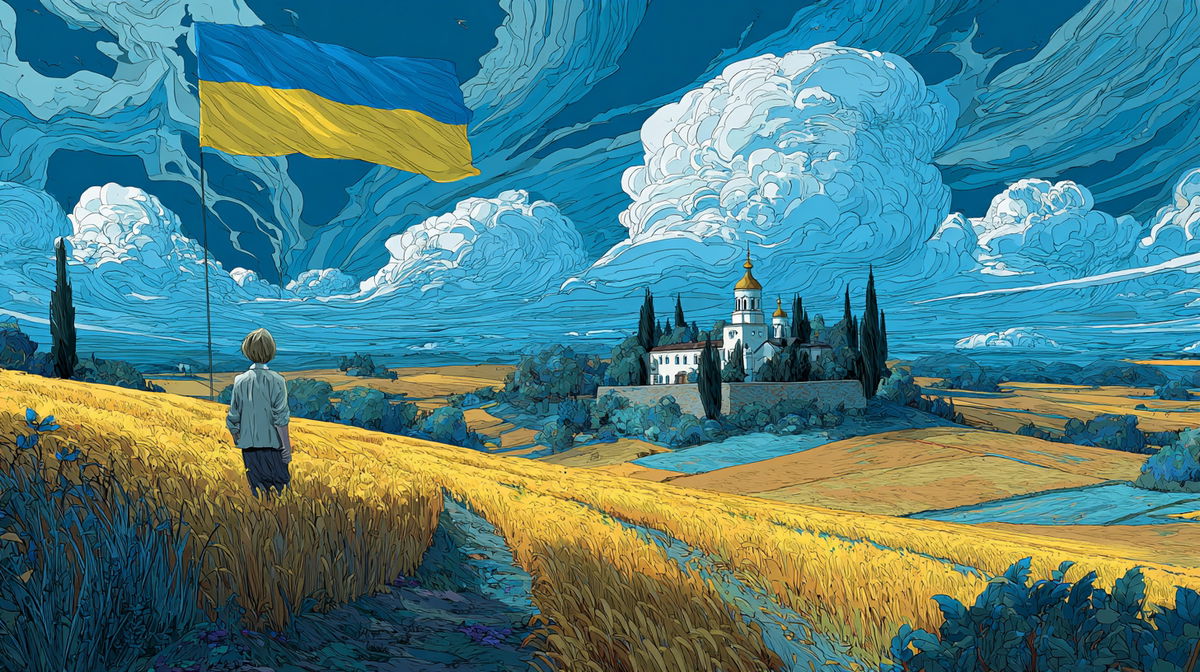
Russia’s war against Ukraine is entering its fifth year. It has already lasted longer than the Great Patriotic War. As in the trench warfare of World War I, thousands are wounded and killed every day on a front line that has hardly moved.
The toll on Ukraine is devastating. Soldiers are dying in bitter trench battles. Millions have been displaced, bombed, and suffer daily from the consequences of war. Infrastructure and entire cities are being destroyed by relentless air strikes. People are exhausted, left without electricity or heating in the bitter cold. The army faces an acute shortage of soldiers.
Yet Russian attacks have so far failed to break Ukraine. The defensive struggle has strengthened Ukraine’s national identity in unprecedented ways. It is a bitter irony that Putin, who claims there is no such thing as a Ukrainian nation, has done more than anyone else to awaken and mobilise Ukrainian national consciousness. Ukraine is no longer a largely unknown patch of land on the world map beside Russia but a nation of courageous men and women fighting for their freedom.
In Russia, too, mothers, wives, and children mourn hundreds of thousands of dead and millions of wounded soldiers. But they have nothing to be proud of. The war is a disaster for Russia. Putin is the worst leader his country has ever had—a failing tyrant. The dictator in the Kremlin is making people forget what generations of Russians were rightly proud of. He is destroying the Soviet Union’s greatest historical legacy—the victory over Nazi Germany, achieved at enormous human cost. He joins the ranks of ruthless Russian and Soviet dictators from Ivan the Terrible to Stalin—except that they used their brutality to increase Russian power, while he is squandering it.
Smart, Progressive Thinking on the Big Issues of Our Time
Join 20,000+ informed readers worldwide who trust Social Europe for smart, progressive analysis of politics, economy, and society — free.
An empire unravelling
Putin can only watch as his allies falter. His friends in Venezuela and Syria are deposed; he abandons Armenia out of weakness; he cannot aid Iran; Azerbaijan grows closer to Turkey and Israel; and Kazakhstan and Uzbekistan gradually distance themselves from Moscow. He stood by helplessly as the United States seized a Russian oil tanker in the North Atlantic. India has stopped buying Russian oil after Trump’s threats. The former superpower has sunk to the status of China’s junior economic partner and raw-materials supplier. Even Lukashenko, his most loyal vassal, is now reaching out to Washington.
Russian citizens are barred from travelling to Europe, cut off from academic exchange with the free world, and foreign tourists hardly find their way to Russia any more. Russia’s efforts to build a fascist international alliance are failing because of the invasion of Ukraine. Marine Le Pen, Giorgia Meloni, Nigel Farage, and even Alice Weidel have been forced to distance themselves from Putin. Russia has lost all soft power. Even its immediate neighbours are slipping from its grasp, and it is unable to protect the few “friends” it still has.
The population is shrinking by a million people per year. The birth rate is dramatically low. Since 2022, around one million—mostly well-educated—citizens have emigrated. Technologically, the country is falling further behind. Thirty years of Putin have meant thirty years of decline. The KGB man in the Kremlin may be a risk-taking and shrewd tactician, but he is a disastrous strategist.
Despite numerical superiority and a willingness to absorb heavy casualties, Russia’s successes against Ukraine’s desperate defenders remain limited. In the past three years, it has captured only about 8,000 square kilometres—an area slightly smaller than Crete. Recent months have brought reports of up to 35,000 Russian deaths and injuries per month. Recruiting new soldiers is increasingly difficult—and decidedly more costly. Russia spends roughly $24 million a day to sign up 1,000 to 1,500 “death-defying” troops for front-line duty, and the price keeps rising. In some regions, bonuses exceed $50,000. The more it becomes known in poor, remote areas that recruits are sent straight to their deaths, the higher the price climbs. The abuse and exploitation of Russian soldiers by their own officers reveal the army’s moral decay: soldiers literally have to pay their way out of death squads.
To finance staggering annual war costs of $170 billion—around 30 per cent of the state budget—the budget deficit has risen to 2.6 per cent of GDP. Two-thirds of the National Wealth Fund have been drained to pay for the war. Taxes are rising, and inflation is accelerating. Despite frequent circumvention, the European sanctions are not without effect. Due to falling oil demand and Trump’s tougher measures, Russian oil revenues have dropped by 25 per cent.
Putin has failed to achieve his goals. He has driven Sweden and Finland into NATO’s arms. Conquering—or subjugating—Ukraine is unthinkable. Why the largest country on Earth should need even more land, on top of its 17 million square kilometres, seems as irrational as Trump’s eagerness to acquire Greenland.
Winning the peace
Yet despite Russia’s worsening position, there is a real danger that Ukraine will collapse before Russia exhausts itself. A peace settlement involving the cession of the Donbas would be very bitter, but Ukraine’s long-term fate will be decided not by some square kilometres of the Donbas but by the quality of the peace that follows. Trump is pushing for a quick, bad peace. If a better one is unattainable, even a flawed peace may be preferable to endless war with uncertain prospects. The Ukrainians are exhausted; their strength is finite. But Putin, too, cannot keep sending thousands to die indefinitely, and the Russian war economy is reaching its limits. Europe, rich and at peace, commands resources many times greater than Russia’s. Its support, or absence thereof, will decide how this war ends.
What Olaf Scholz said at the beginning still holds true: Russia must not win this war, and Ukraine must not lose it.
Ukraine understandably seeks security guarantees. But Europe and NATO have not fought for Ukraine so far, and no serious signs suggest they intend to commit combat forces in future. Instead of relying on treaties and promises, Ukraine would do better to demand weapons and economic aid. The goal must be to strengthen Ukraine’s defence capabilities so that Russia does not dare to attack it again.
Europe can promise a gradual lifting of sanctions once the guns fall silent and Russia refrains from undermining Ukrainian efforts to strengthen its defences. On the basis of mutual deterrence, a cautious rapprochement could follow if the ceasefire holds.
As long as the ceasefire remains fragile, Germany should invest heavily in Ukrainian defence capabilities. Germany’s neighbours will be reassured if Berlin not only speaks of European military strength but actively contributes to building it—instead of seeking to make Germany on its own the strongest conventional military power in Europe. With regard to sanctions, too, it should be clear that Europe is determined to escalate if the weapons do not finally fall silent.
Germany and Europe must show greatness, determination, and generosity if Ukraine is to win the peace after what will inevitably be a painful ceasefire. Ukraine is plagued by deep-rooted corruption, weak institutions, immense national debt, and countless traumatised citizens. Rebuilding the country will be a Herculean task with an uncertain outcome. Without European funding and support, there can be no prosperous Ukraine. Whether it succeeds even then will depend on Ukrainians themselves. But a free and increasingly prosperous Ukraine, supported by Europe, is precisely the alternative to the Russkij Mir that Putin fears.
A ceasefire will not fail because of Ukraine—it has no real choice. The biggest obstacle is Putin’s fear of peace. Once the guns fall silent, as mothers weep at graves, invalids roam the streets, and the elite can no longer deny how this war furthered Russia’s geopolitical decline, people will begin to ask whether all this suffering was worth it—and who is responsible for Russia’s moral, cultural, economic, and ultimately power-political decline. No one can predict whether the Russian people will find the strength to liberate themselves. But 1905, 1917, and 1991 remind us that even the legendary patience of the Russian people has its limits.