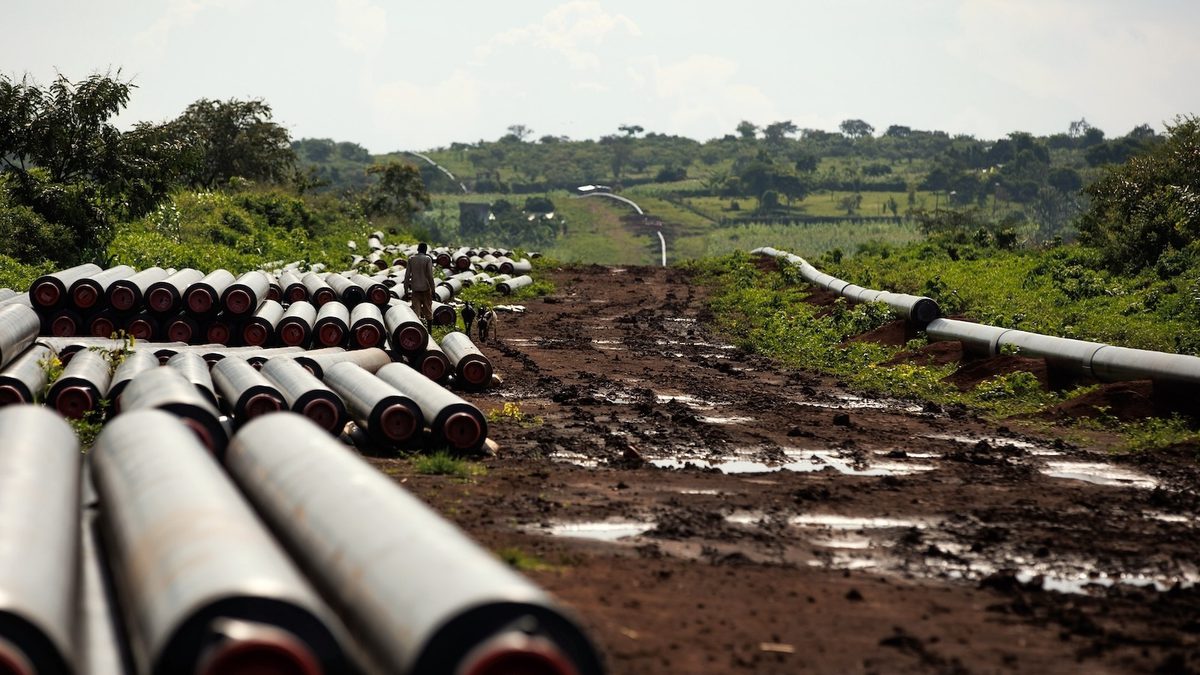
Despite years of opposition, a 900-mile crude oil pipeline through East Africa is about to be completed, and its environmental and social risks are coming into focus. Campaigners in Uganda and abroad are making a final push to halt the project before the oil starts to flow.
An eleventh-hour legal effort is underway to halt the completion of a 900-mile oil pipeline through key African wildlife habitats. The East African Crude Oil Pipeline (EACOP) is weeks from being ready to operate, but the ecological impacts of the pipeline and the two oil fields in Uganda that it will serve are only now becoming clear.
A key concern is the likely threat to Uganda’s Murchison Falls National Park, where the French energy giant TotalEnergies is set to begin producing oil in October. The park is one of Africa’s greatest havens for wildlife, Uganda’s last stronghold for around 240 lions, a critical link in an elephant migration corridor stretching into South Sudan and the Democratic Republic of Congo (DRC), and home to large populations of giraffes, buffalo, crocodiles, and hippos.
A second oil field is also ready to begin production on the eastern shore of nearby Lake Albert. The oil from both will be delivered to world markets via the pipeline, which stretches from Uganda across neighboring Tanzania to the Indian Ocean.
The project is moving forward despite a years-long campaign that marshaled major banks and insurers against it, and despite revelations of the intimidation, harassment, and abuse of people living in its path.
“Where there were once unbroken vistas of savannah, there are now bulldozed roads and the gleam of an oil rig’s lights.”
The world’s oil consumers are keen to see a new source of oil come online that is not dependent on the militarized Strait of Hormuz. But campaigners are planning to make a last legal challenge in courts in London, where EACOP Ltd, the company largely owned by TotalEnergies that is in charge of the pipeline, is registered. Next month, they are expected to claim that its operation will breach the laws and constitution of Uganda.
Murchison Falls National Park was first gazetted as a game reserve by British colonial authorities exactly a century ago, in 1926, and made a national park in 1952. At its heart is one of Africa’s most dramatic waterfalls, where the River Nile bursts through a narrow gorge and creates a spectacular delta wetland before entering Lake Albert, Africa’s seventh largest lake, on the border between Uganda and the DRC.
But since the discovery in 2006 of an estimated 6.5 billion barrels of oil reserves beneath the lake and its vicinity, the biodiversity hotspot has also become a magnet for oil companies. Now, two oil fields are about to begin production, both exporting crude oil via EACOP, which is set to be the world’s longest heated oil pipeline.

The East African Crude Oil Pipeline will stretch 900 miles from Lake Albert in western Uganda to the Tanzanian port of Tanga on the Indian Ocean.Yale Environment 360 / Google Maps
The two production areas are TotalEnergies’ Tilenga oil field, much of it in the national park, and the Kingfisher oil field, run by the China National Offshore Oil Corporation (CNOOC) in a remote marshy area on the southeastern shore of Lake Albert.
Bill Powers, principal of Powers Engineering in San Diego, one of America’s leading energy engineering and environment consultants, reviewed the project design for Yale E360. He says that by not following best practices, the Tilenga project is causing wholly unnecessary destruction of vital ecosystems in the park, which includes headwaters of the River Nile, Africa’s longest river.
Instead of creating nine large, fenced drill pads in the park, Powers says, the company could have concentrated drilling at just one or two pads. And instead of trucking large volumes of drill cuttings to landfills outside the park, it could have injected the cuttings in situ. Such steps “would have avoided hundreds of daily heavy truck movements [along with] the associated road network.” Satellite imagery has revealed almost 24 miles of roads created by TotalEnergies’ contractors within the park.
TotalEnergies did not respond to the technical specifics of the criticisms but said it was limiting development to only a small part of the park and was making the production pads “as compact as possible,” with “minimal visual impact.” Meanwhile, the Kingfisher project, Powers says, could be just as environmentally damaging as the Tilenga operation because of its proximity to the lake, a major fishery on which more than 100,000 locals depend for their livelihoods.
The Ugandan government sees the oil fields and pipeline as vital to a goal of stimulating economic activity.
Neighbors of the Kingfisher oil field claim contractors have dumped oil and production waste into the lake, causing fish kills. And after a recent visit to the Murchison Falls National Park, Environmental Defenders, a conservation and human rights group working in Uganda, reported “dramatic changes” to the park.
“Where there were once unbroken vistas of savannah and roaming herds, there are now freshly bulldozed roads, fenced-off well pads, and the faint gleam of an oil rig’s lights on the horizon,” the group says. Villagers outside the park say that elephants and other park wildlife fleeing the noise and disturbance from oil drilling have been trampling their crops and have killed several people.
The Ugandan government sees the oil fields and pipeline as vital to President Yoweri Museveni’s goal of stimulating wider economic activity and job creation to help the nation achieve upper-middle income status by 2040, including doubling GDP every five years. But for now, all the crude oil is set for export, so the local benefits may prove minimal. Work has not yet begun on a long-delayed $4-billion oil refinery intended to supply East African markets.

A Ugandan police officer arrests an activist protesting EACOP in Kampala in August 2024.Badru Katumba / AFP via Getty Images
EACOP Ltd calls the 24-inch pipeline “the world’s most innovative and smart pipeline system,” pressure-tested and monitored along its entire length, and able to detect and isolate any leaks. It says that the pipeline, which must be heated to 50 degrees C (122 degrees F) to prevent the low-sulfur crude from solidifying, will be “underground and invisible, leaving no mark on the landscape.”
But the pipeline will hardly be undetectable: The company will maintain rights to a corridor almost 100 feet wide along the length of the pipeline, where no buildings or other obstructions will be allowed. And the pipeline will be monitored and operated from 80 above-ground control stations along the corridor.
“The pipeline has a far larger footprint than previously estimated,” says Juan Pablo Osornio, engagement and policy director of Earth Insight, a California-based environment and land-rights NGO which in May published a detailed mapping study of that footprint that shows in much greater detail than before the ecological value of the terrain that it will cross.
For instance, the new study found that the pipeline route crosses more than 10,000 subsistence farms, with 84 percent of the route intersecting antelope habitat, 67 percent monkey habitat, 22 percent leopard habitat, and 17 percent giraffe habitat.
Where the pipeline ends, some 200 acres of mangrove swamps have been removed to make way for an export terminal.
It also establishes that EACOP and its feeder pipelines cut through 44 areas registered in a database of protected areas created by the U.N. Environment Programme and the International Union for Conservation of Nature (IUCN) — apparently contradicting TotalEnergies’ claim that “the pipeline does not cut across any IUCN protected area.”
And the pipeline could disrupt the ecology of other precious places. It passes through a corridor used by chimpanzees to migrate between the neighboring Wambabya and Bugoma forest reserves in Uganda. And it crosses some 230 rivers that could disperse any leaking oil far and wide.
Osornio singles out the risks where oil-laden pipes tunnel beneath two major rivers. One is the River Nile within the Murchison Falls National Park, where the feeder pipe from Tilenga to EACOP is buried for more than a mile beneath the river and a delta rich in papyrus that is famous for its crocodiles, hippos, and birdlife. The delta is also a vital breeding ground for the fish in Lake Albert.
The second is EACOP’s crossing beneath a wetland, fed by the Kibale and Bukoora rivers, that flows directly into papyrus swamps on the western shore of Lake Victoria, Africa’s largest freshwater lake. The swamps are home to endangered black rhinos, African wild dogs, primates, and pangolins.

A drilling rig in the Kingfisher oil field sits on the shore of Lake Albert in Kikuube, Uganda.Luke Dray / Bloomberg via Getty Images
The company says its technology, which will include robotics devices travelling through the pipeline to inspect its condition, minimizes the risk of leaks. But environmentalists say that is no guarantee against earthquakes. The pipeline passes through two seismically active branches of the East African Rift Valley. An earthquake in 2016, centered along the pipeline route west of Lake Victoria, destroyed almost a thousand buildings.
The pipeline ends on the shores of the Indian Ocean, where some 200 acres of mangrove swamps on the Chongoleani peninsula have been removed to make way for the export terminal. From there, tankers up to a thousand feet long will regularly pass two nearby marine protected areas noted for their coral reefs, as they ship more than 200,000 barrels of oil per day to markets across the world.
That oil will eventually be burned, generating over the project’s 25-year lifespan some 379 million metric tons of CO2 — equivalent to more than 40 years of Uganda’s current domestic emissions, according to the Colorado-based Climate Accountability Institute.
Faced with international environmental opposition to the project, many banks, including Barclays, Deutsche Bank, and Japan’s Sumitomo Mitsui, have backed off funding the pipeline. But others continue to offer support, most notably South Africa’s Standard Bank and the giant state-owned Industrial and Commercial Bank of China.
A vocal opponent of EACOP was abducted by Ugandan military, beaten up, and dumped on a roadside five days later.
With its finance underwritten, and production costs likely to be far below the international price of crude oil, installation of the pipeline has rushed ahead this year, with the delivery of 260,000 tons of pipes from China. The EACOP company says the pipeline will be complete by the end of July and delivering oil to the export terminal in October.
While environmental issues have excited international attention, within Uganda and Tanzania concern has mainly focused on the disruption to the lives of 100,000-plus people on the oil fields and along the pipeline, and on the Ugandan government’s treatment of anyone speaking out against the project.
In 2023, after clearing of farms for the pipeline got under way, a panel of U.N. special rapporteurs on human and environmental rights wrote to the Ugandan government criticizing a “pattern of intimidation and harassment” of NGOs raising human-rights concerns about the project.
But rather than taking heed, the government’s crackdown has hardened. Two years ago, Stephen Kwikiriza, a vocal opponent of the project, was abducted in Kampala by military officers in plainclothes, beaten up, knocked unconscious, and dumped five days later on a roadside 150 miles away.

A giraffe on the shore of Lake Albert in Uganda's Murchison Falls National Park.Giulio Origlia / Getty Images
In this hostile environment, most displaced people have taken the compensation proffered by TotalEnergies, whether in cash or new land, despite the sometimes “huge inadequacies” identified by the Africa Institute for Energy Governance (AFIEGO), a Kampala-based energy policy research and advocacy group. The group found TotalEnergies offered poor land to displaced people and insufficient cash compensation to buy new land. Most took the offers “because they were threatened with court action if they refused,” says AFIEGO’s Diana Nabiruma. “The EACOP is not just displacing people from their land — it is displacing them from their dignity and future.”
In May, the government enacted a new Protection of Sovereignty Act, which criminalizes the promotion of “foreign interests” in domestic politics. Local activists say it could result in long prison terms for anyone seen as siding with outsiders in speaking against oil developments. “The law is a huge, huge threat for civil society organizations such as ours,” says Nabiruma.
Opponents have not given up hope, however. Some are seeking redress abroad. In April, Ugandan activists and farmers’ groups and human-rights lawyers at the U.K.-based Leigh Day law firm announced plans to file a legal injunction in London, where the EACOP company is registered, arguing the project should be halted because it breaches Uganda’s national environmental laws and the Ugandan Constitution.
The Lake Albert basin holds other oil reserves that have not been feasible to tap for export. The pipeline changes that.
Not all environmentalists have opposed the oil developments outright, however. Some see more to be gained from collaborating with the oil companies to minimize damage and offset it with environmental projects elsewhere.
Local scientists and conservationists at the 117-year-old NGO NatureUganda, along with the U.S.-based Wildlife Conservation Society and the Netherlands-based Wetlands International, have participated in the Independent Biodiversity and Livelihoods Advisory Committee set up by TotalEnergies “to support the company’s efforts to achieve biodiversity net gain” in its project areas. These efforts include funding wildlife monitoring, planting 2,500 acres of forest, a reintroduction program for black rhinos, and a crackdown on poaching.
Meanwhile, the lure of economic development boosted by oil revenues remains strong. The Lake Albert basin is known to hold other oil reserves that are not yet being tapped. But for how much longer? Until now, it has not been feasible to export oil from the remote Lake Albert area. But the pipeline changes that. “Oil blocks across the other side of Lake Albert in the DRC become viable with the completion of EACOP,” says Osornio.
For some in the energy sector, oil is a sunset industry, doomed by the drive to decarbonize global energy systems. Others are continuing to develop new reserves of fossil fuels, increasingly putting many of Africa’s great wilderness areas — the last refuges of the planet’s megafauna — in harm’s way.